Most founders start with the wrong question. They ask which UAE setup is cheapest, when the question that actually decides success is what the company is supposed to do. Choose a jurisdiction before you understand the business model, and you can spend the next year, and a real amount of money, undoing it. This flexibility is a big reason the UAE ranks as the best country to start a business. Groups with an overseas parent often choose setting up a subsidiary as a separate legal entity.
This guide covers every legal type of business in the UAE, from a sole establishment to an offshore holding company. It shows how three things fit together: the legal structure, the jurisdiction, and the trade license. Best Solution Business Setup Consultancy has formed more than 5,000 companies in the UAE since 2014. The pattern is consistent. The setup that wins is the one that still fits when the business grows larger than planned. Whichever structure you choose, the business licence essentials apply to all of them. Still unsure which form fits? Business setup consultants can match a structure to your goals. business setup consultants Each structure pairs with a licence, so check the types of trade licence too.
the quick view
| Structure | Best For | Ownership / Liability |
|---|---|---|
| Sole Establishment | Solo professionals, freelancers | 100% owner; unlimited personal liability |
| LLC | Most SMEs and trading firms | Up to 100% foreign; liability limited to shares |
| Free Zone (FZE / FZCO) | Export, online, single or multi-owner | 100% foreign; separate legal entity |
| Offshore (RAK ICC / JAFZA) | Holding, IP, asset protection | 100% foreign; no UAE trade or visas |
| Joint Stock (PJSC / PrJSC) | Large or capital-raising ventures | Shareholders; AED 30M / AED 5M minimum |
What are the legal types of business in the UAE?
The UAE recognises several legal types of business: the sole establishment, civil company, limited liability company (LLC), private and public joint stock companies, partnership companies, branch and representative offices, free zone companies, and offshore companies. Each is governed by Federal Decree-Law No. 32 of 2021 (the Commercial Companies Law) or by a free zone authority, and they differ in ownership, liability, and capital.
Two layers shape every UAE setup. The first is the legal structure (what kind of entity you form). The second is the jurisdiction (where you register it: mainland, free zone, or offshore). A landmark reform in 2021 removed the old requirement for a 51% local partner on most mainland activities, so foreign investors can now hold 100% ownership of the majority of commercial and industrial businesses. You can read the full law at the UAE Government Legislation portal. Some structures need a local stakeholder, so finding the right business partner matters.
Who can set up a business in the UAE?
The UAE is open to local entrepreneurs, international investors, and established companies alike. In practice, most first conversations do not start with “mainland or free zone?” They start with a situation: “I want a UAE visa, what should I do?”, “Can I own 100% of my company?”, or simply “I don’t know where to start.” Certain entities and capital levels qualify founders for the investor Golden Visa. Ownership caps vary by activity, so review the UAE company ownership rules first.
- Entrepreneurs: solo founders and small teams often begin with a sole establishment or a free zone company for speed and cost.
- Investors: those chasing scale or share-based funding look at LLCs or joint stock companies in sectors like technology and real estate.
- Companies: global firms expanding into the region usually choose a branch office or an LLC.
Dubai’s D33 agenda aims to double the emirate’s economy by 2033, and the UAE Ministry of Economy sets out the routes for establishing a business. If you are still weighing the first move, our guide on how to start a business in Dubai walks through the sequence step by step. If you opt for onshore trading, a Dubai mainland company gives the widest market access. Whatever you register, you will need to open a corporate bank account before trading.
The 11 legal business structures in the UAE, explained
Here are the eleven legal forms of business you can establish in the UAE, with the practical points that actually change your decision.
1. Sole Establishment (sole proprietorship)
One person owns and runs the business under a trade license in their own name. It is the simplest structure and gives full control. The catch is unlimited personal liability: your personal assets are legally tied to the business’s debts. It suits freelancers, consultants, and small traders. If your revenue passes AED 1 million in a tax period, you must register for Corporate Tax. You must also keep records for seven years for the Federal Tax Authority.
2. Civil Company
A civil company is a partnership of two or more licensed professionals: doctors, lawyers, engineers, accountants, consultants, or architects. The partners own the firm and are personally liable for its debts. It cannot trade commercially. It usually needs sign-off from the relevant regulator, such as the Dubai Health Authority for medical services.
3. Limited Liability Company (LLC)
The LLC is the workhorse of the UAE economy. Two or more partners form it, and each is liable only up to their share of the capital. Under Federal Decree-Law No. 32 of 2021, there is no fixed minimum capital unless a sector demands it. Foreign investors can now own 100% of most commercial and industrial activities. An LLC can have up to 50 shareholders. For a deeper comparison with a one-person setup, see sole proprietorship vs LLC , and for the formation steps themselves, LLC company formation in Dubai . Lean structures can often operate from a virtual office rather than a leased unit. Sidestep the common company formation mistakes that trip up new owners.
4. Private Joint Stock Company (PrJSC)
Like a public company, but its shares stay private and cannot be offered to the public. It needs a minimum of two shareholders and AED 5 million in minimum capital under the Commercial Companies Law, plus Ministry of Economy approval. It suits medium to large firms backed by private investors.
5. Public Joint Stock Company (PJSC)
A large company that can sell shares to the public. It requires AED 30 million in minimum capital and is overseen by the Securities and Commodities Authority. Banks, insurers, and certain financial firms are generally required to operate as PJSCs. Emaar Properties, listed on the Dubai Financial Market, is a well-known example.
6. Partnership companies (general and limited)
UAE law recognises partnership structures beyond the civil company. In a general partnership, all partners share unlimited liability. In a limited partnership, general partners carry unlimited liability while limited partners are liable only up to their investment. These forms are less common for foreign investors but remain valid legal options.
7. Branch of a foreign company
A branch is an extension of an overseas parent, not a separate legal entity. It can do the same activities as the parent and stays 100% parent-owned. It needs a Local Service Agent (LSA) to handle government liaison. UAE-sourced profits are taxed at 9%. Many international firms enter Dubai this way.
8. Representative office
A UAE office of a foreign company limited to marketing, market research, and liaison. It cannot generate revenue locally and is 100% foreign-owned, licensed through the DED on the mainland or through a free zone authority. It is the right tool for a company that wants a presence without trading yet. If full ownership matters, setting up in a free zone narrows the structure choice.
9. Free Zone company (FZE and FZCO)
A free zone company is registered inside one of the UAE’s 40-plus free zones, such as JAFZA, DMCC, IFZA, Meydan, or RAKEZ. A Free Zone Establishment (FZE) has one shareholder. A Free Zone Company (FZCO) has two or more. Both are separate legal entities. Both allow 100% foreign ownership and need no local agent. Free zones suit export and online businesses. One catch: a free zone license no longer means automatic 0% tax. To keep the 0% rate, you must qualify as a Qualifying Free Zone Person (QFZP). That means real substance, Qualifying Income, and audited accounts. Revenue from direct trade with the mainland is usually taxed at 9%.
10. Offshore company (RAK ICC, JAFZA Offshore)
Most “types of business” articles leave this one out, and getting it wrong is costly. An offshore company is not a cheaper free zone. It is a different tool for a different job. It is built to hold things: international holding structures, asset protection, intellectual property, group-company ownership, and cross-border activity outside the UAE. It does not grant UAE visas. It cannot trade inside the UAE. It needs no local premises. The common jurisdictions are RAK ICC and JAFZA Offshore. Your entity type also shapes the business visa options open to owners and staff.
In our consulting experience
A founder often asks for a UAE company because they want a bank account, international ownership flexibility, and holding-company capabilities. Once we review the model and find they will not hire locally, will not trade inside the UAE, and do not need visas, an offshore structure can be far more efficient than mainland or free zone. The biggest misconception is treating offshore as a budget free zone; used incorrectly, it creates operational limits later. If offshore fits your goals, our offshore company setupservice covers it end to end.
11. Holding company
A holding company exists to own and control assets, shares, or other companies rather than to trade directly. It can be set up on the mainland, in a free zone, or offshore, depending on whether the assets are inside or outside the UAE. It is a planning structure: useful for grouping subsidiaries, ring-fencing risk, and consolidating ownership ahead of investment or succession.
Mainland vs free zone vs offshore: the three jurisdictions
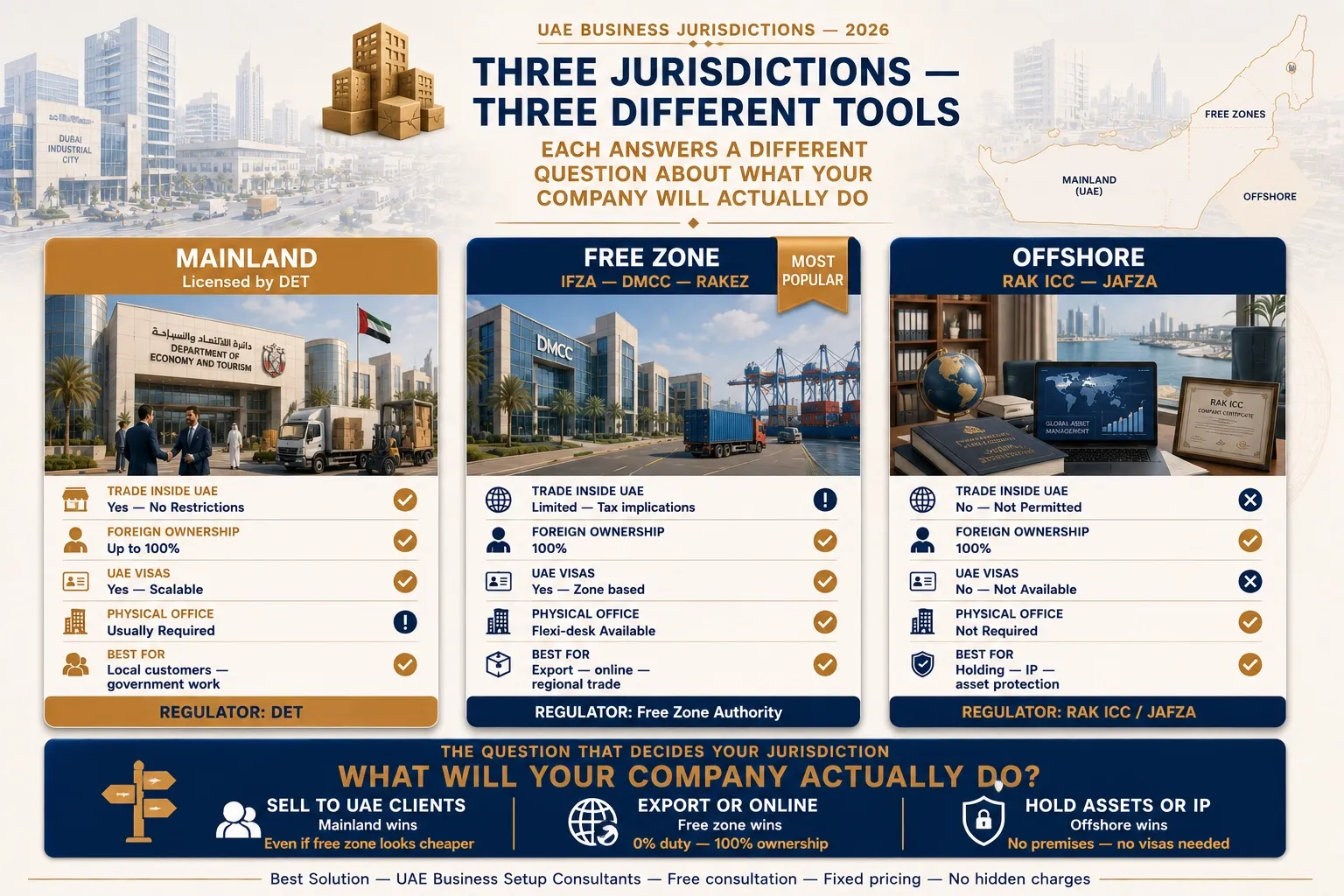
Many comparison articles present mainland, free zone, and offshore as three equal alternatives. They are not. Each answers a different question about what the company will actually do.
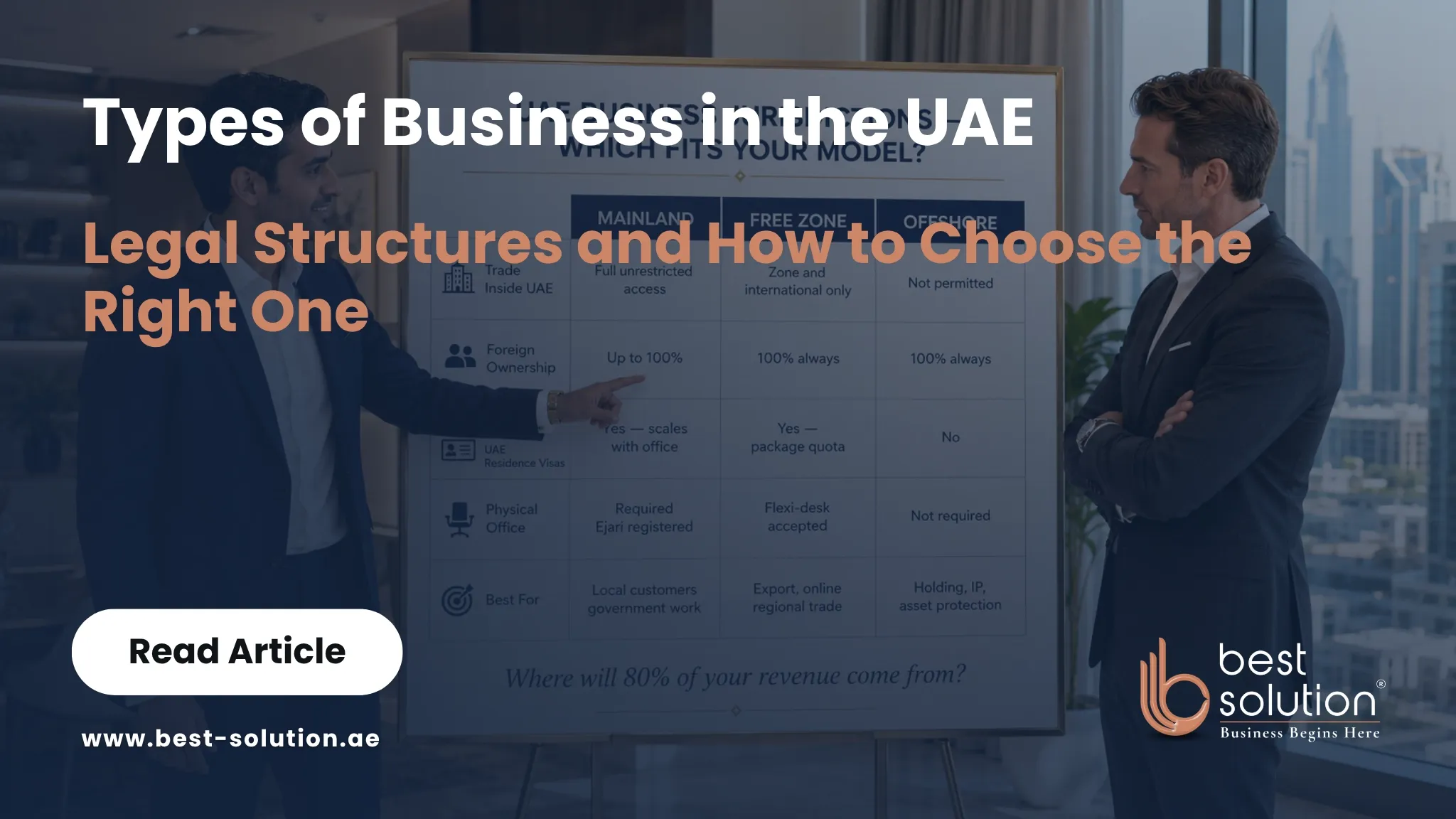
| Feature | Mainland | Free Zone | Offshore |
|---|---|---|---|
| Trade inside UAE | Yes, no restrictions | Mainly within zone; mainland trade is taxed/limited | No |
| Foreign ownership | Up to 100% | 100% | 100% |
| UAE residence visas | Yes | Yes | No |
| Physical office | Usually required | Flexi-desk options | Not required |
| Best for | Local customers, government work | Export, online, regional trade | Holding, IP, asset protection |
| Regulator | Emirate DED | Free zone authority | Offshore authority (e.g. RAK ICC) |
If your decision sits mainly between the first two, our dedicated guide on free zone vs mainland in Dubai goes deeper on costs and trade rights.
Make the Right Choice
Begin Your Business Journey Today
Which business license type do you need?
Your legal structure decides what your company is; your trade license decides what it may do. The UAE issues four main license categories, and the activity you choose drives the rest of the setup.
- Commercial license: trading, buying and selling goods, and general commerce.
- Professional license: services and expertise, such as consultants, IT, legal, and design.
- Industrial license: manufacturing, processing, and production.
- Tourism license: hospitality, travel, and tourism activities.
How to choose the right legal structure (and the #1 mistake to avoid)
In our experience, the single biggest mistake founders make is choosing a jurisdiction before they understand their own business model. They compare setup fees, promotional packages, and visa allocations before answering the questions that actually matter.
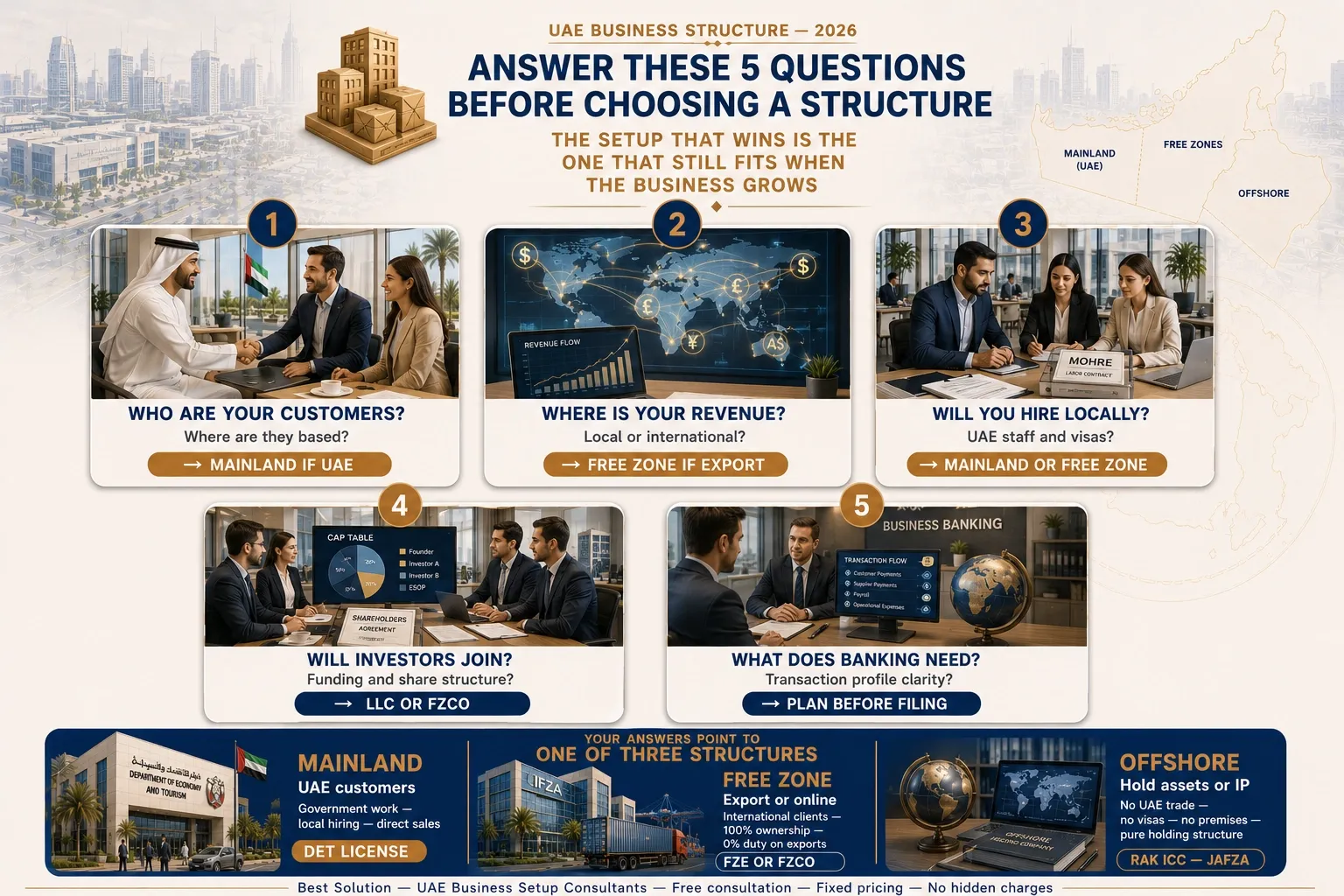
Before you compare prices, answer these:
- Who are your customers, and where are they based?
- Where will your revenue actually come from?
- Will you hire staff in the UAE?
- Will investors be involved?
- What will your banking need to look like?
Skip this, and six months later the cracks show: mainland revenue is larger than expected, banking gets complicated, or an investor wants the company restructured. The cheapest setup is often the most expensive structure to fix later. Our rule is simple: choose the structure after you understand the business, not before.
Case example: free zone on paper, mainland in reality
How is each business structure taxed in the UAE?
- Tax treatment varies by structure and jurisdiction. The headline rules, per the Federal Tax Authority, are these:
- Corporate Tax is 9% on taxable profits above AED 375,000; profits at or below that are taxed at 0%.
- Free zone companies can keep a 0% rate on Qualifying Income only if they meet the Qualifying Free Zone Person conditions; otherwise the 9% rate applies.
- Small Business Relief can simplify obligations for companies with revenue up to AED 3 million, available through the end of 2026.
- A sole establishment’s liability is personal, so business debts can reach personal assets, a risk an LLC or free zone company limits.
Quick reference and next step
Decision shortcuts
Choosing the right legal type of business in the UAE is not just paperwork; it is the foundation your growth sits on. Decide what the company should do first, then let the structure follow. If you want a second opinion before you commit, Best Solution offers a free consultation, and we will tell you honestly when the cheapest option is not the right one.