You have decided to set up in Dubai. You have a shortlist of activities, maybe a quote or two in your inbox, and one question blocking everything else: mainland vs freezone, which one fits your business? The quotes you have seen range from AED 6,000 to AED 50,000. And every consultant seems to push whichever option they sell. If local-market access is the priority, a Dubai mainland company is usually the answer. Either way, the same business licence essentials apply to your setup. On the mainland, forming an LLC is the usual route to local trade. The choice also shapes critical tax structuring decisions down the line.
Here is the honest starting point. Neither side is better. One of them is better for your revenue model. The gap shows up in market access, tax treatment, visa capacity, and what your bank thinks of your license. Pick well and the structure fades into the background. Pick badly and you will pay for a second setup within a year (we see this more often than you would expect).
This guide covers what each setup is, the real 2026 costs, the new tax rules, and the one question we ask every client before we recommend either route.
Key Takeaways: Mainland vs Free Zone in Dubai
| Key Point | Summary |
|---|---|
| Core difference | Mainland companies trade anywhere in the UAE; free zone companies trade inside their zone and internationally, and need a local distributor for mainland sales |
| Ownership | 100% foreign ownership is now available in both, for most activities |
| Cost (first year, all-in) | Free zone: AED 15,000 to 35,000 with one visa; mainland: AED 12,000 to 50,000+ including office Ejari |
| Corporate tax | 9% above AED 375,000 profit for mainland; 0% only for free zone companies that qualify as a QFZP |
| How to decide | Ask where 80% of your year-one revenue will come from: inside the UAE points to mainland, outside points to free zone |
What Is the Difference Between Mainland and Free Zone in the UAE?
A mainland company is licensed by an emirate's economic department and can trade anywhere in the UAE, including with government bodies. A free zone company is licensed by an independent free zone authority, trades within its zone and internationally, and must appoint a local distributor to sell directly into the mainland market.
That single point, market access, drives most of the practical gaps that follow. Everything else (cost, visas, audits, banking) is detail layered on top of where you are allowed to earn revenue.
Both routes now allow 100% foreign ownership for most activities. The old ownership question has mostly fallen away. The choice in 2026 turns on market access, real first-year cost, and tax treatment.
What Is a Mainland Company in Dubai?
A mainland company (also called an onshore company) is registered with the economic department of its emirate. In Dubai that is the Department of Economy and Tourism (DET), formerly known as the DED. The trade license it issues covers commercial, professional, industrial, tourism, agricultural, and occupational activities. Either way, your activity dictates the licence, so review the types of trade licence.
Since the Commercial Companies Law was amended (Federal Decree-Law No. 32 of 2021), foreign investors can hold 100% ownership in most mainland activities. A short list of strategic-impact activities still needs Emirati participation. Some professional activities need a local service agent, who holds no equity. The blanket 51% local sponsor rule is gone.
What a mainland license gives you:
- Freedom to trade anywhere in the UAE and internationally, with no geographic restriction
- Eligibility to bid for UAE government and semi-government contracts
- No cap on residence visas; your quota scales with your office size
- The widest range of business activities, including retail, restaurants, clinics, construction, and real estate
- Easy branch expansion across the emirates
What slows mainland setups down:
- A physical office with an Ejari-registered tenancy contract is mandatory; flexi-desks rarely qualify
- External approvals can apply depending on activity (Dubai Municipality, MOHRE, KHDA for education, DHA for health)
- Annual financial audits are required for most license types
- Setup typically takes 7 to 14 working days once documents are ready, longer if external approvals apply
What Is a Free Zone Company in Dubai?
A free zone company is registered with one of the UAE's 40+ free zones, each governed by its own Free Zone Authority under its own regulations. The UAE government's official portal (u.ae) lists the full inventory of zones, which range from broad commercial zones such as IFZA and Meydan to sector-specific hubs like DMCC for commodities, JAFZA for logistics, and SHAMS for media.
Inside a zone you can form a Free Zone Establishment (FZE, single shareholder), a Free Zone Company (FZC or FZCO, two or more shareholders), or a branch of an existing company. Ownership is 100% foreign from day one, with no local sponsor and no service agent.
What a free zone license gives you:
- Full foreign ownership regardless of activity or nationality
- Lower entry cost: many zones bundle the license, a flexi-desk, and a visa allocation into one package
- Faster formation, often 2 to 7 working days
- Customs duty exemptions on goods moving within designated zones or re-exported
- 100% repatriation of capital and profits
The limits that cheap packages do not mention:
- You cannot sell directly into the UAE mainland without a licensed local distributor, a mainland branch, or an operating permit
- Visa quotas are capped by your package or office type, typically 1 to 6 visas on entry-level packages
- Your activity must appear on that zone's approved list; a mismatch between your license activity and what you actually sell is one of the most common causes of bank account rejection
- Some banks apply stricter compliance reviews to licenses from low-cost zones
But the restriction that matters most is the first one. If your customers are in Dubai and you hold a free zone license, you have a structural problem, not a paperwork problem.

Not Sure Which Route Is Right? Let's Map It Together
Tell us where your revenue will come from and we'll recommend the structure that fits — mainland, free zone, or a combination
Mainland vs Free Zone: Side-by-Side Comparison
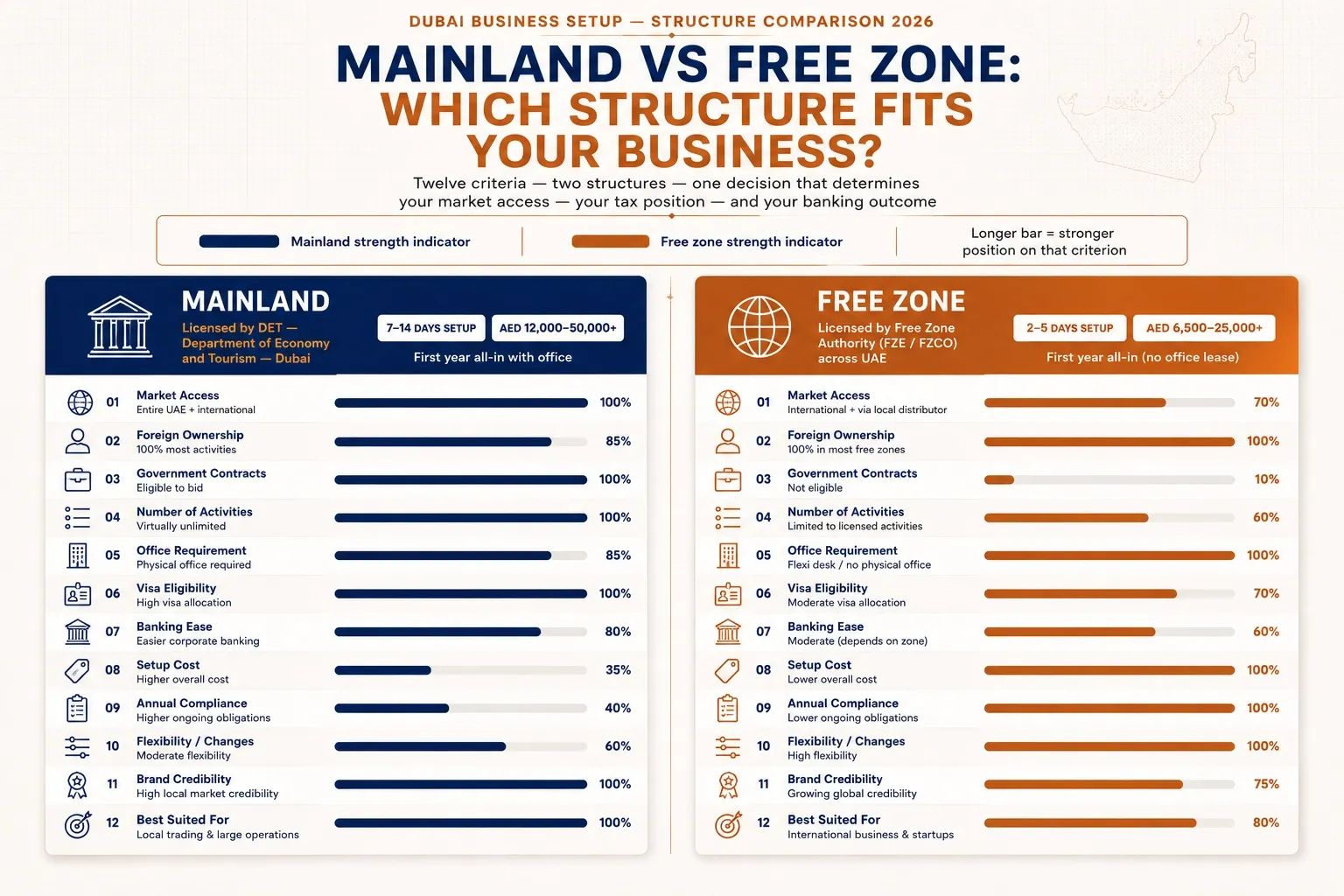
Comparison: Mainland company vs free zone company in the UAE (2026)
| Criteria | Mainland Company | Free Zone Company |
|---|---|---|
| Licensing authority | Emirate economic department (DET in Dubai) | The zone's own Free Zone Authority (e.g. DMCC, IFZA, JAFZA) |
| Market access | Entire UAE plus international | Inside the zone plus international; distributor needed for mainland sales |
| Foreign ownership | 100% for most activities | 100% always |
| Government contracts | Eligible to bid | Not eligible without a mainland presence |
| Office requirement | Physical office with Ejari, mandatory | Flexi-desk or virtual office accepted in many zones |
| Visa quota | No cap; scales with office size (approx. 1 visa per 80 to 100 sq ft) | Capped by package, typically 1 to 6 visas |
| Corporate tax | 9% on taxable income above AED 375,000 | 0% on qualifying income for a QFZP; otherwise 9% |
| Customs duties | 5% standard rate on imports | Exempt within designated zones and on re-exports |
| Annual audit | Mandatory for most license types | Required by some zones (DMCC, JAFZA); optional in others |
| Setup time | 7 to 14 working days | 2 to 7 working days |
| First-year cost (realistic, 1 visa) | AED 12,000 to 50,000+ (in AED, office included) | AED 15,000 to 35,000 (in AED, all-in) |
| Best for | UAE-facing revenue: retail, F&B, contracting, local services, government work | Export, e-commerce, consulting, holding structures, digital services |
How Much Does Each Setup Really Cost in 2026?
Advertised packages start around AED 6,000 for a free zone license. Almost nobody pays that as a final figure. The advertised number usually covers the license alone, with zero visas, and excludes the items every operating business needs. The jurisdiction pairs with your entity, so compare the types of business structures. Your jurisdiction also shapes the business visa options available.
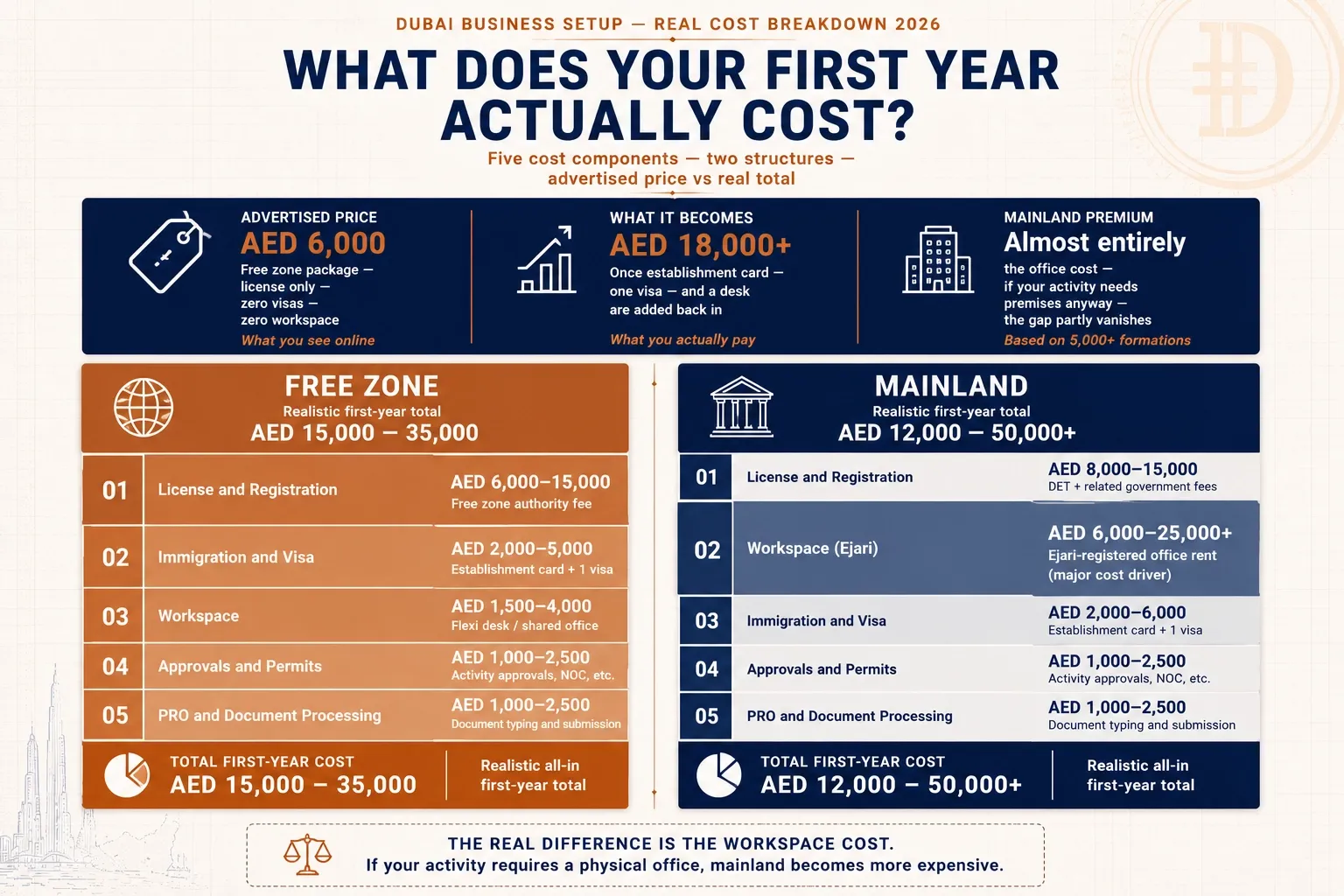
Based on Best Solution's client work across 5,000+ company formations, a realistic all-in first-year budget looks like this:
Comparison: Realistic first-year setup costs in Dubai (2026)
| Cost Item | Free Zone (typical, AED) | Mainland (typical, AED) |
|---|---|---|
| License and registration | 6,000 to 15,000 | 10,000 to 15,000+ |
| Immigration / establishment card | 2,000 to 5,000 | 2,000 to 5,000 |
| Residence visa, medical, Emirates ID (per person) | 3,500 to 7,500 | 3,500 to 7,500 |
| Workspace (flexi-desk vs Ejari office) | 0 to 8,000 (often bundled) | 8,000 to 30,000+ |
| Attestation, translation, approvals | 500 to 3,000 | 1,000 to 5,000 |
| Realistic first-year total (1 visa) | 15,000 to 35,000 | 12,000 to 50,000+ |
Two patterns worth knowing. First, the gap between advertised and real cost is widest at the cheap end of the free zone market. An AED 6,000 package quietly becomes AED 18,000 once you add an establishment card, one visa, and a desk. Second, the mainland premium is almost entirely the office. If your activity needs premises anyway (a shop, a clinic, a restaurant), the mainland "extra cost" partly vanishes because you were paying for space regardless.
For a full breakdown by activity type, see our guide to the cost of starting a business in Dubai. New to all this? Start with our guide on how to start a business in Dubai. If the choice is close, business setup consultants can model both for you.
Corporate Tax Changed the Free Zone Math
Plenty of comparison articles still describe free zones as simply "tax-free" and the mainland as tax-exempt. Both claims are out of date.
Under Federal Decree-Law No. 47 of 2022, UAE corporate tax has applied since June 2023: 0% on taxable income up to AED 375,000 and 9% above it. That applies to mainland companies and to free zone companies that do not meet the qualifying conditions.
The 0% free zone rate still exists, but it comes with conditions. A free zone company keeps 0% only on qualifying income, and only if it registers, files, and passes the tests for a Qualifying Free Zone Person (QFZP) set out in Cabinet Decision No. 100 of 2023. The tests cover real substance in the zone, audited financial statements, and a cap on non-qualifying revenue (5% of total revenue or AED 5 million, whichever is lower). Sell too much into the mainland and you lose QFZP status, for the current tax period and the four that follow.
Three more 2026-relevant points:
- Small Business Relief lets businesses with revenue of AED 3 million or less elect out of corporate tax, but only for tax periods ending on or before 31 December 2026, per Ministerial Decision No. 73 of 2023. QFZPs cannot use it.
- Large multinational groups (global revenue of EUR 750 million or more) face a 15% domestic minimum top-up tax (DMTT) from January 2025, which overrides the free zone 0% for in-scope groups.
- Every company, mainland or free zone, must register for corporate tax with the Federal Tax Authority regardless of whether it expects to pay anything.
In our experience, the founders who actually keep the 0% rate are those whose revenue is genuinely export-facing or zone-to-zone. A free zone license does not make UAE-sourced consulting income tax-free. This is the single most common tax misunderstanding we correct in consultations.
This section is general information, not tax advice. Confirm your position with a registered tax agent before you structure around it.
Can a Free Zone Company Do Business in the UAE Mainland?
Not directly. A free zone company has three legal routes into the mainland market. It can appoint a licensed local distributor or commercial agent who invoices mainland customers. It can open a mainland branch registered with the economic department. Or it can obtain a dual license or operating permit where the emirate offers one.
Dubai's dual licensing rules now let some free zone companies (DIFC and DMCC among them) hold a DET license without leasing separate mainland premises. The detail varies by zone and activity. We covered the mechanics in our guide to the free zone to mainland operating permit.
What you cannot do is invoice mainland clients straight from a free zone license and hope nobody notices. The exposure is real: fines, license trouble, and growing friction at the bank, since compliance teams check whether your revenue pattern matches your license scope. And as covered above, mainland revenue can also cost you your 0% QFZP rate.
How to Decide: Ask Where 80% of Your Revenue Will Come From
When a client cannot choose between the two, we do not start with cost. We start with one question: where will roughly 80% of your year-one revenue come from?
- Mostly inside the UAE (retail customers, mainland businesses, government entities): mainland is usually the natural fit. The office cost buys you unrestricted access to the exact market you are selling to.
- Mostly outside the UAE (export clients, international e-commerce, overseas consulting): a free zone keeps your cost down and your tax position clean, and the mainland restriction barely affects you.
- Genuinely split: start where the larger share sits, and plan the expansion route (branch or operating permit) before you commit, not after.
The most expensive mistake we see is the reverse order: founders pick the cheapest free zone package first and assume they can "upgrade later". One client came to us after buying a low-cost package through an overseas reseller on a 24-hour setup promise. The license activity did not match the service they actually sold. The zone blocked the UAE corporate contracts they had already lined up. And the mismatch surfaced during the bank's compliance review. Fixing it meant a second entity with the correct activity, a new banking application, amended contracts and invoices, and corrections to VAT and immigration records. The repair cost several weeks of interrupted onboarding and far more than the original package had saved.
The lesson is not "avoid free zones". It is that the jurisdiction must be chosen against your revenue map and your business activity, not against the lowest advertised price.
Best Solution has been advising on exactly this decision since 2003: 23 years in operation, 50+ specialists, 5,000+ companies formed, and channel partnerships with 50+ free zones including DMCC, IFZA, Meydan, SHAMS, DIFC, Dubai South, RAKEZ, and JAFZA. We earn the same fee whichever jurisdiction you pick, which keeps the recommendation honest.
Mainland vs Free Zone Decision Checklist
Choose the Structure That Matches Your Revenue, Not the Price Tag
The mainland vs free zone choice in 2026 is less about ownership (both offer 100%) and more about where your money will come from and how the tax rules treat it. Mainland buys unrestricted UAE market access at a higher fixed cost. A free zone buys speed and low entry cost, with conditions attached that only matter if you ignore them.
If you can answer the 80% revenue question, you are most of the way to a decision. If you cannot answer it yet, that is precisely the conversation to have before any license fee leaves your account.
Talk to Best Solution's advisors for a jurisdiction recommendation based on your activity, revenue map, and visa needs. The consultation costs nothing, and unlike a wrong license, it never needs to be undone.