“I applied for a general trading license, but my bank keeps asking why my invoices are for consulting.”
That is one of the most common calls Best Solution receives, and it surfaces months after setup, at the most expensive possible moment: when a bank's compliance team reviews the account. The root cause is almost always the very first decision a founder makes, and the one most underestimate: which type of trade license to apply for. Choose on cost or speed instead of activity, and the mismatch eventually shows up, usually as an amendment, a delay, and a bill you did not plan for.
Across 5,000+ company formations since 2014, license-type selection is the single most frequent correction Best Solution's team makes at the intake stage. This guide breaks down every type of trade license in Dubai, who each one is for, what it really costs, and how to choose so the decision holds up later, including when your bank starts asking questions. Some activities carry extra rules — a real estate company needs RERA approval, for instance.
| License Type | Best For | Issued By |
|---|---|---|
| Commercial | Buying and selling goods, trading, retail, logistics | DET (mainland) or a free zone |
| Professional | Services and expertise: consulting, IT, medical, legal | DET (mainland) or a free zone |
| Industrial | Manufacturing and processing goods | DET + Dubai Municipality / free zone |
| Free zone | 100% ownership, export or online focus | A specific free zone authority |
| Specialised | Tourism, e-commerce, freelance, general trading | DET or the relevant authority |
What is a trade license in Dubai?
A trade license in Dubai is the official permit that lets you operate a business legally in the emirate. On the mainland it is issued by the Department of Economy and Tourism (DET), the authority formerly known as the DED. Inside a free zone it is issued by that zone's own authority, such as DMCC or JAFZA. Your licence class also shapes the business visa options you can sponsor. Requirements shift slightly for a Dubai mainland company versus a free zone.
The license defines what you are allowed to do. It lists your approved business activities, fixes your legal structure, and is the document banks, landlords, and partners ask for before they will work with you. No valid license means no corporate bank account, no residence visas, and exposure to fines. It is the foundation everything else is built on, which is exactly why the activity wording on it has to match how you actually invoice.
What are the types of trade license in Dubai?
Dubai has three core trade licenses: commercial (for trading goods), professional (for services and expertise), and industrial (for manufacturing). A free zone license can cover any of these inside a free zone with 100% foreign ownership. Specialised types include tourism, e-commerce, freelance, and general trading licenses.
Most business activities fall into one of three core categories, plus the free zone option and a handful of specialised licenses. Here is each one in plain terms.
Commercial license (for trading)
This is the license for any business that buys and sells physical goods. If you deal in products, commodities, or stock, this is almost certainly your category.
- Typical activities: general trading, import and export, retail and wholesale, car rental, logistics.
- Best for: traders in electronics, clothing, foodstuff, automobiles, and general import/export businesses.
- Ownership: under Federal Decree-Law No. 32 of 2021, foreign investors can hold 100% of most mainland commercial activities. The old rule that forced a 51% Emirati partner has been abolished for the large majority of activities.
Professional license (for services and skills)
This license is for businesses that sell expertise rather than products: knowledge, skill, or a professional service.
- Typical activities: management, IT and marketing consultancy, law firms, auditing, medical clinics, education, beauty and repair services.
- Ownership: a professional license allows 100% foreign ownership. A Local Service Agent (LSA) may be appointed, but the LSA holds no shares and no operational control and is paid a fixed annual fee. Your control of the company stays intact.
- Best for: consultants, doctors, engineers, lawyers, accountants, and IT specialists.
Industrial license (for manufacturing)
If you physically transform raw materials into finished products, you need an industrial license. This covers manufacturing, processing, and assembly.
- Typical activities: garment and textile production, food and beverage processing, machinery and equipment manufacturing, chemical production.
- Requirement: a physical office or warehouse in a designated industrial area or free zone, plus technical and environmental approvals (Dubai Municipality clearances apply, in line with the UAE's Net Zero 2050 direction).
- Best for: factories, production units, and any business adding value to raw materials.
Free zone license
A free zone license is issued by a specific free zone authority rather than by DET, and the activity can be commercial, professional, or industrial. Free zones offer 100% foreign ownership, full profit repatriation, and, for a Qualifying Free Zone Person, a 0% corporate tax rate on qualifying income.
Important distinction: a free zone company is legally separate from a mainland company. It cannot trade directly in the local UAE market without a distributor or a mainland branch. That trade-off is the heart of the mainland-versus-free-zone decision below.
Specialised and emerging license types
Beyond the big three, Dubai offers licenses built for specific models:
- Tourism license: for travel agencies, tour operators, hotel and holiday-home rentals.
- E-commerce license: for selling products or services online, popular with startups and home-based founders.
- Freelance permit / e-Trader license: a low-cost route for solo professionals; the e-Trader license is aimed at home-based businesses and starts at around AED 1,070.
- General trading license: a flexible commercial license that lets you trade many non-restricted product lines under one license.
- Agriculture and craftsmanship licenses: for crop cultivation and agricultural consultancy, and for skilled trades such as plumbing, carpentry, and electrical work.
From our formation data
The fastest-growing license category among Best Solution clients in 2024–25 is e-commerce and digital services, specifically founders combining an online trading activity with a content or consultancy component on a single free zone license. Many are formalising after operating informally, and this group almost universally underestimates one thing: they hit the AED 375,000 VAT registration threshold before their first license renewal. Build the activity stack with that growth curve in mind.
Mainland vs free zone: which license is right for you?
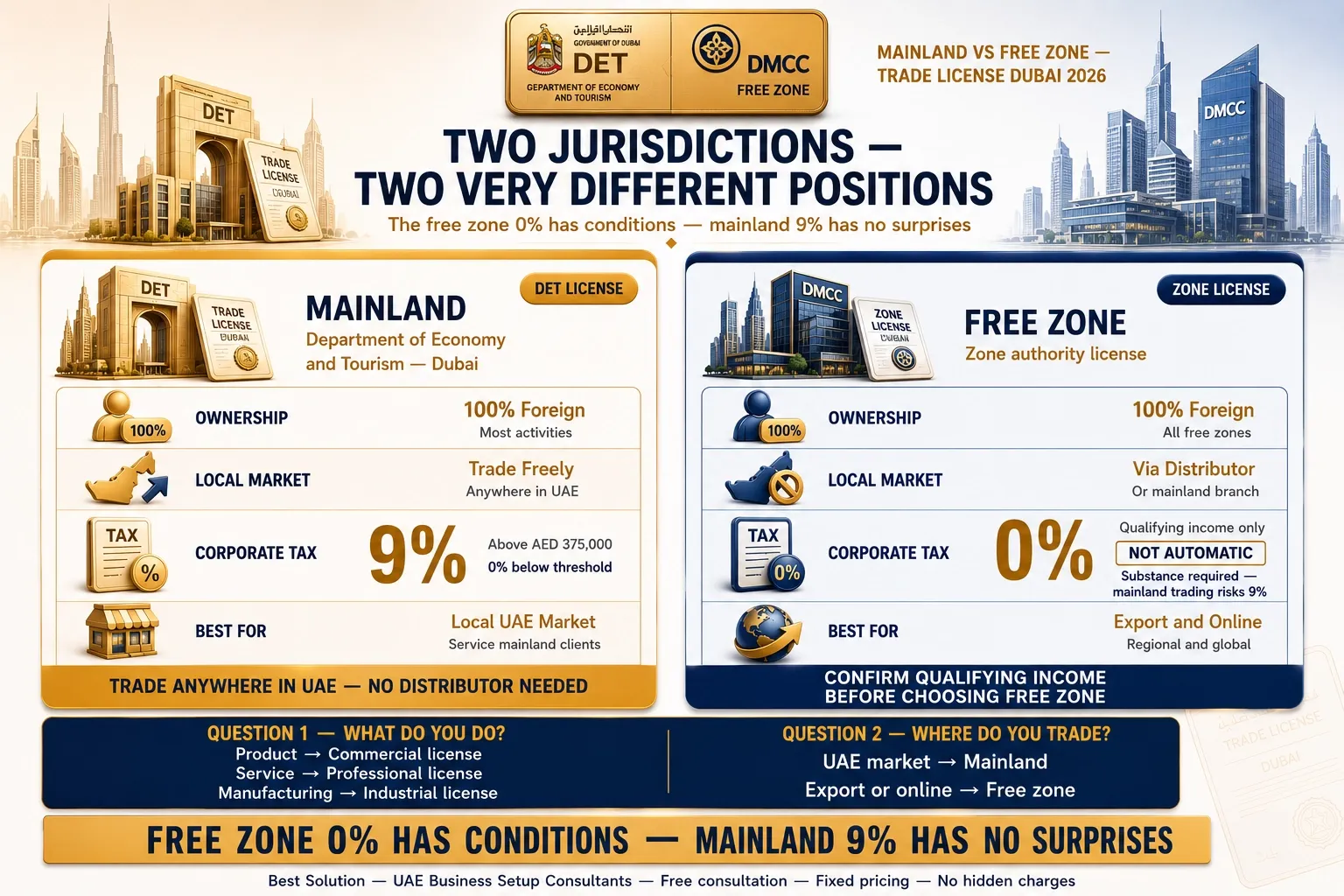
The license category tells you what you can do. The jurisdiction, mainland or free zone, tells you where you can do it and how you are taxed. Since UAE Corporate Tax took effect (for financial years starting on or after 1 June 2023), this choice carries real money.
| Factor | Mainland (DET License) | Free Zone License |
|---|---|---|
| Ownership | 100% foreign ownership for most activities | 100% foreign ownership |
| Local market | Trade freely across the UAE | Needs a distributor or mainland branch to sell locally |
| Corporate tax | 9% on taxable income above AED 375,000; 0% below | 0% on qualifying income for a Qualifying Free Zone Person (conditions apply) |
| Best fit | Businesses serving the local UAE market | Export, online, and regional or global businesses |
The key insight: a free zone's 0% rate is not automatic. It requires real substance (staff, premises, expenditure) and qualifying income. If a free zone company trades heavily with the mainland, it can lose its qualifying status and fall under the 9% rate. For a fuller comparison, see our guide to free zone vs mainland in Dubai.
How much does a trade license cost in Dubai? The real all-in number
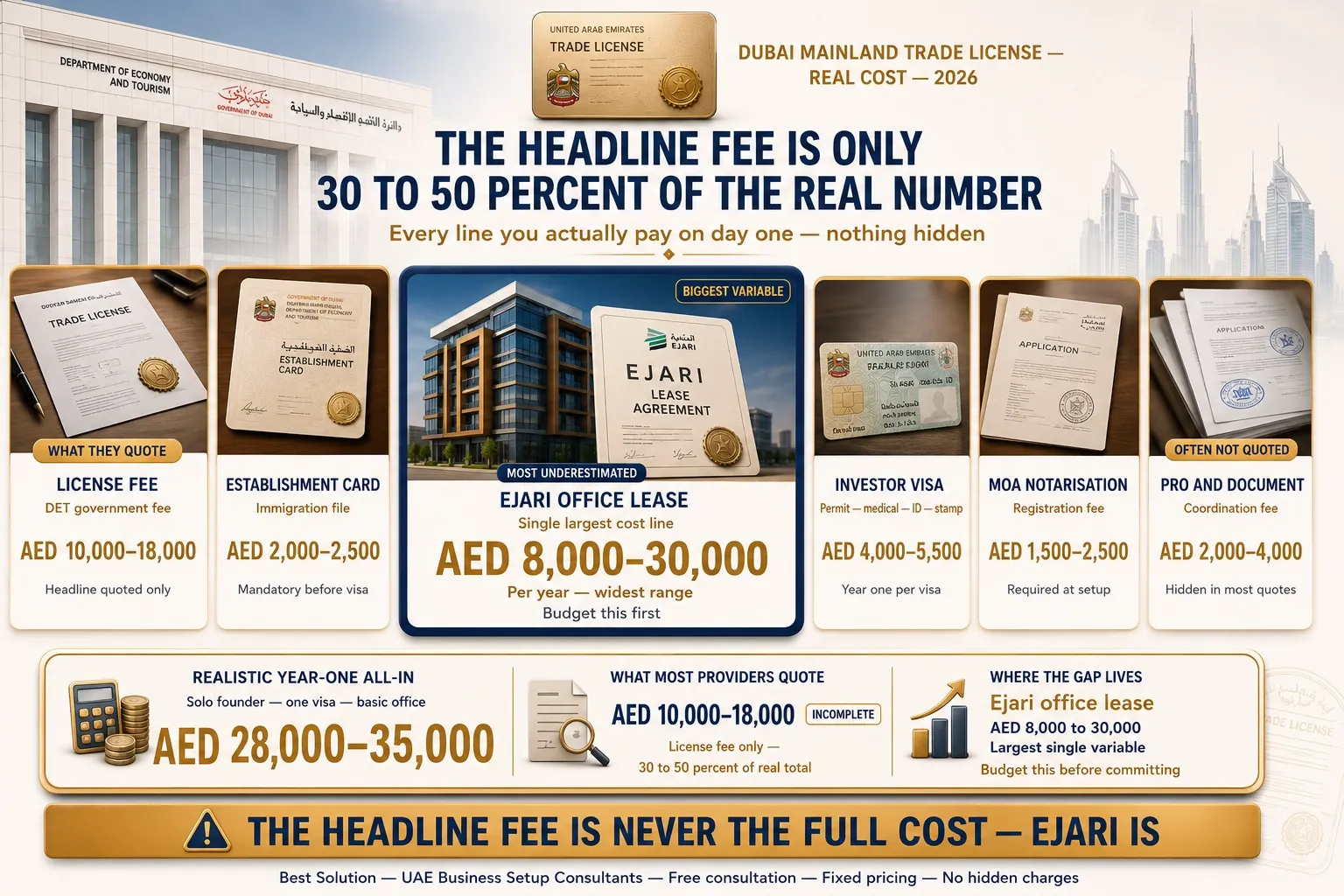
Most providers quote the headline license fee: AED 10,000–18,000 depending on activity and structure. That is rarely what you actually need liquid on day one. For a mainland setup, here is the real first-year picture:
| Cost Component | Indicative 2026 Amount |
|---|---|
| Headline government license fee | AED 10,000–18,000 |
| Establishment card & immigration file | AED 2,000–2,500 (mandatory before any visa) |
| One investor visa (permit, medical, Emirates ID, stamping) | AED 4,000–5,500 |
| Ejari office lease registration | AED 8,000–30,000/yr (the biggest gap vs advertised cost) |
| MOA notarisation & registration | AED 1,500–2,500 |
| PRO & document coordination | AED 2,000–4,000 |
| Realistic year-one all-in (solo founder, 1 visa, basic office) | AED 28,000–35,000 |
In other words, the headline license fee is typically only 30–50% of the real number, with the office lease (Ejari) the single largest variable. Budget for the full figure, not the advertised one. For a complete breakdown, see the cost of starting a business in Dubai. (Government fees change; verify current figures with DET before committing.) For the full journey, see our guide on how to start a business in Dubai. If the categories blur, business setup consultants can pinpoint the right one.
The most common license mistake (and what it costs to fix)
The most frequent and costly error founders make is choosing a commercial license for a business that should hold a professional license, or vice versa, because the choice was made on cost or speed rather than activity classification.
- Professional (services): selling skills, advice, or expertise, such as consultancy, legal, IT support.
- Commercial (trading): selling tangible goods or products, such as retail, import/export, physical stock.
Picture an IT consultant who registers under a commercial license because it looked cheaper or faster. The mismatch surfaces when a client contract requires proof of a professional services entity, or when a bank's compliance team questions why a commercial license is invoicing for advisory work. The correction runs AED 1,000–3,000 in government fees plus two to four weeks of processing.
A pattern from our intake reviews
Roughly one in four files we review from clients who set up with another provider carry a license-type or activity-wording issue that needs correcting, most often a professional service business registered as commercial, or a trader whose activity description is too narrow for what they actually import and invoice.
The Professional vs. Commercial conflict
The professional-versus-commercial conflict is the single most common speedbump we see. Founders need to think about their checkout cart, not just their service offering. If anything is sold as a product, even a software license or a packaged report, it has to be legally recognised. We structure clients' activities to minimise future amendments from day one.
General Manager, Best Solution

The fix: clarify your primary and secondary activities upfront, and make sure the activity wording matches how you will actually invoice. A short conversation before you apply is far cheaper than an amendment, updated bank KYC, and a possible account freeze after.
Start Your Dubai Business the Right Way
Don't risk a frozen bank account or unexpected amendment fees due to a mismatched trade license. Let Best Solution align your business activities, handle the government regulations, and secure your corporate banking setup from day one.
One license or two? Handling a multi-activity business
If you sell both a service and a product, our advice is usually simple: a mixed-activity license first, two entities only when there is a structural reason to separate.
Most DET mainland licenses and the majority of free zone licenses allow multiple activities on a single license for an incremental fee, typically AED 1,000–1,500 per additional activity. A founder selling software products and offering IT consulting can hold both on one license, depending on the dominant revenue model. One entity, one bank account, one set of compliance obligations. For most early-stage multi-activity businesses, that is the right answer.
Two entities make sense when the activities fall under different regulatory authorities, when you want to isolate liability between business lines, or when one revenue stream is mainland-facing and the other international (a free zone plus mainland dual structure). A second entity costs roughly AED 15,000–35,000 all-in for year one, justified only when the separation creates a real tax, liability, or operational benefit. Adding a second entity purely to hold extra activities a single license would already cover is an unnecessary cost, and one we actively steer clients away from.
When the simple rule breaks down
“Professional for services, commercial for trading” is a good starting rule, but it fails in three specific situations. Recognise them before you choose.
Regulated activities
Healthcare, education, food services, legal advice, and financial services cannot be resolved from the DET activity list alone. Each needs a third-party authority approval (DHA, KHDA, Dubai Municipality, SCA, or equivalent) that determines the license type, the entity structure, the premises, and the staffing qualifications. For regulated activities, the license type is the last decision, not the first.
E-commerce with physical goods plus digital services
A business selling physical products online and also selling downloadable software or digital subscriptions has a genuinely mixed commercial-and-professional model. A single general trading license does not cleanly cover digital service delivery. The activity stack must cover both, and the wording must match the transaction types on your invoices for VAT and bank compliance. The licence pairs with your entity, so review the types of business structures too.
Free zone companies planning UAE mainland supply
Standard free zone advice assumes your customers sit outside the UAE or in other free zones. The moment a significant share of revenue comes from mainland buyers, the license type becomes secondary to the jurisdiction choice, because a free zone license of any type cannot directly service mainland clients without a distribution arrangement or a mainland operating permit. Answer the license-type and jurisdiction questions together, not in sequence.
How to choose the right trade license (2-question framework)
Stripped back, the decision comes down to two questions:
- What is my core business activity? Am I selling a product (commercial), providing a service (professional), or making something (industrial)?
- Where do I want to trade? Do I need to sell directly to customers across the UAE (mainland), or am I focused on export and online sales (free zone)?
Answer those two and your license type and jurisdiction are usually clear, unless you fall into one of the exceptions above. If you are unsure where your activity sits, our guide on how to choose your business activity walks through it.
Not sure which license fits your business?
Get a free 15-minute license consultation. Tell us your activity, and we will tell you the exact license, jurisdiction, and real all-in cost — before you spend a dirham.
Which free zone suits your license type?
Free zones are no longer generic; each is built around certain activities. Matching the zone to your license is as important as the license itself.
| License Type | Ideal Activity | Suggested Free Zones |
|---|---|---|
| Commercial (trading) | Logistics, import/export, e-commerce | JAFZA (logistics + port access); Dubai CommerCity (pure e-commerce) |
| Professional (services) | Marketing, IT, media, consulting, fintech | DMCC (global professional services); DIC (tech, IT, SaaS) |
| Industrial (manufacturing) | Production, assembly, fabrication | JAFZA (industrial + customs); Dubai Industrial City (purpose-built factories) |
Choosing your license with confidence
Understanding the core types, commercial, professional, industrial, and the free zone option, plus your jurisdiction, puts you most of the way to a confident decision. The remaining risk is the grey area: multi-activity businesses, regulated activities, and the activity wording that your bank will later check against your invoices. That is where getting it right the first time saves the most.
Why trust this guide
Best Solution has operated from Business Bay since 2014 (founded by Essa Al Harthi), completing 5,000+ company formations with a 99% approval rate and a 50+ strong in-house team. We hold DED-approved, Authorized Free Zone Partner, and FTA-certified status, with channel-partner relationships across 50+ free zones including DMCC, IFZA, Meydan, SHAMS, RAKEZ, DIFC, and Dubai South, and we were named RAKEZ Best Business Partner in 2021, 2022, and 2025. Every one of those 5,000+ formations required an activity-classification decision: that is the experience behind this advice.