You know what your business will do. Dubai's licensing system now wants you to express that as one of more than 2,000 entries on the DED activity list, each with its own code, license category, and approval chain. Pick well, and your trade license, corporate bank account, and visa applications move in a straight line. Pick badly, and you pay for amendments before you have invoiced your first client. Your activity determines your licence, so it helps to know the business licence essentials.
Best Solution, we have helped form over 5,000 companies in Dubai since 2003, and activity selection is where most avoidable setup problems begin. Not because the list is hard to read, but because founders treat it as an administrative checkbox rather than a business decision.
This guide explains how the DED activity list works under the Department of Economy and Tourism (DET) and what the four license categories cover. It then gives you the decision method our consultants apply to every new client: where will roughly 80% of your first-year revenue come from? And it covers the part most guides skip, which is how your chosen activity shapes bank account approval.
Key Takeaways: Dubai DED Activity List
| Key Point | Summary |
|---|---|
| What the list is | An official register of 2,000+ approved mainland business activities, each with a code, maintained by the DET (formerly DED) |
| License categories | Commercial, Professional, Industrial, and Tourism, plus smaller categories such as Agricultural and Craftsmen |
| Maximum activities | Up to 10 activities on one trade license, if they fall under the same category |
| Choosing method | Pick the activity that matches roughly 80% of your projected first-year revenue, not what you might do someday |
| Cost of mistakes | Activity amendments cost AED 1,000 to 2,500 in authority fees and take 2 to 10 working days; unapproved activity changes carry an AED 2,000 fine |
What Is the DED Activity List?
The DED activity list is Dubai's official register of more than 2,000 business activities approved for mainland companies. It is now maintained by the Department of Economy and Tourism (DET, formerly the Department of Economic Development). Each activity carries a code that fixes your trade license category, your approval requirements, and the legal scope of your operations.
Every entry on the list has four parts. There is an activity code (a number such as 4690018 for General Trading), a description of exactly what the activity permits, a category (the license type it belongs to), and a group (the broader economic sector). The description is the part founders skip and should not. Two similar-sounding activities can permit very different work, and your license only covers what the description says.
You can search the full register on the official Invest in Dubai portal. It lets you filter by keyword and shows the code, description, and category for each entry. Every company must pick at least one activity when applying for a trade license. The DET permits up to 10 activities on a single license, provided they sit within the same category.
If you are still mapping out the wider process, our guide to starting a business in Dubai shows where activity selection fits in the full company formation sequence. Some activities carry extra approvals — a real estate company, for example, needs RERA sign-off.
The Four License Categories on the Activity List
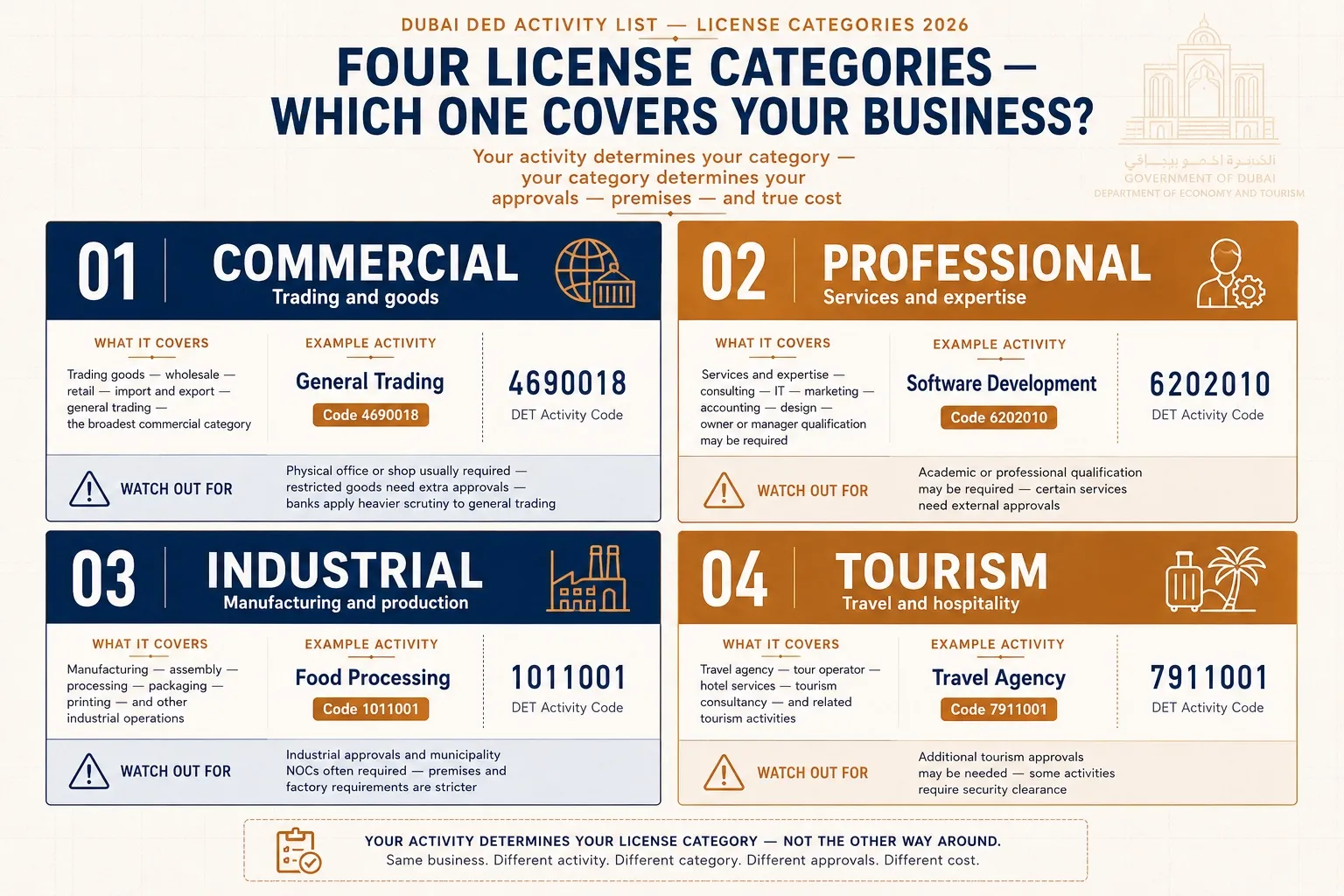
Your chosen activity determines your license category, not the other way around. The DET issues four main types, and each carries different premises, approval, and qualification requirements.
Comparison: DED license categories and what they cover
| License category | What it covers | Example activity and code | Watch out for |
|---|---|---|---|
| Commercial | Trading goods: wholesale, retail, import and export, general trading | General Trading, code 4690018 | Physical office or shop usually required; restricted goods need extra approvals |
| Professional | Services and expertise: consulting, IT, marketing, accounting, design | Software Development, code 6201001 | Owner or manager may need to prove qualifications for regulated professions |
| Industrial | Manufacturing, processing, and production | Bakery Product Manufacturing, code 1071023 | Physical industrial premises plus environmental and Civil Defense approvals |
| Tourism | Travel, hospitality, and leisure | Travel Agency, code 7912014 | DTCM permit and, for travel agencies, a bank guarantee |
Smaller categories exist too. Agricultural and Craftsmen licenses cover farming and artisan work. The E-Trader permit allows certain home-based online activities without office space, though it is limited to low-risk business types and specific residency conditions.
For a deeper breakdown of each license type and its costs, see our guide to the types of trade license in Dubai.
How to Choose Your Business Activity: The 80% Revenue Rule
Most clients do not arrive asking regulatory questions. They ask: "I want to do a bit of consulting and trading, what activity should I choose?" Or: "Can I just add everything now and decide later?" The most common request we hear is for maximum flexibility. In practice, that means stacking unrelated activities onto one application.
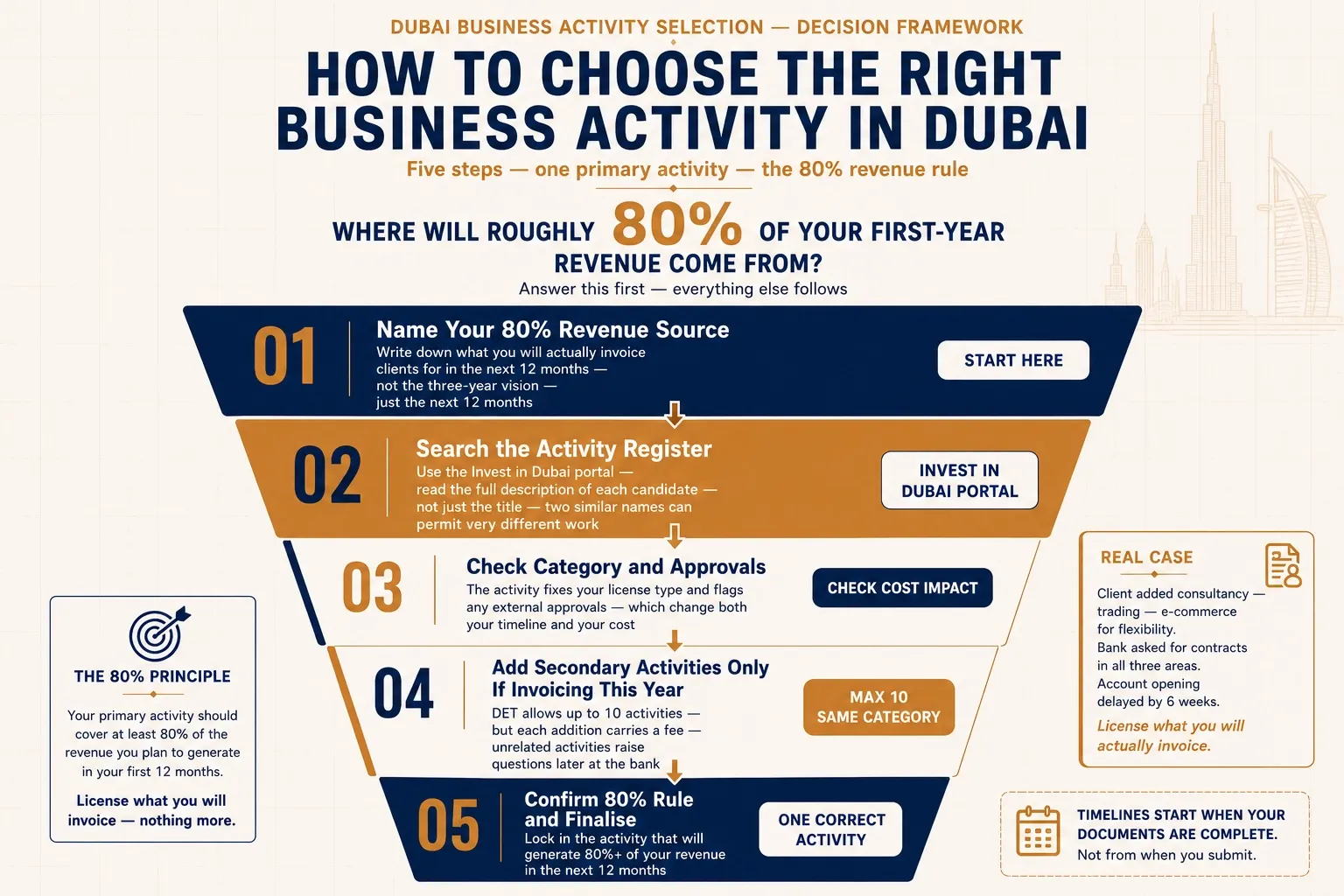
Our answer starts with a single question: where will roughly 80% of your first-year revenue come from?
The answer points to your primary activity. From there, your license category, jurisdiction, banking profile, and true setup cost follow. If 80% of projected revenue comes from management consulting, then management consultancy should be the core licensed activity. That holds even if you hope to launch e-commerce or trading later.
Here is the process in practice.
- Step 1: Name your 80% revenue source. Write down what you will actually invoice clients for in the next 12 months. Not the three-year vision. The next 12 months.
- Step 2: Search the activity register for a matching description. Use the Invest in Dubai portal and read the full description of each candidate, not just the title. "Marketing Services" and "Marketing Management" sound interchangeable but permit different work.
- Step 3: Check the category and approvals attached to that activity. The activity fixes your license type and flags any external approvals, which change both your timeline and your cost.
- Step 4: Add secondary activities only if you will invoice them this year. The DET allows up to 10 activities per license, but each addition carries a fee, and unrelated activities raise questions later. Future amendments are often cheaper than carrying unnecessary complexity from day one.
- Step 5: Make sure everything tells the same story. Your trade name, activity, Memorandum of Association, and business plan will all be read together, by the DET first and by your bank shortly after.
We saw what skipping this looks like with a client who selected business consultancy, general trading, and e-commerce on one application because he wanted flexibility. When we reviewed his model, 95% of projected revenue came from management consulting. The unused activities triggered extra compliance questions during banking, requests to justify the extra scope, and delays in the account review. Removing them cost AED 1,000 to 2,500 in amendment fees and took under two weeks. The real cost was the delayed launch.
How Does Your Business Activity Affect Bank Account Approval?
This is the consequence no activity list shows you, and it is the one that hurts most. Founders often assume the bank only cares that the company legally exists. It does not. We have opened more than 4,500 corporate bank accounts for clients, and banks review the whole compliance chain: Certificate of Incorporation, trade license, MOA, business plan, and expected transaction profile. The licensed activity is the foundation of that review.
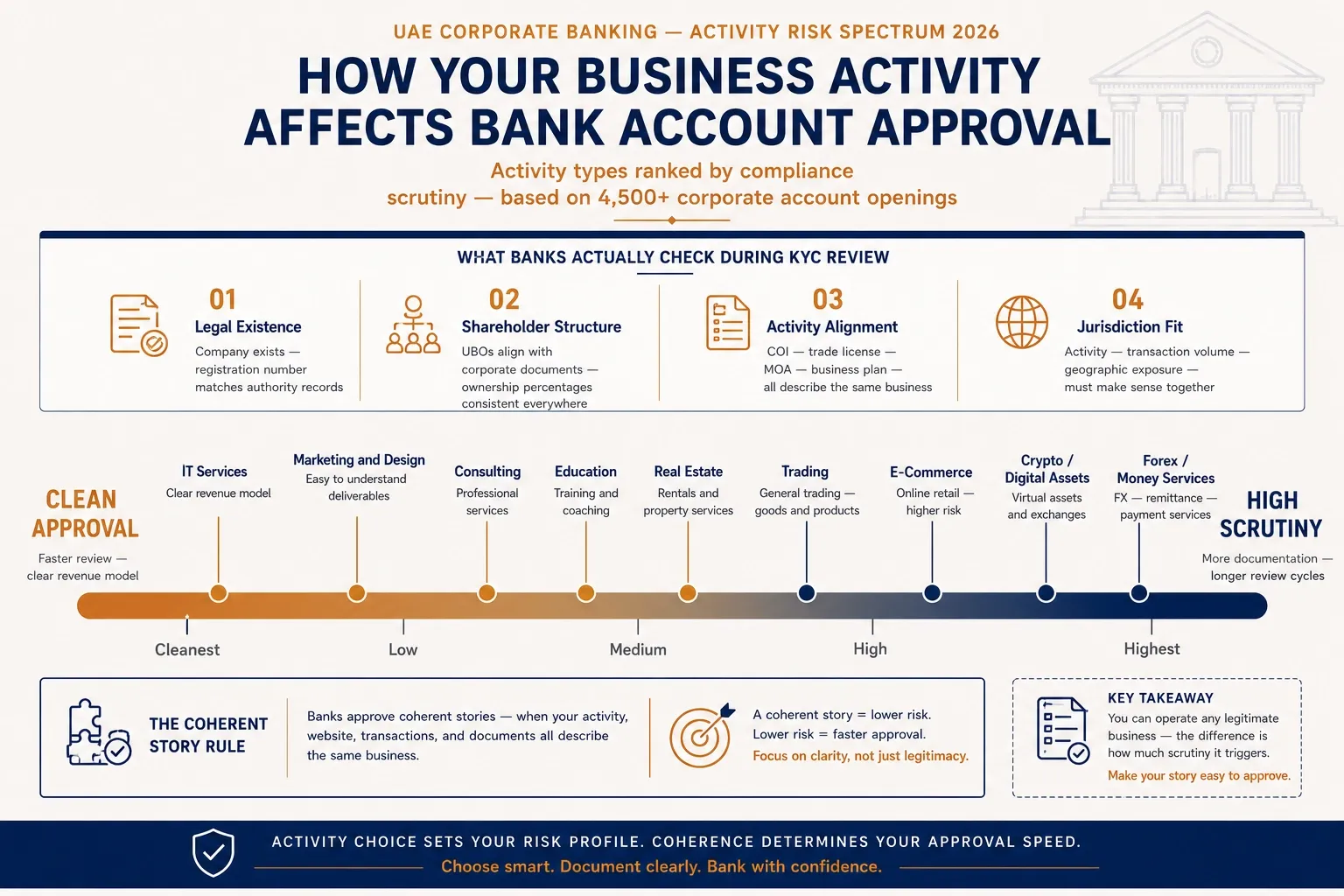
Some activities consistently receive heavier compliance scrutiny:
- General trading
- Precious metals and stones
- Cryptocurrency-related activities
- Money services and payment solutions
- International brokerage
- High-volume import and export structures
- Cross-border investment activities
Heavier scrutiny does not mean rejection. It means more documentation, longer review cycles, and higher expectations for proof of business substance.
By contrast, activities such as IT services, marketing, design, software development, and most professional services tend to produce cleaner compliance reviews, because the revenue model is easy for a bank analyst to understand.
The pattern behind both lists is the same: banks approve coherent stories. When your activity, website, transaction profile, and supporting documents all describe the same business, approval is faster regardless of category. When a consultancy license arrives with a general trading activity bolted on "just in case," the analyst has questions, and questions cost weeks.
Which Activities Need External Approvals, and What Do They Cost?
The DET will not issue your license until any external regulator has signed off. The main ones to know:
- Healthcare activities (clinics, medical services): Dubai Health Authority (DHA)
- Education and training institutes: Knowledge and Human Development Authority (KHDA)
- Real estate brokerage: Real Estate Regulatory Agency (RERA)
- Food businesses: Dubai Municipality Food Safety Department
- Tourism activities: Department of Tourism and Commerce Marketing (DTCM)
- Financial services: Central Bank or Securities and Commodities Authority
These approvals change your budget, not just your paperwork. A standard management consultancy with minimal external approvals typically falls within the AED 4,888 to 6,000 entry-level range in current market packages. An educational services activity can add several thousand dirhams in regulator review and paperwork, depending on jurisdiction. Medical activities sit far higher again because of authority licensing. This is why we price packages after activity selection, never before: the activity determines the true cost structure.
Compliance does not end at issuance either. Operating outside your licensed activity, or adding and changing an activity without prior DET approval, carries an administrative fine of AED 2,000 under Dubai's commercial compliance rules, and inspections do happen. Our breakdown of the cost of starting a business in Dubai itemises where these fees sit in the full budget.
Since the UAE's 2021 company law reforms, most commercial and industrial activities also allow 100% foreign ownership. Restrictions remain only in strategic sectors such as defense, certain transport, and some financial services. The UAE government portal maintains current foreign ownership rules if your activity sits near one of those boundaries.

Not Sure Which Activity to License? Start With One Question
The Dubai DED list has 2,000+ options. We'll help you find the one that matches your revenue model, clears the bank's compliance review, and avoids a costly amendment later.
Free Zone or Mainland: Two Different Activity Lists
The DED activity list applies to Dubai mainland companies only. Every free zone maintains its own independent register of permitted activities, and the differences between them are practical, not cosmetic.
From our channel partnerships with more than 50 free zones, a rough map. IFZA, Meydan Free Zone, and SHAMS support broad activity ranges across consulting, digital services, e-commerce, trading, and creative work under relatively flexible structures. Sector zones such as Dubai Media City, Dubai Internet City, and Dubai Healthcare City offer stronger industry positioning but narrower activity alignment.
Mainland becomes the better, or required, option for some models. Physical retail, restaurants and food establishments, medical clinics, educational institutions, and certain regulated professional services all point that way. So do direct UAE market operations that need flexibility a free zone permit cannot give.
But the deciding factor is rarely the activity name alone. It is the operational model attached to it. An e-commerce activity fulfilled from a free zone warehouse and an e-commerce activity with a Dubai Mall pickup counter are the same words on paper and completely different licensing decisions. Our free zone vs mainland comparison walks through that decision using the same 80% revenue question.
Can You Change or Add Business Activities Later?
Yes, and it is more routine than most founders fear. Activities can be added, removed, or swapped through a license amendment with the DET. Authority fees typically run between AED 1,000 and 2,500, and processing takes 2 to 10 working days depending on jurisdiction and whether external approvals apply.
Two cautions. First, the amendment must happen before you start invoicing the new activity, not after; retroactive fixes are where fines and bank account reviews appear. Second, your trade name and MOA may need updating alongside the activity if the change alters what your company visibly does. Our trade license amendment service handles the full chain in one pass.
This is also why our advice on day one is to license what you will invoice within 12 months and no more. Amendments later are cheap and quick. Unnecessary activities from day one create compliance weight you carry permanently, in every renewal and every bank review.
Choosing Your Business Activity in Dubai
Choose Once, Choose Right
The DED activity list looks like a database problem. But it is really the first strategic decision your company makes, and it sets your license cost, your approval chain, and how your bank reads you. Apply the 80% revenue rule, read the activity descriptions in full, and resist the urge to buy flexibility you will not invoice.
If you want a second pair of eyes before you commit, our consultants at Best Solution have matched activities to business models for over 5,000 companies since 2003. Share your business model and projected revenue, and we will map your activity, jurisdiction, and true setup cost in one consultation, before you spend a dirham on the wrong license.