Most people researching a business license in Dubai are not worried about the license itself. They are worried about choosing wrong. Wrong jurisdiction, wrong activity, a structure that looks fine today and becomes a problem in two years. That uncertainty is the real reason the research feels heavier than it should. With the licence issued, you can move on to your business visa options. The licence sits on top of your entity, so review the types of business structures too.
This guide maps the process the way it actually runs in 2026: seven steps, the documents you need, what each stage costs, and the few decisions that genuinely matter later. It also corrects two things competitors still get wrong, including an ownership rule that changed years ago and is still printed on top-ranking pages.
Quick summary
| Stage | What It Involves |
|---|---|
| 1. Activity | Match the licensed activity to where your revenue will actually come from |
| 2. Jurisdiction | Mainland (DET) for the local market, free zone for 100% ownership and export |
| 3. Trade name | Reserve a compliant name with the authority |
| 4. Initial approval | Authority confirms no objection to your activity and name |
| 5. External approvals | Some activities (training, healthcare, food) need a regulator's sign-off |
| 6. Documents + MOA | Passports, application, lease, Memorandum of Association |
| 7. Pay and collect | Settle fees; the trade license is issued |
What is a business license in Dubai?
A business license in Dubai is the official document that lets a company trade, provide services, or manufacture legally in the UAE. Mainland licenses are issued by the Dubai Department of Economy and Tourism (DET), while each free zone authority, such as IFZA, Meydan, DMCC, or RAKEZ, issues its own. Operating without one exposes you to fines and closure, and you cannot open a corporate bank account, sponsor visas, or sign enforceable contracts without it. Licences are not one-size-fits-all; review the different types of trade licence first. Requirements differ slightly for a Dubai mainland company versus a free zone.
One correction worth making up front. Several top-ranking guides still state that a UAE national must own 51% of a mainland company. For most commercial and professional activities, that requirement was removed in 2021. Foreign nationals can now hold 100% ownership of the majority of mainland activities. A short list of strategic-sector activities still needs an Emirati partner or a local service agent, which is one reason activity selection comes first.
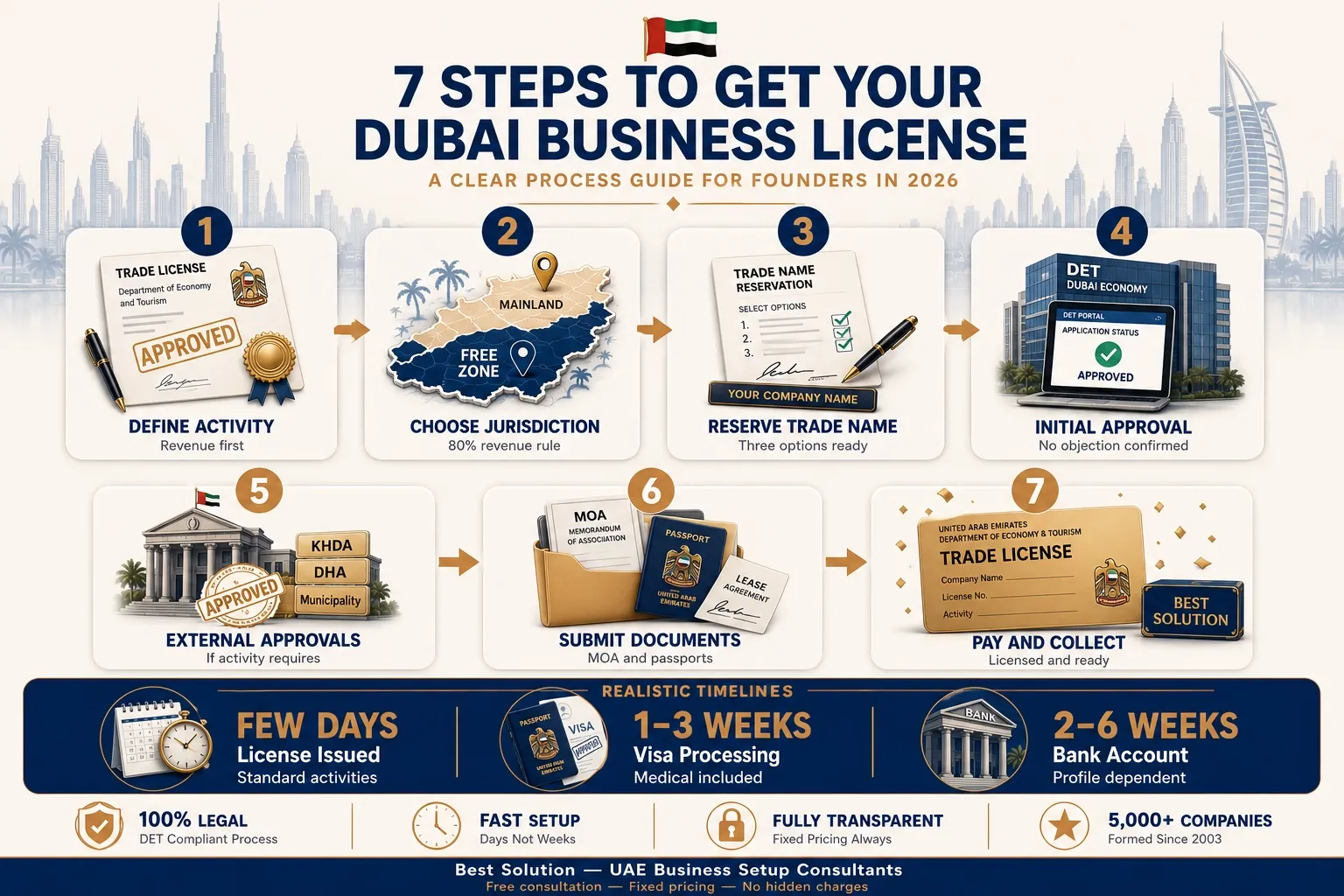
How to get a business license in Dubai in 7 steps
In short
To get a business license in Dubai, define your business activity, choose mainland or free zone, reserve a trade name, obtain initial approval from the authority, secure any external regulatory approvals your activity requires, submit your documents and Memorandum of Association, then pay the fees and collect the license. Straightforward activities can be licensed within a few working days.
Here is what each step involves and where people lose time.
Step 1: Define your business activity
Dubai licenses activities, not vague business descriptions. The activity you register sets your license category, your regulatory pathway, and how a bank later reads your company. Start from one question: where will most of your first-year revenue actually come from? Register the activities that match that, not a long list of things you might do someday. Over-listing activities can trigger extra fees, extra approvals, and higher bank scrutiny for no benefit. If you are unsure how to scope this, our guide on choosing the right business activity walks through it in detail. The licence is one stage in the wider how to start a business in Dubai journey. Regulated lines like a real estate company add extra licence conditions.
Step 2: Choose mainland or free zone
Mainland (licensed by DET) lets you trade anywhere in the UAE and bid for government contracts. A free zone gives you 100% ownership, tax incentives, and a faster, package-based setup, but it is built for activity inside the zone and for export. A simple test: if roughly 80% of your year-one revenue will come from inside the UAE, mainland usually fits; if it comes from outside, a free zone usually fits. Our free zone vs mainland comparison covers the trade-offs in full.
Step 3: Reserve your trade name
Reserve a company name with the relevant authority. It must be unique, must not use restricted or religious terms, and cannot copy an existing brand. Names that violate UAE naming rules are rejected until corrected, which delays everything downstream. See our trade name registration guide for the naming rules in practice.
It ensures you choose the proper company setup—Mainland, Free Zone, or Offshore—and that you comply with local regulations, including obtaining necessary approvals and managing employee visas. By focusing on meticulous preparation, you streamline the application process and lay a solid foundation for your business. If the requirements feel dense, business setup consultants can handle them.
Step 4: Apply for initial approval
Initial approval is the authority confirming it has no objection to your chosen activity and name. It is not permission to start trading. For foreign applicants, immigration clearance from the relevant residency authority is generally needed before initial approval is granted. This stage usually takes a few working days when the paperwork is consistent.
Step 5: Secure external approvals (if your activity needs them)
Most activities are licensed directly by the authority. Some are not. Education and training, healthcare, food, telecoms, engineering, and security activities require sign-off from an external regulator before the license is issued. This is the single most common reason a launch timeline slips, because applicants assume every activity works like a standard consultancy license. It does not. The next section lists which activities to watch and what the approvals cost.
Step 6: Submit documents and sign the MOA
Submit your application form, passport copies of shareholders and managers, proof of address where required, your tenancy contract or flexi-desk agreement, and the Memorandum of Association signed by all partners. Documents not in Arabic or English typically need a certified Arabic translation to be accepted. Incomplete or inconsistent documentation is the most common cause of outright rejection. Some activities need a local stake, so finding the right business partner matters.
Step 7: Pay fees and collect your license
Once documents are approved, you pay the license and government fees, and the trade license is issued. Keep copies ready for bank account opening, visa processing, and contracts. You can confirm any UAE license is genuine through the official UAE government verification service. Getting it right at submission means you avoid the amendment fees and resubmission delays that come from licensing the wrong activity in the first place. If an application does get knocked back, our breakdown of business license rejection reasons explains how to recover.
Here, we will highlight the key aspects of license preparation and how a structured approach can help you succeed in Dubai's competitive market.
Documents required for a business license in Dubai
The exact list varies by activity and jurisdiction, but a standard application includes:
- Completed license application form with the business name in English and Arabic
- Passport copies of all shareholders and the manager (visa or entry-stamp copies where applicable)
- Proof of address, and a certificate of address from the home country for some nationalities
- Tenancy contract, Ejari, or a flexi-desk / virtual office agreement
- Memorandum of Association (MOA) signed by all partners
- Three proposed trade names for reservation
- Attested degree or experience certificate for certain professional activities
- A business plan for regulated or specialised sectors
Types of business licenses in Dubai
Dubai issues several license categories, and your activity decides which one applies:
| License Type | Covers |
|---|---|
| Commercial | Trading, import/export, retail, brokerage, general trading |
| Professional | Consultancy, IT, marketing, design, accounting and similar services (100% expat ownership) |
| Industrial | Manufacturing and processing; requires a physical facility |
| Tourism | Travel agencies, tour operators, hospitality-linked activities |
| E-commerce / e-trader | Online selling and digital services |
For the full breakdown with examples, see our guide to the types of trade license in Dubai .
Which activities need extra approvals before you can be licensed
This is where launch timelines most often slip. Some activities cannot be licensed by the authority alone; they need a regulator to approve them first. The activities that surprise applicants most often are:
- Education and training
- Healthcare services
- Telecommunications-related activities
- Food businesses
- Engineering activities
- Security services
- Certain e-commerce categories
A real example. A client wanted to set up a training and professional development business and assumed it would work like a standard consultancy license. Training activities require KHDA approval, which added roughly AED 15,000 in approval cost, extra documentation, a regulatory review, and several weeks to the timeline. The monetary difference was not enormous, but the effect on the expected launch date was significant.
Cost is not the only consideration. General trading is a popular activity because it covers a wide scope, but it carries around an AED 10,000 activity fee and draws higher bank scrutiny, because regulators treat broad trading as a higher-risk profile. This is exactly why activity selection has to happen before any conversation about setup cost. The activity determines the regulatory pathway, and the pathway determines the real timeline and budget.
For personalised assistance,
Schedule a consultation call with our experts today!
Instant License: why fast is not the same as complete
DET's Instant License can issue a license in minutes without a first-year office lease, and for the right business model it genuinely reduces setup friction. For a straightforward professional activity, it is a reasonable way to incorporate quickly. Many licences can be paired with a virtual office instead of leased space.
The risk is treating speed as the whole strategy. An Instant License does not, on its own, solve banking requirements, future office needs, regulatory approvals, or whether the activity even suits the business. In practice it also caps you at two visas, and the absence of a physical office can complicate the bank inspection that comes with opening a corporate account. We have seen companies licensed quickly that later hit problems because the activity or structure had not been thought through. A fast license is not the same as a complete business setup.
How much does a business license cost in Dubai?
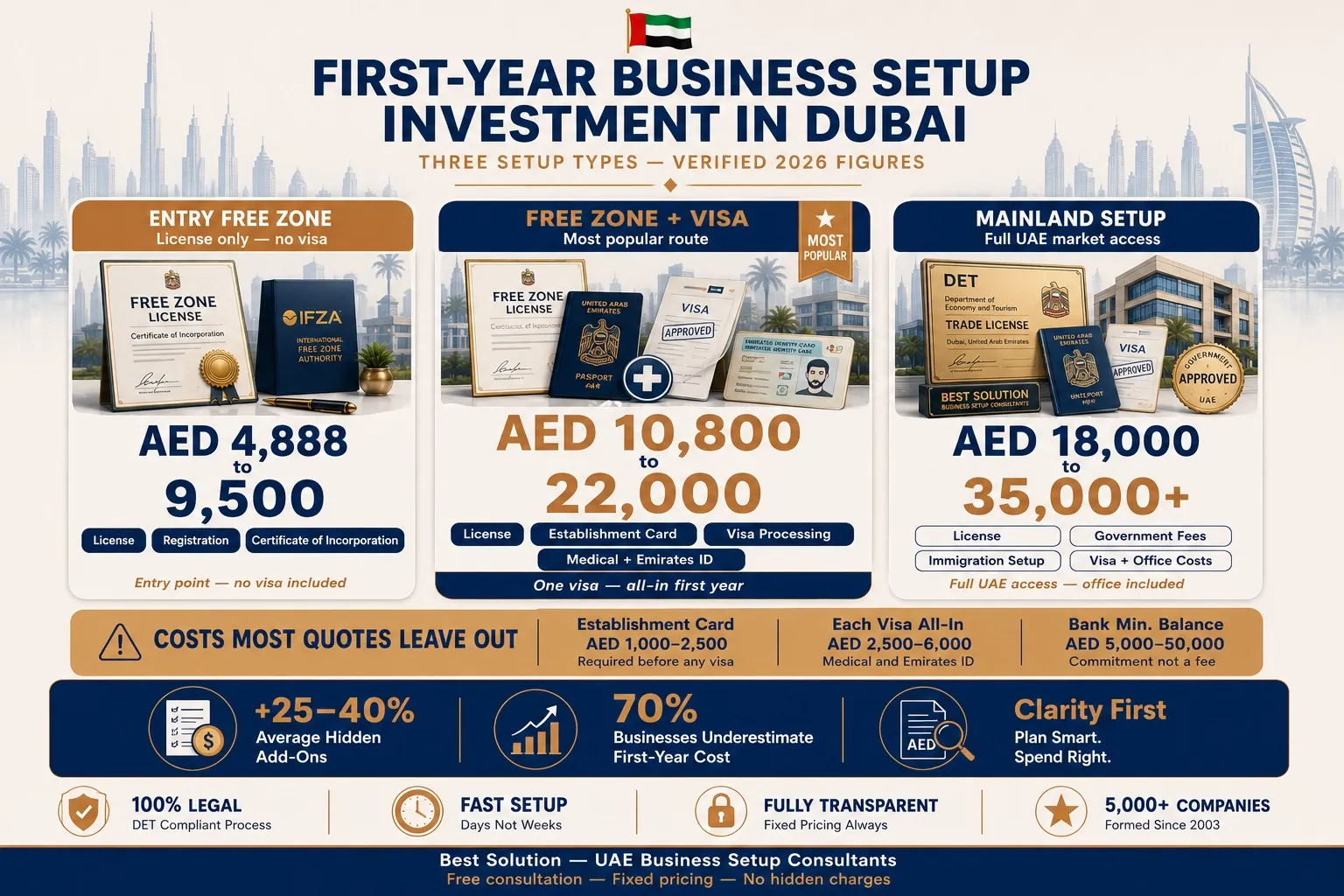
It is more useful to think in terms of first-year setup investment than license cost alone, because a license on its own does not make you operational. Many providers quote only the license fee to win the deal, then add charges once you are committed. These are realistic, client-verified ranges that include what it actually takes to start trading:
| Setup Type | Typical First-Year Investment | Usually Includes |
|---|---|---|
| Entry-level free zone | AED 4,888 - 9,500 | Company registration, license issuance, certificate of incorporation |
| Free zone with one visa | AED 10,800 - 22,000 | License, establishment card, visa processing, medical, Emirates ID |
| Mainland setup | AED 18,000 - 35,000+ | License, government fees, immigration setup, visa, office-related costs |
These figures exclude activity-specific external approvals (for example KHDA for training). For a full first-year budget broken down line by line, see our guide to the cost of starting a business in Dubai . One more 2026 note worth budgeting around: a free zone license does not automatically mean 0% corporate tax. To keep the 0% rate you must qualify as a Qualifying Free Zone Person with the Federal Tax Authority, and Small Business Relief applies only to tax periods ending on or before 31 December 2026.
The review we run before submitting any application
Most avoidable problems are not licensing problems; they are decisions made too quickly before submission. Before any application goes in, we run a first-stage consistency review across five areas:
Pre-submission review
That last question matters more than most applicants expect. A licensed company that a bank cannot make sense of is a stalled company. Getting the activity, jurisdiction, and structure aligned before submission is what avoids amendment costs, resubmissions, and the banking friction that surfaces months later. As a UAE citizen-owned consultancy with a single transparent quotation and no hidden add-ons, that is the part of the process we focus on most.