Most people do not call us asking for a “mainland company.” They call with a problem. “My client says I need a UAE company.” “Can I invoice customers here?” “I need a visa for my family.” “My free zone licence will not let me do this deal.” Picking a jurisdiction is the first big call, and our free zone versus mainland comparison lays out the trade-offs. Foreign companies expanding here often weigh setting up a subsidiary against forming a fresh entity.
A Dubai mainland setup is usually the answer to one of those problems, not the goal itself. So this guide does two things. It shows you the real steps and costs. And it helps you decide whether mainland is the right structure before you spend a dirham. Get that decision right and you avoid the most expensive mistake in company formation: building the wrong thing and fixing it six months later. If the paperwork feels heavy, experienced business setup consultants can handle the filings for you. Not every mainland activity needs leased premises; some qualify with a virtual office or flexi-desk.
Quick summary
| Question | Short answer |
|---|---|
| What is it? | An onshore company licensed by Dubai’s Department of Economy and Tourism (DET/DED). It can trade anywhere in the UAE. |
| Who is it for? | Businesses serving UAE customers, bidding for government work, or hiring locally. |
| Realistic starting cost | From AED 12,000–15,000+ for a simple professional activity. Visas, office and Ejari are usually extra. |
| Ownership | 100% foreign ownership in most activities. No local partner needed for those. |
| Timeline | Often a few days once documents are ready. Regulated activities take longer. |
| Biggest risk | Choosing your activity and structure for today, not for next year. |
What is a Dubai mainland company?
A Dubai mainland company is an onshore business licensed by the Department of Economy and Tourism (DET), still widely called the DED. Unlike a free zone company, it can trade anywhere in the UAE, sell directly to local customers, bid for government contracts, and scale its visa quota with its office space. For most activities, you can now own 100% of it as a foreign national. Before you apply, it helps to understand the business licence essentials that every mainland company needs. Once licensed, you can sponsor yourself and staff through the available business visa options.
In plain terms: a mainland licence gives you the widest access to the UAE market. That is why it is the default choice for businesses that earn most of their money from UAE clients.
Mainland vs free zone: which is right for your business?
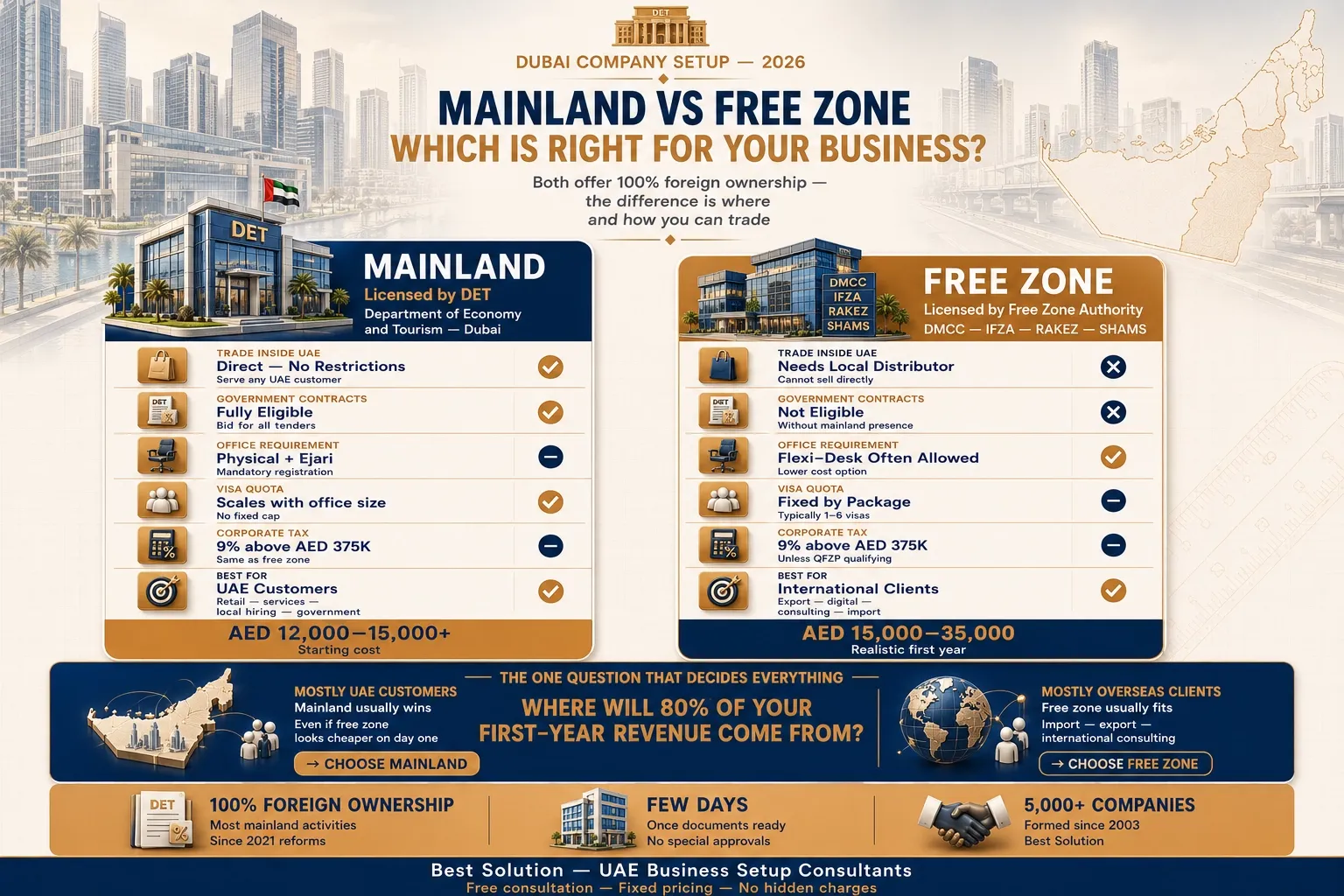
This is the real decision behind most setups. Both give you 100% ownership today. The difference is where and how you can trade.
| Factor | Mainland | Free Zone |
|---|---|---|
| Trade inside the UAE | Direct, no restrictions | Usually needs a local distributor |
| Government contracts | Eligible | Not eligible |
| Office | Physical address + Ejari required | Flexi-desk often allowed |
| Visa quota | Tied to office size, scalable | Fixed by package |
| Corporate tax | 9% above AED 375,000 | 9% above AED 375,000 |
| Best for | UAE customers, retail, services, hiring | Import/export, international clients |
There is no universally “better” option. The honest test we use with every client is one question: where will about 80% of your first-year revenue come from?
If the answer is UAE customers, mainland almost always wins, even when a free zone package looks cheaper on day one. If the answer is overseas clients or pure import/export, a free zone may fit. To compare licence types side by side, see our guide to the free zone and mainland operating permit.
How much does business setup in Dubai mainland cost?
There is no single price, and any headline figure that promises one is usually quoting the licence alone, not the full setup. Here is the realistic picture.
For a simple professional or consultancy activity, mainland company formation generally starts from AED 12,000–15,000+. The final number depends on your activity, your visa needs, your office, and any external approvals.
What is usually included
- Trade licence
- Initial approvals
- Trade name reservation
- Memorandum of Association, where applicable
- Company registration
- Establishment card
- Basic setup support
What is usually not included (and surprises founders)
- Investor visa
- Employee visas
- Medical tests and Emirates ID
- Ejari and office rental
- External authority approvals
- Corporate bank account support
Our advice: budget for the business, not the licence
The licence is usually one of the smaller decisions in the whole setup. The costs that move your budget are visas, office and approvals. Plan for those from the start and you will not be surprised in month two.
For a fuller breakdown of what drives the number, see our guide to the cost of starting a business in Dubai. For the wider end-to-end view, see our guide on how to start a business in Dubai. Local partnerships still matter for some activities, so choosing the right business partner pays off.

Start Your Mainland Company
Get your free Consultation and lock business dream with Best Solution
How to set up a mainland company in Dubai, step by step
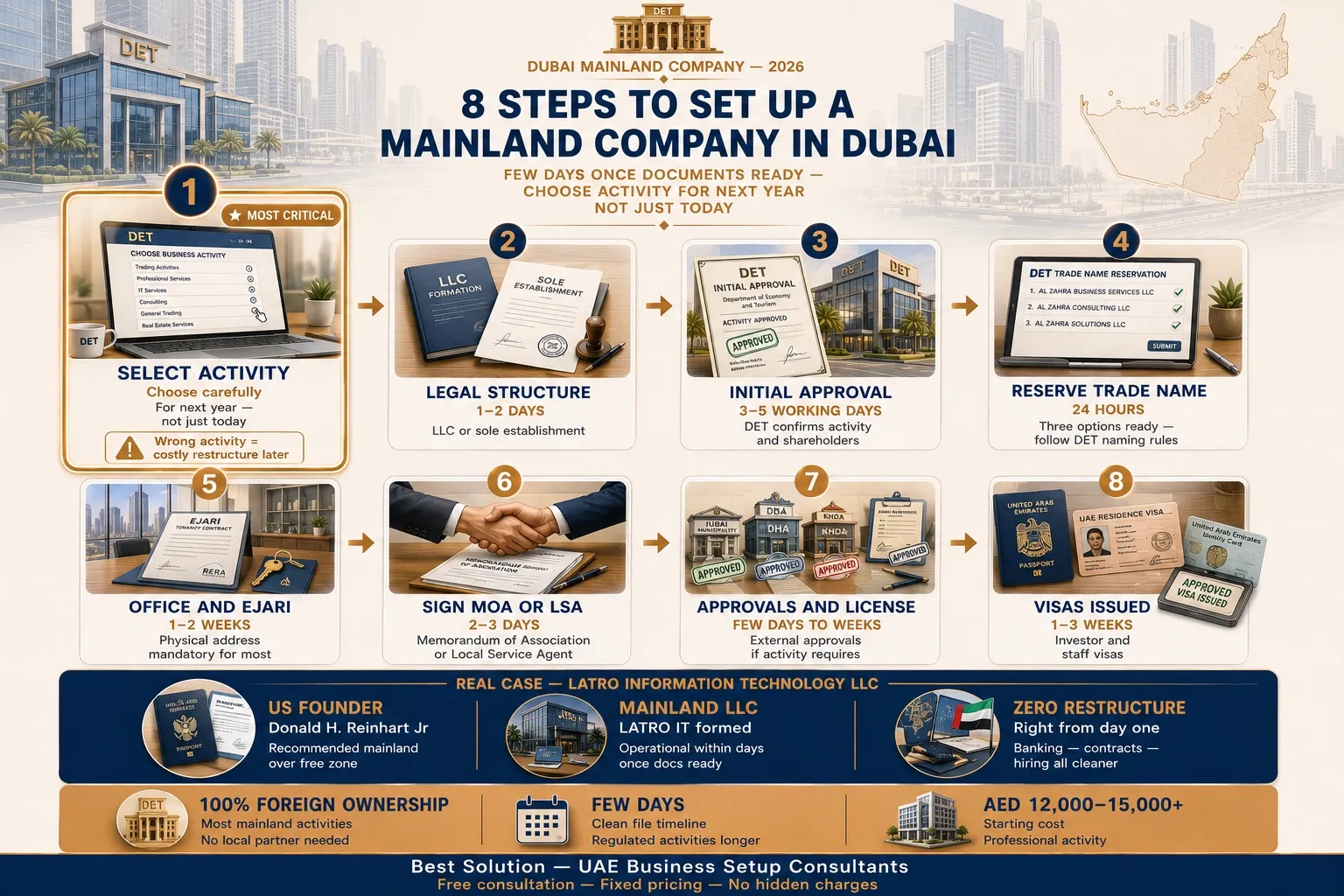
The process is well-defined. With clean documents and no special approvals, it can move quickly.
- Select your business activity. The DET groups activities, and different groups can need different licences. Choose for where your business is going, not just where it is today.
- Choose your legal structure. An LLC, sole establishment, or civil company each carries different liability and ownership rules.
- Get initial approval. The DET confirms it has no objection to your activity. Enhanced due diligence on some nationalities can add a few working days.
- Reserve your trade name. Have three options ready and follow DET naming rules (more on the “language trap” below).
- Sort your office and Ejari. Most mainland licences need a physical address registered on Ejari through RERA. Some instant licences allow a virtual office for the first year.
- Sign the MoA or LSA. The DET can generate the Memorandum of Association, or the local service agent contract where one applies.
- Get external approvals and the trade licence. Certain activities need sign-off from other authorities first. The DET then issues your mainland trade licence.
- Apply for visas. With the licence issued, apply for your investor visa and staff visas: entry permit, medical, Emirates ID, then residency.
Which trade licence and legal structure do you need?
The four main licence types
| Licence | Best For |
|---|---|
| Commercial | Trading, retail, general buying and selling |
| Professional | Services that rely on skill: IT, consultancy, design, legal |
| Industrial | Manufacturing, production, assembly |
| E-trader | Sole proprietors selling via social media (mainly UAE/GCC nationals; some expats eligible) |
Common legal structures
A Limited Liability Company (LLC) is the most popular form and now allows 100% foreign ownership in most sectors under the Commercial Companies Law reforms (Federal Decree-Law No. 26 of 2020). A sole establishment gives one owner full control but unlimited personal liability, and expats need a local service agent for professional activities. A civil company suits two or more professional partners.
If you are weighing personal liability against simplicity, our comparison of sole proprietorship vs LLC in Dubai lays out the trade-offs.
Documents and approvals you will need
For initial approval, the DET typically asks for passport copies of all shareholders, visa or entry-stamp copies, passport photos, contact details, your chosen activities, and the articles of association.
Some activities also need sign-off from a sector regulator before the licence is issued. A few common ones:
| Authority | Activities It Approves |
|---|---|
| Ministry of Justice | Legal activities and consultancy |
| Dubai Municipality | Architecture, engineering, clinics |
| Dubai Health Authority (DHA) | Health and medical services |
| TDRA | Telecom and e-commerce activities |
| Executive Council | Travel, tourism, transport, branches of foreign firms |
The trade name itself has a trap worth knowing. A name that sounds professional in English can fail the DET translation check. Words like “International” or “Global” can trigger higher capital requirements, and “Emirates” or “Dubai” need special approval. Have three clean options ready so a rejection does not stall your branding. Every setup begins with trade name registration before the licence can be issued.
Staying compliant after setup: tax, VAT, Emiratisation
A mainland company comes with ongoing duties. Missing them is where avoidable fines appear.
- Corporate tax: register regardless of profit. Tax is 9% on taxable income above AED 375,000, in force since 1 June 2023 (UAE Federal Tax Authority).
- VAT: register if taxable supplies pass AED 375,000, and file returns within 28 days of each tax period. Late filing starts at an AED 1,000 penalty.
- UBO declaration: file ultimate beneficial owner details with the DET. Non-compliance can cost AED 15,000 or more.
- Emiratisation: companies with more than 20 skilled staff must meet annual Emirati hiring targets set by MOHRE.
If tax registration is your next worry, our complete guide to tax registration in Dubai walks through it.
The most expensive mistake in mainland setup
After helping form more than 5,000 companies across the UAE, and supporting over 4,500 corporate bank account applications, we see the same costly error again and again: choosing your activity and structure for today’s requirement instead of next year’s business model.
A founder picks the cheapest activity package. Six months later they need more activities, government contracts, extra staff, or a proper banking relationship. Now they need amendments and, sometimes, a full restructure. The other frequent traps are underestimating visa needs, choosing an office purely on price, and ignoring future banking requirements.
A real example: cheapest setup vs right setup
A US founder, Donald H. Reinhart Jr, planned to open a low-cost free zone company because the package looked cheaper. In the consultation we reviewed his customer profile, revenue projections, staffing and banking needs. Almost all of his first-year revenue would come from mainland UAE clients. Our 80% rule pointed clearly to mainland. We formed LATRO Information Technology L.L.C as a mainland company. It was operational within days once documents were ready. Client contracting was simpler, local hiring was easier, and banking conversations were cleaner. When mainland revenue grew, nothing had to be restructured. The win was not licensing speed. It was that he never had to spend time and money fixing the structure later.
The businesses with the fewest problems are the ones that spend a little more time defining their model before they incorporate.
Should you set it up yourself or use a consultant?
It is a fair question. Company formation information is everywhere now, and the government portals have become easier to use. If your setup is genuinely simple, you can handle parts of it yourself.
The honest answer is that the value of an advisor is not filing forms. It is knowing where the risks are. Most clients do not hire us because the application is hard. They hire us because getting it wrong is expensive: the wrong activity, a banking rejection, an unnecessary restructure, licensing limits, or visa complications.
If you would like a second opinion before you commit, our Dubai mainland licence service includes a structure review and a corporate bank account opening assessment. The goal is simple: set it up once, set it up right. Regulated activities carry extra approvals — opening a childcare centre is one example with its own steps.
Before you commit, run this check
The 5-minute structure check
Want a structure review before you spend anything? Talk to the Best Solution team and we will tell you honestly whether mainland is right for you.