The most expensive mistake in opening a nursery in Dubai is not the license. It is signing the tenancy contract before the regulator has approved the premises. A founder finds a bright, well-placed unit, signs the lease, then learns the floor level, the play-area access, or the evacuation routes will never pass inspection. What follows is a lease penalty, a redesign bill, and a launch pushed back by weeks.
This guide reverses the usual order. It treats licensing feasibility as the first decision rather than the last, because in childcare the regulator effectively decides whether a location is usable before you spend a single dirham on it. You will get the current regulatory framework (the one many published guides still get wrong), the real all-in budget for a 30 to 40 child centre, the premises rules that quietly disqualify most first-choice units, and the exact sequence Best Solution uses to take clients from idea to an open door without a costly reversal.
In short
| Question | Short Answer |
|---|---|
| Who regulates it? | KHDA leads, alongside DET, MOE, Dubai Municipality and Civil Defence (not the Ministry of Social Affairs) |
| What does it cost? | All-in for 30–40 children: AED 350,000–900,000+. Licensing fees are minor; premises and fit-out are the bulk |
| How long? | About 10–16 weeks; premises readiness, not paperwork, is the usual delay |
| Biggest mistake? | Signing a lease before KHDA premises approval |
| Free zone or mainland? | Realistically mainland; home-based childcare is heavily restricted |
How do you open a nursery in Dubai?
To open a nursery in Dubai, you secure DET trade-name and initial approval, obtain KHDA concept approval for your academic plan, pass Dubai Municipality and Civil Defence premises inspections, then receive the final KHDA license. Validate premises feasibility before signing any tenancy contract. The full process typically takes 10 to 16 weeks.
Is opening a nursery in Dubai a good business in 2026?
Yes, for the right operator, the fundamentals are strong. Dubai draws working professionals who bring families and want reliable early years care. Dual-income households are common, disposable income is high, and parents place real value on structured early childhood education. That combination produces consistent demand and year-round enrolment.
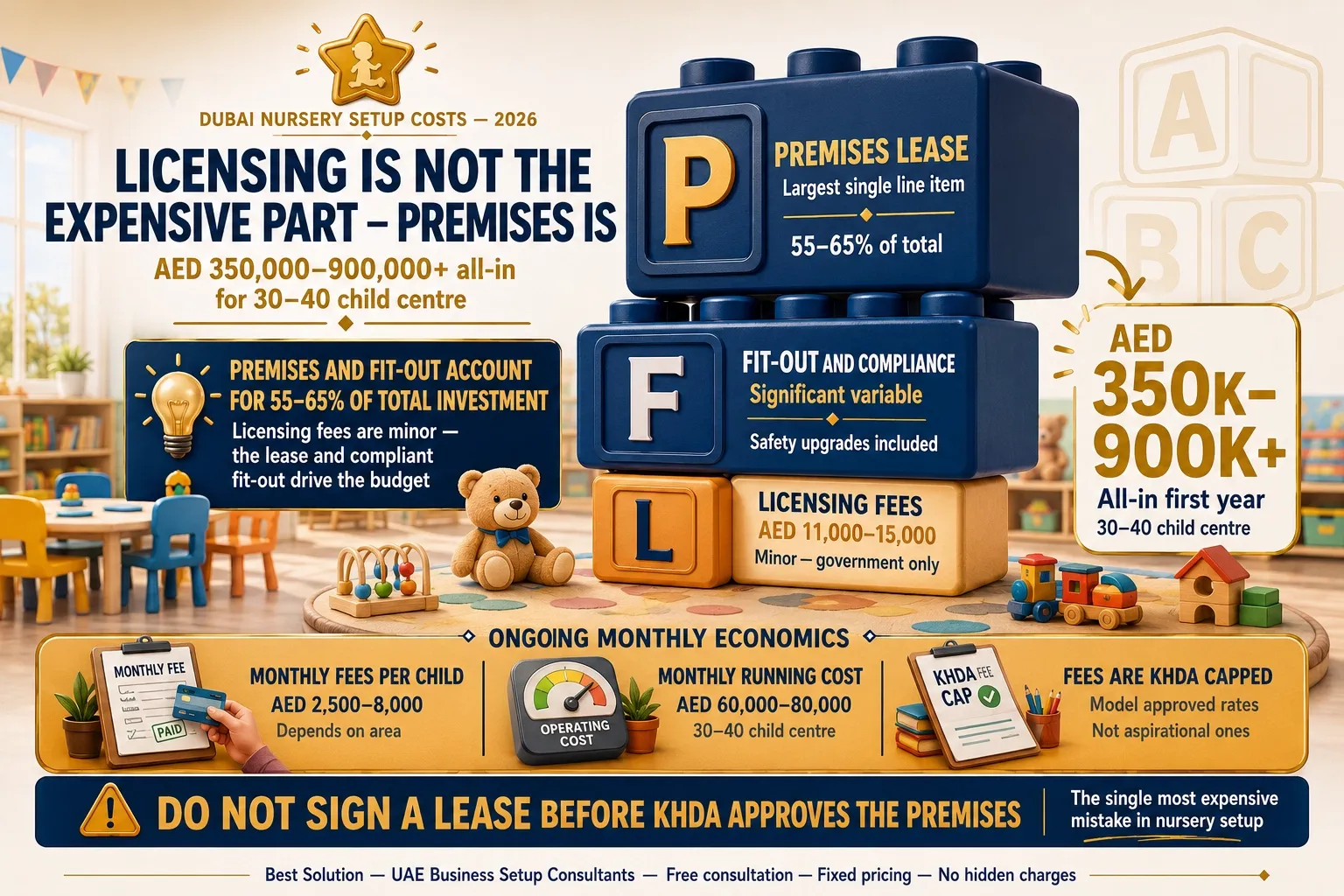
The economics can work, but the numbers are wide. Monthly fees commonly run from AED 2,500 to AED 8,000 per child depending on area and offering, while operating costs for a small centre sit around AED 60,000 to AED 80,000 a month (nursery cost research). One detail many guides skip: KHDA reviews and effectively caps the fees a nursery can charge, so your pricing is not entirely your own decision. Model the business on approved fees, not aspirational ones. For a wider view of setup economics, see our guide to the cost of starting a business in Dubai. The licensing groundwork follows our guide on how to start a business in Dubai. Staffing ratios and safety add hidden operational costs to a nursery.
Who regulates nurseries in Dubai? KHDA and the five authorities
Here is where most online guides are out of date. Several still tell you that nursery licensing runs through the Ministry of Social Affairs. For private nurseries in Dubai, that reference is outdated. Today the framework is led by the Knowledge and Human Development Authority and involves five bodies working together:
- KHDA (Knowledge and Human Development Authority): the lead regulator for early childhood centres. It approves your academic plan, inspects the premises, sets quality standards, and issues (and annually renews) the license.
- DET (Dubai Department of Economy and Tourism): handles the commercial side, the trade name and the business license that gives your centre a legal structure.
- Ministry of Education (MOE): comes into play for curriculum and educational standards, especially for centres delivering a formal or international curriculum.
- Dubai Municipality: approves the building, floor plan, and public-health and safety compliance of the premises.
- Dubai Civil Defence: inspects fire-safety systems, alarms, ventilation, and emergency exits, then issues a No Objection Certificate.
Getting this right matters because the order in which you satisfy these bodies determines your timeline and your risk. You can confirm the current requirements directly on the KHDA early childhood centre permit guide and the UAE Government early childhood care portal. If your concept leans toward a structured curriculum, our educational institute license in Dubai guide explains the adjacent approvals.
Ready to Launch Your Nursery the Right Way?
Don't spend a single dirham on a lease until you know your concept and location are 100% compliant. At Best Solution, we've helped over 5,000 businesses navigate UAE regulations using our Feasibility-First Method—saving founders up to AED 150,000 in unnecessary relocation and redesign costs.
How much does it cost to open a nursery in Dubai?
Published figures range from around AED 11,000 to AED 700,000, which is confusing until you separate two very different things: government licensing fees and total setup investment. Licensing fees are small. The real money goes into premises and a compliant fit-out.
Government and licensing fees (approximate, professional mainland structure):
| Item | Indicative Cost (AED) |
|---|---|
| Professional license + name/board permissions | 600 – 2,400 |
| Municipality knowledge & service fees | 100 – 200 |
| Civil Defence fees | 500 |
| Market fee (≈5% of building rent, varies) | varies with rent |
| Immigration & labour establishment cards | ≈ 3,200 |
| Indicative licensing subtotal | ≈ 11,000 – 15,000 |
Now the part that actually shapes your budget. For a 30 to 40 child centre, a realistic 2026 all-in investment is AED 350,000 to AED 900,000 or more, driven mostly by the lease and a KHDA-compliant fit-out. A separate industry estimate puts year-one investment for a similar-size centre at AED 230,000 to AED 684,000, with premises lease and fit-out alone accounting for 55 to 65% of the total (startup cost research).
What is fixed vs variable
Typically inside a structured setup package: trade license setup, KHDA application support, initial approvals coordination, Civil Defence submission support, basic PRO services, and founder plus staff visa planning. Variable cost drivers (not fixed): premises lease (often the single largest line), KHDA-compliant fit-out, safety upgrades and layout changes, staffing-compliance costs, and Civil Defence fire-safety systems. The takeaway: licensing is not the expensive part. Premises compliance is.
Step-by-step: how to open a nursery in Dubai
Notice that feasibility comes first, before any lease. That single change of order prevents the most common and most expensive failure in this sector.
- Validate premises feasibility and your licensing path first. Screen candidate locations against KHDA and Municipality rules and confirm the right structure before you commit to anything. This is the step competitors skip.
- Write a business and academic plan. The business plan covers financials, target market, fee structure (modelled on approved fees) and operations. The academic plan, which KHDA scrutinises, covers curriculum (for example EYFS or Montessori), daily schedules, staff-to-child ratios, and health and safety policy.
- Form the company and reserve the trade name with DET. Choose a compliant legal structure and secure initial approval. Our LLC company formation in Dubai service covers this end to end.
- Get KHDA initial (concept) approval. Submit the academic plan and owner credentials for review against Dubai's early years standards. Expect 2 to 6 weeks at this stage.
- Secure premises and register the tenancy (Ejari), only after feasibility is confirmed. With approval logic already validated, you can sign and register the lease with confidence rather than hope.
- Clear Dubai Municipality and Civil Defence. Municipality approves the floor plan and public-health compliance; Civil Defence inspects fire-safety provisions and issues the NOC. Our PRO and document-clearing team manages these government interactions on your behalf.
- Pass the final KHDA inspection and collect your license. Submit the complete file (DET approval, Ejari, NOCs), pass the on-site inspection, and receive the license that lets you open. Remember it renews annually.
KHDA premises and space requirements (the rules that disqualify most units)
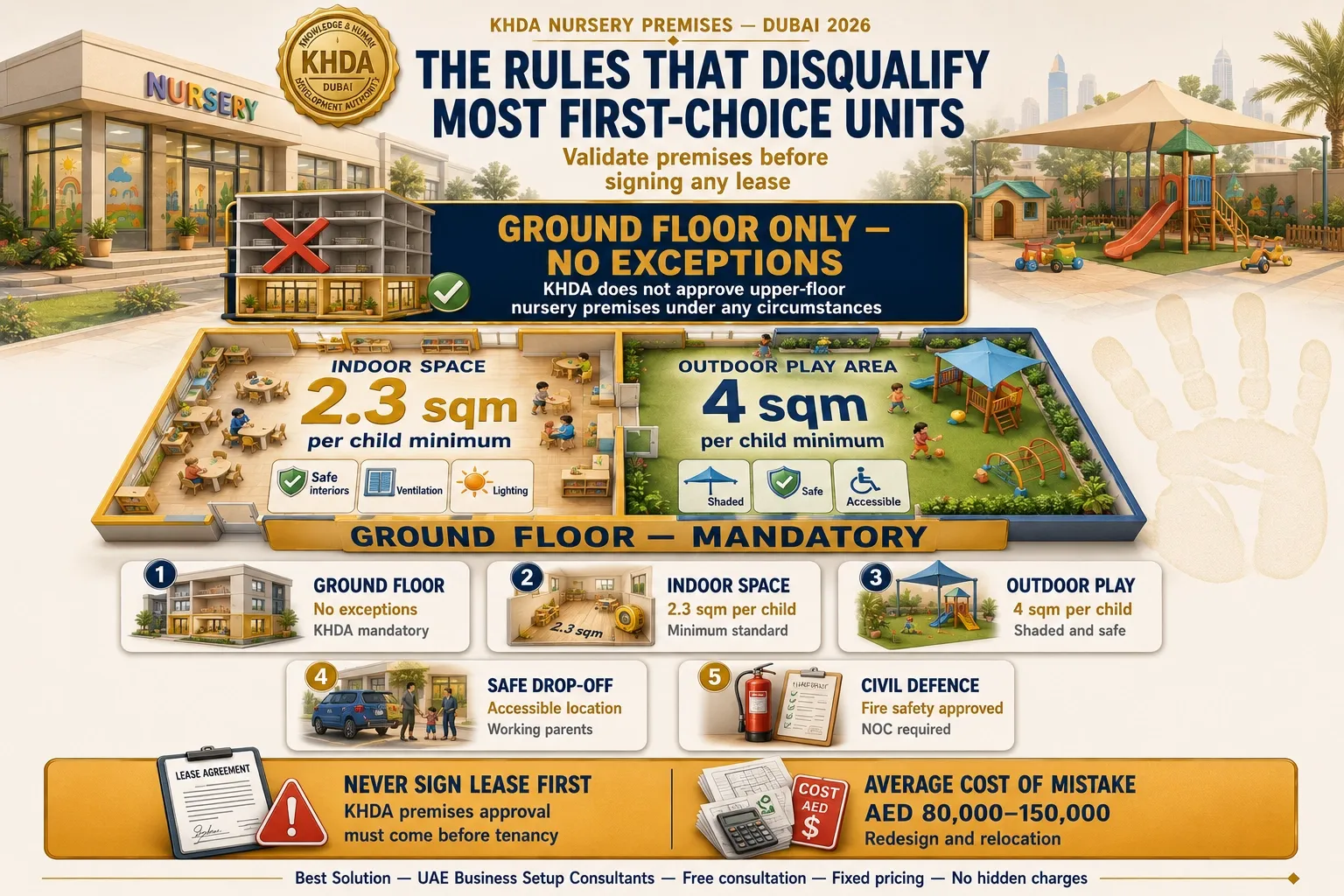
More first-choice locations fail on premises than on paperwork. Check these before you fall in love with a unit:
- Ground floor, mandatory. KHDA does not approve upper-floor nursery premises. No exceptions.
- Indoor space. A minimum of about 2.3 sqm of indoor space per child under the KHDA standard.
- Outdoor play area. A dedicated, safe, shaded outdoor area, typically a minimum of around 4 sqm per child.
- Accessibility. A residential location that is easy for working parents to reach, with safe drop-off.
- Safety and fit-out. Child-safe interiors, proper ventilation and lighting, compliant evacuation routes, and Civil Defence-approved fire systems.
Staffing and curriculum requirements
KHDA's standards extend to who works in your centre and what you teach:
- Arabic language. At least one Arabic teacher is required; Arabic exposure is part of the mandate.
- Islamic studies. At least one Islamic studies teacher for Muslim children, which can be a part-time role.
- Leadership qualifications. The director or principal is generally expected to hold at least a bachelor's degree in education.
- Health and safety staffing. A share of staff certified in pediatric first aid and CPR, plus ongoing professional development.
- Curriculum approvals. Centres delivering a formal or international curriculum may need MOE-aligned approvals on top of KHDA's.
The one mistake that costs founders months and money
If you take one thing from this guide, take this: do not sign a tenancy contract before KHDA has approved the premises. It is the single most common and most damaging mistake we see. Founders pick a space they like, then apply for approval. Only then do they discover the unit cannot comply. The usual reasons are floor level, insufficient outdoor access, or evacuation limits. The cost is real: lease penalties or locked contracts, redesign or relocation bills, and delays of four to ten weeks. In some cases the signed location has to be abandoned entirely.
Client outcome (anonymised)
An early learning centre for 30 to 35 children in a Dubai mainland community zone. Best Solution ran feasibility and concept review first (1 to 2 weeks), then KHDA and DET initial approvals (3 to 5 weeks), Municipality and Civil Defence approvals (4 to 8 weeks), and fit-out (6 to 10 weeks), reaching opening in roughly 10 to 16 weeks. Because the layout was aligned to the rules early, the founder avoided an unsuitable first-choice premises and an estimated AED 80,000 to AED 150,000 in redesign and relocation costs, and moved through inspection more smoothly.
How long does it take to open a nursery in Dubai?
Plan for roughly 10 to 16 weeks from kickoff to opening. KHDA initial (concept) approval usually takes 2 to 6 weeks, and the full set of regulatory approvals across KHDA, Municipality and Civil Defence runs about 6 to 12 weeks in total, overlapping with fit-out. The honest caveat: KHDA paperwork is rarely the bottleneck. Premises readiness and fit-out compliance are what move the date, which is exactly why feasibility-first sequencing shortens the real timeline.
Home-based vs commercial, free zone vs mainland
Standard advice breaks down in three places. Home-based childcare is heavily restricted in Dubai and cannot be treated like standard commercial licensing. Free zone versus mainland: nurseries are realistically structured on the mainland. KHDA oversight, Municipality inspection and Civil Defence compliance all sit in the mainland path. If you are weighing structures generally, our free zone vs mainland in Dubai comparison is a useful primer. Curriculum-based centres delivering an international or formal programme may require additional MOE-aligned approvals beyond KHDA. Confirm ownership structure and any nationality conditions for your specific activity as part of feasibility rather than assuming a single rule applies to all nurseries.
How Best Solution helps you open a nursery in Dubai
Best Solution has supported UAE business setup since 2014 and more than 5,000 company formations, with cross-department coordination across KHDA, DET, Dubai Municipality and Civil Defence. For childcare specifically, the value is concentrated where the risk is: feasibility-first screening of premises and licensing path before you commit to a lease, so you do not pay to discover a unit cannot be approved. We coordinate the approvals, manage the PRO workload, and keep the sequence in the order that protects your budget. Carers need sponsorship, so map your business visa options up front.
Ready to check if your location can actually be licensed?
Talk to Best Solution before you sign anything. We will screen your premises and licensing path first, then map the approvals end to end with our fixed, transparent pricing.
| Checkpoint | Do This |
|---|---|
| Before anything | Screen premises feasibility and licensing path |
| Premises | Ground floor only; check indoor ~2.3 sqm/child and outdoor ~4 sqm/child |
| Order | Feasibility → plans → DET → KHDA concept → lease → Municipality + Civil Defence → final KHDA |
| Budget | Licensing ≈ AED 11–15K; all-in AED 350K–900K+; premises is the big cost |
| Never | Sign a tenancy before KHDA premises approval |
This guide is general information, not legal or financial advice. Government fees, ownership rules and KHDA standards change; confirm current requirements for your specific case before committing funds.