Here is the mistake we see most often. A founder gets the trade license, celebrates, and assumes they can start enrolling students next week. Then KHDA asks for the curriculum, the trainer credentials, and the attested degrees, and the real work begins.
A training institute is not a normal consultancy. The trade license is the easy part. The KHDA approval is the actual project. Founders who understand that early move fast. Founders who do not lose weeks fixing avoidable problems. Training providers that also advise on hiring may add an HR consultancy licence.
This guide walks through the real process, the current 2026 fees, the timelines we actually see, and the things most consultant guides leave out, drawn from the training institutes we have set up at Best Solution.
The short version
| Question | Quick Answer |
|---|---|
| Who approves it? | KHDA (Knowledge and Human Development Authority) regulates all private training in Dubai. Approval is mandatory. |
| What you actually need | A trade license (DET mainland or a free zone) plus a KHDA Educational Services Permit. |
| Current KHDA permit fee | AED 15,000–25,000, depending on the number of training programs (official KHDA rate). |
| Realistic timeline | 6–10 weeks for a straightforward institute; 2–4 months for moderate complexity. |
| Biggest delay cause | Trainer documents and attestation — not KHDA itself. |
| Mainland or free zone | Decide by where your revenue comes from, not by setup cost. |
Why KHDA approval is the real project (not the trade license)
Most entrepreneurs approach a training institute like any other business. Get the license, rent a space, start selling. For a trading company, that works. For education, it does not.
In Dubai, you cannot legally advertise a course, enroll a student, or issue a recognised certificate until KHDA has approved your institute. The Knowledge and Human Development Authority reviews your curriculum, your learning outcomes, your trainer qualifications, and your facility before you operate. That review is where the time goes. To sponsor tutors and staff, you first need the establishment card. Gauge demand for your courses with market research in Dubai first.
So when we plan a training institute, we treat the trade license as step one of many, and we build the project plan around the educational approval. That single shift in mindset is what separates a 6-week launch from a 6-month one.
What is KHDA approval, and who needs it?
Direct answer
KHDA approval is the Educational Services Permit issued by Dubai’s Knowledge and Human Development Authority. Any business that delivers training or education in Dubai — a training institute, language centre, vocational academy, tutoring centre, or corporate-training provider — must hold one before it can teach, advertise courses, or enroll students. Operating without it is illegal.
KHDA regulates the private education and training sector in Dubai. It covers schools, nurseries, higher education, and the category most new founders fall into: training institutes, also called technical and vocational education and training (TVET) providers.
If you teach paid courses to the public or to companies, KHDA approval applies to you, whether your delivery is in a classroom, online, or blended. There is no “we’re too small” exemption.
How to get a training institute license in Dubai: the real 7-step process
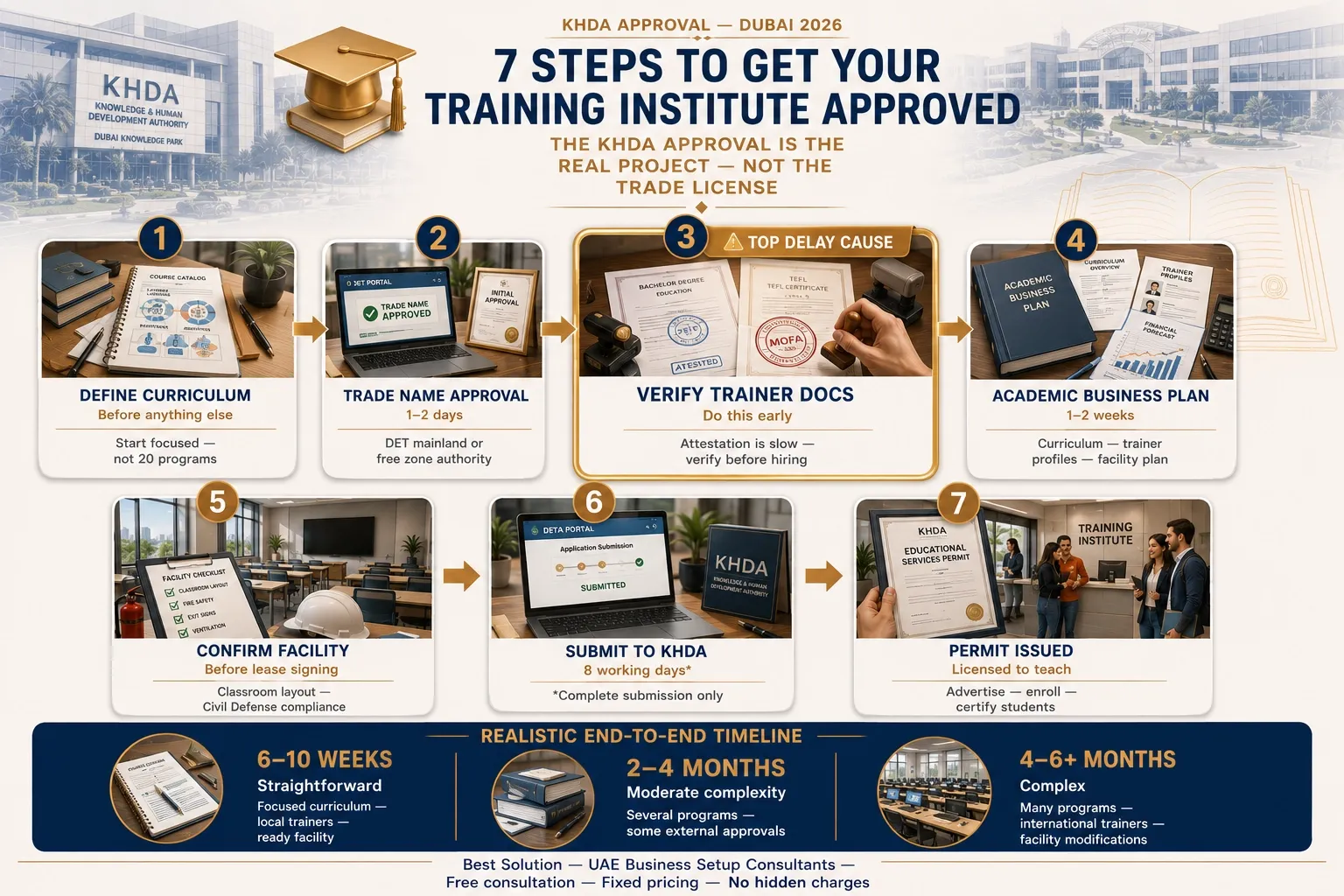
The steps below are the order we actually run them in, with the dependencies that guides usually skip.
- Define a focused curriculum first. Decide your initial courses before anything else. KHDA wants to understand the learning outcomes, structure, duration, delivery method, and assessment for each program. Start with a tight catalog, not 20 programs.
- Reserve your trade name and get initial approval. Apply through the Department of Economy and Tourism (DET) for a mainland setup, or through your chosen free zone authority. This secures the name and confirms your activity is permitted.
- Verify trainer qualifications and attestation. Before you commit to staff, confirm their degrees meet KHDA expectations and that certificates are properly attested. This is the single most common cause of delay, so we do it early.
- Prepare the academic and business plan. This is the backbone of the application: curriculum, course descriptions, trainer profiles, facility plan, and a financial forecast. Every document must tell the same story.
- Confirm the facility before signing the lease. Classroom layout, occupancy limits, accessibility, and Civil Defense / safety compliance all matter. Leasing first and checking later is how founders end up paying rent on a space KHDA will not approve.
- Submit to KHDA and pass the review. Apply through the KHDA e-Service portal (for mainland, via the Invest in Dubai platform). KHDA reviews the documentation and may inspect the facility.
- Receive your Educational Services Permit. Once approved, you hold the permit that lets you operate, advertise approved courses, and enroll students legally.
How long does KHDA approval really take?
You will see wildly different timelines online, from “8 working days” to “2 to 7 months.” Both can be true, because they measure different things.
KHDA’s published figure of 8 working days is the authority’s review window after it receives a complete, compliant submission. Founders, on the other hand, measure from “I have an idea” to “I can accept students.” Those are very different clocks.
Here is what we actually see, end to end:
| Institute Complexity | Realistic End-to-End Timeline |
|---|---|
| Straightforward (focused curriculum, local trainers, ready facility) | 6–10 weeks |
| Moderate (several programs, some external approvals) | 2–4 months |
| Complex (many programs, international trainers, facility modifications) | 4–6+ months |
The step founders underestimate most is curriculum preparation. Many assume they will “figure out the content later.” KHDA will not approve an institute on a promise. The curriculum review often takes longer than the licensing paperwork itself.
What does a training institute license cost in Dubai?
Two numbers matter, and most guides confuse them: the KHDA permit fee and the real first-year investment. They are not the same thing.
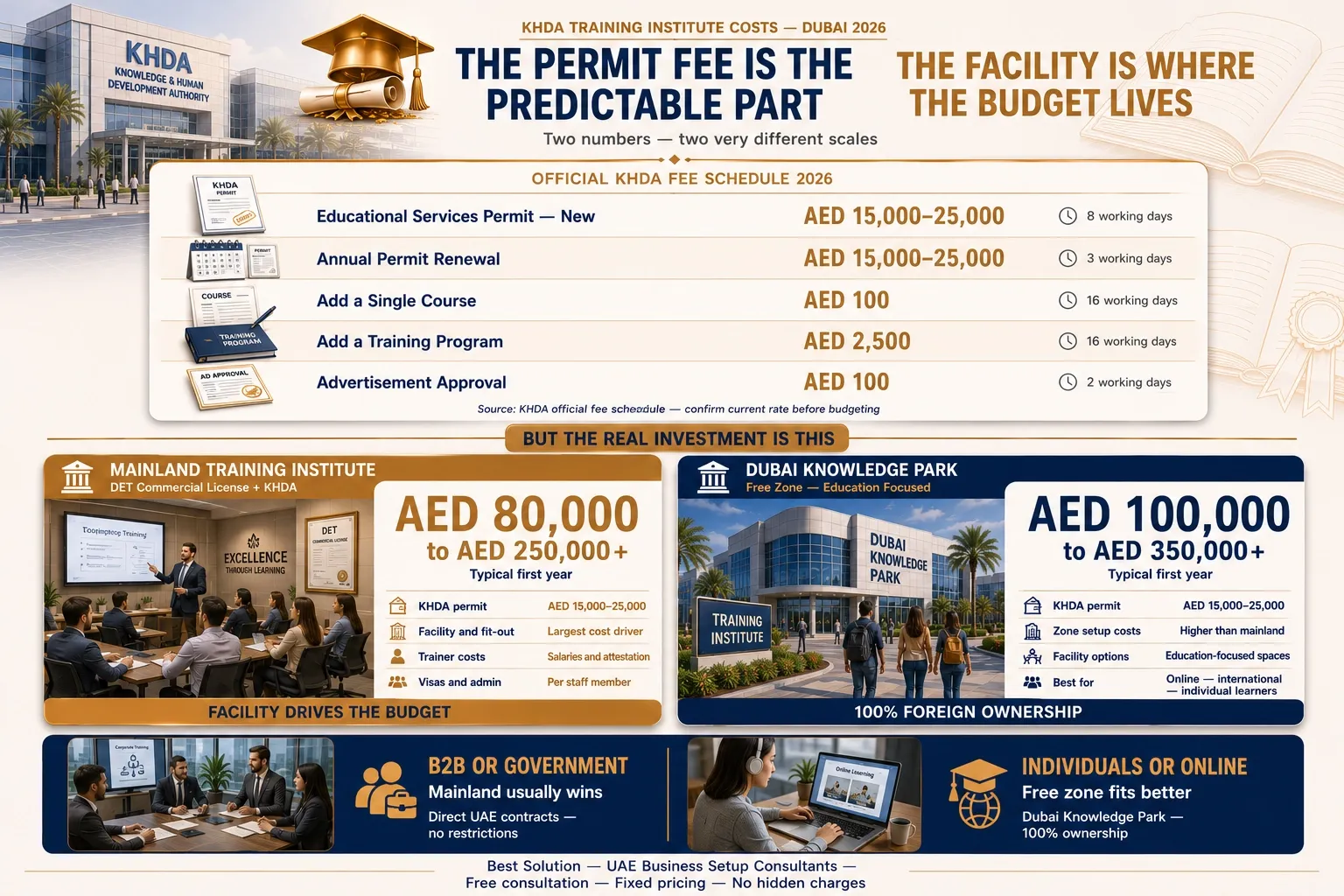
The current KHDA Educational Services Permit fee is AED 15,000 to 25,000, depending on the number of training programs you offer (per the official KHDA fee schedule). Many consultant pages still quote an outdated AED 30,000 figure, so confirm the current rate before you budget.
| KHDA Service (Official 2026 Rates) | Fee | Timeframe |
|---|---|---|
| Educational Services Permit (New) | AED 15,000–25,000 | 8 working days* |
| Annual permit renewal | AED 15,000–25,000 | 3 working days |
| Add a single course | AED 100 | 16 working days |
| Add a training program | AED 2,500 | 16 working days |
| Change name / manager / shareholder / location | AED 100 each | 6 working days |
| Advertisement approval | AED 100 | 2 working days |
For a complete, compliant submission. Source: KHDA Permits for Training Institutes guide.
The license is only part of the picture. The real first-year investment is driven mostly by your facility, not the permit:
| Setup Route | Typical First-Year Investment (Our Client Range) |
|---|---|
| Mainland training institute | AED 80,000–250,000+ |
| Dubai Knowledge Park (free zone) | AED 100,000–350,000+ |
Low-end projects are usually limited programs, a small space, founder-led teaching, and minimal staff. High-end projects involve multiple classrooms, a broad course portfolio, several trainers, and corporate-training infrastructure. As our consultant puts it, the facility cost is often a bigger driver than the license itself. For a wider view of setup budgets, see the real cost of starting a business in Dubai. The setup groundwork follows our guide on how to start a business in Dubai.
Ready to start your training institute in Dubai?
Schedule A Free Consultation Today
Mainland or free zone for a training institute?
Most founders choose a structure based on setup cost. We think that is the wrong starting point. We use one question instead: where will roughly 80% of your year-one revenue come from?
If most revenue is corporate or government (B2B): a mainland structure usually makes more sense. You are effectively a B2B training provider, and mainland lets you contract directly with UAE companies and government entities without location restrictions.
If most revenue is individual learners, international students, or online: a free zone such as Dubai Knowledge Park or Dubai Academic City can be more attractive, with education-focused facilities and 100% foreign ownership.
A real example. We recently set up a professional training institute focused on management and leadership programs. The founder wanted a free zone, but the projected revenue was UAE corporate contracts. We recommended mainland, because the customer profile pointed there. The institute went from engagement to permit in roughly six to eight weeks. The customer determines the structure more reliably than the course category does.
compare free zone vs mainland in detail
The five mistakes that delay KHDA approval
These come straight from our case files. Each one is avoidable, and each one costs weeks when it is not caught early.
- Copied course descriptions. Generic content lifted from competitors gets flagged. KHDA wants real learning outcomes, structure, and assessment for each program.
- Choosing trainers before checking qualifications. If a degree is not attested or does not meet KHDA expectations, your submission stalls. Verify first, hire second.
- Leasing the facility too early. Sign a lease before confirming classroom, occupancy, and safety compliance and you may be paying rent on a space that will not pass.
- Underestimating attestation. Instructor degree attestation is routine but slow. In one recent project, an un-attested certificate would have delayed the whole submission had we not caught it during document review.
- Launching with 20–30 programs. A huge catalog at launch means more approval work, more cost, and a longer review. The strongest applications start focused and expand later.
What our internal KHDA checklist covers
Most online guides stop at “get a license, get a facility, apply to KHDA.” Our internal review goes further, because that is where delays actually originate.
- Trainer qualification review: degree requirements, attestation, industry certifications, and relevant experience, checked before submission.
- Course-document consistency: titles, learning outcomes, training hours, assessment methods, and marketing descriptions all matching across every document.
- Facility readiness: classroom layouts, occupancy limits, municipality requirements, accessibility, and emergency compliance, assessed before lease commitments.
- Marketing compliance: reviewing advertising language early, because educational marketing is itself subject to KHDA approval.
- Banking readiness: preparing how the institute will explain tuition collection and corporate contracts before the bank application goes in.
What banks want before they open your account
Founders often assume that holding a KHDA approval guarantees a bank account. It does not. Banking is a separate process, and training institutes face extra scrutiny for a specific reason: you collect student fees in advance, before you deliver the service. That makes banks want to understand your refund policy, your student agreements, and how revenue is recognised.
The files that get approved smoothly usually include the KHDA approval, the trade license, the facility lease, trainer profiles, course catalogs, student agreements, a realistic revenue forecast, and any corporate-training contracts already in hand. What causes delays: an unclear business model, unrealistic projections, no physical training infrastructure, and thin evidence of future enrolment.
The institutes that bank most easily are the ones that built a complete operational story before approaching the bank. For the documentation sequence, see how to open a business bank account in Dubai. Education businesses overlap; opening a childcare centre follows a similar approval path.