
Most founders do not fail in Dubai because the market is too small. They fail because they mistook encouragement for demand. Friends say the idea is great. An agent says the city is booming. A relative promises to be your first customer. None of that is market research. It is reassurance, and reassurance has never paid an invoice.
This guide shows you how to test a Dubai business idea with evidence instead of hope. You will learn the seven questions that actually matter, the methods that produce real answers, what proper research costs in 2026, and the mistakes that quietly sink new ventures. It is written for the stage you are likely in now: you have decided on Dubai, but you have not yet proven that your specific idea will work. Once the opportunity is clear, brush up on the business licence essentials before applying. Hiring plans from your research feed directly into your business visa options.
| Question | Short Answer |
|---|---|
| What is market research? | Evidence that tells you whether enough people will buy your product, at your price, before you commit money. |
| Where do I start? | Set one clear goal, define your target customer, then test demand with primary and secondary research. |
| What does it cost? | Entry validation AED 5,000-10,000; full research AED 15,000-30,000+ depending on scope. |
| Biggest mistake? | Choosing the business activity first and looking for supporting evidence later. |
| What does good research do? | Sometimes it tells you not to launch this version - which can save far more than it costs. |
How do you do market research in Dubai?
To do market research in Dubai, set a single clear goal, define the exact customer you want, then gather two kinds of evidence: primary research you collect yourself through surveys and interviews, and secondary research from government and industry data. Compare what you find against your pricing and your competitors, then decide whether demand is strong enough to justify the setup cost. Validate before you commit, not after. Early-stage founders testing a market can start lean from a virtual office.
The real question is not whether Dubai has demand
Dubai has demand for almost everything. The useful question is narrower and far harder: is there enough demand for your version of the product or service, at your price point, with your competitive advantage?
That single shift changes how you research. You stop asking whether people want coffee shops and start asking whether enough people in this neighbourhood will pay your price for your concept, given who already sells there. The first question has an obvious yes. The second one has a number behind it, and that number decides whether you have a business. Sound research is often what confirms the UAE as the best country to start a business.
Why market research matters before you set up
Many investors want fast approval and a quick launch. The temptation is to skip ahead to the licence and sort out customers later. The problem is that licence choice, jurisdiction, and even your costs all depend on decisions that good research should make first.
Research done before setup helps you:
- Confirm there is real demand, not just polite interest
- Size the market and set realistic revenue targets
- Understand competitors and find a gap you can own
- Price with evidence about what customers will actually pay
- Choose the right licence and the right jurisdiction the first time
If you are still weighing structures, our guide to free zone vs mainland in Dubai explains how that choice flows directly from what your research tells you about customers and costs.
Understanding Dubai's market landscape
Dubai sits between Europe, Asia, and Africa, which makes it a natural hub for trade and investment. Its economy is diverse, and that diversity matters for research: a tactic that works in tourism can mislead you in fintech. Before you study your niche, understand the sectors around it.
Key industries to know
- Tourism and hospitality. Dubai welcomed 18.72 million international visitors in 2024, up 9% year on year and a new record (Dubai Department of Economy and Tourism). Strong footfall supports retail, food and beverage, and experience-led concepts.
- Real estate. Property transactions reached AED 761 billion across roughly 226,000 deals in 2024 (Dubai Land Department), a 20% rise in value year on year. Momentum continued into 2026, with AED 252 billion recorded in the first quarter alone.
- Technology. Smart-city and AI initiatives keep pulling startups in. Treat headline growth figures as context, not as proof of demand for your specific product.
- Healthcare. Population growth and government investment keep demand rising, but licensing and compliance are heavier here, so factor regulatory research in early.
Freshness note
The previous version of this page cited 16.79M tourists and AED 300B in real estate. Both were out of date. Current official figures are used above.
The 7 market research questions every Dubai founder should answer
- Who is your customer, exactly? Map age, nationality mix, income, and spending habits into a clear buyer profile. "Expats in Dubai" is not a segment; "families in Dubai Marina spending on premium childcare" is.
- How does competition differ across mainland, free zone, and offshore? The same idea faces different rivals and rules depending on where it operates. Map direct competitors and their positioning in each.
- What price will the market actually pay? Study competitor pricing and willingness to pay by segment. Decide which features justify a premium and which are just cost.
- How big is the market, realistically? Estimate the total addressable market from government and industry data, then narrow to the slice you can actually reach. Triangulate across sources so one report does not skew the picture.
- How do cultural factors shape buying? Dubai's customers come from many cultures with different expectations of service, communication, and trust. This changes your product and your marketing.
- What regulations affect entry? Identify licence requirements and any activity-specific rules before you build your plan, so your strategy fits the legal framework from day one.
- Which channels deliver the best return? Test where your specific audience actually pays attention before you spend on ads, so budget follows evidence.
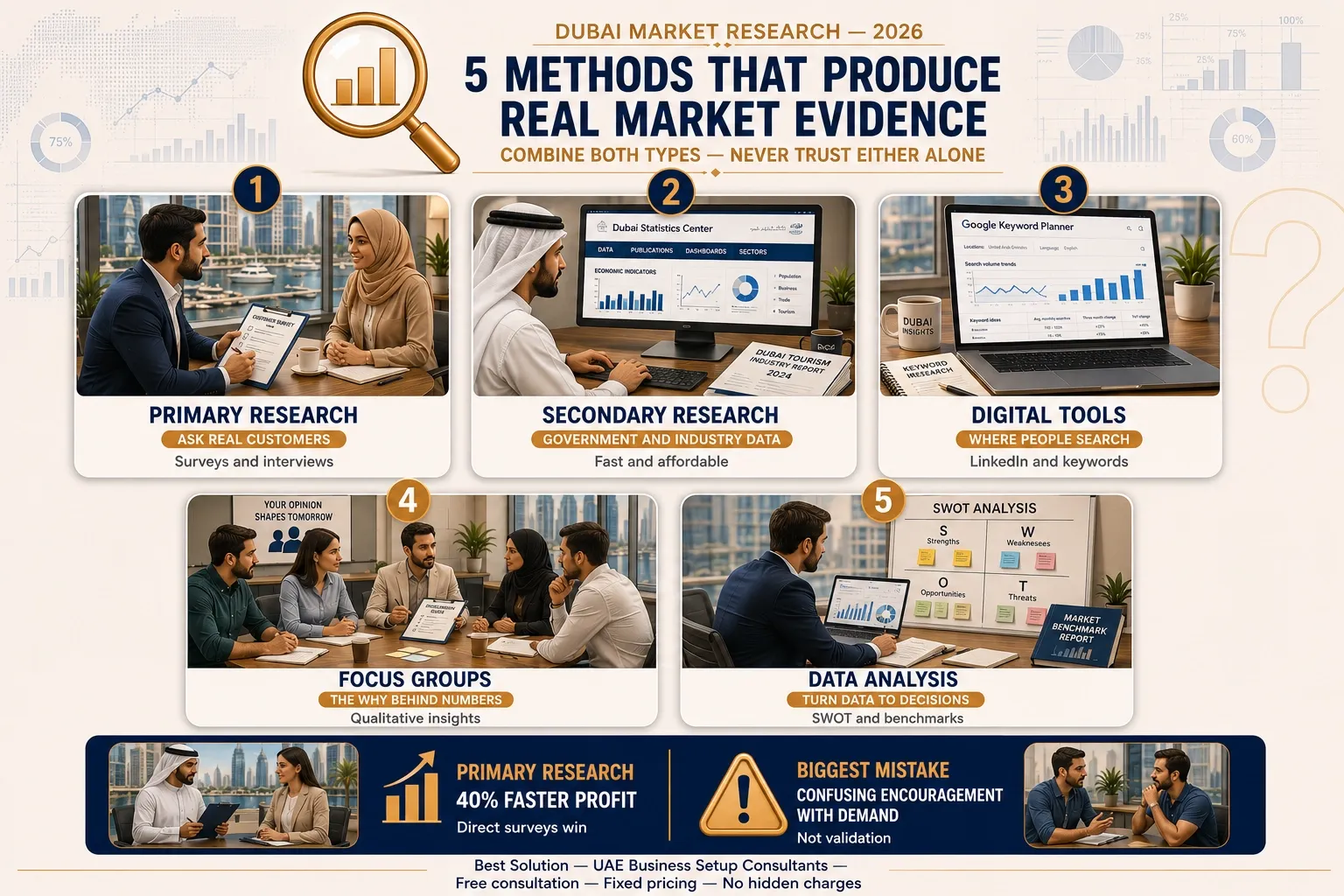
5 proven market research methods
1. Primary research: ask your future customers
Primary research is data you collect yourself. It is the most direct signal of demand. Use targeted surveys with a mix of rating and open-ended questions, run interviews and small focus groups with potential customers, and observe behaviour through field visits across areas like Business Bay, Downtown, and JBR.
2. Secondary research: use existing data
Secondary research draws on data that already exists, which makes it fast and cheap. Pull industry reports from the Dubai Statistics Center and the economic departments, market reports from financial institutions and trade associations, and published studies relevant to your sector.
3. Digital research tools
Use LinkedIn to map B2B stakeholders, social analytics to track consumer behaviour, online survey tools to reach segments quickly, and search and web analytics to read competitor demand. Google Keyword Planner alone will show you whether people are searching for what you plan to sell.
4. Focus groups and qualitative research
Moderated discussions reveal the why behind the numbers. Use them to test a new concept, probe brand perception, and surface objections you would never see in a spreadsheet. Open-ended questions do the heavy lifting here.
5. Data analysis and metrics
Turn raw input into decisions. Run a SWOT analysis for strategic fit, use Porter's Five Forces to read competitive pressure, and benchmark against the targets you set at the start. Combine quantitative data with qualitative insight rather than trusting either alone.
How to conduct market research in Dubai, step by step
- Set one clear goal. Decide what this research must answer: demand, pricing, competition, or trends. A focused goal keeps the work efficient and the conclusion usable.
- Choose your target market. Segment by demographics, psychographics, and location. A cafe for young professionals points you to Downtown or Dubai Marina; a luxury service points to a different map entirely.
- Analyse market trends. Track where your sector is heading using current government and industry data, so your plan reflects 2026, not 2022.
- Run a competitor analysis. List direct and indirect competitors, study their pricing, positioning, and reviews, and find the gap they leave open. Visiting competitors as a customer often teaches more than any report.
- Conduct surveys and interviews. Collect first-hand input from real prospects. Design questions carefully so the answers reflect your actual audience, not a convenient sample.
- Use secondary sources. Fill gaps with the Dubai Chamber of Commerce, Dubai Statistics Center, and reputable industry reports to validate what your primary research suggests.
- Analyse and decide. Look for patterns across both data sets, then make the call. The output should be a decision, not a folder of charts.
Once research points to a viable model, our step-by-step guide on how to start a business in Dubai walks through what comes next. If your data points onshore, a Dubai mainland company widens who you can sell to.
What does market research cost in Dubai?
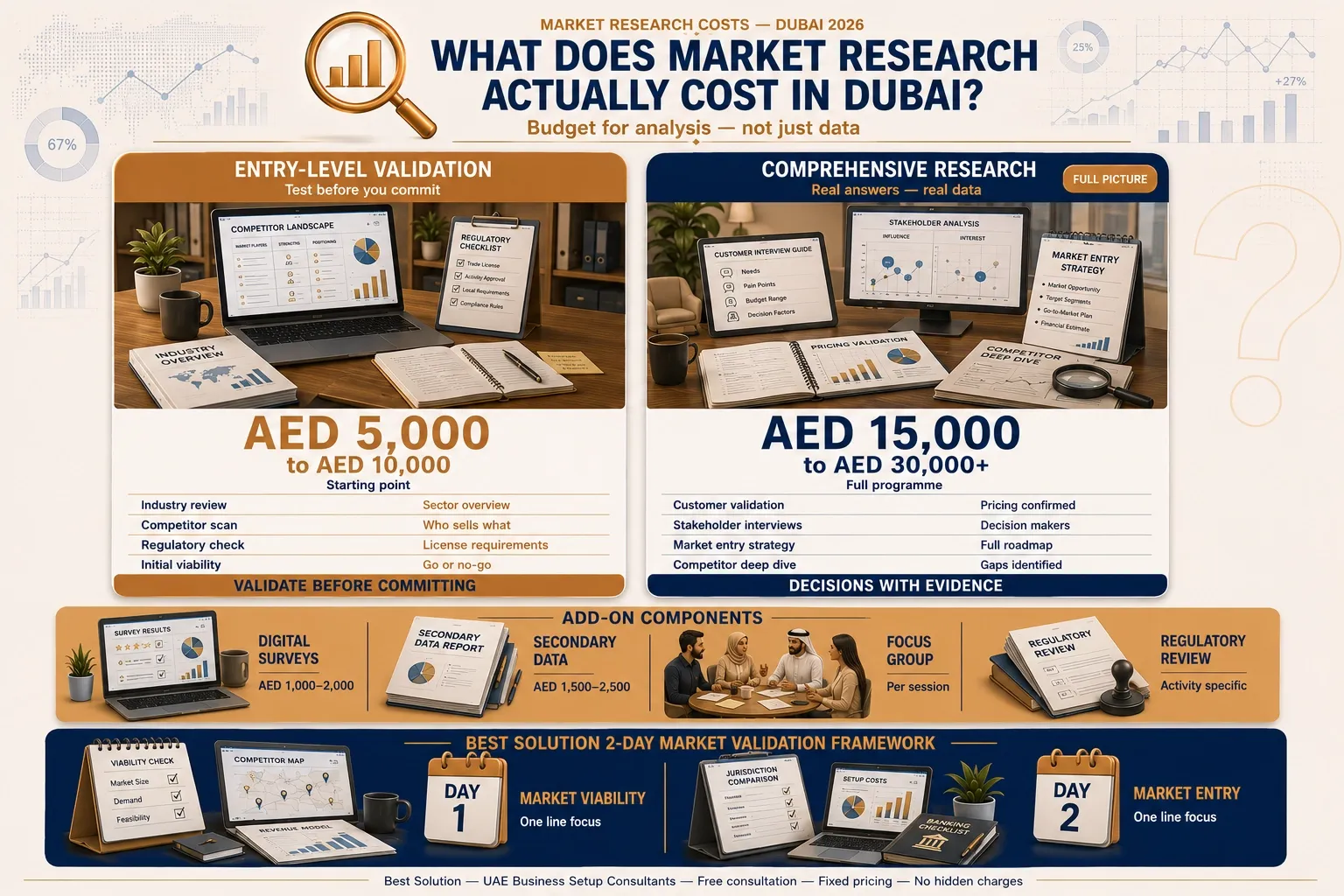
You can begin testing an idea for around AED 5,000. A fuller programme that combines primary and secondary research usually runs AED 15,000 to AED 30,000 or more, depending on industry complexity, geographic scope, and how much original data you need. Here is a realistic 2026 breakdown.
| Level | Typical Cost | What It Covers |
|---|---|---|
| Entry-level validation | AED 5,000-10,000 | Industry review, competitor scan, regulatory check, initial viability |
| Comprehensive research | AED 15,000-30,000+ | Adds customer and pricing validation, stakeholder interviews, market-entry strategy |
| Digital survey component | AED 1,000-2,000 | Online surveys and segment outreach |
| Secondary compilation | AED 1,500-2,500 | Report sourcing and data synthesis |
The budgeting trap
Founders assume research just means buying a report. The most valuable work is usually competitive, regulatory, customer, and pricing validation, not generic statistics. Budget for analysis, not just data.
Research cost sits alongside your wider setup budget. For the full picture, see our breakdown of the cost of starting a business in Dubai. For benchmarks beyond desk research, business setup consultants can share local data.

Is Your Dubai Concept Truly Validated?
Don’t guess your demand based on polite encouragement. Let our strategists run your business concept through our 2-Day Market Validation Framework to cross-examine licensing, pricing reality, and competitor saturation before you drop capital on setup.
Best Solution's 2-day market validation framework
When a decision is time-sensitive, we compress validation into two focused days. The value is not secret data. It is knowing which information matters and how to read it across regulatory, commercial, and operational factors at once.
Day 1 - market viability review. We assess the concept, revenue model, target customer, competitor landscape, licensing requirements, and any regulatory restrictions. We also check whether the chosen business activity actually fits the commercial model, because that mismatch is more common than founders expect.
Day 2 - market-entry assessment. We focus on competitor positioning, pricing structures, jurisdiction selection, setup costs, banking considerations, and operational requirements. The output is not whether this can operate in Dubai. It is whether it can operate profitably and sustainably in Dubai.
Our data
Across an internal review of 500+ Dubai setups over three years, companies that ran primary research, direct surveys and interviews, reached profitability roughly 40% faster than those relying only on secondary sources online.
Common market research mistakes Dubai founders make
- Confusing demand with encouragement. Positive feedback from people who like you is not validation. Test with strangers who have to decide with their wallets.
- Choosing the activity first, researching second. Deciding what to sell and then hunting for supporting evidence reverses the logic. Let the research choose the model.
- Trusting generic sector data, especially in consulting. Reports often call professional services low-barrier because demand is high and setup is cheap. But in Dubai the demand that matters is demand for a specific consultant, not for consulting in general. Without a network, client channels, and a clear differentiator, an attractive market on paper can be very hard to enter. This is where generic research creates false confidence.
- Skipping regulatory research. Licensing and activity rules can reshape your model. Find out early, before they cost you a relaunch.
Picking the wrong activity is one of the most expensive of these errors. Our guide to choosing the right business activity in Dubai shows how to align it with your research.
When research tells you not to proceed
The most valuable research outcome is sometimes a no. One client from Europe planned a general trading company importing consumer products, assuming home-market success would carry over. Our research showed a saturated category with established distributors competing hard on price. Instead of launching as planned, they pivoted to a niche B2B supply model with fewer competitors and higher margins. The result was lower startup inventory, a faster path to first revenue, and far less price pressure. Validation delayed the launch by about two weeks and likely saved much more.
A second client wanted a competitive retail concept. After reviewing saturation, rent, and customer acquisition cost, the economics looked far weaker than expected. The recommendation was not to abandon the business. It was to not start this version of it. They tested online first with a small pilot instead of signing a long lease, and entered the market with much lower risk.
Good research should not just confirm what you hope. The founders who succeed are usually the ones willing to change the plan when the data points elsewhere.
Free market research resources for Dubai entrepreneurs
- Dubai Statistics Center - official demographic and economic data
- Dubai Department of Economy and Tourism - sector performance and visitor data
- Dubai Chamber of Commerce - industry reports and trade information
- Dubai Land Department - real estate transaction data and price indices
- Google Keyword Planner and Trends - live search demand for your product or service
Ready to validate your idea? Book a short call with a Best Solution business setup strategist. We combine market validation with licensing, banking, and setup advice, so you leave with a decision, not just data. Clear pricing, no obligation.