Choosing where to base a business is a bigger decision than most founders treat it as. The country sets your tax bill, your access to banking, your route to customers, and how much friction you fight every week. Get it right and the location works for you. Get it wrong and you spend years pushing against it. Part of the appeal is the choice among several types of business structures.
Best Solution Business Setup Consultancy has formed companies for more than 5,000 entrepreneurs who chose Dubai. This guide is the honest case for that choice. Not the glossy version with the skyline and the zero-tax headline, but the practical one: why global brands keep picking Dubai, how it compares with Singapore, London, and New York, what it costs, and who should think twice. The low-friction reputation still rests on the same business licence essentials. Testing the market first from a virtual office keeps early costs down.
If you have already decided on Dubai and want the registration steps, that is a separate guide. Our walkthrough on how to start a business in Dubai covers the process. This page is about the decision that comes first: is Dubai the right country for your business? Structure choice — sole proprietorship versus LLC — shapes liability and tax here. For some sectors, success still hinges on finding the right business partner.
Quick answers before you read on
Why Do Global Brands Choose Dubai?
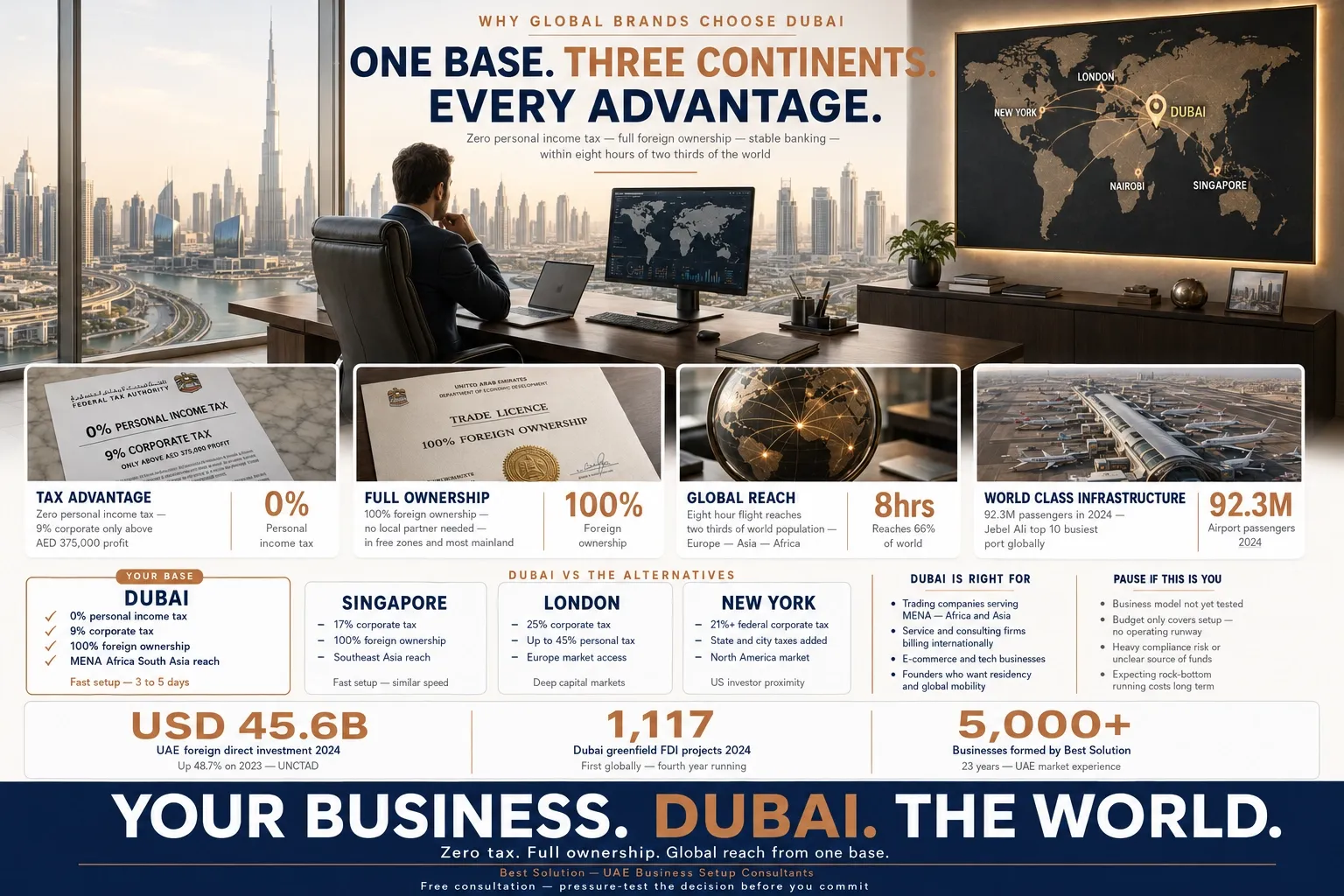
Dubai ranks among the best countries to start a business because it combines zero personal income tax, full foreign ownership, and a stable banking and legal system with a location within an eight-hour flight of two-thirds of the world. For globally minded founders, it removes the friction that slows companies down elsewhere.
Global brands choose Dubai because the systems a company depends on tend to work. Banking, logistics, rules, talent, and travel are predictable. That reliability draws both large firms and first-time founders. The tax and ownership perks matter. But they are the surface of a deeper story.
The advantages every comparison lists
Four advantages show up on every comparison of where to start a business, and they hold up:
- Tax. There is no personal income tax. Corporate tax is 9%, and only on profit above AED 375,000. Smaller firms get a further break. Under the Federal Tax Authority's Small Business Relief, a company earning under AED 3 million a year can be treated as having no taxable income, for tax periods ending on or before 31 December 2026.
- Ownership. You can own 100% of your company in every free zone, and in most mainland activities. A local partner is no longer needed for most sectors.
- Location. An eight-hour flight from Dubai reaches about two-thirds of the world's people. Europe, Asia, and Africa sit inside one working radius.
- Infrastructure. Dubai International Airport handled 92.3 million passengers in 2024. Jebel Ali Port moved 14.47 million containers, which keeps it among the ten busiest ports in the world.
Every one of these is accurate. Every one is also open to every rival writing the same article. They explain why Dubai lands on the shortlist. They do not explain why founders commit.
The reason founders actually give
Best Solution has handled more than 5,000 company formations. The tax line draws the attention. It rarely decides the move. The deeper reason is stability and mobility.
Many founders come from markets where banking is shaky, the currency swings, the rules shift without warning, or cross-border payments are a monthly fight. Dubai offers what those markets do not: the sense that business systems simply work. From one base, a founder can trade abroad, open banking more easily, travel freely, and protect family residency. Back the move with proper market research in Dubai before you commit.
There is also a factor no ranking measures. Call it credibility. A company registered in Dubai carries weight with suppliers, payment firms, clients, and investors. For founders from emerging markets, a Dubai setup is as much about standing and future access as it is about tax. That is the human reason behind the data. Larger commitments can unlock the investor Golden Visa for founders and families.
What the current numbers show
The case for Dubai is often padded with forecasts and illustrative figures. It does not need them. The confirmed numbers stand on their own.
| Indicator | Confirmed Figure | Source |
|---|---|---|
| UAE foreign direct investment, 2024 | USD 45.6 billion, up 48.7% on 2023 | UNCTAD World Investment Report 2025 |
| Dubai greenfield FDI projects, 2024 | 1,117, first globally for the fourth year running | Dubai FDI / Ministry of Economy & Tourism |
| Share of Dubai GDP that is non-oil | Over 95% | Dubai Economy & Tourism |
| Corporate tax | 9% above AED 375,000 profit; 0% personal income tax | Federal Tax Authority |
| Economic Agenda D33 target | Double Dubai's GDP to AED 800 billion by 2033 | Government of Dubai |
One honest note on data. Government dashboards update through the year, so a figure quoted today may later be revised. The numbers above were the most recent confirmed figures at the time of writing. The trend, though, has held for a decade: more investment, a broader economy, more companies.
In March 2026, the Dubai government approved an AED 1 billion support package for businesses and people, in effect from April 2026. Few cities answer a slow patch by spending to keep companies trading. That instinct is the real signal.
Dubai vs Singapore, London, and New York
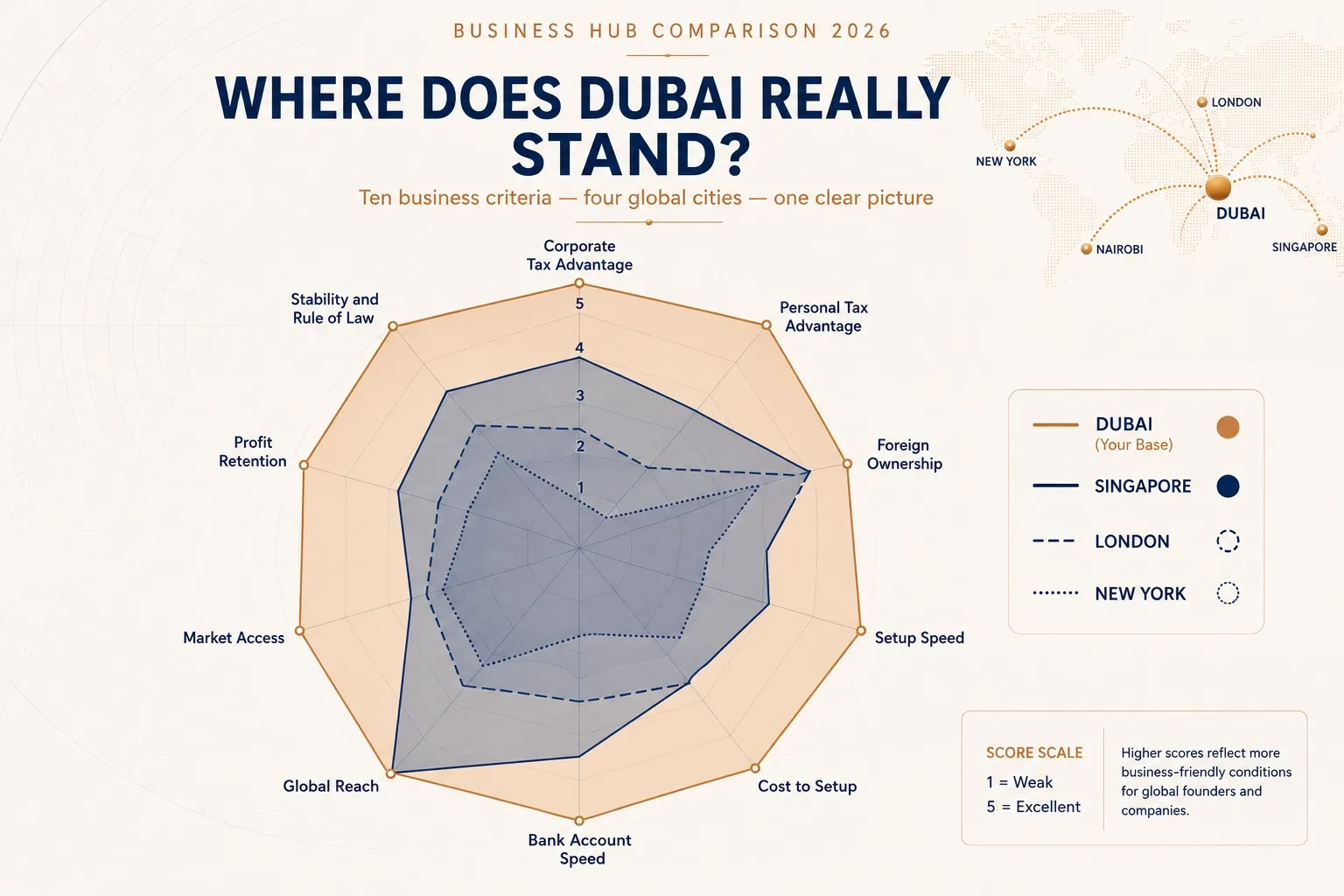
A best-country claim only means something against the alternatives. Founders moving or expanding a company usually weigh Dubai against Singapore, London, and New York. On the measures that move the decision, the contrast is clear.
| Measure | Dubai | Singapore | London | New York |
|---|---|---|---|---|
| Standard corporate tax | 9% above AED 375,000 | 17% | 25% | 21% federal, plus state and city |
| Personal income tax | 0% | Up to 24% | Up to 45% | Federal, plus state and city |
| Foreign ownership | 100% | 100% | 100% | 100% |
| Market on the doorstep | MENA, Africa, South Asia | Southeast Asia | Europe | North America |
Dubai's edge is not that it beats these cities on everything. It is that a founder keeps more profit, sets up faster, and reaches three continents from one base. London and New York still lead on the depth of their capital markets. Singapore matches Dubai on speed.
There is no single best country to start a business. The right answer depends on where your customers are, how you are funded, and what you sell. For a business trading across the Middle East, Africa, and South Asia, or one that simply wants to keep more of its profit, Dubai is hard to beat. For a company raising large venture rounds from United States investors, New York's proximity still counts. Be honest about which of those describes you.
Is Dubai the Right Country for Your Business?
Dubai suits most globally minded businesses. But not all of them, and not at every stage. Whether it is the right country for you depends on three things: where your customers are, how much runway you have, and how ready you are for compliance.
Who Dubai is clearly right for
Dubai is a strong fit for trading companies serving the Middle East, Africa, and Asia. It works well for service and consulting firms that bill abroad, and for e-commerce and technology businesses that want low tax and clean banking. It also suits founders who want residency and mobility alongside the company itself.
Who should think twice
Most guides never say this, so Best Solution will. Dubai is not the right move for every founder, and starting here too early can waste money. Pause, or plan more carefully, if any of the following is true:
- You have not tested demand. If the business model is still a guess, a licence will not fix it. Validate the model first.
- You expect rock-bottom running costs. Setup can be cheap. Staying compliant is not. Accounting, renewals, and operating cash flow all continue well past year one.
- Your business carries heavy compliance risk. An unclear source of funds, high-risk payments, exposure to sanctioned markets, or weak paperwork will slow you down badly.
The founders who do well in Dubai tend to arrive with a clear business model, real capital, a working plan, and a long-term view. The UAE rewards well-built businesses. It is less kind to improvisation than many guides suggest. Relocating founders also benefit from flexible business visa options.

Is Dubai Actually the Right Country for Your Business?
Most founders decide on Dubai after reading the tax headline. The ones who get it right pressure-test the decision first — against their customers, their model, and their banking plan. Best Solution gives you that honest answer before any cost is committed.
What It Costs to Base a Business in Dubai
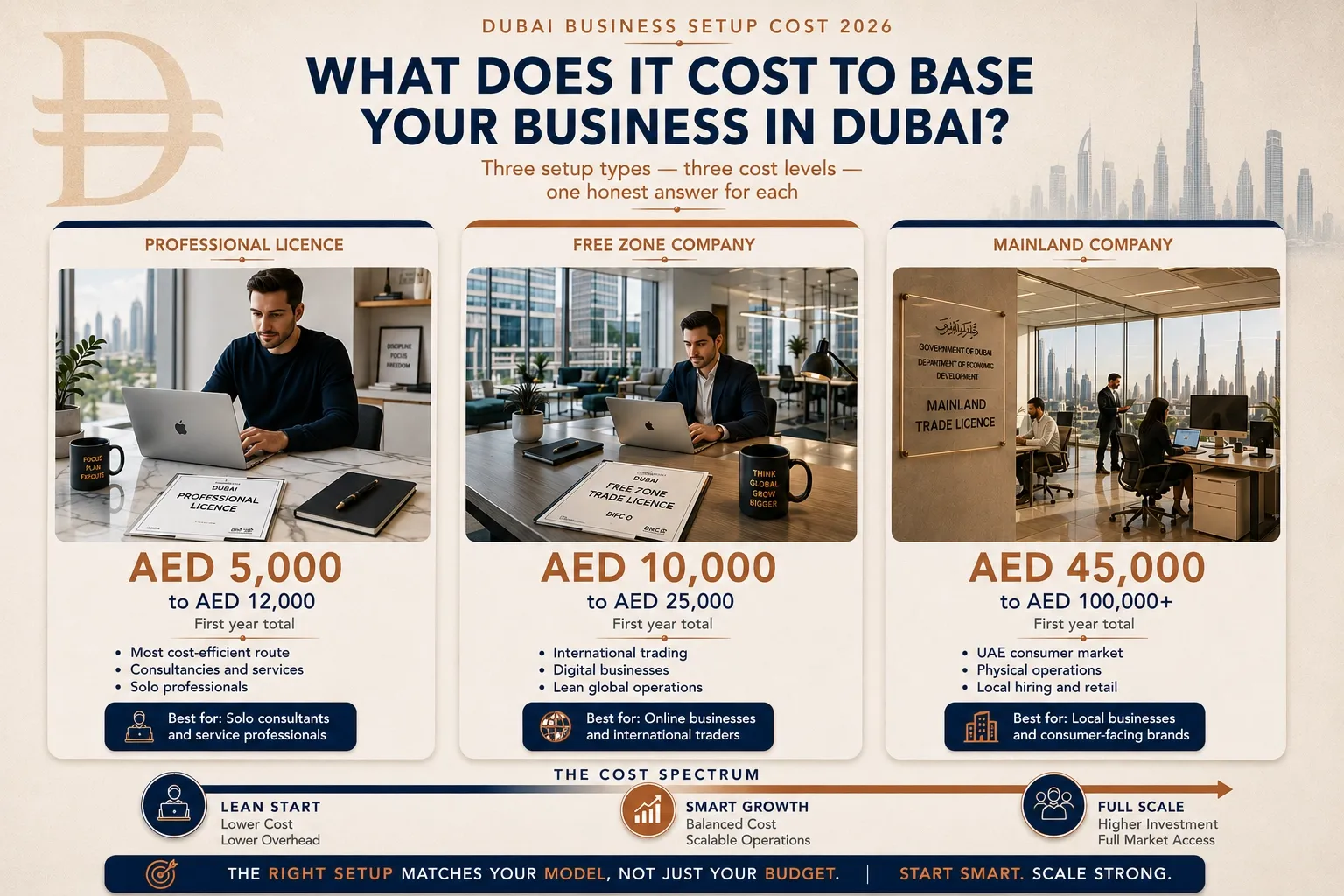
Cost is part of any market decision, so be realistic about it. A business in Dubai usually costs between AED 12,000 and AED 50,000 for the first year. The figure depends on the structure, the activity, and how many visas you need. The licence itself is only one line in that total.
| Setup Type | Typical First-Year Range | Notes |
|---|---|---|
| Free zone company | AED 10,000 to AED 25,000 | Varies by zone and package; lean activities sit at the lower end |
| Mainland company | AED 45,000 to AED 100,000+ | Higher for activities that need extra approvals |
| Professional licence | AED 5,000 to AED 12,000 | The most cost-efficient route for consultancies and services |
Treat these as planning ranges, not quotes. The real figure depends on your activity, your visa count, and your office choice.
The costs that rarely appear in a quote
The advertised price usually covers the licence. The costs around it do not. In Best Solution's experience, founders most often miss:
- Visa costs: the establishment card, entry permit, status change, medical test, and Emirates ID, for each person.
- Office and deposits: Ejari registration for mainland companies, and refundable deposits asked for by some zones.
- Banking: many company accounts carry a minimum balance rule.
- Yearly tasks: accounting, VAT where turnover requires it, corporate tax filing, and insurance.
- Renewals: the licence, the office, and the visas all renew each year, on their own clocks.
The working-capital mistake
The most damaging cost error is not a missed fee. It is spending almost the whole budget on setup and leaving too little for what comes next: marketing, payroll, stock, and the first months of trading. A licence does not earn revenue. Plan the setup cost and the operating runway as one number. For a fuller breakdown, see Best Solution's guide to the real cost of starting a business in Dubai .
Mainland or Free Zone: Your Two Routes Into the Dubai Market
Choosing Dubai also means choosing how to enter its market. There are two main routes: a mainland company or a free zone company. The decision shapes who you can sell to and how you can grow.
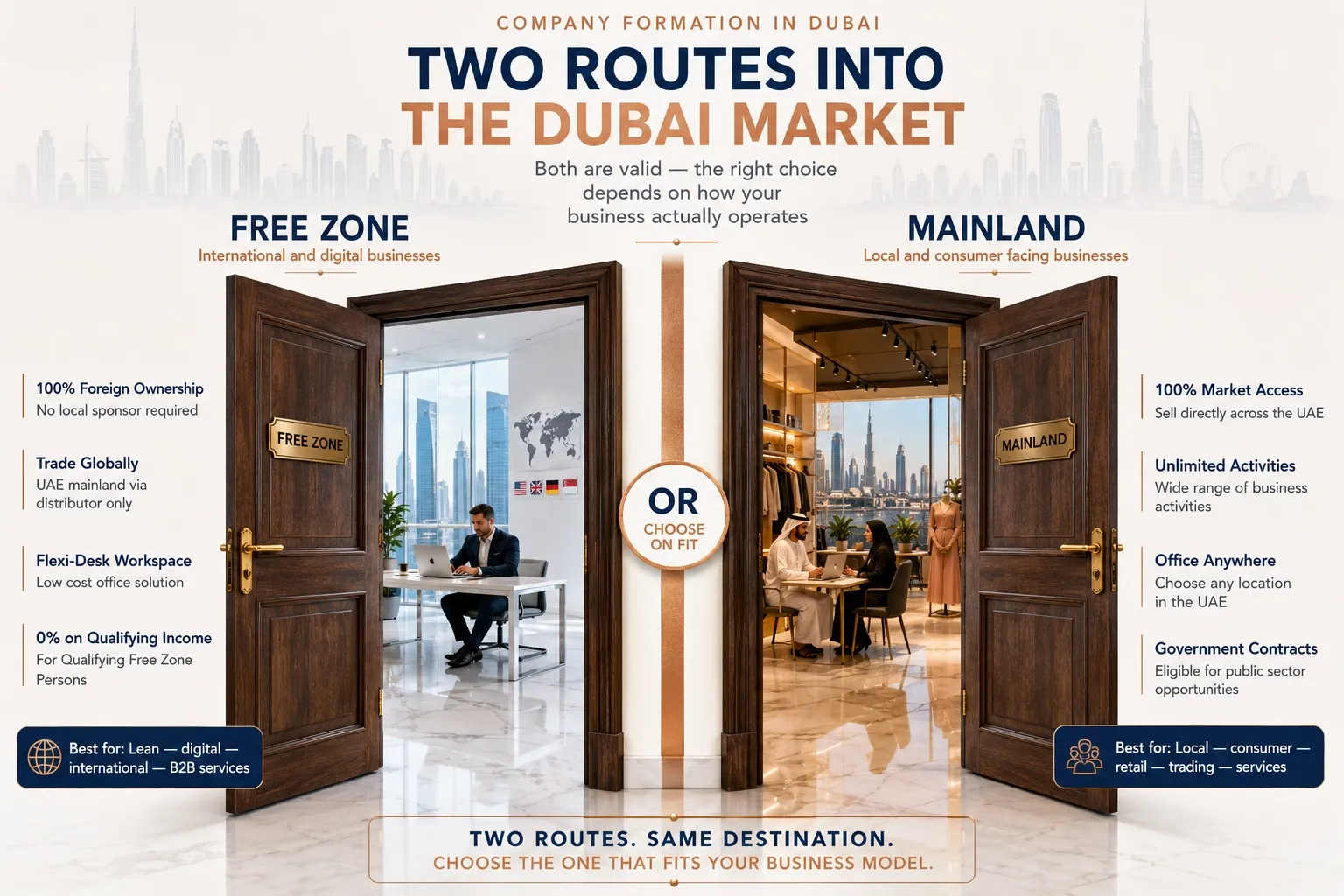
| Feature | Mainland | Free Zone | Offshore |
|---|---|---|---|
| Trade with the UAE market | Direct, no restrictions | Through a distributor or agent | Not permitted |
| Foreign ownership | 100% for most activities | 100% | 100% within the free zone |
| Best suited to | UAE-facing trade, retail, services | Lean, internationally focused businesses | Holding companies, overseas operations |
| Corporate tax | 9% above AED 375,000 | 9%, with 0% possible on qualifying income | Outside UAE corporate tax in most cases |
When mainland is the better fit
Choose mainland when your customers are inside the UAE and the business works here in person: a clinic, a restaurant, a retail brand, a firm serving local clients. Mainland companies trade anywhere in the UAE and can bid for government work. See Best Solution's mainland company formation service for the detail.
When a free zone is the better fit
Choose a free zone when the business is lean and global: online retail, consulting, technology, media, or trading routed outside the UAE. Free zones offer full ownership, a 0% corporate tax rate on qualifying income, and the freedom to send profits home. The limit: a free zone company cannot sell straight into the UAE market without a local agent. Best Solution's free zone company setup service covers the main zones. Long-term entrants benefit from strategies aligning with local partners on the ground.
The three questions that settle it
When a client cannot decide, Best Solution asks three questions:
1. Where will your customers actually be? If most income comes from UAE clients, mainland is usually the natural fit.
2. Will you need local room to operate? Warehousing, retail expansion, local hiring, and direct trade in the UAE all point to mainland.
3. Are you aiming for the lowest startup cost or for long-term growth? Lean global businesses are well served by free zones. A UAE-facing model is usually cleaner on the mainland.
The right answer becomes clear once the talk shifts from licence price to business reality.
The Mistake That Quietly Undoes Cheap Setups
If there is one piece of advice Best Solution would push back on hardest, it is this: just pick the cheapest free zone. That advice ignores how the business will work after the licence is issued, and it is the single most common reason a setup goes wrong.
Here is a real example. A founder bought a low-cost package online because the advert promised same-day company formation. It delivered. The licence arrived fast. But the structure did not match the actual business, which planned to import products, hold stock in the UAE, sell through online marketplaces, and take cross-border payments.
The problems surfaced afterward. The activity wording was too narrow. The chosen free zone made logistics harder. The founder had assumed banking would be automatic. It was not. Banks wanted supplier invoices, revenue forecasts, a plan, and proof the business was real. The setup had been built for the lowest price, not for how the company needed to work.
Best Solution rebuilt the company around its operating model rather than its price tag. The lesson is general. A licence is easy to get now. A setup that survives a bank's review is the real work. A cheap licence that cannot open a bank account is not cheap. It is a delay you pay for twice.
From Decision to Setup: What Happens Next
Once you have decided Dubai is the right country, the setup itself is quick. In outline: you define your business activity, choose mainland or free zone, reserve a trade name, secure approvals and a trade licence, process residency visas, and open a corporate bank account. A licence can be issued in a few business days. A fully operational setup with banking usually takes several weeks. One hurdle global founders underrate is the time it takes to open a corporate bank account.
Each of those steps has detail worth getting right, especially the corporate bank account . Our full guide on how to start a business in Dubai walks through the process step by step. This page stops at the decision. That one takes you through the execution.
How Best Solution Helps You Get It Right
Best Solution Business Setup Consultancy starts every engagement with a discovery call, not paperwork. Before any form is filed, the talk covers the activity, where customers are based, whether the business is local or global, visa needs, banking plans, and goals for growth. The point of that call is to pressure-test the decision itself, not just sell a licence.
What separates a durable setup from a fragile one is an operational-readiness check that standard guides skip. That internal checklist looks past the paperwork at the things that decide whether the company can trade: whether the chosen activity will create friction with banks, whether the business will trigger VAT registration sooner than expected, what customs exposure the model carries, and whether corporate tax obligations have been planned from day one.
The track record behind that approach: more than 5,000 entrepreneurs supported, a 99% approval rate on clean applications, and standard licences issued in three to five business days. Two honest caveats. The three-to-five-day timeline covers the licence, not full banking and residency, which take longer. And the 99% rate assumes the client provides clean documents for a legitimate activity. Best Solution works across many UAE jurisdictions, with founders in e-commerce, consulting, trading, technology, logistics, and professional services.
Pressure-test the decision first
Still weighing whether Dubai is the right country for your business? Best Solution offers a free consultation with a setup specialist who will test the decision against your model before any cost is committed. Book your free consultation.
Before you decide: a quick checklist
Deciding whether Dubai is the right country for your business? Book a free consultation with Best Solution Business Setup Consultancy, and pressure-test the decision before you commit.
This guide is general information, not legal or financial advice. UAE business regulations, government fees, and tax rules change. Confirm current requirements with the Department of Economy and Tourism, the Federal Tax Authority, or a licensed business setup consultant before you act. Incoming brands often lean on business setup consultants to localise quickly.