Your board has approved the UAE move. The market case is clear. What is not yet settled is the structure: should the parent open a subsidiary, a branch, or a free zone entity, and what does each choice commit you to for the next five years? That one decision shapes your liability, your tax position, your ability to bid for contracts, and how quickly a UAE bank will open your account.
This guide walks a foreign parent company through the subsidiary route, step by step. It shows where a subsidiary beats a branch and where it does not, and it is written from what actually happens inside UAE applications, not the headline version.
What is a subsidiary company in the UAE?
In short
A subsidiary company in the UAE is a separate legal entity incorporated under UAE law and owned, wholly or partly, by a parent company. It is usually structured as a Limited Liability Company (LLC). The subsidiary holds its own assets, signs its own contracts, and carries its own liabilities, which keeps the parent's balance sheet ring-fenced from UAE risk.
"Subsidiary" is not a license type. It describes the ownership relationship between your UAE entity and your parent company. The entity itself registers as an LLC, a joint stock company, or a civil company, and the parent simply holds the shares. Because recent reforms allow 100% foreign ownership across all free zones and most mainland activities, a foreign parent can now own its UAE subsidiary outright, with no local Emirati partner required.
Subsidiary vs branch in the UAE: which structure fits your expansion?
The choice comes down to one question: does the parent need to ring-fence liability from its UAE operations, or does it need to trade directly under the parent brand with the same activity?
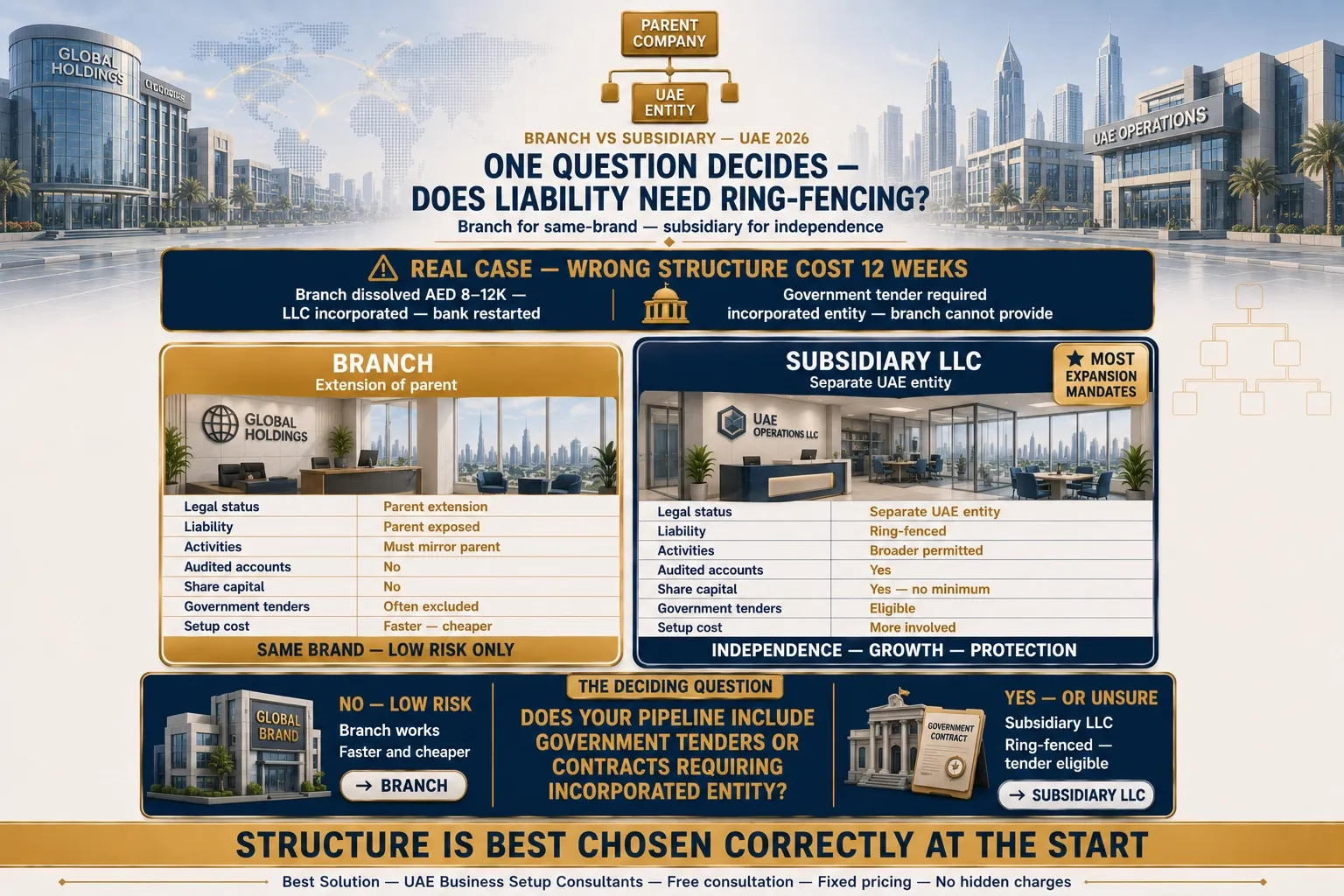
- Choose a branch when the parent wants to replicate its existing business under its own name, the UAE activity matches the parent's activity, and liability exposure is low. A branch is simpler and cheaper to set up. Since the Commercial Companies Law reforms, a foreign branch no longer needs a Local Service Agent or the old AED 50,000 bank guarantee with the Ministry of Economy.
- Choose a subsidiary when the parent wants a legally independent UAE entity, different or broader activities than the parent, genuine limited liability protection, or the flexibility to add local partners or investors later. For most expansion mandates Best Solution handles, particularly Indian corporate groups, European engineering firms, and holding structures, the subsidiary LLC is the right answer.
| Factor | Branch | Subsidiary (LLC) |
|---|---|---|
| Legal status | Extension of the parent, not a separate entity | Separate UAE legal entity |
| Liability | Parent directly exposed to UAE liabilities | Ring-fenced to the subsidiary's own assets |
| Activities | Must mirror the parent's activities | Can pursue different or broader activities |
| Own audited accounts & share capital | No | Yes |
| Eligible for most UAE government tenders | Often no (incorporation usually required) | Yes |
| Foreign ownership | 100% (post-reform) | 100% (most sectors / all free zones) |
| Setup speed & cost | Faster, cheaper | Slightly more involved |
| Best for | Same-brand, same-activity presence, low risk | Independent operations, liability protection, growth |
Real case (why the structure choice matters)
One client registered a mainland branch, then won a UAE contract that required a locally incorporated entity with its own audited accounts and share capital. A branch cannot provide that, because it is an extension of the parent, not a standalone UAE company. They had to wind down the branch (roughly AED 8,000 to 12,000 in liquidation costs and six weeks of process), incorporate a mainland LLC subsidiary, and restart the bank account and visa applications. Total lost time: twelve weeks. The detail they missed at planning was their own pipeline, which included UAE government tenders. Those tenders typically require a locally incorporated entity, which a branch is not.
If a branch looks like the better fit for your case, our foreign company branch setup guide covers that route in full.
Types of subsidiary structures in the UAE
Limited Liability Company (LLC)
The most common and flexible structure for a foreign subsidiary. It has no statutory minimum share capital under the Commercial Companies Law (Federal Decree-Law No. 32 of 2021) and suits most trading and service operations. See our LLC company formation guide for the full process.
Joint stock company (PJSC / PrJSC)
For large-scale or capital-raising operations. A Public Joint Stock Company (PJSC) requires AED 30 million minimum share capital and can list shares publicly. A Private Joint Stock Company (PrJSC) requires AED 5 million. Both are rare for a straightforward expansion subsidiary and involve heavier governance.
Civil company
Used for professional subsidiaries (legal, audit, engineering, consultancy). It allows 100% foreign ownership for professional activity, but a mainland civil company appoints a Local Service Agent who holds no shares and no management stake.
Offshore subsidiary
A RAK ICC or JAFZA Offshore company. It cannot trade inside the UAE and cannot sponsor visas, but it works well as a holding or intellectual-property vehicle inside a group structure (covered below).
How to set up a subsidiary company in the UAE, step by step

- Plan the structure and pick the jurisdiction. Confirm the activity, choose mainland or free zone, and state the share capital in the MOA. The deciding question is where most of your UAE revenue will come from: local market means mainland; international trade or services points to a free zone. Our free zone vs mainland guide breaks this down.
- Reserve the trade name and get initial approval. Apply to the Department of Economy and Tourism (mainland) or the free zone authority, and watch for restricted words (one client's "Royal" had to become "Royal Green Energy-FZE" before approval).
- Attest the parent company documents. The real bottleneck, covered in detail in the next section.
- Draft and notarise the MOA. For a mainland LLC, the Memorandum of Association is bilingual (Arabic and English) and signed before a UAE notary.
- Secure office space. An Ejari-registered tenancy for mainland, or a flexi-desk or office within a free zone.
- Submit the final application and collect the trade license. Once the authority approves and the fees are paid, the license issues and the subsidiary is a legal entity.
- Complete post-license formalities. Establishment card, employee and manager visas, the corporate bank account, and corporate tax registration with the Federal Tax Authority.
Documents required, and the attestation mistake that delays most setups
Attestation of the parent company's documents is where most subsidiary timelines slip. Across the foreign-entity applications Best Solution reviews, more than 60% of first-time submissions carry at least one document discrepancy that would cause a rejection or hold if filed uncorrected.
The single most common mistake is not the order of attestation or an expired certificate. It is a name mismatch between the parent's Certificate of Incorporation, its MOA/AOA, and the Board Resolution prepared for the UAE entity. The legal name on the incorporation certificate often differs from the name typed on the resolution, because someone drafted the resolution from a letterhead instead of the corporate registry record. UAE authorities check every document for exact name consistency, and a mismatch caught at the MOFA stage sends the whole chain back to the home country.
The second most common is a Certificate of Good Standing pulled too early. Most UAE authorities want it dated within three to six months of submission. A parent that requests it in month one and submits in month four is often filing an expired certificate.
Core documents (each runs the full attestation chain)
- Certificate of Incorporation or Registration of the parent company
- Memorandum & Articles of Association (MOA & AOA)
- Certificate of Good Standing or Incumbency (dated within 3-6 months)
- Board Resolution approving the subsidiary, appointing the General Manager, and granting signing authority
- Power of Attorney for the appointed manager or consultant
- Audited financial statements (usually the last one to two years)
The chain for every document: notarisation in the home country, then UAE Embassy legalisation, then final Ministry of Foreign Affairs (MOFA) attestation in the UAE. Our certificate of incorporation guide explains the parent-document side in depth.
From the CEO
Document attestation, not licensing, is the prime source of delay in subsidiary setups. When parent-company documents are fully and correctly attested before submission, we routinely cut weeks off the timeline

How long it takes and what it really costs in 2026
The attestation chain in the home country (notarisation, UAE Embassy, MOFA) takes two to four weeks and must finish before the UAE process starts. Once attested documents are in the UAE, a mainland branch or subsidiary takes a further three to six weeks, while a free zone license can issue in three to seven working days. A realistic total from first engagement is five to ten weeks. Bank account opening adds another three to five weeks after the license, in either jurisdiction. Groups expand here because the UAE is widely rated the best country to start a business.
| Route | All-In Year 1 (2026) | License Fee Component | Typical Timeline |
|---|---|---|---|
| Mainland subsidiary or branch | AED 60,000 - 120,000 | AED 15,000 - 25,000 | 5 - 10 weeks |
| Lean free zone subsidiary | AED 35,000 - 65,000 | Included in package | License 3 - 7 working days |
The all-in figures above cover initial approval, the trade license, an Ejari office or flexi-desk, the establishment card, one investor visa with medical and Emirates ID, and the attestation and PRO coordination. The AED 15,000 to 25,000 number many providers advertise is the license fee, not the budget a CFO should plan against. Our cost of starting a business in Dubai sets out the wider cost picture. A subsidiary often takes the form of a Dubai mainland company for local trade.

Ready to Structure Your UAE Subsidiary Correctly?
Don't let document mismatches or structural traps delay your expansion pipeline by months. Get a clear, bulletproof roadmap tailored to your parent company’s business model.
Opening a corporate bank account for a parent-owned subsidiary
Banking is usually the hardest step, and for a foreign-parent-owned entity the bank assesses the parent before it approves the subsidiary.
What gets an account approved quickly: a parent with a clean, verifiable online presence (website, LinkedIn, home-country regulatory filings); a clear business plan explaining why the UAE entity exists and what it will transact; a parent bank reference letter or six months of parent statements; and a corporate structure chart showing the ownership chain from parent to UAE entity.
What gets it stuck: a parent that is hard to verify or sits in a jurisdiction the bank's compliance team treats as opaque; a UAE activity that does not match the parent's known business; any name gap between the license and the supporting documents; and an unclear source of the initial capital funding the subsidiary.
At the major UAE banks (Emirates NBD, Mashreq, FAB), the document that most often decides the outcome is the parent's most recent two years of audited financial statements. For an established parent this is routine. For a newly incorporated parent or a family business without formal audits, it is the item that triggers the most follow-up and the longest delay.
Corporate tax and QFZP status for UAE subsidiaries
Every UAE subsidiary must register with the Federal Tax Authority, whether it expects to pay 0% or 9%. Mainland subsidiaries pay 0% on taxable income up to AED 375,000 and 9% above it, and the late-registration penalty is AED 10,000.
The most common misconception from parent companies is "free zone means 0% tax, full stop." It does not. The Qualifying Free Zone Person (QFZP) 0% rate applies only to qualifying income, broadly income from other free zone persons and from outside the UAE. It also requires adequate UAE substance, an annual corporate tax return, and audited financial statements.
The trap for subsidiary structures: a parent routes service or consultancy revenue from UAE mainland clients through its free zone subsidiary, expecting 0%. That mainland-sourced income is generally non-qualifying. Once it crosses the de minimis threshold, the lower of 5% of total revenue or AED 5 million (confirm current limits with the FTA), the subsidiary loses QFZP status for that tax period and the four following periods, and the 0% rate disappears on all of its income, not just the non-qualifying part.
The practical rule: get a formal UAE tax opinion before you finalise the jurisdiction, not after the subsidiary is incorporated and the first invoices go out. Current rules are published by the Federal Tax Authority (tax.gov.ae) and the UAE Ministry of Finance (mof.gov.ae).
Using a subsidiary inside a holding or group structure
Many parents set up a UAE subsidiary as one piece of a larger group, and this is where structure choices pay off or backfire.
Two common architectures appear again and again. The first is a UAE holding company (often a RAK ICC offshore entity, or a DMCC or DIFC company) sitting above one or more UAE operating subsidiaries, used for asset protection, IP holding, and intra-group dividend flows. The second is a UAE free zone subsidiary sitting under a foreign parent holding company, used to run regional contracting while the equity or IP stays with the parent.
Offshore companies (RAK ICC, JAFZA Offshore) are distinct from free zone operating companies. They cannot trade inside the UAE and cannot sponsor visas, but they are cheaper to maintain and serve a real purpose as holding and IP vehicles, including when the parent needs a UAE entity purely to hold shares in another UAE company. See our offshore company setup for that route.
On tax, dividend income a UAE holding company receives from its UAE subsidiaries is generally exempt from corporate tax. But the holding company must meet the substance requirements relevant to its activity to keep that treatment. A shell holding entity with no genuine UAE presence is the structure most exposed in the post-2023 corporate tax environment, and it is the one most often proposed by providers optimising for setup cost rather than long-term compliance.
Common mistakes to avoid
- Choosing the wrong structure for the contract pipeline. A branch cannot hold audited accounts and share capital, which government tenders and some contracts require.
- Treating attestation as admin, not a legal chain. Name mismatches and an expired Certificate of Good Standing are the most expensive avoidable delays.
- Vague business activities on the license. Broad or missing activities trigger banking friction and renewal problems.
- Assuming the bank account opens with the license. KYC and AML review takes weeks; prepare the parent documents in advance.
- Optimising for setup cost over compliance. A shell free zone or holding structure with no substance is the riskiest choice under the corporate tax regime.
Ready to structure your UAE subsidiary correctly?
Best Solution has supported more than 5,000 company formations and 4,500 corporate bank account applications in the UAE since 2014, for foreign parents across engineering, trading, professional services, and holding structures. We assess your business model, contract pipeline, and tax position first, then recommend the structure and jurisdiction that fit, with an all-inclusive quotation that separates government fees from professional fees. Talk to our business setup consultants in Dubai for a structure assessment and a personalised roadmap.