Renewing a trade license in Dubai is an annual legal requirement, and missing it carries real consequences. Yet most of the advice online makes it sound like one of two extremes: either a frightening AED 25,000 bill or a one-click task you finish before your coffee gets cold. Neither version is the whole truth. After helping thousands of companies through this process, the pattern we see is consistent. The renewal itself is rarely the problem. What trips people up is everything sitting around the renewal. Renewal timelines matter most for active traders, such as a general trading company. Mainland renewals sometimes involve a local service agent, depending on the activity.
This guide walks through what trade license renewal in Dubai actually involves, what it costs, how long it takes, and the specific blockers that turn a 'ten-minute' job into a multi-week scramble. It covers both mainland (DET) and free zone renewals, and it answers the question most owners are quietly asking: do you actually need help with this, or can you do it yourself? Renewal is a good moment to confirm your corporate tax registration is in order.
| The Short Version | Key Point |
|---|---|
| Validity | One year. Renew before expiry. |
| Real cost (mainland SME) | AED 8,000-25,000+ all-in, depending on activity, lease value, and approvals. |
| Timeline | 1-3 working days for a clean file; longer if blockers exist. |
| Biggest trap | Expired Ejari and a forgotten establishment card (MOHRE). |
| DIY or consultant? | If your file is clean, pay it yourself. If not, get it checked first. |
What Trade License Renewal in Dubai Actually Involves
Quick answer
A Dubai trade license is valid for one year and must be renewed before it expires to keep your business legal. Mainland renewals go through the Department of Economy and Tourism (DET) on the Invest in Dubai portal; free zone renewals go through your free zone authority. Renewal is a separate paid service, not an automatic extension.
To renew a trade license in Dubai, you must act before it expires. A Dubai trade license is valid for one year. Renewal keeps your business legal. For mainland companies, the Department of Economy and Tourism (DET, formerly the DED) handles it through the Invest in Dubai portal. For free zone companies, the free zone authority manages it. Either way, renewal is a separate paid service, not an automatic extension. If you are still setting up, our guide on how to start a business in Dubai covers the basics. A lapsed licence can freeze banking, so keep it current if you plan to open a corporate bank account.
One detail catches people out: renewing late does not extend your license further into the future. Whenever you renew, the new expiry date is set one year from the previous expiry date, not from the day you paid. So delaying renewal gains you nothing. It only shortens the time you actually hold a valid license and exposes you to fines. There is no upside to waiting.
The renewal also sits on top of supporting documents and approvals that have their own expiry dates and their own authorities. Your trade license might be ready to renew while your tenancy registration, establishment card, or an activity-specific approval quietly is not. That gap is where most renewal problems live.
Documents Required for Trade License Renewal in Dubai
For a standard Dubai mainland renewal, you will typically need:
- A copy of your existing trade license
- A valid Ejari-registered tenancy contract
- The BR/1 renewal form
- Passport copies of the shareholders
- A No Objection Certificate or external approval, depending on your activity
The single most common reason a renewal stalls is tenancy documentation. Many owners watch the license expiry date closely but forget that renewal often depends on a current, registered tenancy. If your Ejari has lapsed, the renewal usually cannot proceed until it is sorted, and the Real Estate Regulatory Authority will check it for validity. The assumption we hear most often is, 'The business hasn't changed, so renewal should be automatic.' In practice, it is the paperwork around the business, not the business itself, that causes the delay.
Free zone companies face a different document set. Beyond the license and shareholder documents, a free zone authority may request an updated lease or flexi-desk agreement, a No Objection Certificate where relevant, and in some zones audited financial statements or additional compliance reports. If your activity itself is changing at renewal, that is a separate amendment process — see trade license amendment in the UAE.
How to Renew Your Trade License in Dubai: Step by Step
The mechanics differ between mainland and free zone, but the logic is the same: get the file renewal-ready first, then pay.
Renewing a Dubai mainland (DET) license
- Confirm your license expiry date and check that your Ejari tenancy registration is active and valid beyond the renewal.
- Gather your documents and clear any outstanding fines or violations on the license.
- Submit the renewal through the Invest in Dubai portal, entering your license number to pull up your details.
- If your activity requires an external approval or an inspection, complete that step before payment.
- Pay the calculated fees by card. The renewed license is then issued electronically and can be downloaded from the portal.
Renewing a free zone license
Log in to your free zone authority's client portal, confirm your company details and expiry date, upload any updated lease or compliance documents the zone requires, and pay the renewal fee. Many free zones can issue the renewed license quickly once the file is complete, sometimes the same day.
Renewing by SMS (the 6969 auto-renewal service)
For eligible mainland DET licenses with a clean file, you can use the auto-renewal service by sending your license number by SMS to 6969 and paying through the link you receive. This works only when no external approvals or document updates are pending. If anything needs attention, you will be directed back to the portal, which is exactly why a quick file check before you start saves time.
The 'renewal within the hour' claims you see in the market usually describe this final payment stage, after every prerequisite has already been handled. The real work is making the file renewal-ready in the first place.
How Much Does It Cost to Renew a Trade License in Dubai?
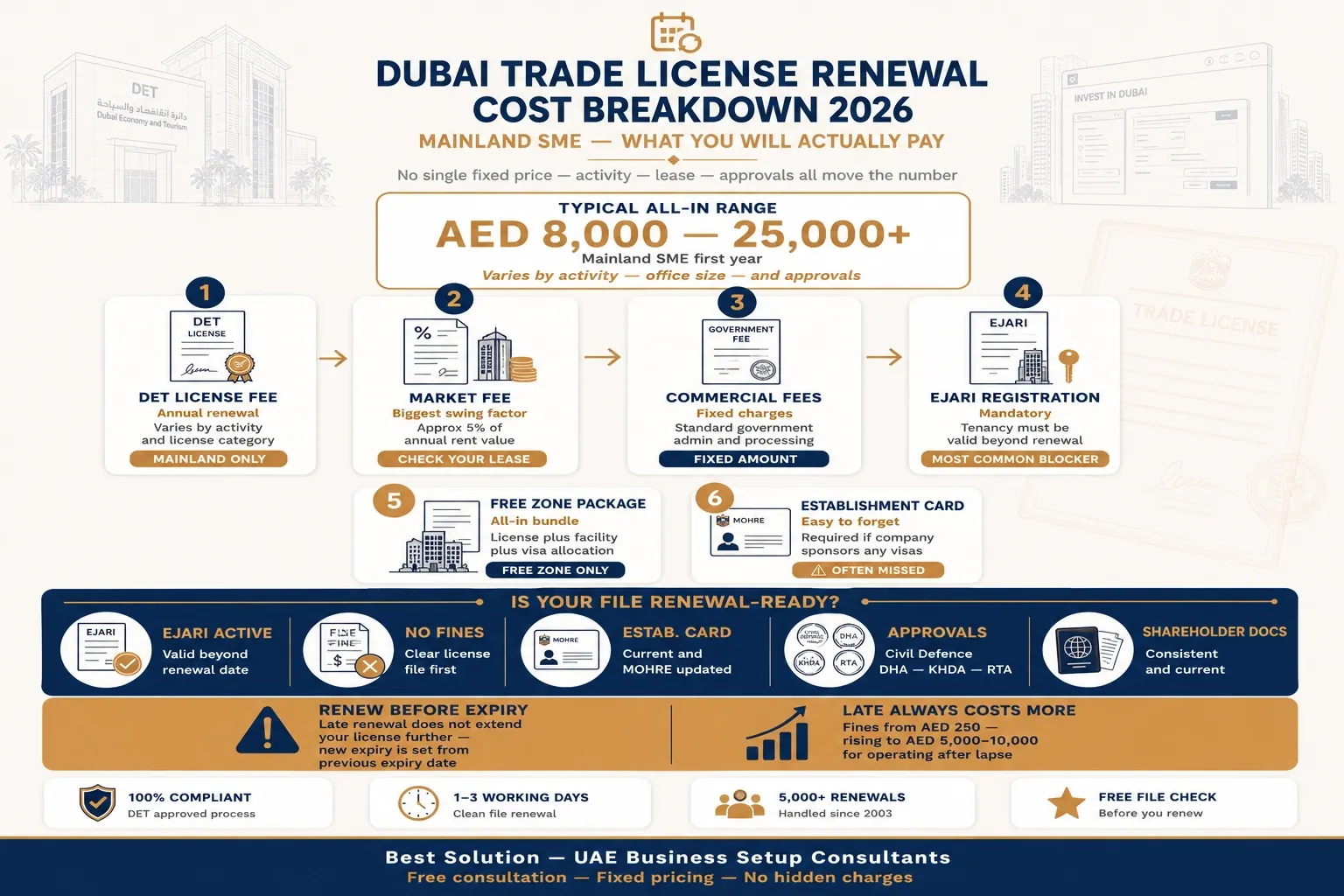
There is no single fixed price, and any provider quoting one is simplifying. For a standard Dubai mainland SME, all-in renewal costs commonly fall between AED 8,000 and AED 25,000 or more.
| Cost Component | Applies To | Notes |
|---|---|---|
| DET license renewal fee | Mainland | Varies by activity and license category |
| Market fee | Mainland | ~5% of annual rent — the biggest swing factor |
| Commercial / admin fees | Mainland | Fixed government charges |
| Ejari registration | Mainland | Required; tenancy must be valid beyond renewal |
| Free zone package | Free zone | Often bundles license + facility + visa allocation |
| Establishment card renewal | Both (if sponsoring visas) | Easy to forget; late fees accrue |
This is the part the market understates. Renewal is not a fixed-price service, because the inputs are not fixed. Your activity, office size, Ejari value, external approvals, municipality charges, outstanding fines, and jurisdiction all move the number. Free zones tend to publish predictable, packaged rates. Mainland costs vary far more by activity and location. To get an accurate figure for your license, enter your license number on the DET's Invest in Dubai portal and it will show the applicable fees.
Is There a Grace Period for Trade License Renewal in Dubai?
This is one of the most misunderstood areas, largely because articles mix historical rules, different emirates, and different authority practices. You will see confident claims of a 30-day grace period, claims of no grace period at all, and fines quoted at both AED 200 and AED 250 per month. The honest answer is that the rules and their enforcement vary, and they change.
Our advice to clients is simpler and safer: do not rely on any grace period. Renew before expiry. Because the renewed expiry date is fixed to your previous expiry date rather than your payment date, waiting buys you no extra license time. It only invites accumulating fines, blocked transactions, banking complications, and restricted immigration processing.
A few numbers give context. The DET's Commercial Compliance Manual treats failure to renew on time as a commercial violation. Late renewal fines have been documented at AED 250. Penalties rise sharply, into the AED 5,000 to AED 10,000 range, if you keep operating after the license lapses or after an administrative closure. Confirm the exact figures with your authority at renewal (the DET). The direction, though, is clear: late always costs more than on time.
We have assisted businesses that delayed because they believed they had grace time. By the time they reached us, fines had accumulated, some transactions were blocked, and additional approvals had to be obtained before renewal could even proceed. The direct fine was rarely the worst part. The operational disruption cost far more.
The Renewal Blocker Most Owners Miss: Your Establishment Card
Here is the issue that catches new entrepreneurs more than any other. If your company sponsors any visas, you almost certainly have an establishment card. This is the immigration file that lets your company sponsor residency. When you renew your trade license, that card usually needs renewing too. It also needs to be updated with the Ministry of Human Resources and Emiratisation (MOHRE). Many investors do not even know the card exists. Often a previous agent handled their first visa and never mentioned it.

The problem surfaces at the worst time: when a visa renewal gets stuck. By then the establishment card has often been expired for months, and the late fees have quietly stacked up. Last week a client came in to renew his business license. Once that was done, we asked for the company's establishment card so we could renew it too. He had no idea the card existed. He had used it once to get his own visa under the company, through another agency, and assumed that was the end of it. We found the card using his details. But it had already expired, so he had to pay a fine to renew something he never knew he had. Your licence also underpins staff sponsorship, so review your business visa options.
This is the difference between treating renewal as a single transaction and treating it as an annual compliance check. A trade license renewal that ignores the establishment card, MOHRE updates, and dependent visa timelines is not actually complete. It just feels complete until something breaks.
Mainland vs Free Zone Renewal: What Actually Differs
Free zone renewals are generally more predictable, because the authority controls more of the process internally. Jurisdictions such as IFZA, Meydan Free Zone, and SHAMS tend to offer streamlined renewals when documentation is complete. Authorities with heavier compliance requirements can involve extra review stages, particularly for larger businesses or regulated activities.
The deeper difference is in what drives cost and complexity. Free zone renewals are usually packaged around the license, the facility, and visa allocation, all in one place. Mainland renewals are pulled in more directions: Ejari, municipality market fees, and any external approvals tied to your activity. Some activities cannot be renewed in a few clicks at all. They need sign-off first from bodies such as Civil Defence, the Dubai Health Authority (DHA), KHDA, the municipality, the RTA, or SIRA before DET will process the renewal. If you are still choosing between structures, our guides to the mainland license and the free zone license compare them in detail.
So the useful comparison is not 'which is cheaper.' It is 'which structure fits how the business actually operates.' That question is best asked at renewal, which is the natural annual checkpoint.

Is Your License Actually Ready to Renew?
Don't get caught off guard by a forgotten establishment card or an expired Ejari at the checkout screen. Let our compliance team run a quick, zero-obligation file check to surface any hidden blockers before they turn into late fines.
Should You Renew Yourself or Use a Consultant?
This is the fair question every owner now asks: if there is an online portal, why pay someone to click renew? The honest answer is that if your file is genuinely clean, with active Ejari, no pending approvals, and no outstanding fines, you can often complete the payment yourself in a few minutes. Paying the fee is not where a consultant adds value.
The value is in catching what you cannot see before it costs you. That means an expired Ejari, a lapsed establishment card, an activity approval you forgot to renew, fines sitting on the file, a shareholder document that no longer matches, or a structure that quietly costs too much. The businesses that benefit most are usually not the ones with perfect files. They are the ones who find a problem only after they try to renew and hit a wall.
There is one more reason to involve someone who looks at the whole picture. Renewal is the best annual opportunity to ask whether your setup still matches how you operate. We have helped clients drop unnecessary activities, simplify inefficient license structures, and remove avoidable costs. In several cases, a modest review at renewal saved far more in future compliance and friction than the review itself cost. Treating renewal as a pure admin task is the most common, and most expensive, mistake we see. If a renewal has already stalled, our guide on why business licenses get rejected in Dubai covers the usual culprits. Renewal fees are recurring, much like the cost of starting a business up front.
is your file renewal-ready?
If you would rather have your file checked before you renew, our team can confirm whether it is renewal-ready, surface any blockers early, and handle the authorities on your behalf so a routine renewal stays routine.