The trading license is the easy part. After helping form more than 5,000 companies and open over 4,500 corporate bank accounts in Dubai, our team has seen the same pattern again and again: the license gets issued in days, and then the real work begins at customs, at the bank, and on the first shipment. Founders who treat the license as the finish line are the ones who hit delays. Founders who treat it as step four of a longer sequence move fast. If you also sell online, an e-commerce licence extends your reach.
This guide gives you the full picture a generic checklist leaves out. You will see the license types that actually exist, what a trading license really costs in your first year (not just the headline fee), the customs and banking steps that trip people up, and a clear way to decide between mainland and a free zone for a trading business. The right order is Products, then Supply Chain, then Compliance, then License. Get that order wrong and you pay for it later. Warehouse and sales staff need sponsorship through your business visa options. Pick the entity first by comparing the types of business structures.
In short
| Question | Short Answer |
|---|---|
| What is it? | A commercial license from Dubai's Department of Economy and Tourism (DET) or a free zone authority that lets you buy and sell goods. |
| Cost, year one | Free zone from roughly AED 12,000–25,000+; mainland roughly AED 25,000–50,000+ all-in, depending on visas, office, and activity. |
| How long? | The license itself can be days. Customs registration, approvals, and banking add weeks if not planned upfront. |
| Biggest trap | Assuming "general trading" means you can import anything. Restricted goods still need product-specific approvals. |
| Mainland or free zone? | Ask where 80% of revenue comes from AND where the goods physically move. For traders, logistics often decides. |
What is a trading license in Dubai?
A trading license in Dubai is a commercial license, issued by the Dubai Department of Economy and Tourism (DET) or by a free zone authority, that legally permits a business to buy, sell, import, export, and re-export goods. A general trading license is the broadest version: it lets you trade many unrelated product categories under one license, while a standard trade license is limited to the specific goods named on it. A trading firm should first compare the types of trade licence available. Keep operations running by staying ahead of trade licence renewal.
That distinction matters more than most founders expect, so it is worth pinning down before you choose.
Types of trading licenses in Dubai
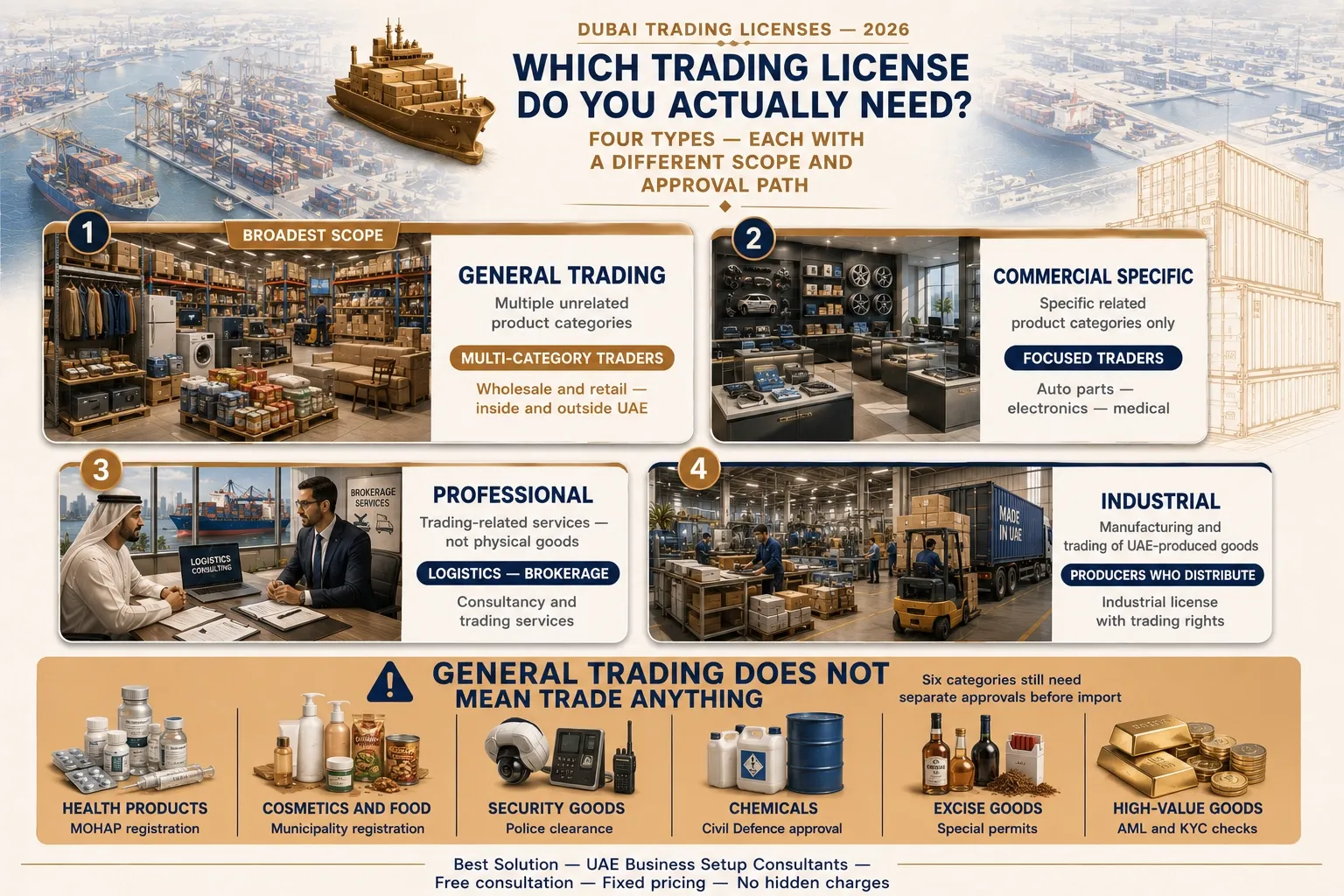
Dubai issues a few license types that cover trading activity. Choosing the right one depends on what you sell and how you sell it.
| License Type | What It Covers | Best For |
|---|---|---|
| General Trading | Trading of multiple unrelated products under one license (for example clothing, food, and furniture together). | Importers and multi-category traders who want flexibility. |
| Commercial (specific) | Trading of specific or related product categories only. You can hold several related activities, but they must sit in the same category. | Focused traders: auto parts, electronics, medical supplies. |
| Professional | Service-oriented trading activities such as logistics, brokerage, or consultancy rather than physical goods. | Firms offering trading-related services. |
| Industrial | Manufacturing, processing, and trading of goods produced in the UAE. | Producers who also distribute. |
Two faster-entry options also exist on the mainland. The Instant License gives a one-year commercial license without requiring office space upfront, useful for getting started quickly, though you secure premises at renewal. The E-Trader license suits home-based, online-only sellers with a single owner and no physical office. Both have limits, so match them to your actual model rather than the lowest fee.
General trading license vs a standard trade license
People use these terms interchangeably, but they are not the same. A general trading license lets you wholesale and retail almost any non-restricted goods, inside and outside the UAE, under one license. A standard trade license is scoped to the specific goods registered on it: a license for clothing does not let you sell electronics without adding that activity. If you genuinely plan to trade across categories, the general trading license saves you repeated amendments. If you sell one focused range, the specific commercial license is cheaper and cleaner.
Restricted goods a general trading license does not automatically cover
Here is the assumption that costs founders the most time: "general trading means I can trade anything." It does not. A general trading license gives broad commercial permission, but it does not remove product-specific regulatory requirements.
One overseas entrepreneur came to us wanting a general trading license to import a wide range of products, including cosmetics and health-related consumer goods. The license was never the problem. The delay appeared later, because some of those products required additional registrations and approvals before they could be imported. We reviewed the actual product list, identified the restricted categories, secured the right registrations, restructured the import plan, and adjusted the timeline. The lesson the founder took away: the most expensive mistakes happen after incorporation, not before.
Categories that typically need extra approvals on top of the license include:
- Health: medicines, supplements, and medical devices (Ministry of Health and Prevention registration).
- Cosmetics and food: municipality and regulatory product registration before import.
- Security: firearms, surveillance, and security equipment (police and security clearances).
- Chemicals: hazardous or industrial chemicals (Civil Defence approval).
- Excise goods: alcohol and tobacco (special permits).
- High-value commodities: precious metals and similar goods (AML and KYC checks).
How to get a trading license in Dubai, step by step
The process is logical once the products and supply chain are defined. Here is the sequence we run with clients.
- Map your products first. Before anything else, list exactly what you will import, store, and sell. This determines your activities, your approvals, and your license type. Our guide on choosing your business activity walks through this in detail.
- Reserve a trade name. Pick a unique name with the correct legal suffix (LLC for mainland, FZE or FZ-LLC for free zones). Avoid offensive or religious terms and overly generic words. Aspirational names like "Global" or "Hub" are frequently flagged, which slows approval.
- Choose your jurisdiction. Decide between mainland and a free zone based on where your customers and your goods are (covered in the next section).
- Apply for initial approval. Submit to DET (mainland) or the relevant free zone authority to confirm your proposed activity is permitted.
- Secure premises. Mainland companies lease office space and register an Ejari tenancy. Free zones offer flexi-desks, offices, or warehouses depending on your storage needs.
- Obtain external approvals. If any product is regulated, clear it with the relevant authority before you proceed.
- Register for customs and your import code. If you import, register with Dubai Customs and obtain an importer code. This is a real step, not a formality (see below).
- Pay fees and receive your license. Submit verified documents, settle the fees, and collect your trading license. You can now operate legally.
The customs import code step most traders forget
The most common misconception we hear is: "once my trade license is issued, I can start importing immediately." In reality, importers usually still need customs registration, an importer code from Dubai Customs, and sometimes product approvals and municipality registrations before a single shipment clears. For businesses importing regularly, customs registration becomes part of supply-chain planning, VAT handling, and banking compliance, not an afterthought. The groundwork follows our guide on how to start a business in Dubai.
The founders who experience the fewest delays are the ones who think about customs before ordering inventory, not after the shipment is already on the water.
Mainland vs free zone for a trading company
The standard advice is the 80% revenue rule: ask where roughly 80% of your first-year revenue will come from. If it is inside the UAE, mainland usually fits; if it is outside, a free zone usually fits. That rule still holds. For traders, though, we add a second question that often matters more: where will the goods physically move?
Those two answers are not always the same, which is why logistics frequently decides the structure for a trading business. Three real patterns:
Imports into Dubai, sells across the UAE. Even if suppliers are overseas, the business is serving the UAE market. Mainland is often the more natural structure, because it allows direct local trade without a distributor.
Imports into a free zone, re-exports internationally. Here a free zone structure can be highly efficient, with customs duty advantages and 100% foreign ownership.
E-commerce trader, imports into the UAE, sells across the GCC. The answer depends on warehousing, fulfilment, customs flow, and customer location. This one needs a real conversation, not a template.
One operational rule worth knowing: a free zone trading company generally cannot sell directly into the Dubai mainland. It must work through a mainland-licensed distributor or agent who handles local delivery and fulfilment. If most of your customers are on the mainland, factor that in early. For a deeper comparison, see our guide on free zone vs mainland in Dubai.
How much does a trading license in Dubai cost?
The advertised license fee is rarely the true project cost. Headline quotes of "from AED 12,000" describe a base fee, not your first-year outlay. On the mainland, DET applies a general-trading activity fee of around AED 15,000 on top of the base license, which is exactly why the real number runs higher than the advertised one.
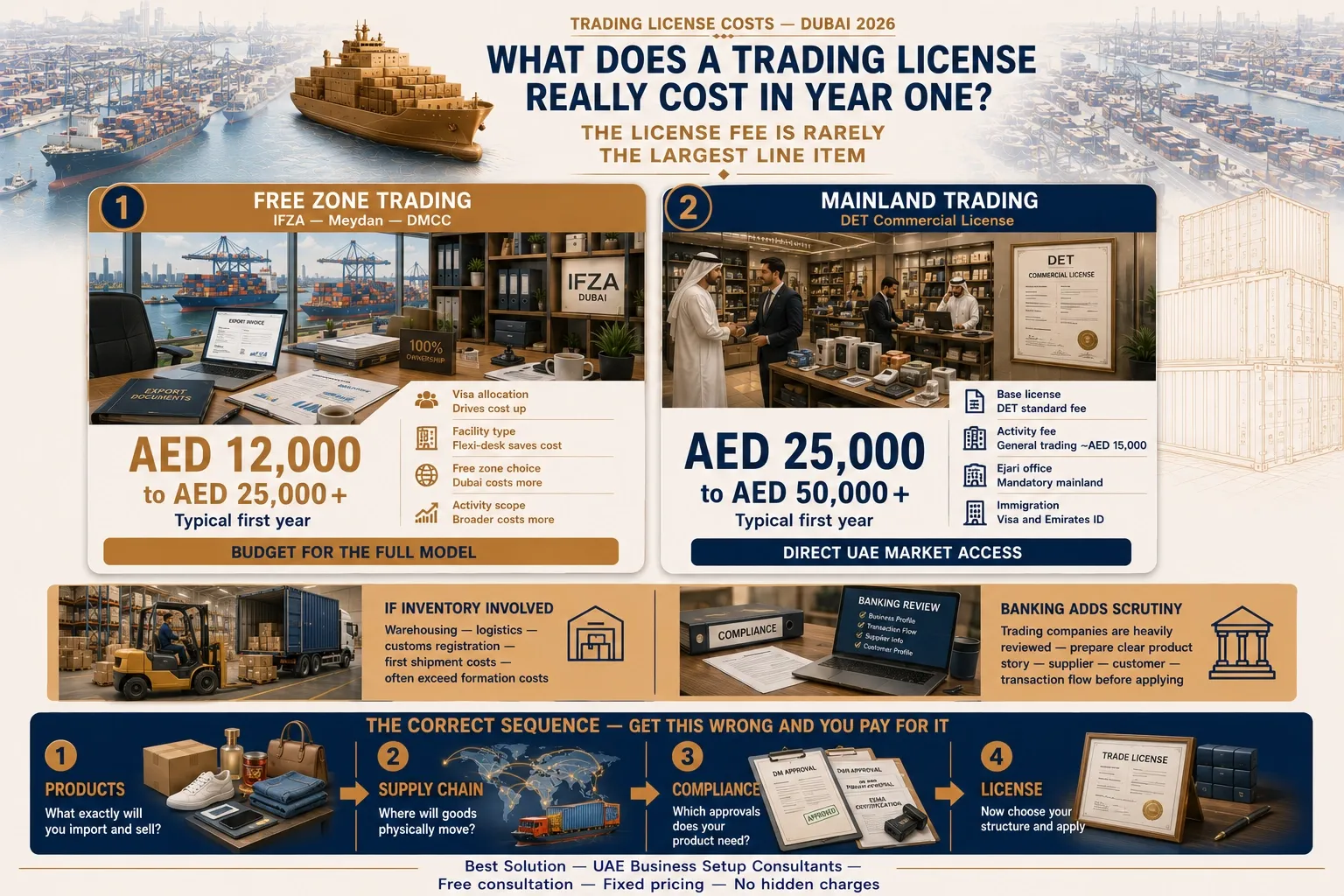
Based on current setups, here is what to actually budget for year one:
| Setup Type | Typical First-Year Range | What Drives It |
|---|---|---|
| Free zone trading | AED 12,000 – 25,000+ | Visa allocation, facility type, free zone choice, activity scope. |
| Mainland trading | AED 25,000 – 50,000+ | Base license + DET activity fee, Ejari office, immigration, initial approvals. |
| If inventory is involved | Often well beyond the above | Warehousing, logistics, customs registration, staff, first shipment. |
Many traders spend more on their first shipment than on the company formation itself. That is why we tell clients to budget for the business model, not just the license. For a full breakdown of setup economics, see our guide to the cost of starting a business in Dubai. And note the tax position: free zones can offer 0% on qualifying income, while mainland companies pay 9% corporate tax only on profits above AED 375,000, per the UAE's federal tax framework. For unrestricted local trade, a Dubai mainland company gives the widest access.
Why trading companies get extra scrutiny at the bank
Trading businesses are among the most heavily reviewed when opening a corporate bank account, and very few guides tell you this in advance. Across more than 4,500 accounts we have helped open, the pattern is consistent.
Banks move quickly when they can see clear products, known suppliers, documented customers, and transparent transaction flows. Consumer goods, household products, industrial supplies, office products, and straightforward B2B distribution usually progress smoothly.
More questions tend to arise around precious metals, jewellery, high-value commodities, dual-use goods, electronics with complex supply chains, cross-border wholesale, and general trading licenses with extremely broad activity descriptions. The irony is real: the broader the license, the more a bank asks. Faced with a general trading company, a compliance officer will ask "what exactly are you trading?" If the answer is vague, the review gets harder.
Our internal rule: the easiest trading companies to bank are the ones that can clearly explain what they sell, where they buy it, who they sell it to, how money flows, and why the transaction makes commercial sense. Banks are not worried about trading. They are worried about not understanding the trading activity. Preparing that story upfront is half the battle, and it is the core of how we approach corporate bank account opening.
The most common mistake trading founders make
If we had to name one mistake that causes the most avoidable cost, it is this: choosing activities and a license before defining the products. Many founders open with "which license is cheapest?" The better question is "what exactly am I going to import, store, and sell?"
We have seen companies set up successfully and then discover that their products need approvals, customs procedures differ, warehousing is required, banking reviews are more complex, or additional activities must be added. The result is license amendments, customs delays, shipment holds, banking complications, and restructuring costs that were entirely avoidable.
The correct sequence is simple and it is the spine of this entire guide: Products, then Supply Chain, then Compliance, then License. Not the other way around.
Documents required for a trading license in Dubai
- For individual shareholders, you typically need:
- Passport copies of all shareholders and directors
- Passport-size photographs
- Residence visa and Emirates ID copies (if UAE resident)
- Trade name reservation and initial approval certificate
- Tenancy contract and Ejari (mainland) or free zone facility agreement
For corporate shareholders, you also provide a certificate of incorporation, a certificate of incumbency listing current directors and shareholders, the Memorandum of Association, and a shareholder resolution approving the new company. These often require attestation, so confirm the requirements for your jurisdiction before you start.
Why Dubai is built for trading businesses
Beyond the paperwork, the fundamentals are why traders choose Dubai in the first place:
- 100% foreign ownership in free zones, and in most mainland trading activities, with no local partner required.
- Competitive tax: 0% corporate tax on qualifying free zone income and 9% on mainland profits above AED 375,000, with 100% repatriation of capital and profits.
- World-class logistics: Jebel Ali Port, two major airports, and bonded warehousing make import, export, and re-export efficient.
- Gateway location: direct access to the Middle East, Africa, and South Asia from one base.
- Stability: clear investor protections and a predictable regulatory environment.
Start your trading company with Best Solution
Setting up a trading company in Dubai is a strong move, and it does not have to be complicated when the order is right. Best Solution has formed more than 5,000 companies and opened over 4,500 corporate bank accounts, with channel partnerships across DMCC, IFZA, Meydan, RAKEZ, and more. We map your products and supply chain first, then build the license, customs, and banking around them, so the expensive surprises never arrive. Talk to our team about the right structure for what you actually plan to trade.