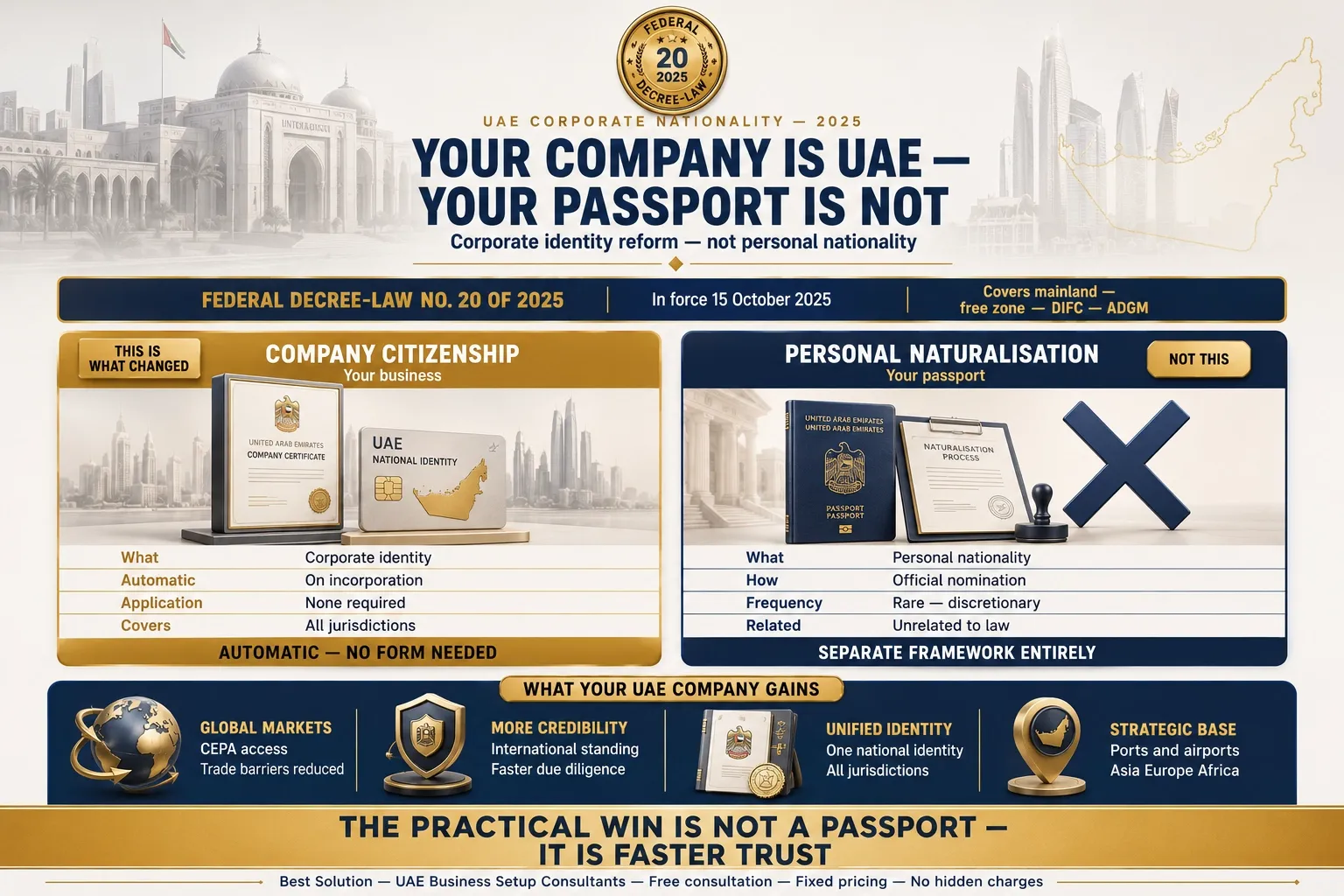
The headline sounds dramatic: the UAE is granting citizenship to companies. If you own a business here, or you are planning one, your first question is probably the obvious one. Does this hand me an Emirati passport, or change who is allowed to own my company? The short answer is no on both counts. UAE company citizenship is a corporate identity reform, not a personal nationality route and not a new compliance burden. It changes how your company is recognised, not your passport and not your shareholding.
That distinction matters, because much of the coverage online blurs it. Below is a plain, accurate explanation of what changed under the 2025 Commercial Companies Law amendments, why the UAE did it, and whether it actually affects your setup decision.
UAE company citizenship at a glance
| Question | Short Answer |
|---|---|
| What is it? | Recognition of every UAE-registered company as a UAE company in identity and economic status, regardless of who owns it. |
| Personal passport? | No. It does not grant Emirati nationality to owners, shareholders, or investors. |
| Ownership change? | No. 100% foreign ownership and existing shareholding structures stay exactly as they are. |
| Legal basis | Federal Decree-Law No. 20 of 2025, amending Federal Decree-Law No. 32 of 2021 on Commercial Companies. In force 15 October 2025. |
| Who it covers | Mainland, free zone, and financial free zone companies (including DIFC and ADGM). |
What is UAE company citizenship?
UAE company citizenship is a policy that recognises any company incorporated in the UAE as a UAE company in terms of legal identity, economic status, and global standing, regardless of who owns it. It applies to mainland, free zone, and financial free zone entities. It does not grant personal Emirati nationality and it does not change foreign ownership rights.
UAE Minister of Economy and Tourism Abdulla bin Touq Al Marri put it simply when announcing the amendments:
If you open a company in Germany, you’re a German company. If you own a company in the UK, you’re a UK company. Same here. If you open a company here, you’re a UAE company.
In legal terms, the reform confirms that a company incorporated anywhere within UAE territory, including free zones and financial free zones such as the DIFC and ADGM, holds UAE nationality. That is the substance behind the word “citizenship”: a clear, unified national corporate identity for the business itself.

Get the structure right from Day One
The new 2025 reforms make incorporating in Dubai more lucrative than ever—but the jurisdiction, ownership framework, and trade license you choose still dictate your success. Since 2014, Best Solution has helped over 2,500 founders navigate company formation, corporate banking, and residency visas without the headache.
Does company citizenship change your personal nationality or visa?
No. This is the single most common misunderstanding, so it is worth being blunt about it. Corporate citizenship is given to the company, not the owner. Your nationality, your passport, and your residency status do not change. If you hold a UAE Golden Visa as an investor or entrepreneur, that remains your route to long-term residency. Personal Emirati nationality is a separate framework entirely, granted only by nomination from designated authorities, and it is unaffected by this law.
Two different things, often confused
What the Commercial Companies Law amendments actually changed
Officials announced the company citizenship initiative during a media briefing on Federal Decree-Law No. 20 of 2025, which amends parts of Federal Decree-Law No. 32 of 2021 on Commercial Companies. The decree came into force on 15 October 2025. The headline idea, company nationality, sits alongside a set of practical modernisations aimed at making the UAE a more flexible place to incorporate, invest in, and exit a business.
The key change behind the term is a clarification: any company incorporated within UAE territory, including in free zones and financial free zones, holds UAE nationality. Earlier, some businesses felt caught between mainland and free zone regimes. The amendment gives every registered company a single, recognised national identity.
Why the UAE introduced corporate citizenship
The policy is not symbolic. It supports several long-running economic goals:
- Consolidating the UAE’s economic identity so local and foreign-owned firms are recognised under one national brand.
- Raising the global credibility of UAE companies when they trade, raise capital, or seek partners abroad.
- Supporting homegrown brands and easing access to international markets.
- Attracting foreign direct investment and encouraging new company formation and entrepreneurship.
It aligns with the UAE’s wider strategy of economic diversification across technology, manufacturing, logistics, renewable energy, and finance, and with its push to expand global trade through Comprehensive Economic Partnership Agreements (CEPAs).
Key benefits of UAE company citizenship for businesses
For companies registered in the UAE, the framework translates into several practical advantages:
- Easier access to global markets: UAE companies can lean on the country’s growing network of CEPAs with partner economies, which reduce trade barriers and make cross-border expansion smoother.
- Stronger business credibility : Operating as a recognised UAE company signals stability, regulatory compliance, and a trusted base. That shortens due diligence for international investors and partners.
- A unified legal identity : Whether you sit in the mainland or a free zone, your company carries one national corporate identity, which simplifies branching, restructuring, and expansion between jurisdictions. If you are still weighing structures, our guide to free zone vs mainland in Dubai breaks down the trade-offs.
- Strategic location, reinforced : The status reinforces an already strong base: top-tier ports, airports, and logistics links to Asia, Europe, and Africa.
From the Best Solution desk
In our experience advising founders since 2014, this status meaningfully boosts ‘Brand UAE’ credibility abroad. It signals to international investors and banks that the firm meets national standards, which simplifies due diligence and cross-border partnerships. The practical win is not a passport. It is faster trust

Consultant, Best Solution
Does it change foreign ownership or shareholding?
No, and this is worth stating clearly because some coverage implies new obligations that do not exist. Ownership rules are unchanged. 100% foreign ownership remains available where it already was, local ownership rules are untouched, and existing shareholding structures stay intact.
It is also not an ESG or “corporate social responsibility” law, despite how a few summaries frame it. There is no new sustainability filing or community-contribution requirement attached to the word “citizenship.” The reform strengthens your company’s legal standing. It does not add a compliance layer on top of your trade licence.
What it means if you are setting up or already running a business
For a foreign founder, the practical takeaway is reassurance rather than action. There is no form to file for company citizenship; it follows automatically from incorporating in the UAE. What changes is the standing your company carries once it exists.
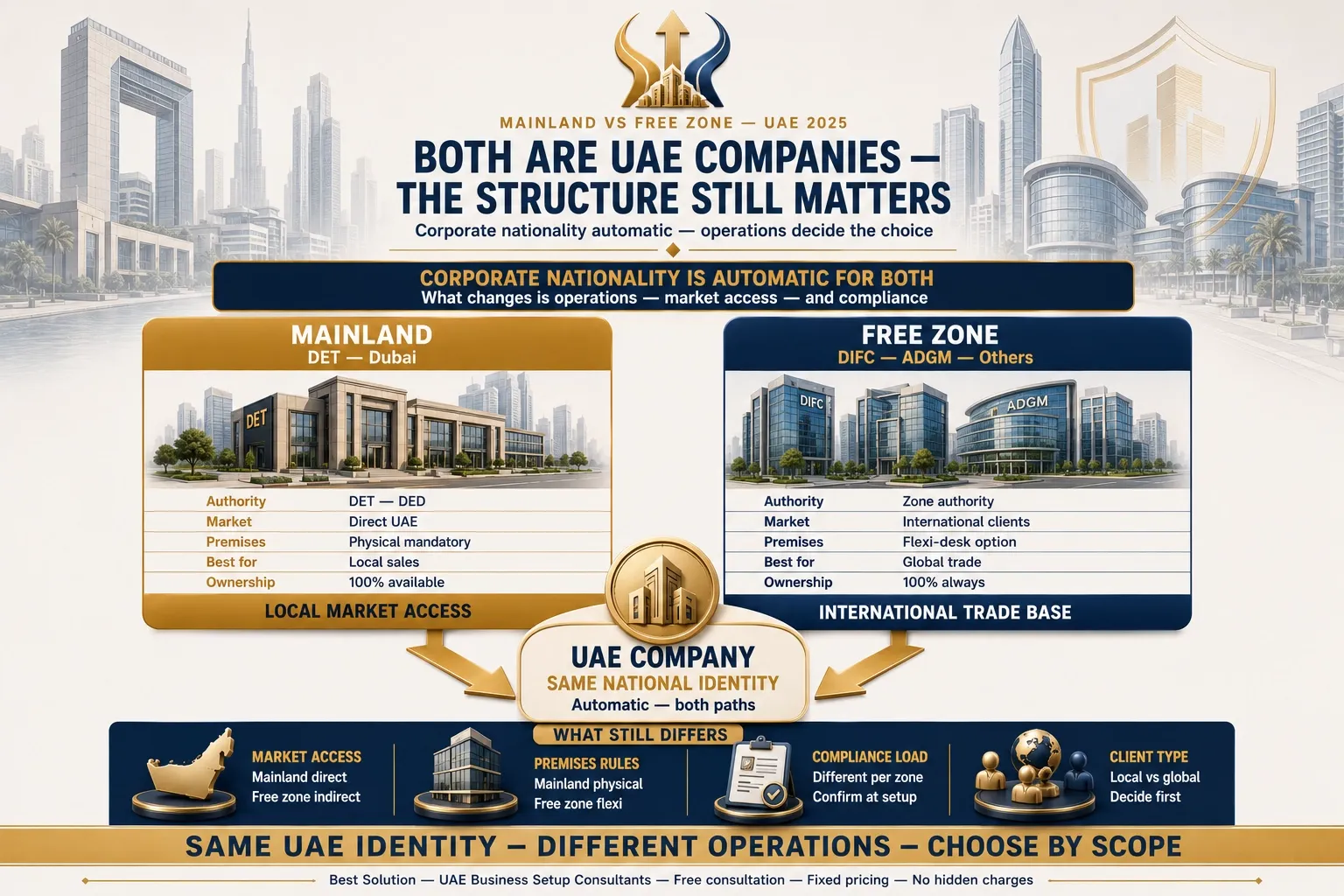
If you are at the planning stage, the reform is one more reason the structure you choose at the start matters. The jurisdiction, ownership setup, and licensed activities you pick still drive how regulators, banks, and partners see you. Our overview of how to start a business in Dubai and our LLC company formation guide walk through those decisions in order.
This announcement also lands during a period of record growth. The UAE added 250,000 new companies in 2025, taking the total past 1.4 million registered businesses, a 118.7% rise in four years. Two earlier reforms are widely credited for that momentum: 100% foreign ownership, introduced in 2021, and the Golden Visa programme, which gave investors and entrepreneurs a long-term residency route.
Beyond citizenship: other 2025 reforms worth knowing
Company nationality grabbed the headlines, but Federal Decree-Law No. 20 of 2025 modernised several other areas:
- A more flexible founders’ lock-up. The Ministry of Economy can now reduce or waive the previously rigid founders’ lock-up on share disposals, and the statutory lock-up no longer applies where shares are offered by private subscription and listed on a UAE market (subject to regulator approval). This gives founders earlier exit and investment flexibility.
- Multiple share classes for LLCs and a statutory basis for drag-along and tag-along rights, which makes the UAE friendlier to venture and private-equity style investment.
- Clearer rules for share succession, deadlock scenarios, and a framework for non-profit companies.
- A Geographical Indication initiative to protect products tied to UAE heritage, such as Hatta honey, Dabas dates from Al Dhafra, and Ras Al Khaimah ceramics, strengthening national branding.
The Practical Takeaways
Thinking about setting up in the UAE? Best Solution has guided founders through company formation, licensing, and business banking since 2014. If you want the structure right from day one, talk to our business setup consultants in Dubai.