Dubai moves fabric the way it moves everything else: fast, and to everywhere. The emirate re-exports textiles to markets across the Middle East, Africa, and Asia, and the wider GCC textile and apparel market is forecast to grow from about USD 15.1 billion in 2024 to USD 20.9 billion by 2029. For a trader or importer, the question is rarely whether the market is worth entering. It is which licence you need, whether to set up in a free zone or on the mainland, and what the whole thing actually costs once the hidden line items are added in. Test demand for your fabrics with market research in Dubai first.
This guide answers those three questions directly, with current figures and the jurisdiction logic most pages skip. It is written by Best Solution, a Dubai business setup consultancy operating since 2014 that has handled more than 5,000 company formations and 4,500 corporate bank account applications. For licensing help, business setup consultants can handle the filing. Sourcing and logistics make the UAE the best country to start a business for textiles.
What you need to start a textile business in Dubai
Quick answer
To start a textile business in Dubai you need a commercial trade licence with a textile or garments trading activity, issued by the Department of Economy and Tourism (DET) for the mainland or by a free zone authority. You choose a jurisdiction, reserve a trade name, get initial approval, secure premises (Ejari), and pay the licence fee. Budget roughly AED 12,500 to AED 25,000 for the licence.
Textile trading licence or manufacturing licence: which do you need?
Your business activity decides your licence, and it is printed on the licence, so getting it right at the start avoids an amendment later. Textile founders usually fall into one of three activity groups:
- Trading / re-export: buying fabric or ready-made garments and selling or re-exporting them, under activities such as 'Textile Trading', 'Garments Trading', or 'Readymade Garments Trading'. The most common route.
- Retail: selling to end customers from a shop, which needs a retail trade licence and a physical store address.
- Manufacturing: producing fabric or garments, which needs an industrial licence and approvals. If production is your plan, read our guide on starting a textile or fabric manufacturing company.
The mistake that costs the most: Textile Trading is not Garments Trading
On the DET activity register these are two distinct codes. Textile Trading covers fabric, yarn, and raw material. Garments Trading covers finished clothing and accessories. The code on your licence defines what you may legally import, store, and invoice. Register the wrong one and the problem surfaces at the worst moment: a customs query, a bank compliance review, or an inspection. Adding the correct activity is only AED 1,000 to AED 2,500 and a few days. The expensive part is that your Dubai Customs importer code was mapped to the wrong HS code, so shipments get held and your bank starts asking why your invoices do not match your declared activity. Realigning licence, customs code, and bank KYC can take four to eight weeks. Correct sequence, always: list the exact products you will trade, confirm the specific DET codes that cover them, check whether any need municipal approval (some food-contact textiles require Dubai Municipality registration), then pick the jurisdiction and licence type.
Most traders end up registering both Textile and Garments activities (or a general trading licence) so they can sell fabric, finished garments, and accessories without reapplying. We map the activity list to the products you actually move, not just your first order.
Free zone or mainland: which is right for your textile business?
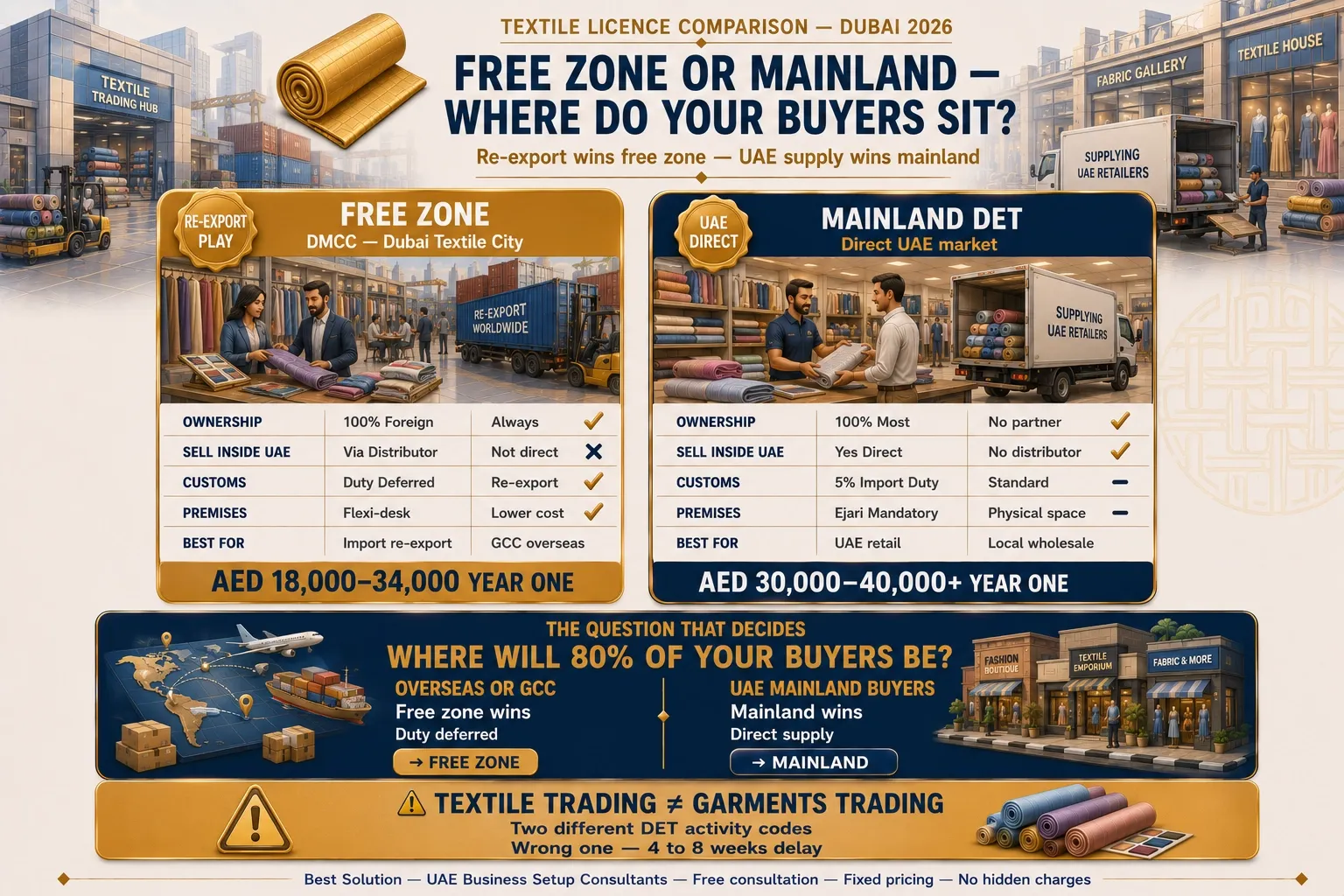
This is the decision that changes your cost, your market access, and your customs setup, and the one most competitor guides gloss over. The honest trade-off for a textile business:
| Factor | Free Zone | Mainland (DET) |
|---|---|---|
| Ownership | 100% foreign ownership | 100% for most trading activities |
| Sell inside UAE | Via a mainland distributor or agent | Sell directly across the UAE |
| Best for | Import / re-export, wholesale overseas | Local wholesale, retail, supplying UAE shops |
| Customs | Duty-deferred in the zone; ideal for re-export | Standard 5% import duty into the market |
| Premises | Flexi-desk or warehouse in the zone | Office, showroom, or warehouse anywhere in Dubai |
| Indicative first-year cost | AED 18,000-34,000 | AED 30,000-40,000+ |
For a pure import-and-re-export play, a free zone such as DMCC or Dubai Textile City in Ras Al Khor (a hub built specifically for textile and apparel firms) usually wins on cost and logistics. If you intend to supply UAE retailers directly, the mainland is cleaner because you avoid the distributor layer. Many founders start in a free zone and add a mainland presence later. See our full free zone versus mainland comparison. To supply local retailers, a Dubai mainland company gives the widest reach. If you move upstream into manufacturing, a fabric production company is the next step.
How much does it cost to start a textile business in Dubai?
Total cost depends on jurisdiction, licence type, visa quota, and premises. The licence alone is the smallest part. Indicative 2026 ranges:
| Cost Component | Indicative Range (AED) | Notes |
|---|---|---|
| Trade licence (textile/garments) | 12,500 - 25,000 | Free zone packages start lower; mainland varies by activity |
| Trade name + initial approval | 1,000 - 2,500 | One-time registration |
| Premises (flexi-desk to warehouse) | 6,000 - 50,000+ | Ejari required; warehouse cost scales with storage |
| Investor visa | 3,500 - 7,000 | Per visa; employee visas extra |
| Corporate bank account | 0 - 8,000 | Some banks charge onboarding; minimum balance applies |
| Customs code registration | Approx. 1,000 | Needed for import / export |
Four costs that surprise textile founders after the licence:
- Warehouse Ejari. A mainland trading licence needs a physical address registered on Ejari. The registration is only AED 220, but a basic warehouse unit in Ras Al Khor or Al Quoz runs AED 30,000 to AED 60,000 a year, which often doubles a licence-only budget.
- Customs importer code and HS mapping. Importing requires a Dubai Customs importer code before your first shipment, and each product must map to the correct HS tariff code. Plan around a flat 5% duty without confirming your code and goods can land in a higher bracket or sit on hold.
- VAT compliance. Cross AED 375,000 in twelve months and you must register for VAT, which a healthy wholesale business often does within three to six months. Registration is free; the quarterly filing discipline is the real cost.
- Visa quota vs warehouse size. Mainland visa quota is tied to registered space, roughly one visa per 80 to 100 sq ft. A 500 sq ft unit supports about five to six visas, so plan headcount before signing the lease.
- A fabric and garment-accessories trader sourcing from India and China, selling 60% to UAE mainland buyers and re-exporting 40% to the GCC, came to us weighing DMCC against a budget free zone. DMCC's licence alone was AED 20,285 (AED 35,000+ all-in) and, because most revenue came from UAE mainland buyers, would have needed an added mainland operating permit. A budget free zone would have blocked direct UAE supply entirely.
- We recommended a mainland DET commercial licence with two activities (Textile Trading + Garments and Accessories Trading) at about AED 14,500, a warehouse address in Ras Al Khor, and a customs importer code registered in parallel. Licence issued in seven working days; RAK Bank account opened within four weeks on the first application; the client was importing and invoicing UAE buyers by week ten. Total all-in year one (licence, warehouse Ejari, one investor visa, establishment card, bank prep): AED 65,000 to AED 75,000.
Anonymised from a real Best Solution engagement; figures are representative of this model, not a fixed quote.
For setup economics across activities, see our guide to the cost of starting a business in Dubai. The fundamentals follow our guide on how to start a business in Dubai.
Step-by-step: getting your textile trading licence
- Define your business activity. Pick textile/garments trading, retail, or manufacturing from the DET or free zone activity list. This sets your licence type.
- Reserve your trade name. It must be unique and follow UAE naming rules (no offensive terms or religious references).
- Choose your jurisdiction. Free zone or mainland, based on the trade-off table above.
- Select your legal structure. An LLC for multiple shareholders, or a sole establishment for single ownership.
- Get initial approval. A no-objection certificate from the authority. Submit passport copies and the application form.
- Draft and notarise the MOA. Mainland LLCs need a Memorandum of Association in English and Arabic, notarised. A sole establishment may need a Local Service Agent agreement.
- Secure premises and Ejari. Every Dubai company needs a registered address with a tenancy contract (Ejari).
- Pay the fee and collect your licence. DET or the free zone issues your textile trading licence once documents and payment clear.
- Register a customs code. Essential if you import or re-export; links your licence to Dubai Customs.
- Apply for visas. Investor and employee visas follow licence issue. Apply for staff entry permits at least 30 days ahead.
- Open a corporate bank account. Often the slowest step. Strong banking relationships shorten approval times.
Step 2 includes trade name registration, which we handle end to end, including availability checks and reservation.
Documents required for a textile business in Dubai
Have these ready to keep registration moving:
- Passport copies of all investors and shareholders
- UAE residence visa or entry stamp (residents), or passport (visitors)
- Trade name reservation certificate and initial approval certificate
- Attested Memorandum of Association (MOA) or Local Service Agent agreement
- Ejari tenancy contract as proof of business address
- No Objection Certificate (NOC) from a current sponsor, if you are a UAE resident employed elsewhere
- Activity-specific approvals for manufacturing or wholesale, where applicable
The CEPA advantage: why Dubai works for textile importers
If you are sourcing from India, the timing is unusually good. Under the India-UAE Comprehensive Economic Partnership Agreement (CEPA), the UAE eliminated import tariffs on roughly 80% of labour-intensive Indian products immediately, including ready-made garments, which now enter at zero duty. For an importer re-exporting through Dubai, that is a direct margin gain a non-CEPA route cannot match.
The flow is real but worth sizing honestly: India's textile and apparel exports to the UAE stood at about USD 2.14 billion in 2024, and the UAE's own apparel market is projected by Statista to grow from US$10.55 billion in 2024 to US$12.32 billion by 2029. The opportunity is structural, not a gold rush, which is exactly why getting your licence, customs code, and jurisdiction right at the start pays off.
If your turnover exceeds AED 375,000 you must register for VAT with the Federal Tax Authority. Importers also need a customs registration. We build both into the launch plan so you are not retrofitting compliance after your first shipment.
Ready To Launch Your Textile Business in Dubai
Don't risk customs delays or rejected bank applications with the wrong activity codes. Let our setup experts handle it for you.
How Best Solution helps you launch
A licence is the first milestone, not the finish line. Since 2014 we have completed more than 5,000 company formations and 4,500 corporate bank account applications, and for textile clients the value sits in what comes after the licence: choosing the jurisdiction that matches your trade lanes, registering the right customs code, securing warehouse space that passes Ejari, and opening a bank account that clears compliance the first time. Suppliers expect timely payments, so open a corporate bank account early.
Most textile founders reach us with a supply chain and customers already half-formed. The licence has become urgent because a supplier asked for documentation, customs flagged a mismatch, or a payment was blocked without a UAE entity to receive it. The questions are rarely abstract: 'I have suppliers in Surat and Guangzhou and want Dubai as my GCC base, free zone or not?' or 'My goods are held at customs because my licence does not match the product category.' We answer for the specific model in front of us, then build the structure that clears customs and banking on the first attempt, not the second.
Ready to start?
Tell us your sourcing market and target customers, and we will return an itemised all-in cost and the jurisdiction that fits, not a generic quote. Book a consultation with Best Solution.