Here is the part most guides get wrong: for a fabric production company in Dubai, the license is the cheap part. Serious investors rarely fail because they cannot get approved. They get caught by the factory, the power load, the wastewater permit, and the cash they commit before the approvals are confirmed. Fix a licensing mistake and it costs you thousands. Fix a factory mistake and it costs you hundreds of thousands. Even unrelated ventures like a beauty salon share the same licensing backbone.
So this guide is built for the decision you are actually making. Not whether Dubai is a good market for textiles. It is. The real questions are which business model you are building, which jurisdiction fits it, what the all-in number really looks like, and where the compliance traps sit. Get those right before application day and you save months and serious capital. Fabric production sits close to a textile business, and many founders run both lines. Pick the entity first — compare the main types of business structures for a factory setup.
Dubai’s Multicultural Market: The Hidden Driver Behind Textile Growth
| Question | Short Answer |
|---|---|
| License type | Industrial license (manufacturing). Trading-only models use a commercial license. |
| Where | Free zone (JAFZA, Dubai Industrial City, RAKEZ, Dubai Textile City) for export and 100% ownership; mainland (DET) for direct UAE sales. |
| License fee | AED 12,000-25,000. This is a small line item, not the budget. |
| Real all-in | Small unit AED 250k-750k+; mid-sized AED 750k-3M+. Factory and machinery drive the cost. |
| Key approvals | MOIAT (technical drawings), ESMA/ECAS (product testing), Civil Defence, municipality, wastewater permit. |
| Biggest risk | Committing capital to machinery or a facility before regulatory validation. |
Is Fabric Manufacturing in Dubai Worth It in 2026?
Short answer: yes, if you are export-minded and capitalised. The UAE textile and apparel sector contributes a meaningful share of non-oil GDP and the country exports textile products to more than 50 markets across Asia, the Middle East, Europe and Africa. Around 170 garment and cloth manufacturers already operate, concentrated in Dubai, Abu Dhabi and Sharjah. Demand is strongest in technical textiles, uniforms, sportswear and eco-friendly fabrics, and regional buyers increasingly prefer Made in UAE for shorter lead times. Gauge demand for your textiles with market research in Dubai before scaling.
The structural advantages are real. Dubai sits between Asia, Africa and Europe, with Jebel Ali Port and two international airports putting roughly three billion consumers within an eight-hour flight. Free zones offer duty deferral, 100% foreign ownership and profit repatriation. National policy is pushing the same direction through Make it in the Emirates and the UAE Industrial Strategy (Operation 300bn), which targets AED 300 billion of industrial GDP by 2031.
One number to keep in mind
9% corporate tax applies. Older guides still say zero income tax. Personal income stays untaxed and free zones can offer 0% on qualifying income, but the UAE now levies a 9% corporate tax on profits above AED 375,000, plus 5% VAT. Budget for it from day one. Confirm your position with the Federal Tax Authority.
First Decision: Which Textile Business Are You Actually Building?
Textile business is not one activity. It is several, and each one points to a different license, jurisdiction and approval path. Most founders skip this step and pay for it later in amendment fees and customs friction. Decide your model first.
| Business Model | License Type | Best Jurisdiction |
|---|---|---|
| Retail fabric or garments shop | Commercial (textile/garments trading) | Mainland (DET) |
| Wholesale textile distribution | Commercial (textile trading) | Mainland or Dubai Textile City |
| Fabric import and re-export | Commercial (trading / general trading) | JAFZA or Dubai Textile City |
| Garment manufacturing | Industrial license | Dubai Industrial City or JAFZA |
| Fabric / yarn manufacturing | Industrial license | JAFZA, Dubai Industrial City |
| Private label fashion brand | Commercial + manufacturing agreement | Mainland or DMCC |
The distinction that trips people up is textile trading vs garments trading. Textile trading covers fabric, yarn and raw material. Garments trading covers finished clothing and accessories. Both are commercial licenses, but the exact activity code on your license defines what you may legally do. If you intend to manufacture fabric, you need an industrial license, not a trading one, and that changes everything downstream: MOIAT involvement, factory requirements and ESMA testing.
Expert warning
A close second to the biggest mistake is copying a competitor activity description without checking it matches your real production process. Manufacturing approvals are far less forgiving than trading licenses. The activity description has to reflect reality.

General Manager , Best Solution
Mainland vs Free Zone vs Dubai Textile City: Choosing Your Jurisdiction
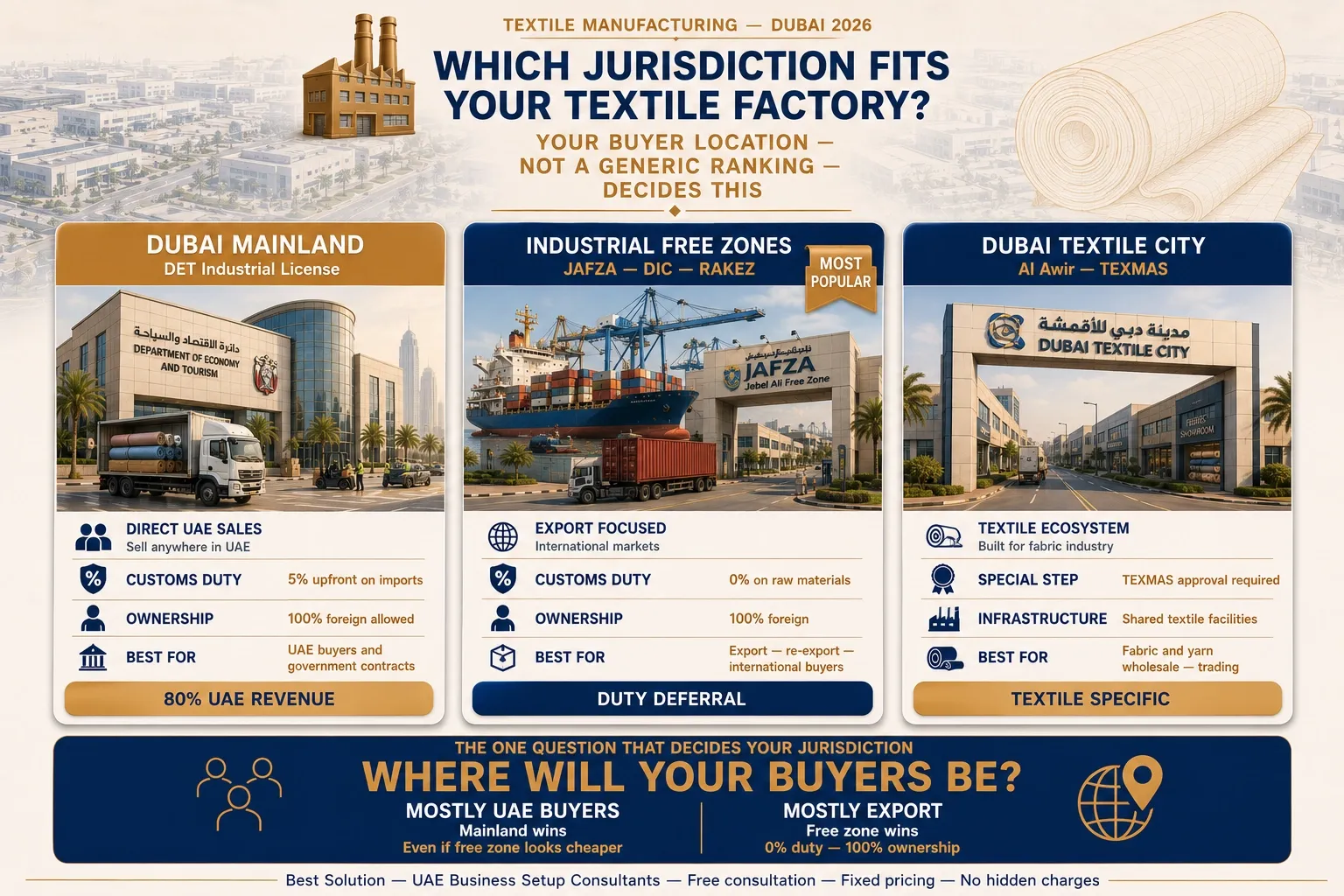
Jurisdiction decides ownership, market access, customs treatment and cost. For a manufacturer, it also decides how easily you can defer duty on imported raw materials. Here is how the three realistic routes compare.
Dubai Mainland (DET)
A mainland industrial setup through Dubai Economy and Tourism lets you sell directly anywhere in the UAE and supply both private and government buyers. You need an Ejari-registered industrial premises and external approvals from MOIAT. The trade-off: standard 5% customs duty is paid up front on imported raw materials, which hits cash flow earlier. A mainland license is the right call if your buyers are inside the UAE.
Industrial Free Zones (JAFZA, Dubai Industrial City, RAKEZ)
Free zones suit export-focused manufacturers. You get 100% foreign ownership, profit repatriation and, critically, 0% duty on raw materials imported for processing and re-export. You only pay duty if finished goods cross into the UAE mainland. Jebel Ali Free Zone (JAFZA) is built for export logistics; Dubai Industrial City (DIC) is tailored for large-scale production; RAKEZ and SAIF Zone are more affordable for SMEs.
Cost insight only experts flag: DIC vs JAFZA
Utility pricing differs sharply by zone. Dubai Industrial City often has lower industrial power and water tariffs because allocation is built for manufacturing. JAFZA tariffs run higher, since its land is prioritised for logistics and trade. For a large-scale dyeing unit, the difference in industrial power alone can exceed AED 50,000 a year. Factor it into the budget before you sign a lease.
Dubai Textile City and TEXMAS Approval
Dubai Textile City (DTC), at Al Awir, is a free zone built specifically for the textile industry, established as a joint venture involving TEXMAS (the Textile Merchants Group) and Dubai Customs. It clusters fabric and textile businesses with shared infrastructure and duty-free trade. The catch most guides miss: a TEXMAS-linked approval step applies before you can complete licensing there, so the path differs from a standard free zone application. Production lines need labour, so map your business visa options up front.
From our consultants
Many entrepreneurs assume that locating inside a textile-focused ecosystem automatically solves regulatory and operational challenges. It does not. For textile manufacturing, infrastructure suitability usually matters more than the address. The wrong facility adds months and significant capital expenditure no matter where it sits.
Consultant, Best Solution
How to Start a Fabric Production Company in Dubai: Step by Step
In Short
choose your activity and legal structure, reserve a trade name, secure initial approval, lease a compliant industrial premises, clear MOIAT and Civil Defence, then apply for the industrial license. Licensing fees run AED 12,000 to 25,000 and approval typically takes one to two weeks once documents are complete. The factory setup around it takes far longer and costs far more.
- Confirm your activity. Under the industrial category, pick the precise activity: fabric or textile manufacturing, yarn production, dyeing and finishing, or recycled/sustainable fabric. The activity must match your real process.
- Pick a legal structure. LLC for mainland trade, Free Zone Company (FZC/FZE) for 100% foreign ownership in a free zone, or sole establishment for limited single-owner activities.
- Reserve a trade name. Unique, non-offensive, and reflective of the activity. Approval usually takes one to two business days.
- Get initial approval. Submit shareholder passports, the trade name reservation, a business plan with factory layout, and a landlord NOC if leasing. Usually two to three business days.
- Secure a compliant industrial premises. Lease in a recognised industrial zone (DIC, JAFZA, RAKEZ, or mainland plots such as Al Quoz). It must meet MOIAT, Dubai Municipality and Civil Defence standards before it qualifies.
- Clear MOIAT and Civil Defence. Submit detailed engineering drawings showing machinery placement, ventilation and fire-safety routes. A simple floor plan is not enough.
- Apply for the industrial license. With initial approval, MOIAT clearance, municipality and Civil Defence sign-off, and environmental clearance where relevant. Fee AED 12,000 to 25,000; about one to two weeks.
- Start operations. Open a corporate bank account, register with Dubai Customs, and import machinery and materials. Renew the license annually.
What Does It Really Cost to Start a Fabric Factory in Dubai?
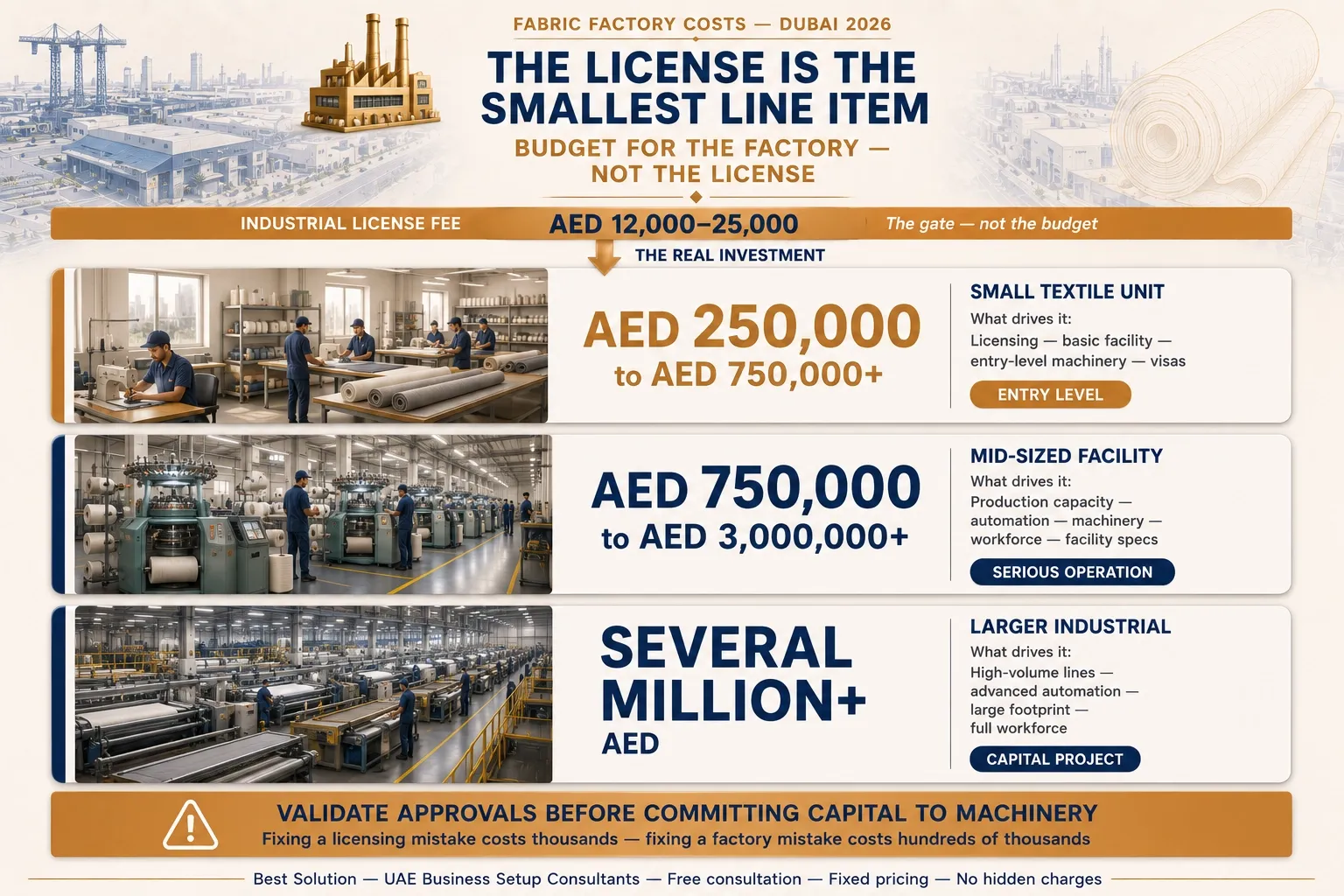
This is where most online content becomes unrealistic, because it quotes the license and stops. The license is one of the smaller line items. A fabric factory is a capital project, and the factory and production infrastructure drive the budget. Here are the all-in ranges our consultants actually see, including licensing, approvals, facility, machinery, visas and compliance.
| Operation Size | All-In Range | What Drives It |
|---|---|---|
| Small textile unit | AED 250,000-750,000+ | Licensing, industrial approvals, basic facility fit-out, entry-level machinery, visas, compliance |
| Mid-sized facility | AED 750,000-3,000,000+ | Production capacity, automation level, machinery, workforce size, facility specs |
| Larger industrial | Several million+ | High-volume lines, advanced automation, large footprint and workforce |
Against those numbers, the AED 12,000 to 25,000 industrial license fee is rounding error. Treat licensing as a gate, not a budget. For a fuller breakdown of the surrounding setup costs, see cost of starting a business in Dubai . And remember the recurring items: annual license renewal, corporate tax registration , visas (roughly AED 4,000 to 5,000 per person), and flexi-desk or office allocation. Manufacturing carries its own permits, so review the business licence essentials early. Local supply contracts often favour a Dubai mainland company for wider access.
Before You Sign a Lease or Buy Machinery
A factory mistake can cost hundreds of thousands in unexpected retrofitting. Let our industrial consultants validate your engineering layout, power requirements, and MOIAT compliance path before you commit capital.
The Industrial Compliance Hurdles Most Guides Skip
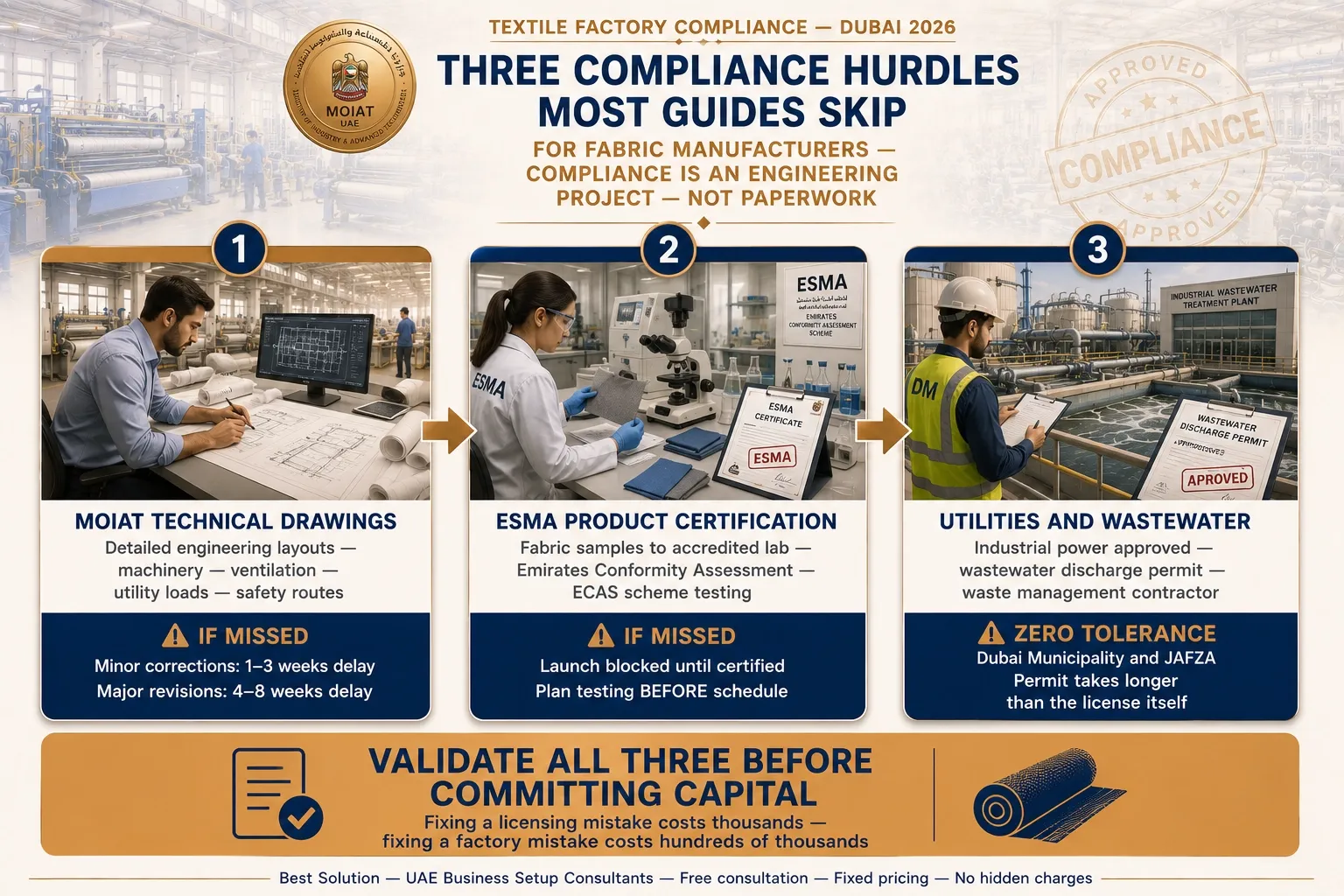
For a service company, the license is the finish line. For a fabric manufacturer, it is the entry point. Three specialised hurdles separate industrial setups from everything else, and they are where self-managed projects stall.
MOIAT Technical Drawings
The Ministry of Industry and Advanced Technology (MOIAT) reviews manufacturing applications against detailed engineering layouts, not a basic floor plan. In our experience, most delays here are documentation problems, not licensing problems. The drawings fail to explain workflow, machinery placement, the production process, utility loads and safety. The cost of getting it wrong: minor corrections add one to three weeks; significant revisions add four to eight weeks or more.
ESMA and ECAS Product Certification
Finished fabric must meet the standards of the Emirates Authority for Standardization and Metrology (ESMA), especially for children wear or protective textiles. That means submitting samples for testing under the Emirates Conformity Assessment Scheme (ECAS). Plan the testing window into your launch schedule, not after it.
Utilities, Wastewater and Waste Management
Manufacturing needs industrial-grade power and water, approved with the utility provider (such as DEWA) during planning, not after you lease. If you dye or chemically finish fabric, you cannot discharge treated water into general sewage. You need specific wastewater discharge permits from Dubai Municipality or the free zone environmental department, often with on-site pre-treatment. All industrial waste must go to a municipality-approved contractor under a signed contract before you begin.
Our proprietary checklist insight
Never submit your license application until you have a clear wastewater discharge plan, especially for dyeing or finishing. Dubai Municipality and JAFZA enforce zero tolerance here, and the specialised permit can take longer than the license itself.
Labour Quota and Industrial Visas
Visa allocation is tied to workspace. A manufacturing unit must show enough physical space (a common rule of thumb is around 9 square metres per employee) to house its workforce. Your industrial license category unlocks specialised industrial labour visas for factory-floor staff. Mainland companies above 50 employees also fall under Emiratisation targets; free zones are generally exempt.
The Biggest Mistakes to Avoid (From Real Setups)
Patterns our consultants see again and again. Each one is avoidable with sequencing discipline.
- Buying machinery before confirming requirements. The single most expensive mistake. Founders commit capital to equipment before validating facility suitability, power load, licensing conditions and environmental rules, then pay again to retrofit.
- Choosing a facility before confirming utilities. A warehouse is not automatically a factory. Confirm power and water allocation first.
- Underestimating power load. Industrial machinery, especially dyeing, draws far more than a standard allocation supplies.
- Misaligning activity codes. Copying a competitor license activity that does not match your real process creates compliance exposure.
- Negotiating a lease before understanding MOIAT and municipality rules. Sign late, not early. Requirements shape which premises even qualify.
How Best Solution De-Risks Your Setup
Words from Experts
Many investors approach us thinking an industrial license is just a bigger version of a service license. They are mistaken. A service setup is a legal checklist. An industrial setup is an engineering and compliance project. It involves MOIAT, Civil Defence, utility allocation and strict waste protocols. Our role is not paperwork. It is making sure your factory is compliant from the foundation up.

CEO , Best Solution
Case study: compliance as a head start
That is the through-line of everything above: validate the regulatory picture before you commit major capital to machinery, facilities or inventory.
The Bottom Line
Dubai is a strong base for fabric manufacturing if you are export-minded and properly capitalised. The opportunity is real, the infrastructure is world-class, and policy is on your side. But the win is not in getting licensed. It is in sequencing the project so the approvals, the facility, the utilities and the capital line up before you spend. Decide your model, choose the jurisdiction that matches your buyers, budget for the factory rather than the license, and clear the compliance hurdles in the right order.
Ready to pressure-test your plan?
Before you commit to machinery or a lease, get your regulatory path validated. Best Solution handles licensing, factory setup, and MOIAT and ESMA compliance for textile manufacturers in the UAE. Book a free consultation and turn compliance from a risk into a head start.