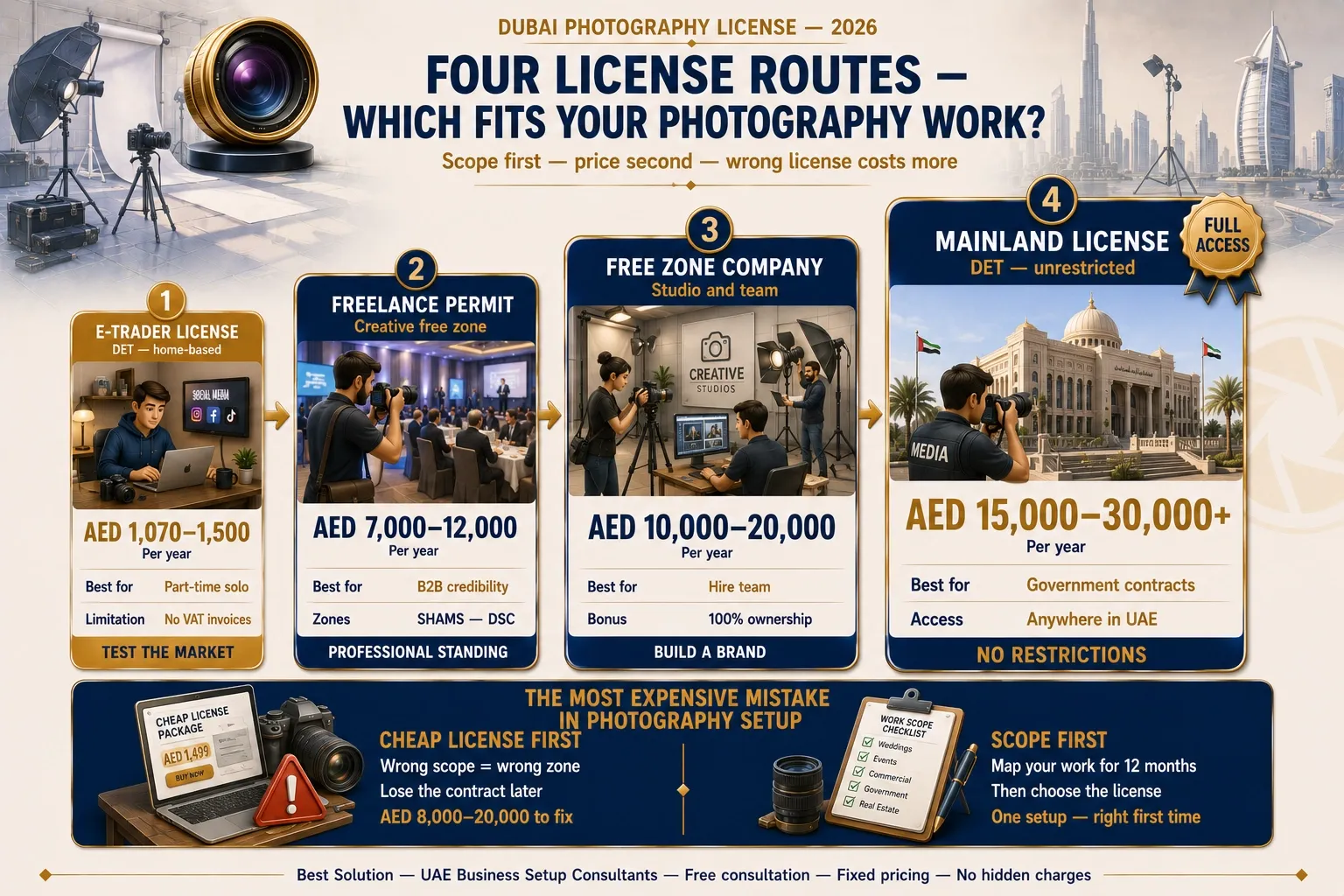
| If You... | The Right Route | Indicative Cost / Year |
|---|---|---|
| Shoot part-time, work from home, hold a residence visa | E-Trader License (DET) | AED 1,070 - 1,500 |
| Want credibility, UAE-wide clients, VAT-ready invoices | Freelance Permit (creative free zone) | AED 7,000 - 12,000 |
| Plan to hire a team and run a studio | Free Zone Company License | AED 10,000 - 20,000 |
| Chase government / large corporate contracts | Mainland License (DET) | AED 15,000 - 30,000+ |
| Shoot commercially in public, or fly a drone | Add DFTC / DM / DCAA permits | Separate from the license |
Most photographers do not call a business consultant because they want a company. They call because a client just asked for a tax invoice they cannot produce, or because someone at a shoot mentioned the word "fine." If you have been shooting weddings, brand campaigns, or product work on an employment visa and that knot has started to form in your stomach, you are asking the right question at the right time. The real question is rarely "how do I set up a company." It is "am I currently doing something I should not be, and what is the smallest correct structure for the work I actually do?" Hiring assistants or second shooters brings your business visa options into play. Photographers often serve sectors like a real estate company, a useful niche to know.
This guide answers both. It walks through every legal route to operate a photography business in Dubai, what each one genuinely costs in 2026, and the part almost every other guide skips: the permit layer that decides whether a specific shoot is legal, separate from the license that makes your business legal. Best Solution has run company formations from Business Bay since 2014, and the gap between "I have a license" and "I can legally shoot this job" is where we watch photographers lose contracts. Let us close that gap. New to licensing? Business setup consultants can handle the studio paperwork. business setup consultants Many studios protect personal assets by forming an LLC.
The two layers most photographers miss: license versus permit
Here is the single most important idea on this page. Starting a photography business in Dubai involves two separate processes, and they are not the same thing. The fundamentals are the same here as in our guide on how to start a business in Dubai. To shoot for local clients freely, a Dubai mainland company gives the widest scope.
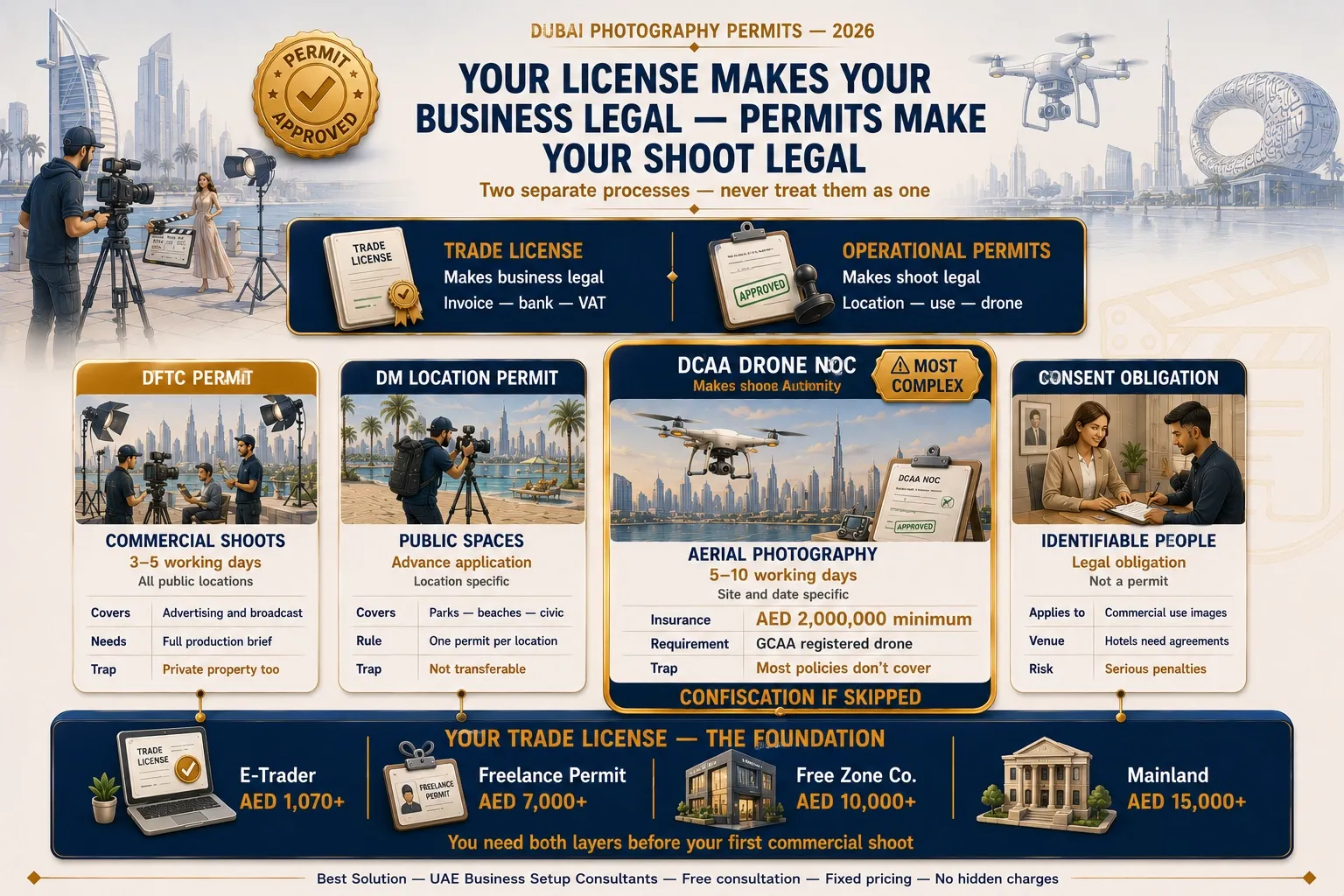
The first layer is your trade license. It establishes your legal business entity, lets you invoice clients, open a corporate bank account, and register for VAT. The second layer is your operational permits: the DFTC, Dubai Municipality, and DCAA approvals that govern whether a specific shoot, in a specific place, for a specific use, is actually legal. A license on its own does not give you the right to film a commercial campaign on a public beach or fly a drone over Dubai Marina. Diversifying later into something like a restaurant follows its own licensing path. Pet photographers sometimes branch into a pet care business too.
Almost every competing guide treats these as one process. They are not. You can hold a perfectly valid photography license and still be operating illegally on a commercial shoot because you skipped a permit. Read this page with that distinction in mind and the rest falls into place.
Which photography license is right for you?
There is no single "photography license" in Dubai. There are four routes, and the correct one depends entirely on the mix of work you plan to do over the next twelve months, not on which package is cheapest today. We have helped more than 500 creatives choose among these four paths.
Option 1: E-Trader License, for testing the water
The E-Trader License from Dubai's Department of Economy and Tourism (DET, formerly the DED) is the lightest legal entry point. If you already live in Dubai on a UAE residence visa, you can register one and start invoicing fast.
It lets you operate from home, promote your services legally on Instagram, TikTok, and WhatsApp, take payments from Dubai-based clients, and issue simple receipts. The limitations are real: it is a single-owner license, you cannot hire staff, it is valid in Dubai only, it does not support VAT invoices, and many corporate clients will not accept it for larger B2B contracts. The license fee runs roughly AED 1,070 to AED 1,500 per year, which is about the value of one or two shoots.
Best for: photographers testing the market, part-timers, and those shooting individuals and social events.
Option 2: Freelance Permit, for professional credibility
A Freelance Permit from a creative free zone gives you professional standing without forming a full company. Zones such as Sharjah Media City (SHAMS), Dubai Studio City, twofour54 in Abu Dhabi, and Fujairah Creative City all issue them.
This route lets you work with clients across all seven Emirates, issue official invoices carrying your trade license number, open a business bank account, register for VAT once revenue passes the AED 375,000 threshold, and sponsor your own residence visa. It is the natural step up for an experienced photographer chasing corporate clients. Expect AED 7,000 to AED 12,000 per year for the permit, plus roughly AED 3,000 to AED 5,000 if you add a visa.
Best for: established freelancers, B2B work, and anyone planning long-term growth in the UAE.
Option 3: Free Zone Company License, for a scalable studio
If you want to build a brand, hire a team, and run a studio, a Free Zone Company license is the right structure. Options include Dubai Studio City, DMCC, IFZA, and JAFZA.
It lets you trade under a formal company name, sponsor employee visas, lease studio space inside the zone, open a corporate bank account, issue VAT invoices, and bid on larger tenders. You keep 100% foreign ownership and full customs exemption. Budget AED 10,000 to AED 20,000 per year for the license, plus AED 5,000 to AED 10,000 per employee visa.
Best for: photographers hiring a team, opening a studio, and building a brand.
Option 4: Mainland Business License, for unrestricted access
A Mainland Business License from DET lets you operate anywhere in Dubai and the wider UAE with no zone restrictions, and bid directly on government contracts. Photography, as a professional service, can often be structured as a sole establishment with 100% ownership under specific conditions, which is why the old "you need a 51% local sponsor" warning no longer applies to most creative work. We run a free eligibility check to confirm your activity qualifies.
The trade-off is a mandatory physical commercial space and a higher fee, typically AED 15,000 to AED 30,000 or more per year. Best for: high-growth studios chasing government and large corporate accounts.
How much does it cost to start a photography business in Dubai?
A photography license in Dubai costs between AED 1,070 and AED 30,000 per year depending on the route. The E-Trader License starts around AED 1,070, a free zone freelance permit runs AED 7,000 to AED 12,000, a free zone company AED 10,000 to AED 20,000, and a mainland license AED 15,000 to AED 30,000 or more. Visas, office space, and operational permits are extra. If you also sell gear, a general trading company can sit alongside the studio.
Cost is the wrong first question, though. The right first question is scope. The cheapest license that does not cover your actual work is the most expensive decision you can make, and the next section explains exactly why.
The permit layer: DFTC, Dubai Municipality, DCAA, and consent rules
This is where Dubai's regulatory architecture surprises people, and where almost no competing guide goes into real detail. Four permit obligations sit entirely outside your trade license, and each one operates independently of the others.
Dubai Film and TV Commission (DFTC) permits
The DFTC permit is the most commonly missed. Any commercial shoot in a public location, on private property that forms a recognisable Dubai backdrop, or intended for broadcast or advertising, requires one. The application needs a full production brief: shoot dates, locations, crew list, and intended use of the footage.
The trap that catches photographers is assuming a wedding or corporate shoot on private property is exempt. The DFTC's jurisdiction extends to the commercial use of the footage, not just the physical location. Turnaround is usually three to five working days for straightforward shoots, longer for iconic or sensitive sites.
Dubai Municipality location permits
Shooting in spaces managed by Dubai Municipality, such as parks, public beach areas, and civic infrastructure, is a separate obligation again. These permits require advance application and are location-specific: a permit for Jumeirah Beach does not cover La Mer. The common mistake is shooting commercially under the belief that "it is a public place" means open access. It does not.
DCAA drone NOC and the AED 2 million insurance rule
Drone work is the most complex of the four. A Dubai Civil Aviation Authority (DCAA) No-Objection Certificate has three requirements. You need a minimum AED 2 million third-party liability policy that names the drone operation. You need a drone registered with the UAE GCAA. And you need the NOC itself, which is site and date specific. Most photographers either lack insurance at that limit or hold general business cover that does not extend to aerial work. Both lead to refusal. Processing runs five to ten working days. Restricted zones near airports, helipads, and government sites can extend that or block it outright. As of 2026, recreational drone use in Dubai is temporarily suspended, though licensed commercial operators with valid approvals may still fly.
Public-place photography and consent under UAE law
Consent is a legal obligation, not a license, and it persists regardless of which permits you hold. Photographing or filming identifiable people in public for commercial use requires their consent under UAE privacy law. Sharing, publishing, or even tagging someone's image without permission can carry serious penalties. Wedding and event photographers in hotels or managed public spaces should also confirm whether the venue itself requires a separate facility shoot agreement, as most premium hotels do.
The framing we give every client is simple: the trade license establishes the legal entity, but the operational permits determine whether a specific shoot is legal. They are two different processes and should never be treated as one.
Step by step: how to register your photography business
The license route shapes the detail, but the core sequence is consistent.
- Map your full scope of work for the next twelve months: weddings, corporate events, advertising, product, drone, stock licensing. This single step prevents the most expensive mistake on this page.
- Choose your jurisdiction and license type based on that scope, not on price.
- Reserve your trade name and confirm your business activity codes.
- Prepare your documents: passport and Emirates ID copies, residence visa page, and proof of address (we assist with Ejari where a flexi-desk is needed).
- Submit your application to DET or the chosen free zone authority.
- Pay the fees and receive initial, then final, approval. Clean applications through our channel-partner zones are typically issued in two working days.
- Open your corporate bank account and register for VAT when your revenue reaches the threshold.
- Layer the operational permits, DFTC, DM, and DCAA, on top of the license before your first commercial shoot.
The most expensive mistake photographers make
The single costliest error is choosing a license jurisdiction by price rather than by the scope of work. It usually looks like this.
A photographer sees a budget creative free zone advertising a media license for AED 5,750 to AED 7,500. They complete setup online in 48 hours. The license is genuine and the zone is legitimate. Six months later, they shoot an advertising campaign for a Dubai hotel. The client's procurement team asks for DFTC permit registration, a mainland-invoicing entity, or arrangements the budget free zone entity cannot satisfy on its own. Now there are only two outcomes. Lose the contract that was already scoped and scheduled, or set up a second entity at AED 8,000 to AED 20,000 and a three to five week delay.
A second, distinct mistake carries even sharper consequences: flying a drone commercially without a DCAA NOC and the AED 2 million policy. That is not a setup error you can quietly fix. It can mean equipment confiscation, a fine, and a permanent restriction on future NOC applications. There is no time to remediate mid-shoot.
The fix is sequencing. Map every category of work first, then build the license and permit stack around the full scope, before the first commercial invoice goes out.
Why photographers work with Best Solution
The most honest objection we hear is, "I can probably do this myself on the government portal, so why pay a consultancy?" It deserves a direct answer rather than a pitch.
The portal can issue a license. What it cannot do is tell you whether SHAMS, IFZA, Dubai Media City, or a mainland DET entity fits your specific mix of work, whether your planned shoots need a DFTC permit, or whether your drone activity needs a DCAA NOC your current insurance does not support. Those are operational decisions, not form-filling. The fee difference between a self-filed budget package and our all-in engagement is usually AED 2,000 to AED 5,000. The cost of choosing the wrong zone or missing a permit layer is usually AED 8,000 to AED 25,000 plus weeks of delay. We are not the cheapest option. We are the option that removes the risk of a more expensive mistake later.
That capability is built on a real track record. Best Solution has operated from Business Bay since 2014 under founder Essa Al Harthi, with more than 5,000 company formations and over 4,500 corporate bank account openings across 100-plus nationalities. We are an active channel partner with SHAMS, Dubai Internet City, Dubai Media City, IFZA, Meydan, DMCC, RAKEZ, and twelve more zones, which means we file directly with the zone authority rather than through an intermediary. That direct relationship is what produces two-day license outcomes on clean applications, not an exceptional best case. Our PRO team also handles the full permit stack, DFTC applications, DM location permits, and DCAA drone NOCs, which is the layer most consultancies stop short of.
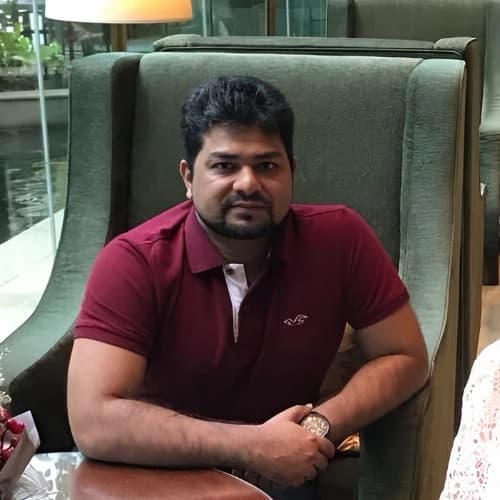
The proof closest to your situation is VCapture Photography. Vishnu Jayan, a well-known photographer from Kerala, came to us in 2024. He believed he needed a full mainland setup costing AED 25,000 or more. Our General Manager, Vipin Kumar, reviewed his actual work and recommended an E-Trader License instead. His license was issued in 24 hours for an initial AED 1,070. He booked his first client within a week. He now earns AED 25,000 or more a month from corporate and event work, including clients such as Damac, and has since upgraded his license. "Best Solution did not just save me money, they saved me from making the wrong decision," he says. For pure speed, the same channel-partner advantage delivered a two-day license for Clear View Group, founded by Switzerland-based entrepreneur Kristian Khachatourian.
Ready to choose the right structure?
Book a free eligibility check with Best Solution. We map your full 12-month scope, recommend the right license and permit stack, and file directly with our channel-partner zones — most clean applications issued in two working days.