Most guides on opening a restaurant in Dubai skip the number you actually care about: what it really costs, and where the money goes. So here it is, up front. The trade licence is the cheap part, roughly AED 10,000 to AED 15,000. The real spend depends on your concept. A small cafe or cloud kitchen typically runs AED 120,000 to AED 250,000. A casual dining restaurant in a mall or on a high street is closer to AED 250,000 to AED 600,000 or more. A premium, branded concept in a prime location can run from AED 600,000 well past AED 2 million. If dine-in is not essential, a cloud kitchen shares most rules at lower cost.
Dubai rewards operators who plan for that number, and it punishes those who do not. Gulf Business reports that close to 60% of new restaurants close within their first year, most of them undone by rushed licensing and thin budgeting rather than bad food. This guide gives you the real cost, the exact licence sequence and the failure points that catch first-time owners, so you commit your capital with your eyes open. Restaurants hire in volume, so plan your business visa options early.
| Question | Short Answer |
|---|---|
| What does it cost? | Licence AED 10,000-15,000; full first-year setup typically AED 150,000-250,000 |
| Which licences? | Two: a DET trade licence and a Dubai Municipality food licence (run them in parallel) |
| Mainland or free zone? | Mainland for serving the public anywhere in Dubai; free zone for delivery-only or cloud kitchens |
| How long? | Roughly 3-6 months, most of it fit-out and inspection, not paperwork |
| Foreign ownership? | 100% allowed; the old 51% Emirati-partner rule no longer applies to standard F&B |
How much does it cost to open a restaurant in Dubai?
Quick answer
It depends on your concept. A small cafe or cloud kitchen typically costs AED 120,000 to AED 250,000. A casual dining restaurant runs AED 250,000 to AED 600,000 or more. A premium branded venue can exceed AED 2 million. The trade licence alone is just AED 10,000 to AED 15,000; the rest is kitchen fit-out, municipality approvals, rent, visas and working capital.
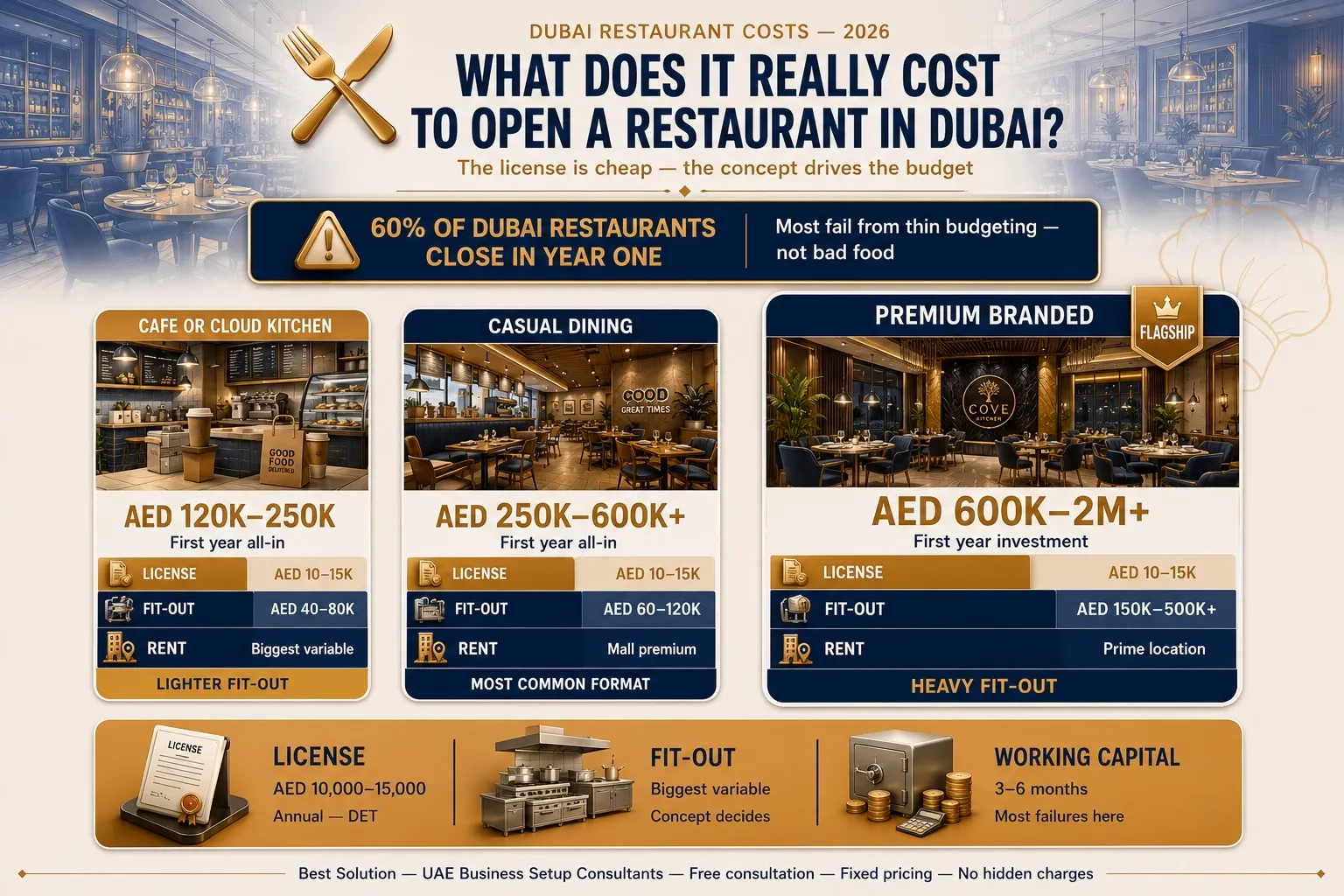
The AED 150,000 to 250,000 figure other guides quote is really an entry assumption, not a typical sit-down restaurant. In practice the cost tracks your concept, your location and your kitchen requirements. Here is the realistic 2026 picture our consultants see:
| Concept | Realistic All-In Cost (AED) | Notes |
|---|---|---|
| Small cafe / cloud kitchen | 120,000 - 250,000 | Lighter fit-out; delivery-first options cut rent |
| Casual dining (mall or high street) | 250,000 - 600,000+ | Most common first restaurant |
| Premium / branded concept (prime location) | 600,000 - 2M+ | Heavy fit-out and design |
Within any concept, the line items below are where the money goes. Government fees and rents move, so treat these as planning ranges, not quotes.
| Cost Item | Indicative Range (AED) | Notes |
|---|---|---|
| DET trade licence | 10,000 - 15,000 | Annual; varies by activity and concept |
| Dubai Municipality food licence & approvals | 5,000 - 10,000 | Includes kitchen plan review and inspection |
| Initial approval, MOA, Ejari registration | 5,000 - 12,000 | Notarisation and lease registration |
| Kitchen fit-out & equipment | 60,000 - 120,000 | The biggest variable; depends on size and concept |
| Annual rent (varies by area) | Deposit + cheques | Downtown far higher than Deira or Al Karama |
| Investor & staff visas | 4,000 - 8,000 each | Plus Occupational Health Cards for food staff |
| Working capital (3-6 months) | Plan a buffer | Most failures are cash-flow, not concept |
For comparison, cafe and quick-service formats are lighter on every line: a cafe licence sits closer to AED 10,000 to 15,000 and a smaller cafeteria setup can open for AED 80,000 to 120,000. If your concept is delivery-first, a cloud kitchen in Dubai cuts rent and fit-out dramatically. For a wider view of setup economics, see our guide to the cost of starting a business in Dubai . Fit-out and licensing push the cost of starting a business higher for food venues. The core steps follow our guide on how to start a business in Dubai.
The costs first-time owners underestimate most
From what our F&B consultants see, the budget rarely breaks on rent or the licence. It breaks on the compliance work clients did not price in. The five we flag every time:
- PRO and government processing: per-employee visa processing, labour and immigration file setup, and ongoing quota management.
- Dubai Municipality approvals: food-safety and kitchen-layout approvals, plus re-inspection fees after modifications, which are very common.
- Civil Defence approvals: fire-safety systems, exhaust and ventilation compliance.
- Fit-out compliance: rework after inspection feedback, material-compliance adjustments, HVAC and grease-trap requirements.
- External consultants: food-safety consultants (often mandatory for certain concepts) and architectural drawing revision cycles.
The real surprise
It is almost never the rent or the licence. It is a compliance-driven redesign after inspection feedback. That single item is what pushes restaurants over budget, which is why feasibility has to come before you finalise the design.

Don't Risk Costly Redesigns
A single kitchen layout mistake can cost you AED 40,000+ in regulatory rework. Let our F&B experts review your concept before you sign a lease.
How to open a restaurant in Dubai: the 10-step process
Opening a restaurant in Dubai is a sequence, not a checklist you can shuffle. Do the steps out of order and you will pay for a lease you cannot licence, or fit out a kitchen the Municipality later rejects. Follow them in this order.
- Lock your concept and business plan. Define the cuisine, the target diner (families, young professionals, luxury), and the numbers: startup cost, monthly running cost and a realistic revenue forecast. Banks and landlords will ask for this.
- Choose your legal structure. For most restaurants a Dubai mainland LLC is the right call: it lets you serve the public anywhere in the emirate and now allows 100% foreign ownership. See setting up on the Dubai mainland .
- Reserve your trade name. It must be unique and follow DET naming rules (no offensive terms, no authority names). We can check and reserve it through our trade name registration in Dubai service.
- Get initial approval. This is the DET's no-objection certificate confirming it approves your activity and trade name. It lets you lease premises and draft legal documents.
- Draft your MOA and secure a location (Ejari). The Memorandum of Association sets out ownership and must be notarised. Then sign a tenancy contract and register it on Ejari, the government lease portal. The Ejari certificate is mandatory for the trade licence.
- Get your restaurant trade licence. With initial approval, a signed MOA and Ejari in hand, submit the final application to the DET. This licence legally lets you operate.
- Secure the food licence and kitchen approval. This is the non-negotiable step, run by the Dubai Municipality Food Safety Department. Submit your kitchen layout plan (space, ventilation, drainage, equipment placement), comply with the Dubai Food Code, and pass a Municipality inspection before the final permit is issued.
- Apply for additional permits. Depending on your concept: a liquor licence (to serve alcohol), a Civil Defense certificate (fire safety) and a signage permit for your external board.
- Process visas and hire staff. Apply for your investor visa, then sponsor employee visas for chefs, servers and managers. Every food handler needs food safety training and an Occupational Health Card.
- Open a corporate bank account. The final step lets you take card payments and keep clean records. This is often the slowest part for restaurants; our business bank account in Dubai support uses direct bank relationships to speed it up.
What licences do you need to open a restaurant in Dubai?
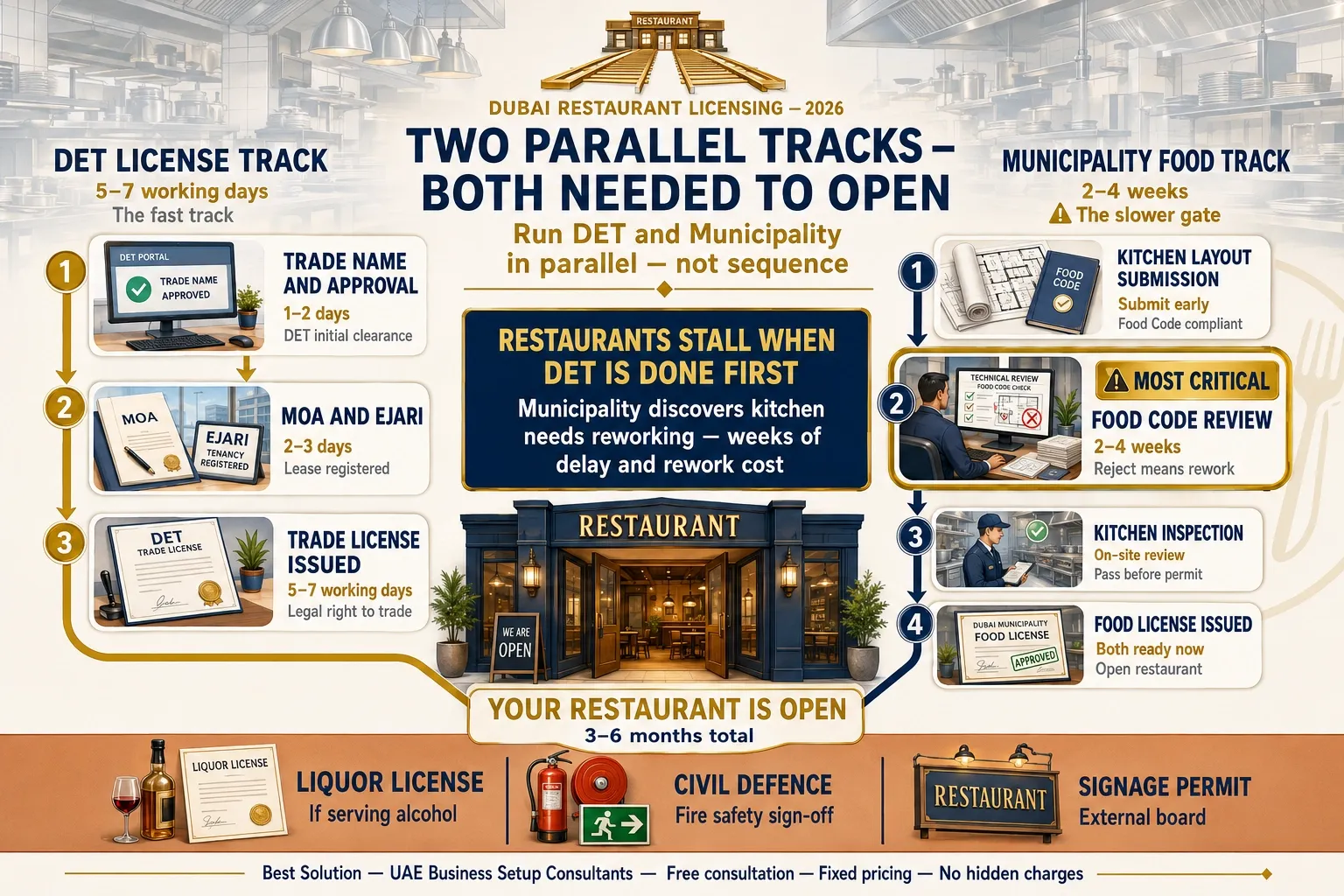
You need two licences, and they come from two different authorities. Treat them as parallel tracks, not a single line. Restaurants stall when owners finish the trade licence and only then discover the kitchen plan needs reworking for the Municipality.
| Licence / Track | Issued By | Covers |
|---|---|---|
| Trade licence (commercial) | Department of Economy and Tourism (DET) | Your legal right to trade; states your activity and structure |
| Food licence (food safety) | Dubai Municipality Food Safety Department | Kitchen layout approval, Food Code compliance, inspection |
| Liquor licence (optional) | Licensed channel / Dubai Police | Required only if you serve alcohol |
| Civil Defense certificate | Dubai Civil Defense | Fire-safety systems sign-off |
Restaurant licences also come in different forms depending on where and how you operate:
| Licence Type | Best For | Key Point |
|---|---|---|
| Mainland restaurant licence | Serving the public anywhere in Dubai | DET-issued; needs commercial space and Ejari |
| Free zone restaurant licence | 100% foreign ownership, lower entry | Operations limited to the free zone |
| Cafeteria / cafe licence | Quick meals, smaller footprint | Lower cost and space than a full restaurant |
Mainland vs free zone restaurant: which should you choose?
This is the decision that shapes your cost and your reach, and most guides skip the trade-off. The short version: if you want walk-in diners anywhere in Dubai, go mainland. If you are delivery-only or testing a concept on a tight budget, a free zone or cloud kitchen can work.
| Factor | Mainland | Free Zone |
|---|---|---|
| Where you can serve | Anywhere in Dubai, dine-in welcome | Inside the free zone; dine-in often limited |
| Foreign ownership | 100% for standard F&B | 100% |
| Setup cost | Higher (commercial rent + Ejari) | Often lower; packaged options |
| Best fit | Sit-down restaurants, cafes with footfall | Cloud kitchens, delivery brands, lean launches |
| Authority | DET + Dubai Municipality | Free zone authority + Municipality food rules |
Still weighing it up? Our detailed free zone vs mainland in Dubai guide walks through the trade-offs for your specific concept and budget.
How long does it take to open a restaurant in Dubai?
Quick answer
Plan for roughly 3 to 6 months from decision to opening day. The paperwork (initial approval, trade licence, food licence) is usually the fast part. The slow part is finding the right premises, the kitchen fit-out and passing inspection.
In practice, the trade licence itself moves fast. The clock is set by approvals, fit-out and inspection. Here is the realistic phasing we see for a casual dining café on the Dubai mainland:
| Phase | Realistic Time |
|---|---|
| Trade licensing | About 5 to 7 working days |
| Dubai Municipality approvals | About 2 to 4 weeks |
| Fit-out and inspections | About 6 to 10 weeks |
| Total operational readiness | About 8 to 12 weeks |
Concepts that serve alcohol, sit in a prime location, or need heavy kitchen work run longer. The single biggest time saver is validating feasibility before you finalise the design, so you avoid re-submission rounds.
Documents required to open a restaurant in Dubai
Have these ready before you apply. Missing paperwork is the most common cause of delay:
- Trade licence copy (once issued), confirming your approved activity
- Restaurant layout / blueprint showing kitchen, storage, washroom and ventilation, for Dubai Municipality review
- Food safety and hygiene plan, especially for dine-in and central kitchens
- No Objection Certificate (NOC) from the landlord if you are renting
- Ejari (registered tenancy contract)
- Passport copies of the investor and shareholders
- Investor visa copy
- Two passport-size colour photographs
- Business plan (often requested by banks and partners)
- Any extra permits: liquor, shisha or pork-handling, depending on concept
Requirements vary slightly between mainland and free zone, and by the size and services of your setup. A quick check with a setup advisor keeps you compliant from day one.
Choosing the right location in Dubai
Where you open can make or break the venue. Match the area to your concept, your diner and your rent budget:
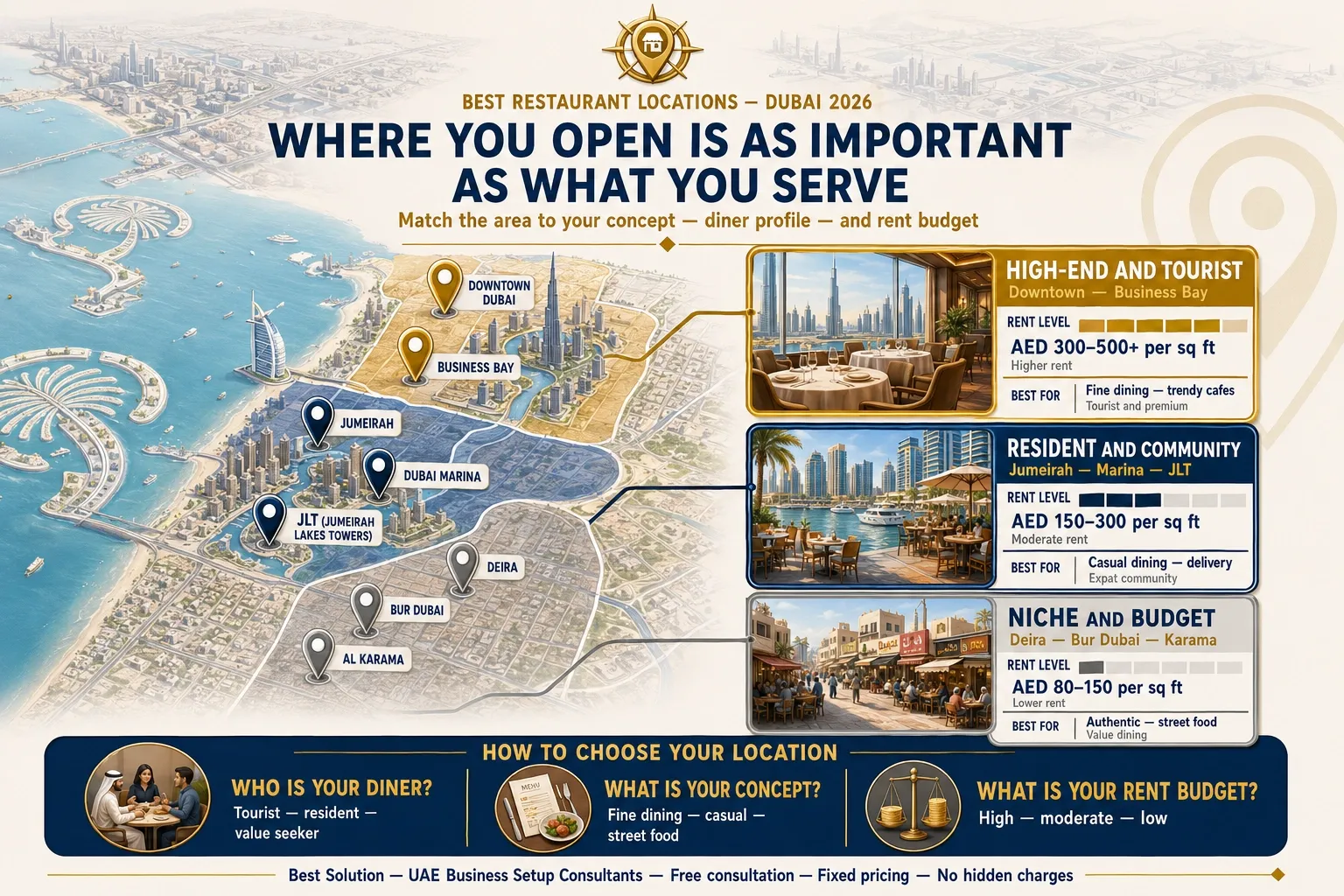
High-end and tourist traffic (higher rent)
- Downtown Dubai and Business Bay: fine dining, trendy cafes and concepts aimed at tourists and high-income professionals.
Resident and community footfall (moderate rent)
- Jumeirah and Umm Suqeim: family-friendly and casual dining for affluent long-term residents.
- Dubai Marina and JLT: dense young-professional and expat base; strong for casual dining and delivery-focused kitchens.
Niche and budget-friendly (lower rent)
- Deira and Bur Dubai: authentic, traditional cuisines for a diverse, value-conscious crowd.
- Al Karama and Oud Metha: lively street-food scene and residents hunting flavour and value.
Mistakes that quietly sink new Dubai restaurants
The licensing path is well-trodden. The reasons restaurants fail are not always obvious, and most competitor guides will not tell you. From what we see on the ground:
The misconception that causes most delays
Once I get a licence, I can open a restaurant." In reality, a restaurant opens only after licensing, municipality approval, Civil Defence sign-off and fit-out compliance all line up. Most delays are not licensing delays. They are approval-alignment issues discovered too late.
- Signing a lease before initial approval. The space looks perfect, but the activity or location does not get approved, and the rent clock is already running.
- Designing the kitchen before reading the Food Code. The Municipality rejects the layout, and you pay twice to rebuild ventilation and drainage.
- Budgeting for the licence, not the fit-out. The AED 12,000 licence is easy; the AED 100,000 kitchen and three months of rent before opening are what break the budget.
- Underestimating the bank account timeline. Card payments depend on it, and for F&B it is often the slowest approval. Start it early.
- Skipping working capital. Gulf Business links most first-year closures to weak planning and cash flow, not the concept itself. Plan three to six months of running costs.
The mistake we see most:
Finalising the concept and interior design before confirming kitchen and municipality feasibility. Founders lock the design, submit for approval, then discover compliance changes are required. The result is layout redesigns, higher fit-out cost, and approval delays of two to eight weeks across re-submission cycles. In F&B, regulatory feasibility has to come before design is finalised.
A real example
A specialty cafe and bakery brand came to us having already signed a fit-out concept for a high-footfall mainland retail zone. The design did not meet ventilation and kitchen-zoning requirements. We revised the kitchen layout before the municipality submission, adjusted the activity classification to match the food-preparation scope, and reworked the documentation to align with inspection requirements before anything was built. The licence was issued within the standard processing time, the client avoided an estimated AED 40,000 to AED 80,000 in redesign and rework, and we removed the re-submission rounds entirely. The value was not speed. It was avoiding rework.
Why work with Best Solution
Opening a restaurant in Dubai can feel daunting, but the complexity is exactly what we remove. We have been handling UAE business setup since 2014, with more than 5,000 company formations and over 4,500 banking applications supported across F&B, retail and hospitality. That depth matters in restaurants, where success depends on coordinating four moving parts at once: licensing, Dubai Municipality, Civil Defence and banking. Our team, led by industry veterans including Essa Al Harthi, runs the full path so you can focus on the food and the guests. Explore our business setup consultants in Dubai service, or book a free, no-obligation consultation to validate your concept before you commit to a lease. Many operators limit risk by forming an LLC for the venue.
| Best Solution at a Glance | |
|---|---|
| UAE business setup since | 2014 |
| Company formations supported | 5,000+ |
| Banking applications assisted | 4,500+ |
| Sector experience | F&B, retail and hospitality licensing |
| End-to-end coordination | Licensing, municipality, Civil Defence and banking |