Most people who set out to open a cloud kitchen in Dubai start in the wrong order. They find a shared kitchen unit, agree a monthly rate, pay a deposit, and only then ask which licence they need. By the time the paperwork is moving, the money is already committed, and that is exactly where cloud kitchens get into trouble. Since orders come through apps, an e-commerce licence often pairs with a cloud kitchen.
A cloud kitchen (also called a ghost kitchen, dark kitchen, or virtual kitchen) is a delivery-only food business with no dine-in space. You cook, you list on Talabat and Deliveroo, and you ship. The model is genuinely cheaper to enter than a restaurant. But in Dubai the rules around food are precise, and the cheapest part of the setup, the licence, is the part most likely to cost you weeks of lost trading if you get the structure wrong.
This guide walks through exactly what you need: the right licence, the permits that make the business legal, the real all-in cost, and the specific decisions (mainland vs free zone, shared vs standalone) that determine whether you launch in nine weeks or stall for three months.
| Question | Straight Answer |
|---|---|
| Licence type? | Dubai mainland (DED) food licence. A free-zone licence cannot legally operate a cloud kitchen in Dubai. |
| Permits? | DED trade licence + Dubai Municipality food establishment permit + Civil Defence clearance for the kitchen. |
| Realistic all-in (year 1)? | AED 25,000 to 35,000 for a solo founder, one visa, shared kitchen. Standalone fit-out runs AED 120,000 to 250,000+. |
| How long? | DED licence in days; Municipality permit 15 to 25 working days. Plan launch around the permit, not the licence. |
| Best entry model? | Shared cloud-kitchen facility on a mainland food licence. Prove the concept, then scale to standalone. |
What a cloud kitchen is, and why Dubai is built for it
A cloud kitchen prepares food only for delivery. There is no shopfront, no seating, and no waiting staff, just a licensed commercial kitchen and one or more brands that exist on delivery apps. That single difference, no dine-in, is what strips out the biggest costs of a restaurant: prime-location rent, fit-out, and front-of-house payroll.
Dubai is one of the strongest cloud-kitchen markets in the world for reasons that are structural, not hype. More than 85% of residents are expats, which creates constant demand for a wide range of cuisines. Smartphone food ordering is a daily habit, and delivery platforms already own the logistics. You are not building an audience from scratch; you are plugging into one.
The numbers back this up. The UAE cloud-kitchen market is projected to grow from USD 430 million in 2025 to USD 1.08 billion by 2032, a 14.1% compound annual growth rate, according to Coherent Market Insights. That growth is also why the regulator now treats delivery-only kitchens as fully licensed food establishments, with the same inspection regime as any restaurant.
Cloud kitchen vs traditional restaurant: which model fits you
If you are weighing a cloud kitchen against a dine-in restaurant, the trade-off is simple: a cloud kitchen optimises for cost, speed, and scale, while a restaurant optimises for experience and brand presence. Here is how they compare on the factors that actually affect your decision.
| Factor | Cloud Kitchen | Traditional Restaurant |
|---|---|---|
| Start-up cost | Low (no dine-in fit-out) | High (location, interior, furniture) |
| Space & location | Small unit, low-rent area | Large, high-footfall, premium rent |
| Staffing | Kitchen team only | Kitchen plus service staff |
| Revenue source | Delivery platforms | Dine-in, takeaway and delivery |
| Scalability | High (multi-brand from one kitchen) | Limited by physical space |
| Time to break even | Faster | Slower |
| Main risk | Platform dependency | High fixed costs |
If your goal is a tested concept and premium positioning with walk-in customers, read our guide on opening a restaurant in Dubai instead. If your model is delivery-first, the cloud kitchen is the leaner route, and the rest of this guide is for you. Cloud kitchens share most food rules with a full venue, so our guide to opening a restaurant is a close read.
Mainland or free zone for a cloud kitchen in Dubai?
Mainland, without exception. A cloud kitchen needs a Dubai Municipality food establishment permit, a Civil Defence clearance for the kitchen premises, and a food activity under a Dubai DED licence. All three are mainland authority processes tied to a physical address. A free-zone licence cannot hold those permits, so it cannot be the operating entity for a cloud kitchen in Dubai.
Why this matters
This is the single most common piece of bad advice in the market. A consultant who quotes you a cheap free-zone food licence is usually pricing the licence without the approvals that make the business legal to operate.
Words By Essa
Any consultant steering a cloud-kitchen prospect toward a free-zone licence is either misinformed or quoting the cost without accounting for the approvals that make the business functional.

Founder, Best Solution
There is one nuance worth understanding. In a shared cloud-kitchen facility, the operator usually holds the master DED food licence and the Municipality and Civil Defence approvals for the premises. Your brand then takes a sub-licence or a separate food establishment permit registered to that address. The exact arrangement varies by facility, which is why the facility's licensing structure should be reviewed before you decide how your own entity is set up.
Which licences and permits you actually need
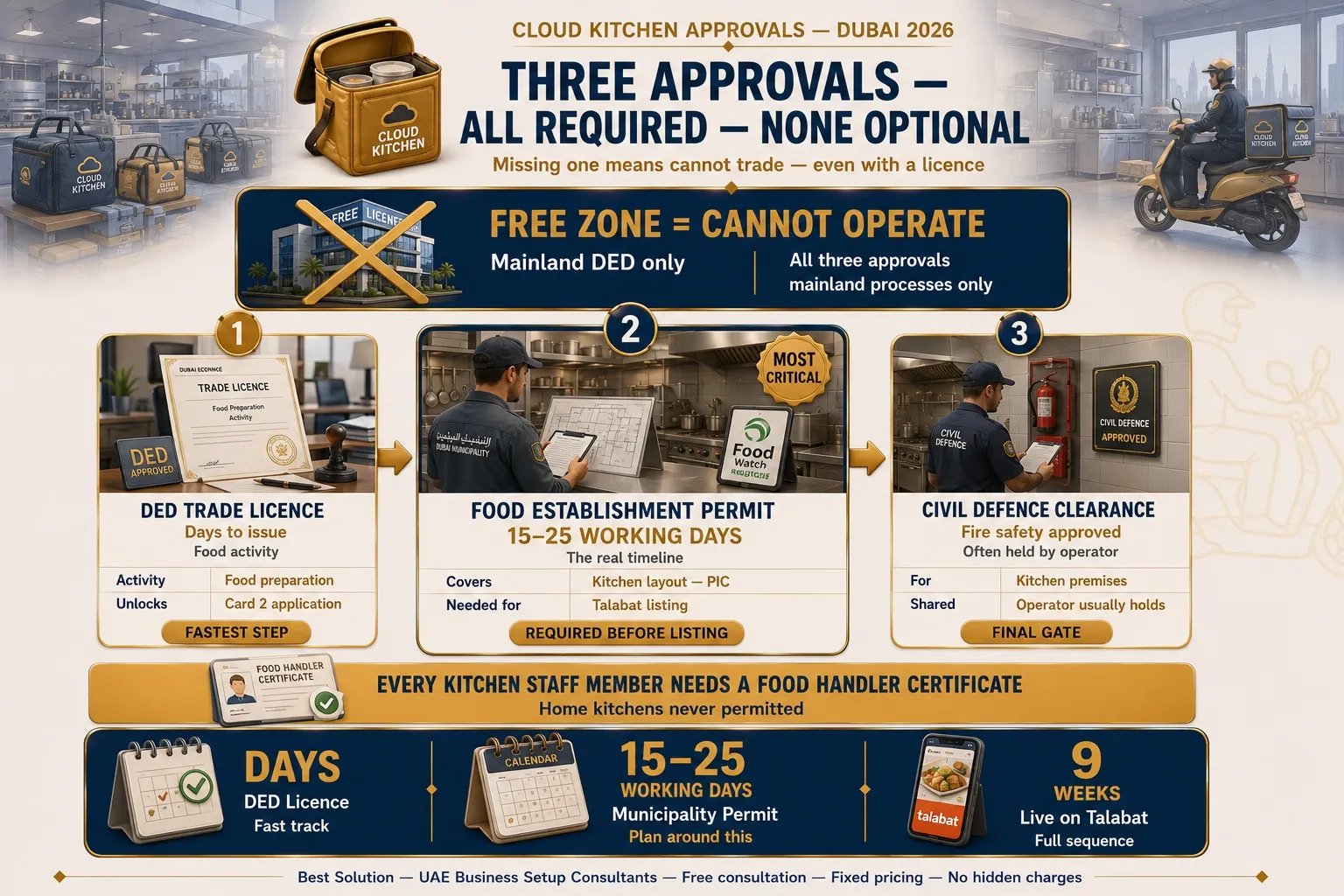
Three approvals, in this order of importance, make a cloud kitchen legal in Dubai. Missing any one of them means you can hold a licence and still be unable to trade.
| Approval | What It Is and Who Issues It |
|---|---|
| DED trade licence | The commercial licence with a food activity such as 'Preparation and Sale of Foodstuff', issued by the Dubai Department of Economy & Tourism (DET/DED). |
| Food establishment permit | Mandatory food-safety approval from Dubai Municipality's Food Control Department: kitchen layout sign-off, Food Watch registration, a named Person in Charge (PIC), and compliance with the Dubai Food Code. |
| Civil Defence clearance | Fire and safety approval for the kitchen premises. In a shared facility the operator usually holds this already. |
| Food handler certificates | Each kitchen staff member must hold a valid food-handler certificate; home kitchens are never permitted for commercial operations. |
Food-safety approval runs through Dubai Municipality's Food Watch platform, and inspections follow the Dubai Food Code. These are not one-time approvals: a cloud kitchen is inspected on the same risk-based schedule as any food establishment, so compliance is an ongoing operating requirement.
Step-by-step: setting up a cloud kitchen in Dubai
- Lock your food concept and a delivery-friendly menu (dishes that travel well).
- Choose your structure: a Dubai mainland sole establishment or LLC under the DED.
- Reserve your trade name and secure initial approval from the DED.
- Run a regulatory feasibility review of your chosen kitchen facility before you sign anything.
- Sign the kitchen lease or sub-licence once the premises approvals are confirmed.
- Apply for the DED food licence and the Dubai Municipality food establishment permit in parallel.
- Confirm Civil Defence clearance for the premises (often held by the facility operator).
- Open a corporate bank account with a clean file: licence, menu, tenancy and a simple revenue projection.
- Onboard with delivery platforms (the food permit is required before listing is confirmed).
- Launch, then manage ongoing inspections, food-handler certification and renewals.
How much does it cost to start a cloud kitchen in Dubai?
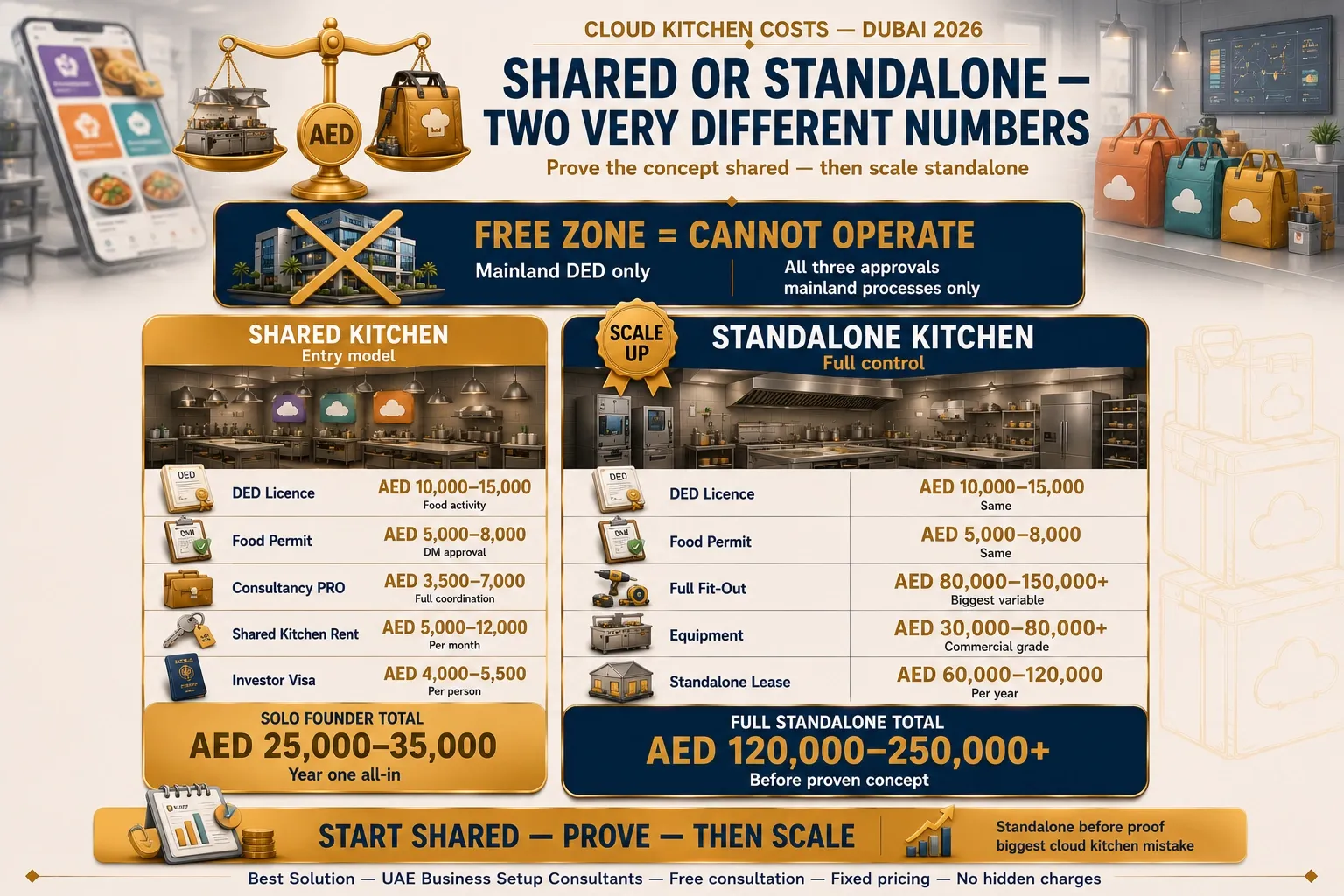
Costs vary with three things: whether the kitchen is shared or standalone, how many food activities you licence, and how many visas you need. There is no single packaged price, so here are the real ranges rather than a headline number.
| Cost Item | Shared Facility (Typical) | Notes |
|---|---|---|
| DED trade licence | AED 10,000 to 15,000 | Food activity under DED/DET |
| Food permit & inspections | AED 5,000 to 8,000 | Dubai Municipality |
| Consultancy & PRO (our fee) | AED 3,500 to 7,000 | Authority coordination, documents, PRO |
| Shared kitchen rent | AED 5,000 to 12,000 / month | Operator holds the fit-out |
| One investor visa | Included in all-in below | Medical, Emirates ID, establishment card |
| Extra staff visa | AED 4,000 to 5,500 each | Kitchen / delivery staff |
Best Solution all-in benchmark (from real client invoices)
Independent market guides put a mainland licence at roughly AED 16,000 to 25,000 and a full small-kitchen setup at AED 30,000 upward depending on equipment, per Shuraa. For a wider view of what business setup costs in the emirate, see our cost of starting a business in Dubai guide. The core steps match our guide on how to start a business in Dubai.
Shared vs standalone kitchen, and the sub-licence trap
For a first concept, a shared cloud-kitchen facility is almost always the right call. The operator already holds the fit-out, the equipment, and usually the premises approvals, so your start-up cost and your risk both drop sharply. A standalone kitchen gives you more control and scalability, but you are paying for fit-out, ventilation, and equipment before you have proven a single dish on the delivery market.
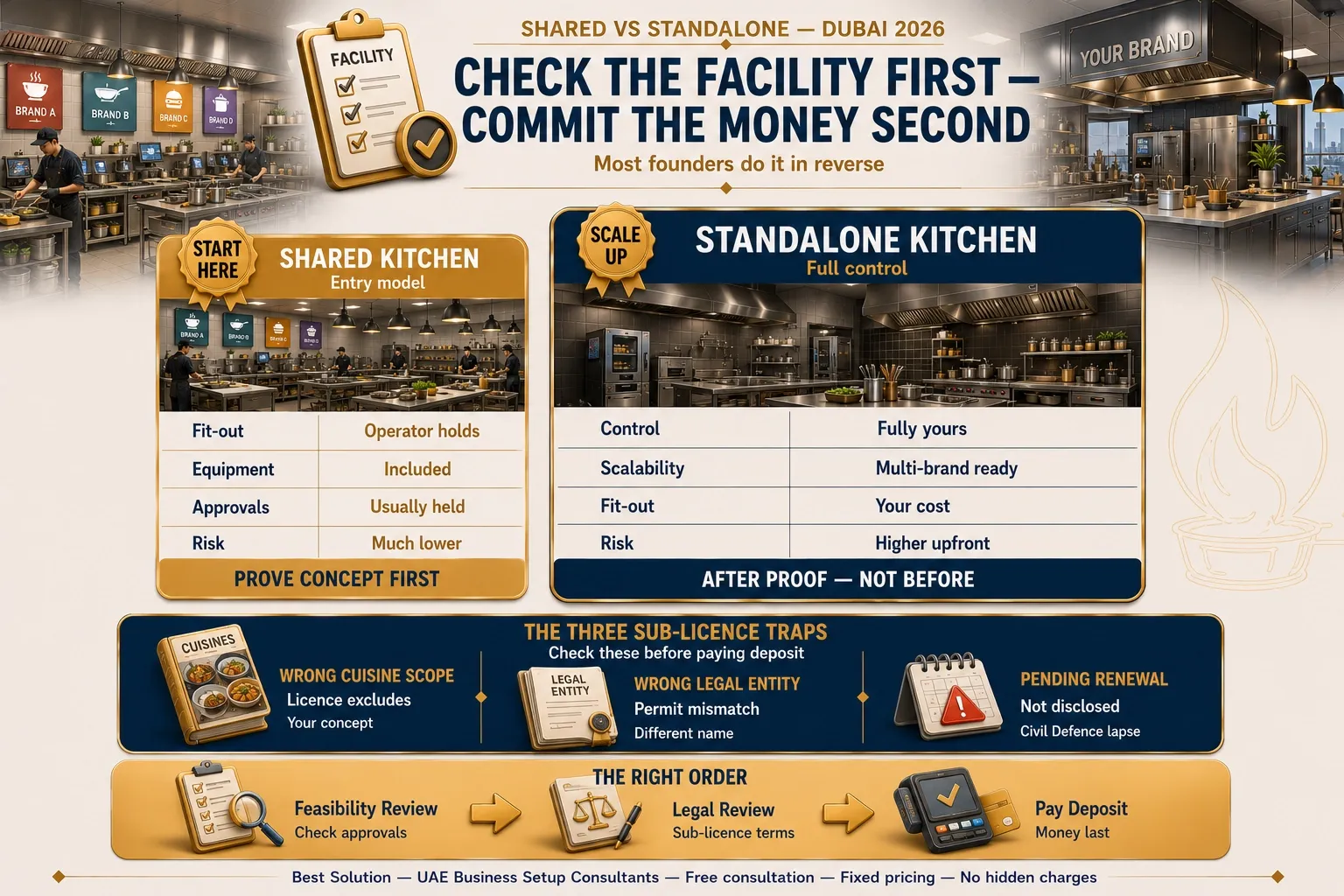
The trap sits in the sub-licence. Before you commit money to any shared facility, confirm that its existing permits actually cover your concept. The three failure modes we see most often:
- The master food licence covers only certain cuisine categories, and your concept falls outside them.
- The Municipality permit is registered to a different legal entity than the one you are sub-licensing from.
- The Civil Defence approval has a pending renewal that the facility has not disclosed.
In every one of those cases the founder has usually already paid a deposit and a first month before the regulatory position was checked. The fix is sequencing: feasibility review of the facility first, legal review of the sub-licence second, financial commitment last. Most people do it in reverse because the kitchen slot feels urgent and the licence feels like paperwork that follows.
Getting listed on Talabat, Deliveroo, Noon and Careem
Your revenue lives on the aggregators, so platform onboarding is part of the launch, not an afterthought. Talabat, Deliveroo, Noon and Careem each handle logistics, payment, and a built-in customer base in exchange for a commission. One detail trips up new founders: the platforms require your Dubai Municipality food permit before they confirm a listing. If you plan your launch date around the licence date and the permit is still in process, your go-live slips.
Single brand or multi-brand: choosing your model
A cloud kitchen can run one strong brand or several virtual brands from the same kitchen. Multi-brand is the model's biggest advantage: you can serve burgers, a healthy bowl concept, and a dessert brand from one licensed space and one team, multiplying revenue without multiplying overhead. Whichever you choose, two things decide profitability. Menu engineering matters because dishes have to travel well and hold quality in a delivery bag, and packaging is part of the product because it is the first physical thing your customer touches.
A real Dubai cloud kitchen setup (Best Solution case study)
A founder came to us with a Pakistani home-cooking concept: three cuisines on one menu, desi comfort food, delivery-only, no storefront. He had already found a shared kitchen in Al Quoz and lined up a chef. His plan was to add a food activity to a free-zone trading licence he had set up the year before and go live.
Two problems surfaced immediately. Operating food from that shared kitchen required the food licence to be registered to the specific kitchen address under a mainland DED structure, which his free-zone entity could not do. And his existing trading licence carried activity descriptions that would have created a conflicting business profile at the bank the moment food revenue started flowing.
We structured a new Dubai mainland sole establishment with the activity 'Preparation and Sale of Foodstuff', ran the Dubai Municipality food-safety approval in parallel with the licence application, and coordinated the Civil Defence clearance through the kitchen operator, who held their own fit-out approvals. That parallel sequencing is what compressed the timeline.
Dubai Food Business Setup: DED Licence, Municipality Permit & Talabat in 9 Weeks
Mistakes that close cloud kitchens early
Dubai did see a wave of cloud-kitchen closures in 2023 and 2024. Most were not caused by bad food. They were caused by operators who overcapitalised on standalone fit-outs and underestimated the cost of acquiring customers on delivery apps. Two setup mistakes do the most damage, and both are avoidable.
First, committing to a kitchen before checking its approvals (covered above). Second, underestimating the Municipality timeline. Founders budget for the DED licence, which can move in under a week, and forget the food establishment permit, which runs 15 to 25 working days and longer if the kitchen layout or ventilation documentation needs revision.
A business that is licensed but not Municipality-approved cannot legally operate or list on Talabat and Deliveroo. We have seen kitchens shut down in their second month because the food permit was not correctly tied to the operating entity. The honest framing for any founder: the setup cost is not what decides whether a cloud kitchen succeeds, but a setup done incorrectly is the single thing most likely to close it early.
Before you commit money: a 60-second checklist
Best Solution sets up Dubai cloud kitchens end to end: structure, DED licence, Municipality and Civil Defence approvals, visas, banking and platform onboarding. Talk to our team for a feasibility review of your concept and kitchen facility before you commit a single dirham.