Most people researching how to start a jewellery business in Dubai have already been handed a quote that looks too good to be true. A setup agent promises a gold or jewellery licence for a few thousand dirhams, and the real costs surface later: the visa, the office, the security approval, the AML registration, the bank account that takes weeks. That gap between the advertised licence price and the true all-in cost is where most first-time owners lose money and confidence. The groundwork mirrors our guide on how to start a business in Dubai.
This guide removes the guesswork. It walks through the licence options, the choice between a free zone and the mainland, the real budget you should plan for, and the approvals you cannot skip when you trade in gold, diamonds or precious stones. The aim is simple: by the end you should know what you are committing to before you spend a dirham.
Dubai lets foreign investors own a jewellery business outright. You choose a free zone (best for wholesale and export) or the mainland (best for retail), pick a trade licence and activity, then layer on the compliance the gold trade demands. The licence alone runs about AED 15,000-25,000, but the realistic first-year all-in cost is higher once visas, office, security and the bank account are included
| Decision | Quick Answer |
|---|---|
| Can a foreigner own it? | Yes - 100% ownership in free zones and most mainland jewellery activities. |
| Free zone or mainland? | Free zone (DMCC / Gold & Diamond Park) for wholesale and export; mainland (DET) for retail shops. |
| Licence cost | ~AED 15,000-25,000/year for the trade licence itself. |
| Realistic all-in (year 1) | Plan for materially more once visa, office, security and bank are added. |
| Hardest step | The corporate bank account - gold traders face heavy AML scrutiny. |
How do you start a jewellery business in Dubai?
To start a jewellery business in Dubai, choose your jurisdiction (a free zone such as DMCC, or the mainland under the Department of Economy and Tourism), select a jewellery or gold-trading activity, reserve a trade name, obtain initial approval, lease premises and register the tenancy, then pay for and collect your trade licence. After that you add the compliance the gold trade requires: hallmarking, AML registration, a corporate bank account and visas. Since jewellery is traded stock, many owners register as a general trading company. To sell freely in local malls, a Dubai mainland company gives the widest reach.
Why Dubai is built for the gold and jewellery trade
Dubai's nickname, the City of Gold, is earned. The emirate sits on a mature, regulated ecosystem for precious assets, anchored by the Dubai Multi Commodities Centre (DMCC), the Dubai Gold & Commodities Exchange (DGCX), the Dubai Gold Souk and the Gold & Diamond Park. Its position between Asia, Europe and Africa makes it a leading re-export hub for gold, diamonds and gemstones.
The commercial case is equally clear. There is no personal income tax, free zones allow full profit repatriation and zero import and export duties on gold, and the banking and secure-vaulting infrastructure is built for high-value commodity trade. The UAE jewellery market has continued to grow at a mid-single-digit annual rate. The point for a new entrant is not the headline numbers; it is that the supply chain, the regulators and the buyers all already exist here.
Free zone or mainland: which fits your jewellery business?
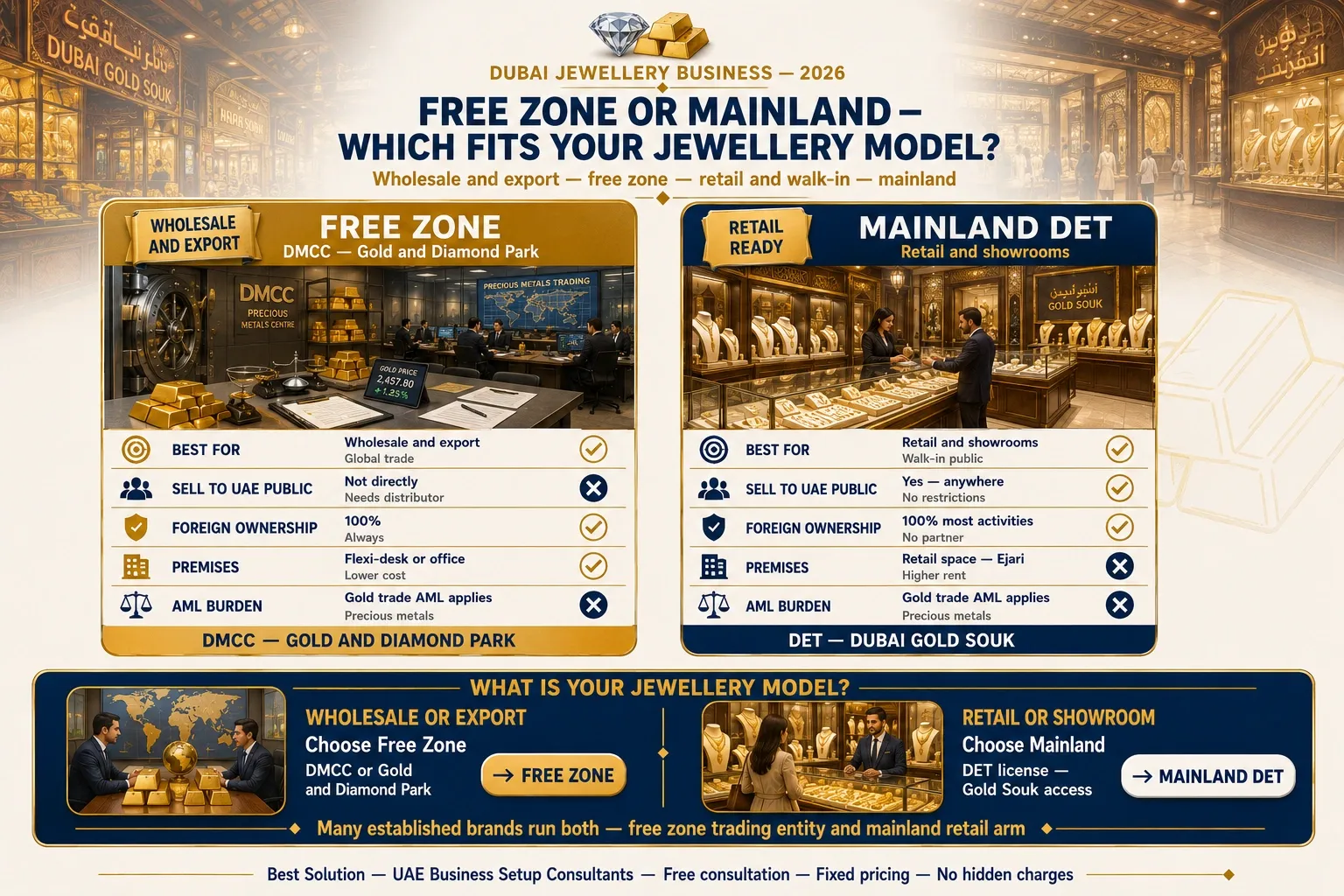
This is the decision that shapes your ownership, your costs and where you can sell. Get it right before you reserve a name, because switching later means re-licensing. Here is the honest trade-off.
| Factor | Free Zone (DMCC / Gold & Diamond Park) | Mainland (DET) |
|---|---|---|
| Ownership | 100% foreign ownership | 100% for most jewellery activities |
| Best for | Wholesale, import/export, gold & diamond trading | Retail shops, showrooms, local UAE sales |
| Sell direct to UAE public? | Not directly - needs a distributor or mainland arm | Yes, anywhere in Dubai |
| Duties | Customs/duty advantages, secure vaulting | Standard mainland rules |
| Setup cost | Comparable licence; bundled packages common | Comparable; premises can cost more |
When a DMCC or Gold & Diamond Park free zone licence wins
If your model is wholesale gold, diamond trading, or import and export to other markets, a free zone is usually the right home. DMCC is purpose-built for precious metals and stones, the Gold & Diamond Park is designed specifically for jewellery enterprises with on-site manufacturing and logistics, and neither requires a local sponsor. You keep full ownership and full profit repatriation.
When a mainland (DET) licence wins
If you want a shopfront - a boutique in a mall or a counter in the Gold Souk selling to the walk-in public - you need a mainland licence from the Department of Economy and Tourism. It gives unrestricted access to the local market and prime retail locations, at the cost of higher premises rent. Many established brands run both: a free-zone trading entity and a mainland retail arm. If you are still weighing the two, our free zone vs mainland comparison covers every activity type.
Choosing your jewellery trade licence and business activity
Your trade licence is defined by the exact activity you register. Pick the activity that matches what you will actually do, because it sets your approvals, your permitted scope and, for gold, your compliance obligations. On the mainland you choose from the DET approved-activity list; in a free zone you choose from that authority's list.
Gold and precious metals trading
A gold and precious metals trading licence covers buying, selling and wholesaling gold bullion and gold jewellery. This is the most regulated route: expect AML registration, source-of-funds checks and bank scrutiny. It is also the most monetisable activity, which is why so many consultancies advertise a gold trading licence in Dubai cheaply and recover the margin elsewhere.
Diamond and gemstone trading
Diamond and gemstone trading requires Kimberley Process compliance for rough and polished diamonds and documentation of ethical, conflict-free sourcing. DMCC's diamond ecosystem is the natural base. Partnering with certified diamantaires and insisting on GIA or equivalent certification protects both your buyers and your licence.
Retail, manufacturing, artificial jewellery and e-commerce
Not every jewellery business is gold bullion. A retail jewellery licence covers a showroom selling finished pieces. A manufacturing licence suits in-house design and production, well served by the artisans in the Gold & Diamond Park. An artificial or fashion jewellery business is the lowest-capital entry point - no precious-metal AML burden, lighter sourcing rules, and strong demand from Dubai's tourist and fashion market. An e-commerce activity lets you sell online to local and international buyers around the clock. Each of these is a distinct licensed activity, so confirm yours before you reserve a name.
Step by step: how to set up your jewellery business
The sequence below is the path for both jurisdictions. The order matters - you cannot lease premises before initial approval, and you cannot apply for visas before the licence is issued.
- Define your model and activity. Decide retail, wholesale, manufacturing, artificial jewellery or e-commerce - this drives jurisdiction, budget and licence type.
- Choose free zone or mainland. Wholesale and export lean free zone; retail leans mainland.
- Select your business structure. An LLC on the mainland, or an FZE / FZ-LLC in a free zone - both allow full foreign ownership for jewellery activities.
- Reserve your trade name. It must be unique, inoffensive and aligned to your activity; reserved through DET (mainland) or the free-zone authority.
- Apply for initial approval. Confirms no objection to your activity; required before you sign a lease.
- Prepare legal documents. Passport copies of shareholders, visa/entry stamp, trade-name certificate, initial approval, activity details and lease; plus MOA and Ejari on the mainland, KYC forms (and sometimes a business plan) in a free zone.
- Lease premises and register the tenancy. A showroom for retail or an office/warehouse for trading; the mainland tenancy is registered via Ejari.
- Pay for and collect your trade licence. Typically issued in 3-5 working days on the mainland and 2-7 in most free zones after documents clear.
- Open a corporate bank account. Mandatory before trading - and the step that needs the most preparation.
- Process investor and staff visas. Begins after the licence and establishment card are issued; quota depends on office size.
- Set up security and operations. CCTV, certified vault storage, Civil Defence compliance, stock insurance and verified, traceable supplier contracts.

Skip the Hidden Costs. Get an Honest Quote
Don't get caught off guard by unexpected visa, security, or banking compliance fees. Get a 100% transparent, itemized breakdown tailored to your specific jewellery business model.
What does it really cost to start a jewellery business in Dubai?
Here is the honest answer the cheap quotes leave out. The trade licence is only one line. The figure that matters is your first-year all-in cost, because a gold or jewellery business carries obligations a generic trading company does not - security, insurance and a bank account that takes real preparation.
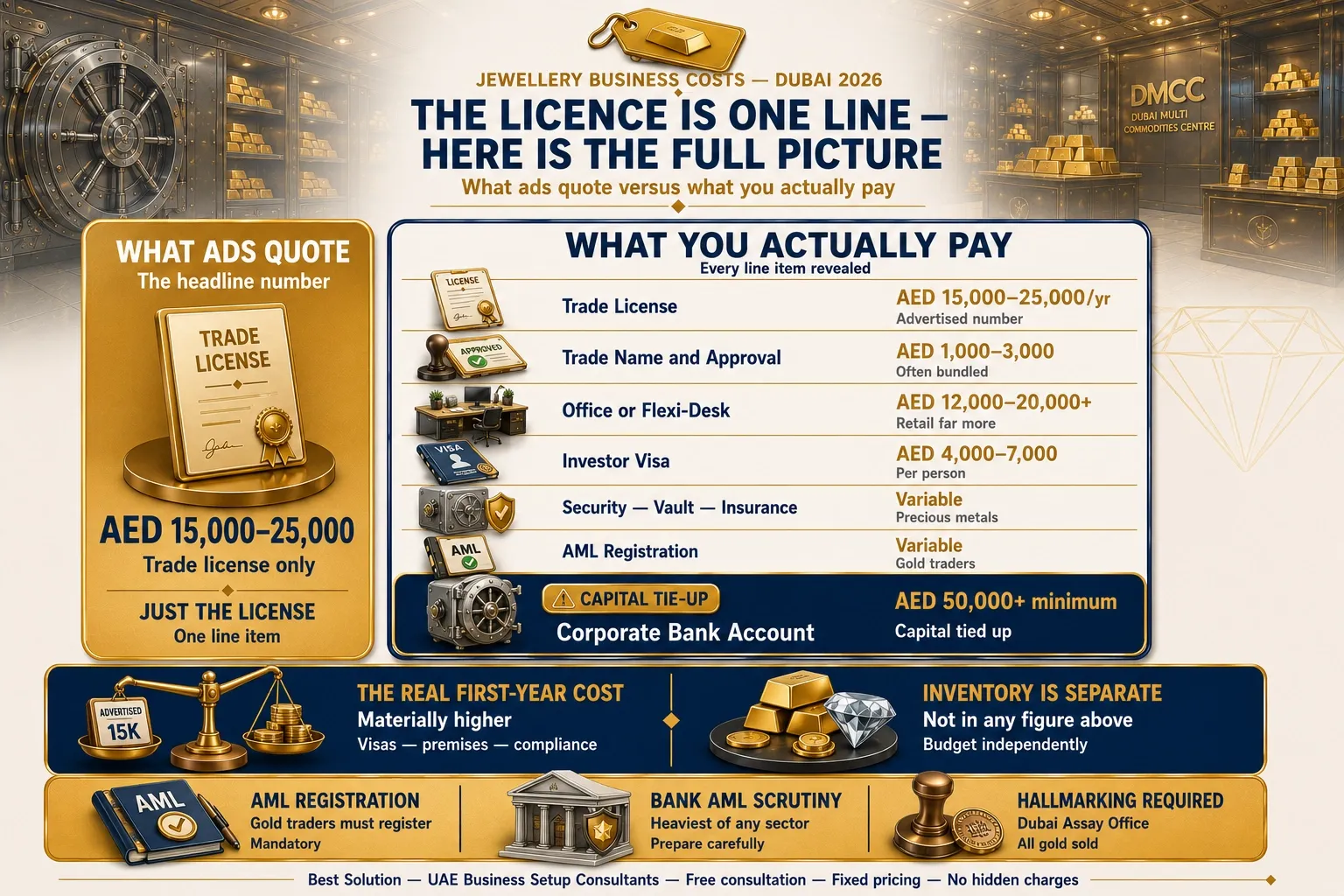
| Cost Line | Typical Range (AED) | Notes |
|---|---|---|
| Trade licence (DET or free zone) | 15,000-25,000 / yr | The figure most ads quote in isolation |
| Trade name + initial approval | 1,000-3,000 | Often bundled |
| Office / flexi-desk or retail | 12,000-20,000+ (flexi-desk) | Prime retail showrooms cost far more |
| Investor visa + establishment card | 4,000-7,000 per visa | Medical, Emirates ID, stamping included |
| Security, vault, insurance | Variable | Mandatory for precious-metal stock |
| AML registration & compliance | Variable | Required for gold/precious stones |
| Corporate bank account | Min. balance ~50,000+ | Held, not spent - but ties up capital |
The real number
Once you add visas, premises, security and compliance to the licence, a realistic first-year budget sits well above the advertised licence price - and inventory (your gold or diamond stock) is separate again. A low licence quote that ignores these lines is not cheaper; it just defers the cost. Best Solution gives a fixed, itemised all-in quote up front so there is nothing to discover later.
For a wider view of setup budgets across business types, see our cost of starting a business in Dubai guide. Pick the entity first by comparing the types of business structures.
Licences, approvals and compliance you cannot skip
Beyond the trade licence, the gold and jewellery trade is governed by several bodies. Missing one can delay your licence, block a sales channel or cost you a bank account.
- Hallmarking - Dubai Assay Office: all gold sold in Dubai must be hallmarked for purity. An assay certificate verifies fineness and is required by law.
- Kimberley Process Certification: mandatory for rough and polished diamond traders to prove conflict-free sourcing. The UAE is a participant.
- AML compliance: dealers in precious metals and stones must register and maintain anti-money-laundering controls and a basic risk assessment.
- Securities and Commodities Authority (SCA): the federal regulator overseeing commodity trade, including gold.
- Dubai Municipality, Dubai Police & the Gold and Precious Stones Office: external approvals some precious-metal activities require before launch.
- Dubai Customs registration: needed if you import or export stock.
- Dubai Gold & Jewellery Group (DGJG): not always mandatory, but membership signals credibility and unlocks market insight and networking.
AML in particular trips up new owners. Our AML compliance guide explains what regulators expect from precious-metal dealers.
Opening a corporate bank account for a gold or jewellery business
This is the step that derails timelines. Every UAE bank operates under Central Bank AML and KYC rules, and gold and precious-metal traders face the heaviest scrutiny of any sector. Banks ask for the trade licence, incorporation documents, shareholder passports, a business plan and clear source-of-funds evidence, and compliance teams can take weeks to approve - or reject - an application. Choosing a bank experienced in high-value commodity trade, and presenting a clean, well-prepared file, is the difference between trading in week three and waiting two months. Our how to open a corporate bank account in Dubai guide covers the documentation in detail.
How Best Solution sets up your jewellery business
Best Solution runs the whole sequence as one engagement rather than handing you a licence and leaving you to fight the bank and the regulators alone. Three things matter for a jewellery setup specifically:
- Fast approval through direct PRO relationships. We file initial approval and licensing through established channels at DET and DMCC, which keeps issuance to the shorter end of the timeline.
- End-to-end handling. Licence, AML registration, the corporate bank account and investor visas are managed together, so the dependencies between them do not stall your launch.
- Transparent all-in pricing. You get one fixed, itemised quote covering every line above - no headline licence price hiding the visa, security and compliance costs behind it.
Book a free consultation Tell us your model - retail, wholesale, diamonds or artificial jewellery - and we will map the right jurisdiction, the exact licence and a fixed all-in cost in one call. No obligation.