Key takeaways
| Question | Short answer |
|---|---|
| What does the government charge for a Dubai mainland licence? | On our files, about AED 12,000 for one shareholder and one trading activity. The fee moves with activity, legal form and licence type |
| What else sits on the licence side? | Dubai Chambers membership, a trade name, initial approval, small statutory fees and document charges. Together with the DET fee they run AED 15,000 to 18,000 |
| What is not in that figure? | Office rent, the market fee, Ejari, the establishment card, residence visas, health insurance and an adviser’s fee |
| What fee follows the rent? | The market fee: 5 per cent of the annual rent on your registered Ejari, collected when you renew |
| What do years one and two cost in total? | Year one AED 46,000 to 62,000. Year two AED 36,000 to 50,000. One stated specification, government and third-party costs only |
| What moves the number most? | Rent, visa count, general trading or regulated activities, and the legal form |
| Can I use a flexi desk? | Not for a standard Dubai mainland licence. DET expects an Ejari-registered office |
The licence fee on a Dubai mainland company is the smallest honest number in the budget, and the biggest source of confusion. A founder reads AED 12,000 on one website and AED 50,000 on another. Both can be right.
They measure different things. The first is what the government charges for the licence. The second is what it costs to run a company that can rent an office, sponsor a visa and open a bank account.
This page splits the two. It sets out the Dubai trade licence cost as the authorities publish it, then lists every line that sits outside, so you can test any quote line by line. Fees come from the Department of Economy and Tourism (DET), Dubai Chambers and the Dubai Executive Council, read in November 2026.
How much does a trade licence cost in Dubai?
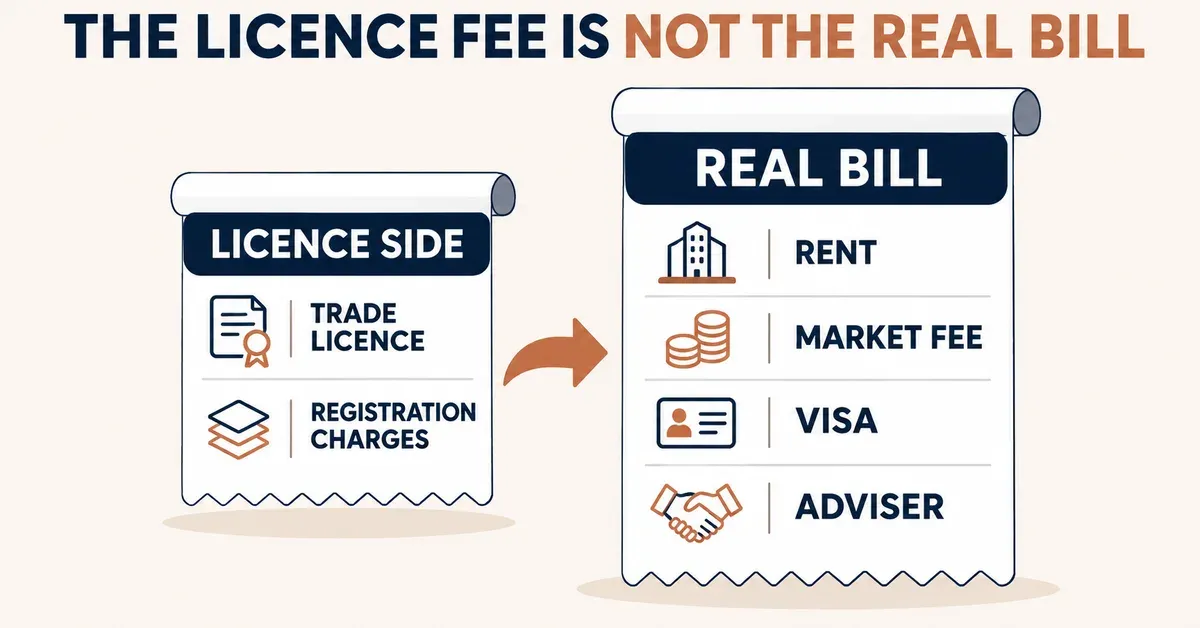
On our files, the government fee for a one-shareholder Dubai mainland licence with one trading activity is about AED 12,000 a year. With Chamber membership, a trade name, initial approval and small statutory fees, the licence side runs AED 15,000 to 18,000. Rent, visas and an adviser’s fee come on top.
Two points sit behind that answer. The DET fee follows the activity and the legal form, so a base figure is a floor, not a quote. And the licence is renewed each year, so the same lines return in year two.
The authority is DET, formerly the Department of Economic Development (DED). The product is the same, and people still search for a trade licence by the old name.
What DET and the Chamber charge, line by line
The licence side has several parts. Only the Chamber line is published as a clean schedule. The other lines are the ranges we see on real files, so check them against the live DET and Chamber tables before you rely on one.
| Line | What it is | Figure |
|---|---|---|
| DET licence fee | Annual fee for the licence, set by activity and legal form | About AED 12,000 |
| Dubai Chambers membership | Annual, by category | AED 500 to 1,200 (up to AED 2,200 for general trading) |
| Trade name | One-off on a new licence | About AED 600 |
| Initial approval | One-off on a new licence | AED 100 to 200 |
| Knowledge and innovation fees | Statutory, AED 10 each | AED 20 |
| Other lines | Memorandum of Association registration, notarisation and related charges | AED 1,500 to 3,500 |
| Total before rent and visas | AED 15,000 to 18,000 |
Specification: one shareholder, one trading activity, a new LLC filed in 2026. Sources: Best Solution files for the DET and other lines; Dubai Chambers membership page and Dubai Laws 1 and 2 of 2018, read November 2026.
The Chamber line is the one most quotes hide inside a lump sum. Dubai Chambers publishes it by category:
| Category | Annual membership fee |
|---|---|
| General trading | AED 1,200 to 2,200 |
| Banks, insurance, contractors, branches of foreign companies | AED 2,200 |
| Free zone companies | AED 2,200 |
| Lawyers, auditors, consultancy engineers | AED 1,000 to 2,200 |
| Hotels, related financial services, insurance brokers | AED 2,000 to 2,200 |
| National establishments with a specific activity | AED 700 |
| Various simple trade | AED 500 |
| E-traders, handicraft and Intelaq licences | AED 300 |
| Simple handicrafts | AED 50 |
| Branches holding the principal’s trade name | AED 100 to 2,200 |
Source: Dubai Chambers membership page, read 2 November 2026. Smaller businesses that belong to the Mohammed Bin Rashid Establishment for SMEs are exempt for five years.
Why the licence side runs above the licence fee
The DET fee is the large line, at roughly two thirds to four fifths of the licence side. The rest adds AED 3,000 to 6,000. Clients see AED 12,000 online and take it for the bill. On a quote, each of the other lines should appear on its own row.
Dubai mainland licence cost by activity and legal form
Dubai has no single “trade licence price”. The same office and the same visa can carry a different licence fee depending on three choices.
The activity. The licence type changes the premises more than it changes the fee. Against one trading activity on the same LLC, our files show:
- General trading: DET fee AED 1,000 to 3,000 higher and the Chamber line AED 700 to 1,700 higher. No bigger office, but goods in some categories need a second approval and activity fees. Year one comes out AED 5,500 to 15,000 higher. A general trading licence sits in the top Chamber band.
- Professional: DET fee up to AED 2,000 lower and the Chamber line stays near AED 500. No bigger office, but a regulated profession needs its body’s approval. Year one lands between AED 2,500 lower and AED 500 higher.
- Industrial: DET fee AED 3,000 to 8,000 higher. It needs a factory or workshop unit, plus Municipality and Civil Defence approvals. Year one is AED 10,000 to 30,000 higher, mostly rent. For industrial work, the unit sets the cost, not the DET fee.
The legal form. An LLC needs a Memorandum of Association and carries more paperwork than a sole establishment. The liability trade-off is set out in sole proprietorship versus LLC, and the full filing route in LLC company formation in Dubai.
The licence type. The fee for each type in full is planned as Trade Licence Cost in Dubai: Fees by Licence Type. Our guide to the types of trade licence in Dubai explains how they differ.
Choose the activity first, because the wording must also match what you invoice. Our guide to choosing a business activity shows why banks check it.
What sits outside the licence fee
This is the part most price lists skip. Each line below is real, most recur every year, and none is in the AED 12,000.
The office and the market fee
Dubai mainland needs a real office with its own Ejari, the tenancy registration. A bare flexi desk with no Ejari of its own does not meet that rule. The smallest option DET accepts for a standard LLC is a desk in an approved business centre with its own Ejari, from about 50 square feet. It costs roughly AED 15,000 to 22,000 a year and carries one or two visas on service activities. Stock, or any activity that DET inspects, needs a walled unit. Press coverage describes an instant licence with a virtual site in its first year. We have not filed one on a Dubai file, so we give no figure for it here. Its cost is planned as Instant Licence Cost in Dubai: Fees and What’s Included.
For the small office or flexi-plus unit in our matched example, rent runs AED 22,000 to 32,000 a year.
Then comes the market fee. It is 5 per cent of the annual rent on your registered Ejari, collected when you renew the licence. On AED 22,000 that is AED 1,100. On AED 32,000 it is AED 1,600. It is not the housing fee that runs through DEWA on residential tenancies, and the two are often confused.
The market fee follows the contract you sign, not the size of the space. For a desk, it is charged on the rent in your desk contract. On AED 15,000 to 22,000 of rent it is AED 750 to 1,100. DET collects it when you renew, and the renewal cannot complete until it is paid.
No other government line rises with the rent. Landlord deposits and the Ejari deposit do. So does 5 per cent VAT on the rent, which adds AED 1,100 to 1,600 on the larger rent band. VAT is recoverable only once the company is VAT-registered, so check your registration timing early.
The establishment card and residence visas
Every mainland company with staff or an owner on a residence visa needs an establishment card from the immigration side. Our guide to the establishment card in Dubai covers the steps.
For the owner, budget an investor visa, the medical test, and an Emirates ID. Each staff member adds the same federal lines, which our guide to the Dubai employee visa cost sets out. Health insurance is separate and applies to every visa holder.
On our matched file, the market fee, Ejari, establishment card and one investor visa come to AED 9,000 to 12,000. They split like this:
- Market fee, 5 per cent of AED 22,000 to 32,000 of rent: AED 1,100 to 1,600
- Ejari registration: AED 200 to 300
- Establishment card: AED 1,500 to 2,500
- Investor visa, covering the entry permit, status change, medical, Emirates ID and typing: AED 6,000 to 7,500
The visa is about two thirds of the band. It is a two-year permit, so it does not fall due again until year three.
Names, approvals and the adviser
Some activities need a second regulator before DET issues the licence, such as health, education, food or tourism. Each sets its own fee. The trade name is reserved first, and its fee is part of the licence side.
An adviser’s fee is not a government charge. It should be shown as its own line, with VAT added where the firm is registered.
Dubai first year and year two, side by side
The table below uses one specification: one shareholder, one trading activity, a small office or flexi-plus unit at AED 22,000 to 32,000 of rent with its own Ejari, and one investor visa. It holds government and third-party costs only, with no service or PRO fee.
| Line | Year one | Year two |
|---|---|---|
| Licence side (year two: licence renewal) | AED 15,000 to 18,000 | AED 13,000 to 16,000 |
| Office rent | AED 22,000 to 32,000 | AED 22,000 to 32,000 |
| Market fee, Ejari, establishment card, one investor visa | AED 9,000 to 12,000 | Market fee only: AED 1,100 to 1,600 |
| Health insurance | Outside the band | Outside the band |
| Adviser’s fee | Set by the firm | Set by the firm |
| Government and third-party total | AED 46,000 to 62,000 | AED 36,000 to 50,000 |
Source: Best Solution files, 2026. Indicative, on the stated specification.
The bands add up. Year one comes to AED 46,000 at the low end and AED 62,000 at the high end. Year two comes to AED 36,000 and AED 50,000. A private office, extra visas, a second regulator’s approval and health insurance all widen the band. A desk-only setup narrows it.
Year two is lower because the one-off lines drop out, not because the licence fee falls. The renewal is planned as Dubai Trade Licence Renewal: DET Fees and Steps. Our guide to how to renew a trade licence in Dubai covers the steps today.
Why the first figure is a quarter of the bill
Most clients arrive with AED 12,000 to 15,000. They find it on the DET fee page or an online estimator, and it covers only the licence fee. Take an illustrative file: a single-shareholder trading LLC expected about AED 13,000, and year one came to AED 54,000.
- Licence side: AED 16,500
- Office rent: AED 24,000
- Ejari, establishment card and market fee: AED 3,500
- Investor visa: AED 6,500
- Extras: AED 3,500
That is roughly four times the starting figure. The gap comes from what the first figure leaves out, not from hidden fees. The market fee is the line clients forget most, because it lands a year after the licence is issued.
What it costs to close a Dubai licence
Exit is the part nobody budgets. The government lines are the small part of it.
- Licence cancellation: AED 500 to 2,000
- Establishment card cancellation: AED 200 to 600
- Visa cancellation: AED 300 to 600 per visa
- Government total: about AED 3,000 to 6,000
You also need the visa cancellations, the Ejari termination with a landlord no-objection letter, a final utilities bill, and Federal Tax Authority deregistration for VAT and corporate tax. Clients forget the liquidator’s report from an audit firm (AED 3,000 to 8,000), the newspaper notice to creditors and closing the bank account. A typical total for a company with one visa is AED 6,000 to 12,000. These are practitioner ranges on our files.
Dubai trade licence cost calculator: build your own number
You do not need a tool to work out your own figure. You need five inputs and one rule, which is to price each one separately.
- Licence side. Start from AED 15,000 to 18,000 for one trading activity, then add the uplift for general trading or an industrial activity.
- Office. Pick the smallest premises your activity and visa count allow. Use the rent from the actual lease, and add 5 per cent VAT.
- Market fee. Multiply the annual rent by 5 per cent.
- People. Count the visas. Each adds federal fees and insurance, and more people mean more floor space.
- Adviser. Take the firm’s fee from the quote, not from a package line.
Add the five, and you have a year-one figure you can defend. For year two, swap the licence side for the renewal of AED 13,000 to 16,000, keep the rent, and add the market fee.
How to read a Dubai licence quote
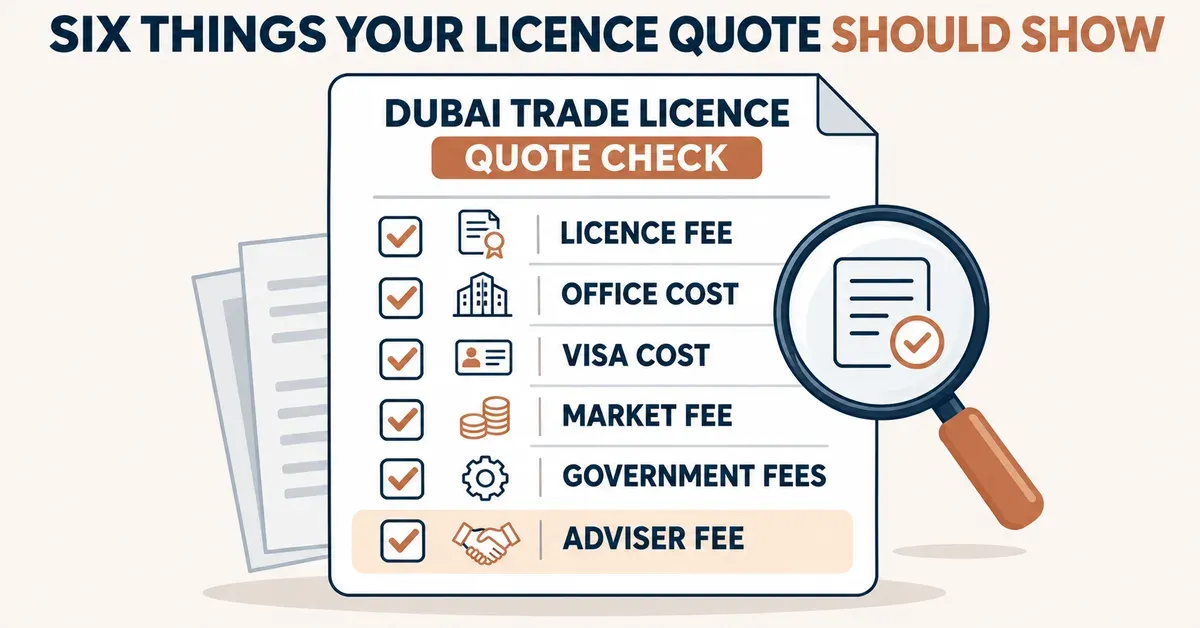
You do not need to know every fee. You need a quote built so you can check it. Ask for these six things before you pay anything.
- Name the licence type and the activity. Commercial, professional or industrial, and exactly which activity. Both set the fee.
- Show the government lines on their own. The DET fee, the Chamber line and the statutory fees should add to around AED 15,000 to 18,000 on a standard single-activity file. A “government fee” far above that is carrying something else.
- Say who holds the lease. Is the rent in the quote, and is the Ejari included?
- State the market fee. It is 5 per cent of the rent and is paid at renewal. A quote that leaves it out is missing a line.
- Count the visas. How many are included, and what does an extra visa add?
- Price year two. A quote with no renewal figure shows only half the cost.
A quote that answers all six is easy to compare with any other. One that will not is telling you something too. The wider question of costs that surface after setup is covered in our guide to hidden operational costs.

Want a quote built this way?
Tell us what you sell, how many visas you need and what premises you can use. We will set out the government lines and every other line separately, for year one and year two.
Dubai mainland or a free zone: how the cost lines differ
A free zone licence changes which lines you pay, not whether you pay lines. A free zone company pays its zone’s licence and its own premises, and to trade with the mainland it needs a second permit. The comparison is in free zone versus mainland in Dubai.
If your free zone company wants to trade on the mainland, DET sets two routes. One is the DAFZA dual licence, and the other is the free zone mainland operating permit. Under Dubai Executive Council Resolution 11 of 2025, the dual licence is AED 10,000 a year and the temporary permit is AED 5,000 for six months. Dual Licence Cost and Process in Dubai will carry the details.
Setting up on the Dubai mainland from scratch is covered in starting a business on the Dubai mainland, and the full first-year build for any structure is in the cost of starting a business in Dubai.
The northern emirates publish their own builds, for comparison: Ajman, Ras Al Khaimah, Fujairah and Umm Al Quwain. Rent and the market fee usually drive the difference between emirates, more than the licence does. The UAE-wide view is planned as UAE Business Setup Cost by Emirate: AED 5,000-50,000.
Budget the bill, not the fee
The Dubai licence fee is one of the few lines you can pin down early. Take it as a fixed block, then put your effort into the lines that vary: the office, the visa count and the adviser.
Three steps settle most budgets. Choose the activity before you choose the office. Count the visas before you sign a lease. And ask for year two in writing before you pay for year one.
Best Solution has formed companies in the UAE since 2014. Our mainland licence service handles the DET filing, our office setup service finds premises with a valid Ejari, and our UAE residence visa service takes the file from there. Each year our trade licence renewal team keeps the licence current.
The filing steps are planned as Dubai Mainland Company Setup: DET Steps to Licence, and the done-for-you comparison is in our guide to business setup consultants in Dubai. To start now, our business setup team is on +971 52 233 0011 or connect@best-solution.ae.