Search "Dubai employee visa cost" and you will see the same headline everywhere: AED 3,000 to AED 8,000. That figure is real, but it is the government fee total for a clean, best-case file. It is not what lands on your invoice. The lines that decide your actual spend, the establishment card, the status change, the typing and PRO coordination, the mandatory health insurance, sit underneath that headline, and most cost guides leave them out.
If you have set up a company in Dubai and you are about to sponsor your first hire, you are not asking "what is the cheapest visa." You are asking "what is the true cost of putting one person on my licence, and what am I committing to when I do it." This guide answers both, using the real all-in figures Best Solution sees on client files, not the headline.
How much does a Dubai employee visa cost in 2026?
A Dubai employee visa costs AED 5,500 to AED 9,500 all-in for a mainland company sponsoring one employee in year one, and AED 4,000 to AED 7,500 through a free zone. The range depends on your MOHRE category, whether the establishment card is already issued, and whether the employee changes status inside the UAE or enters on a fresh permit. The headline "AED 3,000 to 8,000" covers government fees only.
Full cost breakdown: every line on a Dubai employment visa
Here is what an employer actually pays to sponsor one mainland employee in year one. Three of these lines, the establishment card, typing and PRO coordination, and mandatory health insurance, are the ones competitor pages routinely omit. Together they add AED 3,600 to AED 7,500 to the headline government total.
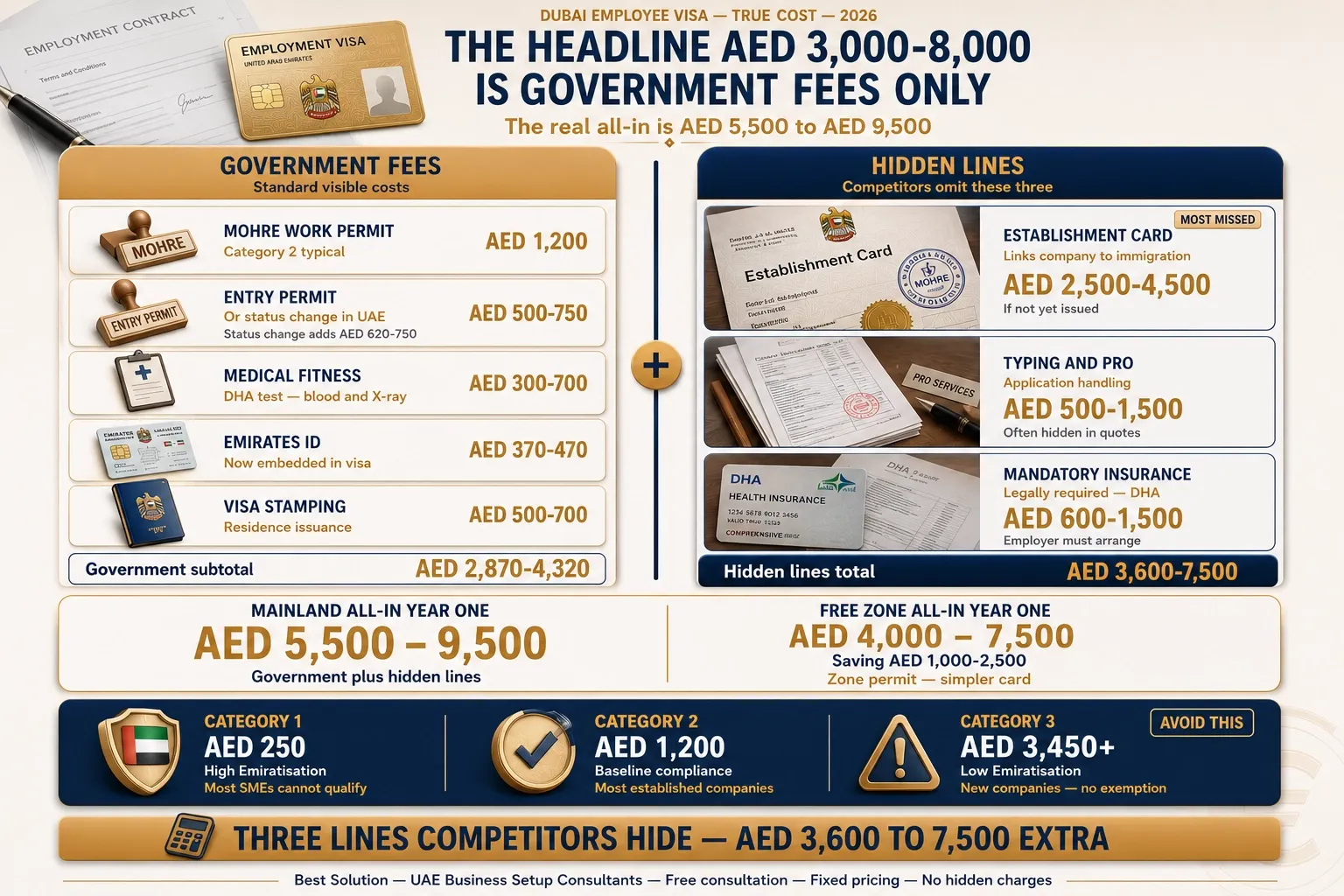
| Cost Line | AED | Note |
|---|---|---|
| MOHRE work permit (Category 2 typical) | 1,200 | Set by company category, see below |
| Entry permit | 500 to 700 | Permission to enter for employment |
| Status change (if already in UAE) | 620 to 750 | Only if hiring someone inside the country |
| Medical fitness test | 300 to 700 | Higher for express or VIP centres |
| Emirates ID | 370 to 470 | Issued per validity period |
| Visa stamping | 500 to 700 | Residence visa issuance |
| Establishment card (if not yet issued) | 2,500 to 4,500 | Links your company to immigration |
| Typing / PRO coordination | 500 to 1,500 | Application handling, often hidden |
| Mandatory health insurance (basic DHA) | 600 to 1,500 | Now legally required |
| Realistic all-in per employee | AED 5,500 to 9,500 |
The low end assumes the establishment card already exists, the employee enters on a fresh entry permit, and you choose basic insurance. The high end assumes a Category 3 work permit, a status change inside the UAE, comprehensive insurance, and the establishment card being issued at the same time as the first visa.
Free zone vs mainland: where the cost actually differs
A free zone employee visa runs AED 4,000 to AED 7,500 in year one. The work permit is set by the zone authority rather than the Ministry of Human Resources and Emiratisation (MOHRE), and is typically lower than a mainland Category 2 or 3 permit. The establishment card through a zone runs AED 1,500 to AED 3,000, against AED 2,500 to AED 4,500 for mainland. The health insurance obligation is identical either way.
The real saving versus mainland is AED 1,000 to AED 2,500 per employee, and it comes almost entirely from lower work permit fees and simpler establishment card processing, not from the visa itself. If your hiring plan and your revenue model already point you toward one structure, the visa cost difference should not be the deciding factor. Our free zone versus mainland guide walks through the choice in full.
What drives your cost up: the MOHRE category trap
The single line with the widest swing is the work permit, because MOHRE charges it by company category: roughly AED 250 for Category 1, AED 1,200 for Category 2, and AED 3,450 or more for Category 3. Most cost guides list these three numbers and stop. They do not tell you what decides which one you pay.
MOHRE assigns a mainland company's category based on its Emiratisation compliance rate and workforce composition. Category 1, the lowest fee, requires a high ratio of UAE national employees and is out of reach for most SMEs and startups. Category 2 applies to companies meeting the baseline compliance thresholds. Category 3, the most expensive, applies to companies with low or zero Emiratisation and no exemption.
In practice, three things push an employer into Category 3: being a new company with no UAE national employees and no activity-based exemption, operating in a sector with mandatory Emiratisation targets without meeting them, or carrying unresolved MOHRE compliance flags from a previous visa cycle.
This is where setup planning pays for itself. At incorporation, we check whether your activity and size qualify for a Tawteen exemption. Small businesses below certain headcount thresholds, in specific activity categories, can apply for exemption from the standard Emiratisation calculation, which preserves Category 2 status. On a five-employee company that would otherwise sit in Category 3, that is worth around AED 2,250 per visa in work permit savings, AED 11,250 a year. We flag it at incorporation, not at the fourth visa when an employer first notices the fee gap.

Tired of calculating blind?
Government fee tables only tell half the story, and a single title mismatch or quota oversight can freeze your hiring for weeks. Let our corporate team map out a transparent, all-in breakdown for your specific headcount plan.
In-country status change vs fresh entry permit
If your new hire is already in the UAE, you can process their visa through a status change rather than bringing them in on a fresh entry permit. The status change adds AED 620 to AED 750 on top of the standard visa cost, and it requires the employee's current visa to be in a changeable category. Tourist visas, visit visas, cancelled visas, and some residence types qualify. An overstayed visa may not, and an absconding record blocks it entirely; where there is only an overstay, the change is still possible once the fine is paid.
The true differential between the two routes is smaller than it looks. The fresh entry permit avoids the status change fee but adds a return flight and a productivity gap while the employee travels, so the net difference is closer to AED 300 to AED 500.
Choose the fresh entry permit when the candidate is outside the UAE, when their current status is not changeable, when you want them to enter on your own company's permit for a clean document trail, or when their existing visa is too close to expiry for the status change window. Choose the in-country status change when the candidate is already in Dubai on a valid changeable visa and you want them to start without a travel gap.
The most expensive mistake: job title vs licensed activity
The costliest error employers make is not a fee. It is sponsoring an employee under a job title that does not match the licensed activity on the trade licence.
MOHRE cross-references the employee's designated job title against your licensed activities. A software company that hires a "Business Development Manager" while its licence only carries "Software Development" and "IT Consultancy" creates a mismatch. MOHRE can reject the work permit, require a licence amendment before it will process, or force a change to the job title.
A recent client case shows how this plays out. A mainland consultancy tried to sponsor a senior hire as "Chief Commercial Officer." Its licence carried "Management Consulting" and "Business Advisory Services," and both covered the role in spirit, but MOHRE flagged the specific title as not matching a licensed activity description and rejected the permit. The fix is either modifying the quota and re-filing the title, which takes at least a day, or amending the licence activity, which needs further approvals and more time. Either way, the joining date slips. Checking activity-to-title alignment before submission, not after a rejection, is the cheapest insurance an employer can buy.
Visa quota: why your office size caps how many people you can hire
Your visa cost per employee matters less than a constraint most first-time sponsors never see coming: how many visas your setup actually allows.
For a mainland company, the quota is calculated against your Ejari-registered office space, at roughly one visa per 80 to 100 square feet. A 200 square foot shared-office Ejari supports two to three visas. A founder planning five hires in year one on that footprint hits the ceiling at employee three and has to upgrade the office, a new tenancy contract, an Ejari amendment, and a MOHRE quota increase, before the fourth visa can move. That upgrade takes three to five weeks and costs AED 5,000 to AED 20,000 in combined fees and higher rent.
Free zone quota is set by your desk or office package. A flexi-desk typically allows two to six visas depending on the zone; IFZA permits up to six, most others two to three. Beyond the package quota, you upgrade.
This is why we map the 18-month headcount before choosing the office and zone. If you plan to hire four people this year, the package that supports four visas costs more upfront but avoids the upgrade fee, the administrative delay, and the weeks of blocked hiring mid-year. The same "where will 80% of your year-one revenue come from" question that governs structure also governs hiring capacity: mainland-revenue businesses live inside the Ejari-to-quota relationship, while free zone businesses manage quota through package selection. Before you sign anything, it is worth reading our cost of starting a business in Dubai breakdown so the office decision and the hiring plan are made together.
The Dubai employment visa process, step by step
The employee visa runs through two regulators. MOHRE handles the labour contract and work permit for mainland companies; the General Directorate of Residency and Foreigners Affairs (GDRFA) issues the entry permit and residence visa, with the Federal Authority for Identity and Citizenship (ICP) handling the Emirates ID and some residence routes. Free zone companies replace the MOHRE step with their zone authority. From offer letter to Emirates ID, a clean file takes two to four weeks once the employee is in the UAE.
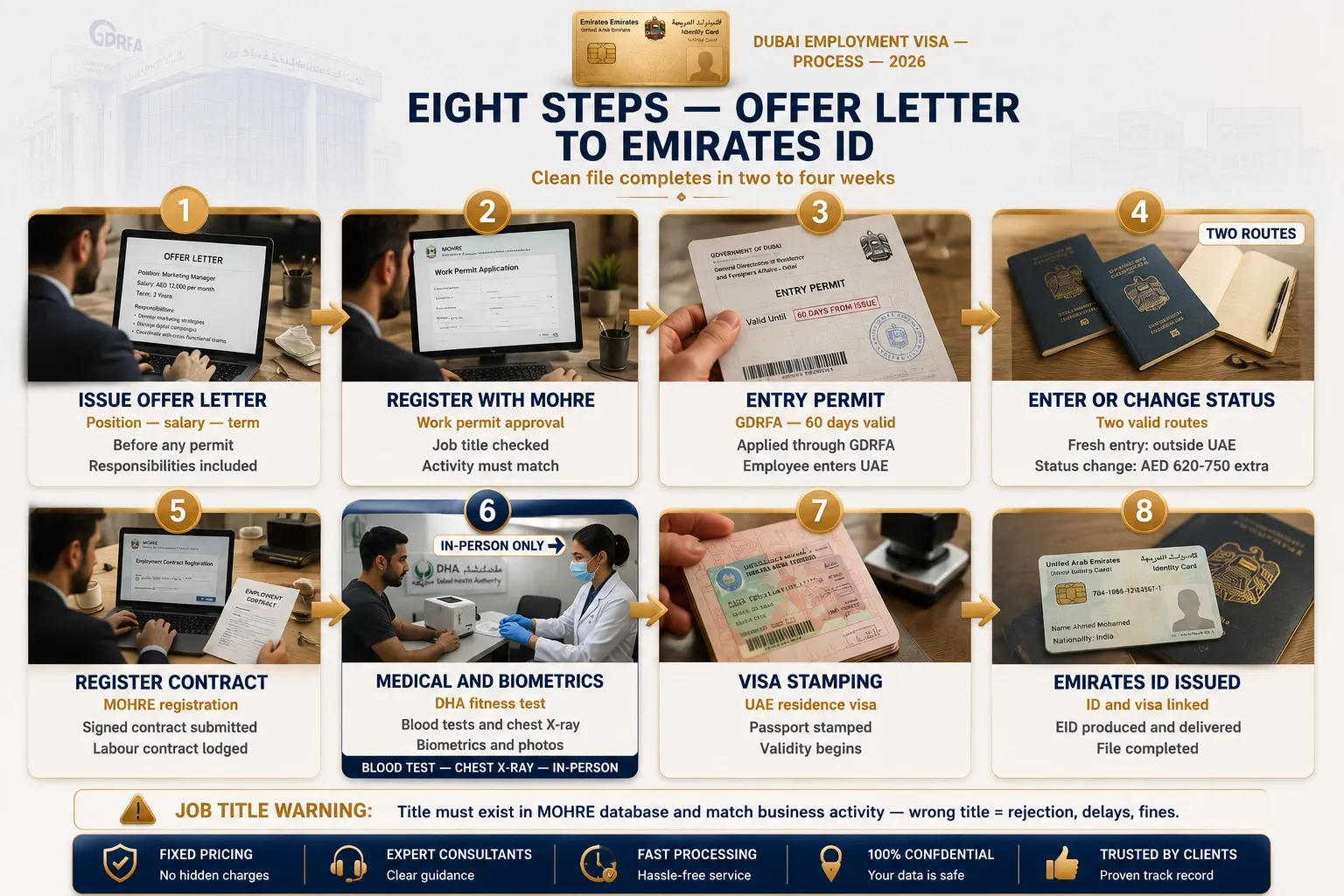
- Issue an offer letter stating position, salary, contract term, and responsibilities.
- Register the job offer with MOHRE and secure initial work permit approval (free zone companies apply through their zone authority).
- Apply for the entry permit through GDRFA. It is valid for 60 days.
- The employee enters on the entry permit, or changes status if already inside the UAE.
- Sign and register the employment contract with MOHRE.
- Complete the DHA medical fitness test (blood test and chest X-ray) and provide biometrics.
- Arrange the mandatory health insurance.
- The residence visa and Emirates ID are issued.
One 2026 detail worth knowing: the residence visa is now embedded in the Emirates ID and is no longer stamped in the passport. Status can be checked through the ICP or GDRFA app. Most steps are processed digitally, which is why a clean file moves quickly and a file with a title mismatch or an attestation gap stalls.
Who pays, and what you are committing to
Under Federal Decree-Law No. 33 of 2021, the employer is legally responsible for the cost of the employment visa, including renewals. The employee does not pay for their own work permit or residence visa. Health insurance is the one line an employer may structure differently, but the visa fees themselves sit with the company.
The hesitation we hear most at this stage is not about the money. It is about commitment and reversibility: "what happens if the hire does not work out and I have already sponsored their visa." That fear is understandable, and the reality is less constraining than it feels. UAE labour reforms have removed the automatic labour ban in most resignation cases, and a clean exit, work permit cancellation, Emirates ID deactivation, visa cancellation, is a straightforward process our PRO team completes in three to five working days for AED 500 to AED 1,500 in government fees. A properly documented contract and a clean MOHRE file from day one make both the employment risk and the sponsorship risk manageable. You can see the mechanics in our visa cancellation guide.
The second hesitation, "I am not sure my licence covers the role I want to hire for," is the job-title risk again, and the answer is the same: we confirm activity-to-title alignment before the work permit is filed.
How Best Solution keeps the cost predictable
Best Solution has supported UAE business setup since 2014, with more than 5,000 companies formed and over 4,500 corporate bank accounts opened across mainland and 50-plus free zones. On the visa side, the value is not in finding a cheaper government fee, because the fees are fixed. It is in the lines that move: keeping you in the right MOHRE category, getting the establishment card and quota right before you hire, aligning job titles to your licensed activities so nothing gets rejected, and processing each file cleanly so the joining date holds.
If you are budgeting your first hires, our PRO and visa services team will give you a real per-employee figure for your specific licence, structure, and headcount plan, not a headline range. Talk to our business setup consultants in Dubai before you sponsor, while the cost is still controllable.