Most “best startups in Dubai” lists you will find still rank companies using 2023 funding data. The city has moved on a lot since then. In the first quarter of 2026 alone, UAE-headquartered startups raised $625.8 million across 46 deals, which was 66.5% of all venture capital deployed across the Middle East and North Africa that quarter.
If you are a founder weighing Dubai as a launchpad, you need the current picture, not a recycled list. This guide gives you both: who the notable startups are right now, which sectors are actually attracting money, why founders keep choosing Dubai, and how to set up your own company so banking, hiring, and fundraising all work later. We write from direct experience. Best Solution has formed more than 5,000 companies and opened more than 4,500 corporate bank accounts in the UAE, so the setup guidance here reflects what works in practice.
| Question | Short answer |
|---|---|
| How big is the scene? | ~1,623 tracked startups in Dubai; ecosystem ranked #48 globally and #1 in the UAE |
| Who leads? | Tabby (~$3.3B), plus Careem alumni, Huspy, Property Finder, dubizzle; Dubai hosts ~12 UAE unicorns |
| Hottest sectors? | Fintech leads funding (46% of Q1 2026 investment); AI/SaaS is the fastest-growing founder category |
| Need a local sponsor? | No for most activities - 100% foreign ownership is now standard on the mainland |
| Biggest setup mistake? | Choosing the cheapest license, then hitting banking and investor problems later |
How big is Dubai's startup ecosystem in 2026?
Dubai's startup ecosystem now contains roughly 1,623 tracked startups and ranks 48th globally and first in the UAE, according to StartupBlink's 2026 index. The wider Dubai tech ecosystem attracted more than $5 billion in venture funding in 2026, closed over 450 funding deals, and pushed its total valuation past $38 billion, with more than 12 companies reaching unicorn status.
That growth is documented across independent trackers. StartupBlink records +6.9% ecosystem growth in 2025, and Q1 2026 regional funding data from Economy Middle East confirms the UAE took the clear majority of MENA venture capital. The headline is simple: Dubai is no longer an emerging scene. It is the regional centre of gravity.
Notable startups in Dubai right now
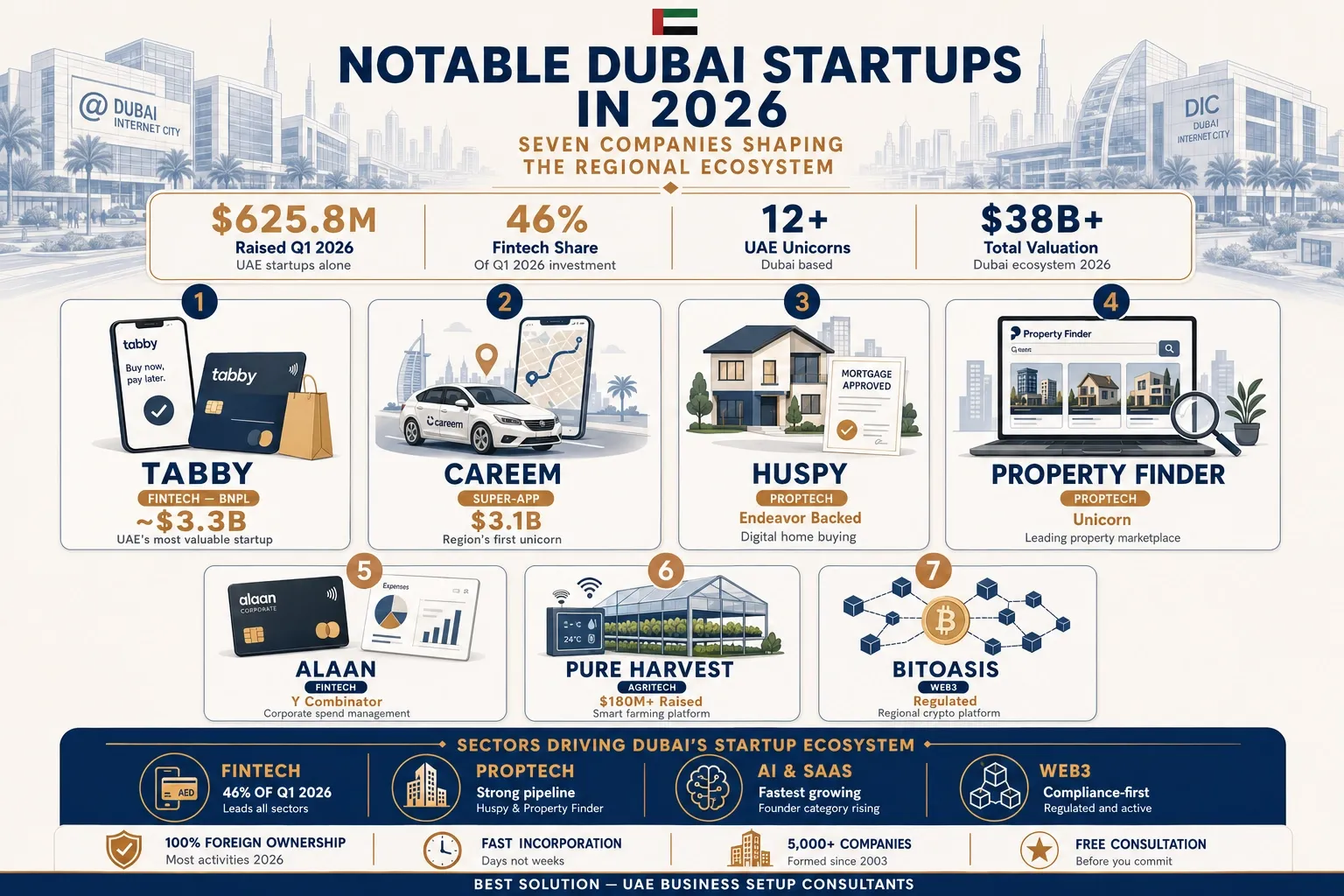
Here are companies that define the current scene, chosen for scale, funding, and influence rather than a fixed countdown. Treat this as a snapshot of who is setting the pace in 2026.
| Startup | Sector | Why It Matters |
|---|---|---|
| Tabby | Fintech (BNPL) | The UAE's most valuable startup at roughly $3.3B; buy-now-pay-later across the UAE, Saudi Arabia and Kuwait |
| Careem | Super-app / mobility | The region's first unicorn (acquired by Uber for $3.1B); 270+ ventures later founded by alumni |
| Huspy | Proptech | Digital home-buying and mortgage platform; an Endeavor Catalyst-backed success story |
| Property Finder | Proptech | One of the region's longest-standing property marketplaces and a unicorn |
| Alaan | Fintech (spend mgmt) | Y Combinator-backed corporate cards and expense automation for SMBs |
| Pure Harvest | Agritech | Smart-farming startup proving deep-tech can scale from Dubai |
| BitOasis | Web3 / crypto | Long-running regional digital-asset platform operating under tightening compliance |
For a fuller live directory, StartupBlink's Dubai list and Forbes Middle East's startups to watch are updated more often than most blog roundups. The pattern is consistent: fintech and proptech dominate the top of the table, and AI-native companies are rising fast behind them.
Which sectors are driving Dubai's startup scene?
Funding data and what we see across our own client base tell a consistent story. Fintech took 46% of total Q1 2026 investment, the largest single share, followed by proptech and foodtech. But the fastest-growing founder category we now meet is AI and SaaS.
From our own formation work, only about 10 to 15% of startup clients are building genuinely venture-scale companies rather than lifestyle businesses, freelancers, or traditional trading firms. Within that group, the sectors cluster like this:
- AI and SaaS. The fastest-growing category: automation platforms, workflow tools, enterprise software, and vertical SaaS products.
- Fintech. Payments, embedded finance, compliance technology, and wealth-tech. These need the most regulatory planning.
- E-commerce and DTC. Still common, though far more competitive than five years ago.
- Marketplaces. B2B marketplaces, service marketplaces, and logistics platforms.
- Web3 and emerging tech. Still active, but banking and compliance now matter far more than during earlier cycles.
The thread connecting all of them: startup founders optimise for scalability, fundraising, and future investment, not immediate profit. That single difference shapes every setup decision that follows.
Why do founders choose Dubai to launch a startup?
A few reasons come up in almost every founder conversation we have:
- 100% foreign ownership. Most mainland activities no longer require a UAE national to hold 51%. Founders keep full control.
- A competitive tax position. A 9% corporate tax rate with relief mechanisms for small businesses keeps Dubai attractive against most startup hubs.
- Fast, founder-friendly setup. Free zones such as IFZA, Meydan and DMCC, plus startup campuses like in5 and Dubai Technology Entrepreneur Campus (DTEC), let founders incorporate in days.
- Capital and residency pathways. Vehicles like the Dubai Future District Fund back local tech, and founder and investor routes to long-term residency, including the Golden Visa, let teams stay and build.
Government-backed programmes reinforce all of this. Invest in Dubai and Digital Dubai's startup support run accelerators and incentives for early-stage companies. The point is not that Dubai is cheap. It is that the ecosystem is built to take a company from incorporation to bank account to first raise without leaving the country.
How to set up a startup in Dubai the right way
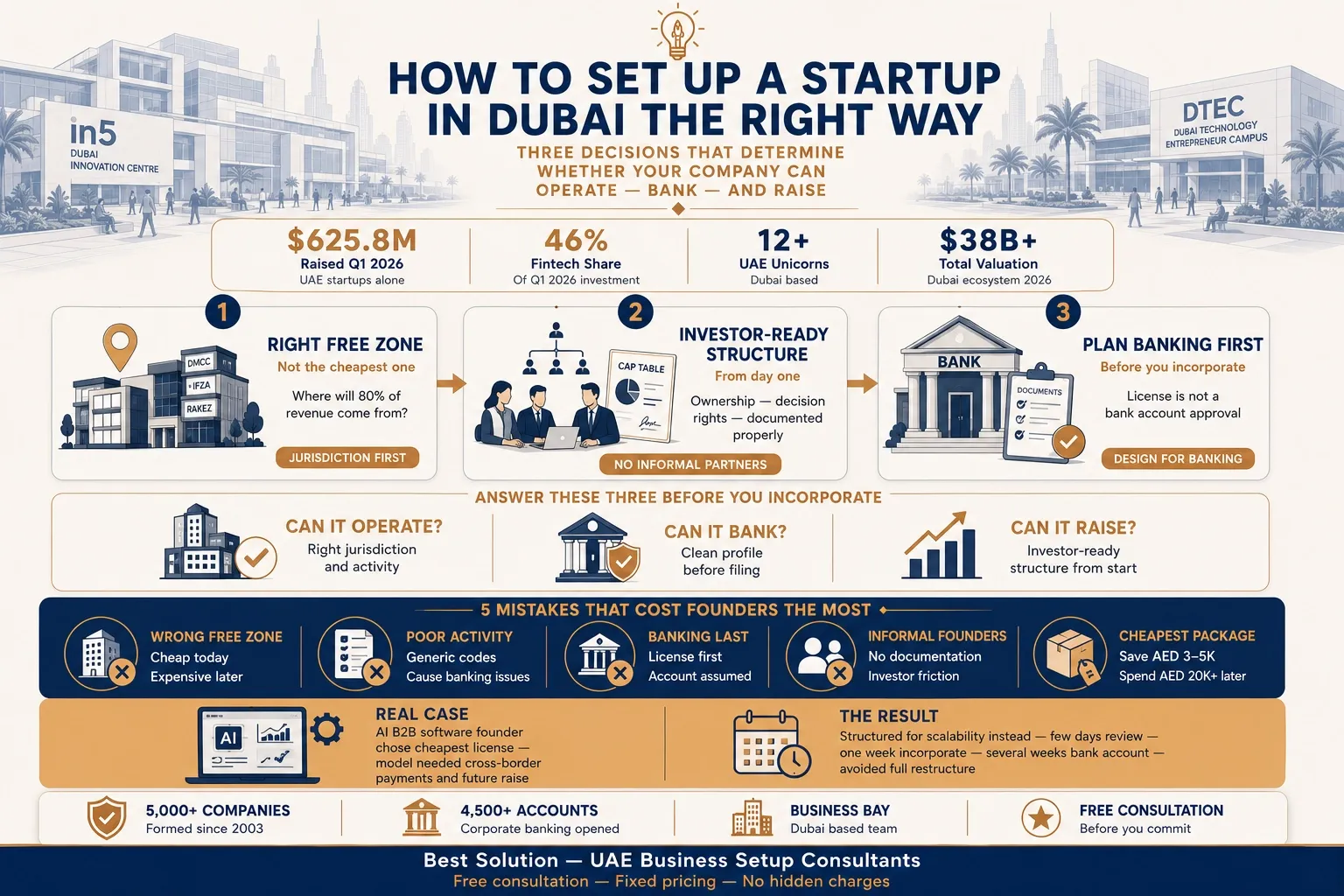
This is where most of the avoidable damage happens. Founders spend months on a product and a pitch deck, then make the formation decision in an afternoon to save a few thousand dirhams. The strongest setups in 2026 are designed around three questions at once: can this company operate, can it bank, and can it raise capital? Answer all three at the start and you usually skip the expensive restructuring later.
Choose the right free zone, not the cheapest one
Free zones are not interchangeable. The right one depends on your funding strategy, team structure, banking needs, and where revenue will actually come from. A jurisdiction that looks cheap on day one can limit your activities, complicate banking, or worry investors during due diligence. We use one question to anchor the decision: where will roughly 80% of your first-year revenue come from? If it is international clients and digital operations, a free zone usually fits. If you need direct UAE market access, the mainland often makes more sense.
Get your activity and ownership structure investor-ready
Pick business activities that accurately reflect your real model, not a generic catch-all that looks convenient. Document co-founder ownership and decision rights properly from the start, because investors scrutinise ownership structure, cap-table clarity, and shareholder rights during a raise. A messy structure creates friction at exactly the moment you can least afford it. Adding counders informally and fixing it later is one of the most common and most expensive errors we correct.
Plan banking before you incorporate
A trade license is not a bank account approval. This is the most expensive assumption founders make. From opening more than 4,500 corporate accounts, we see a clear split. Software development, SaaS, technology consulting, B2B services, and established e-commerce models generally move through compliance smoothly when documentation is clean. Fintech, crypto-related businesses, payment platforms, complex marketplaces, and unclear cross-border flows attract far more scrutiny.
Funding stage matters too. A startup with founder capital, contracts, and operating history is easy for a bank to understand. A pre-revenue company with no customers and no transaction history needs much stronger documentation to explain its future activity. Banks do not assess ambition. They assess risk. Build your banking story before you file, not after.
In practice
One founder building an AI-enabled B2B software platform for GCC enterprises planned to incorporate on the cheapest license and sort out banking later. The model involved international clients, enterprise contracts, cross-border payments, and a future raise, so the cheapest option would likely have failed investor due diligence and bank review. We structured the company for scalability and banking readiness instead: a few days for structure review, about a week to incorporate, and several more weeks to prepare and open the account. Without that planning, the founder would probably have faced shareholder restructuring, activity amendments, and banking remediation inside the first year, at a cost far above the initial saving.
Common mistakes founders make setting up in Dubai
The same handful of errors come up again and again, and almost all of them start long before the first investment round:
- Choosing the wrong free zone. Selecting a jurisdiction that does not match future fundraising or operational plans.
- Poor activity selection. Generic activities that do not reflect the real business model, which causes problems at banking and amendment time.
- Treating banking as an afterthought. Assuming the account follows automatically once the license is issued.
- Informal founder structures. Adding co-founders without documenting ownership and decision-making rights.
- Opsing only for the cheapest package. Saving AED 3,000 to 5,000 up front, then paying far more in restructuring, banking delays, and investor friction.
None of these are legal mistakes on paper. They are governance and planning mistakes, which is exactly why they are easy to make and costly to undo.
What's different about launching a startup in 2026?
A lot of startup content still reflects the 2021 to 2023 environment. The ecosystem has matured, and four myths in particular now age badly:
- Just get the cheapest license. The right structure has to support banking, hiring, fundraising, and scaling. The cheapest structure is rarely the cheapest over the life of the company.
- Think about tax only after funding. Corporate tax considerations apply from day one. Even pre-revenue startups have registration and compliance obligations to understand.
- Investors care about the product, not the structure. Investors care a great deal about ownership, governance, cap-table clarity, and compliance. Messy structures create friction in a raise.
- Banking is easy once the license is issued. Still the most expensive assumption a founder can make. Design for banking from the start.
Founders who plan around operating, banking, and raising at the same time consistently avoid the restructuring exercises that drain time and money in year one.
Dubai Startup Scene Matures and Specializes
I already run a design and tech agency headquartered in Dubai, and it was definitely a calculated choice to be here.
Dubai is uniquely positioned as a growing hub, and the energy around innovation is noticeable.
In the next 3-5 years, I expect Dubai’s startup environment to become even more mature and specialized. We’ll see a deeper focus on specific tech areas like AI, blockchain, and sustainable tech, driven by government initiatives and funding.
There’s already a significant push for smart city development, which creates a huge demand for design and tech solutions.
I also anticipate more international partnerships and a stronger flow of global talent moving here, further enriching the ecosystem. The infrastructure is already world-class, and it’s constantly improving to support this growth.
If I had the chance to start a business in Dubai again, I would absolutely choose Dubai to launch. The government support for new businesses is clear, with easy setup processes in free zones, various funding options, and initiatives like the Golden Visa for entrepreneurs.

Founder & CEO, Tenet
Global Magnet for Regional and International Founders
Dubai’s startup scene is already buzzing, but what’s coming in the next 3-5 years will push it into a whole new league. With aggressive government support like the Dubai Future District Fund and golden visa programs, it’s becoming a genuine magnet for both regional and global founders.
I expect a rise in sector-specific hubs — especially fintech, healthtech, and climate tech — backed by deeper partnerships between corporates and startups. The ease of setting up, favorable tax environment, and growing investor appetite mean early-stage founders won’t have to beg for attention like they often do in Europe.
Would I personally launch a business in Dubai? A few years ago, I might have hesitated — too much fluff, not enough substance. But now, honestly, yes. If you’re building something scalable with a regional focus or global vision, Dubai makes strategic sense. When Spectup started working with UAE-based startups, I saw firsthand how fast things moved — term sheets in weeks, not months.
The hunger is real, and the support system is maturing fast. That said, it’s not for every model. Consumer plays without regional relevance? Tough sell. But for B2B, fintech, or impact-driven ventures, Dubai’s runway is wide open.

Managing Consultant and CEO, Spectup
Expanding Ecosystem Attracts Diverse Industries
In the coming years, the startup ecosystem in Dubai is expected to become more global and expand at an accelerated rate. The already low taxes, good infrastructure, and government encouragement are attracting entrepreneurs to the city. Now it’s not only tech; we are experiencing an increase in green energy, logistics industry, AI services, and professional consulting.
More international founders are venturing in and targeting the MENA region through Dubai. This is also bound to increase competition and quality. Concurrently, domestic organizations are becoming more serious about scaling and developing long-term teams, as opposed to thinking in terms of quick exits.
Given that today was the day I needed to find a location to open a new business, the city of Dubai would have been on the shortlist. Procedures are easy to follow, payment is swift, and the entire process of opening a bank account, renting an office, to name but a few, is far easier than most people suppose.
It is also one of the rare places where you can have investors, clients, and top talents all in a single room. In case you have a scalable idea and you need lots of velocity but less red tape, Dubai makes a lot of sense.

Founder & CEO, Vortex Ranker
Marketing Technology Hub Emerges in MENA
Dubai’s startup scene is rapidly evolving, and over the next 3-5 years, I anticipate it will become one of the most competitive hubs for marketing technology and digital agencies in the region. The government is heavily investing in AI, tech infrastructure, and digital transformation — which means more companies will require assistance with digital strategy, marketing automation, and customer experience platforms.
If I had the opportunity to start a marketing technology business or agency in Dubai, I would seriously consider it. Here’s why:
Global Hub: Dubai provides access to both Western and Eastern markets, as well as fast-growing regions like MENA, Africa, and South Asia.
Business-Friendly Ecosystem: Free zones, tax incentives, and government-backed startup programs make it easier to launch a business.
Demand Spike: Businesses in Dubai are transitioning from traditional marketing to performance-driven and tech-enabled marketing, creating significant demand for CRM consulting, AI-powered advertising, MarTech integrations, and analytics.
Networking Power: Events such as GITEX, Step Conference, and Expand North Star offer substantial opportunities to meet decision-makers and tech partners.

Chief Marketing Officer, maksymzakharko.com
Sustainable Growth Challenges Amid Government Support
Dubai will likely continue pushing hard to brand itself as a global startup hub, but hype alone doesn’t build sustainable ecosystems. While government-backed initiatives and tax incentives may attract founders on the surface, the real test will be whether the city can support startups beyond the launch stage, especially when it comes to long-term capital access, operational cost efficiency, and regulatory consistency. There’s momentum, but Dubai still faces challenges: high overhead, limited regional consumer scale, and overreliance on expat capital. I expect continued growth, but also a thinning out of weaker ventures once the funding environment tightens.
If you had the chance to start a business in Dubai, would you choose Dubai to launch your business? Why or why not?
Not as a first choice, at least not for most businesses. While Dubai is strong for certain verticals like logistics, luxury, or regional trade, the startup scene still lacks the deep, organic infrastructure of places like North America or Europe. Cost of living is high, talent turnover is constant, and local consumer demand can be shallow unless you’re targeting high-income segments or B2B. I’d consider Dubai as a satellite or expansion market, but only after proving the model elsewhere. It’s a strategic location, but not always the smartest starting point.

Director, Crown Billboard Advertising
Evolving Infrastructure for Deep Tech Ventures
Dubai has made bold moves to position itself as a global tech and innovation hub — particularly in AI, sustainability, and fintech. Over the next 3-5 years, I expect its startup environment to continue maturing, especially as regulatory frameworks and funding infrastructure evolve to support more deep tech and research-driven ventures.
If I were launching my company today, Dubai would definitely be on the shortlist. The access to emerging markets, government-backed innovation programs, and growing talent pool make it a serious contender — especially for globally minded founders. That said, for highly technical ventures, the key is still proximity to research institutions and IP pipelines, which currently remain stronger in places like Europe or North America.

CEO, Atlantix
Dynamic Environment Fosters Innovation and Investment
I expect Dubai’s startup environment to become even more dynamic in the next 3-5 years, especially with the government’s continued focus on innovation and technology. Initiatives like the Dubai Future Foundation and various free zones make it an attractive location for entrepreneurs. I foresee the city fostering a stronger ecosystem for fintech, AI, and sustainable industries, alongside a growing influx of talent and investment.
If I had the chance to start a business, I would choose Dubai, but with some considerations. The tax incentives, ease of doing business, and access to global markets are hard to beat. However, the competitive landscape is tough, and understanding local culture is essential.
I would want to ensure I have a clear strategy for navigating the regulatory environment and tapping into local networks. Still, for tech-focused ventures with global ambitions, Dubai is an exciting choice.

Co-Founder & CEO, AIScreen
Strategic Hub for Global Commerce and Technology
I expect Dubai’s startup ecosystem to grow significantly over the next 3-5 years with a strategic focus on sectors like fintech, AI, blockchain technology, clean energy, and logistics. I had the chance to set up my business in Dubai, which I did already 6 years ago, and I still choose Dubai. The city has evolved far beyond being simply a geographically strategic “tax-free haven” into one of the most important centers of commerce on the planet.

CEO & Founder, Lincoln Global Partners
Thinking about launching in Dubai?
Best Solution has formed 5,000+ companies and opened 4,500+ corporate accounts in the UAE. Talk to our team about structuring your startup so it can operate, bank, and raise from day one.