Key takeaways
| Question | Short answer |
|---|---|
| Is there an official Dubai Silicon Oasis activity list? | No. The authority selects activities from the DET list, which is coded on ISIC, and checks each one for fit with a knowledge and innovation zone |
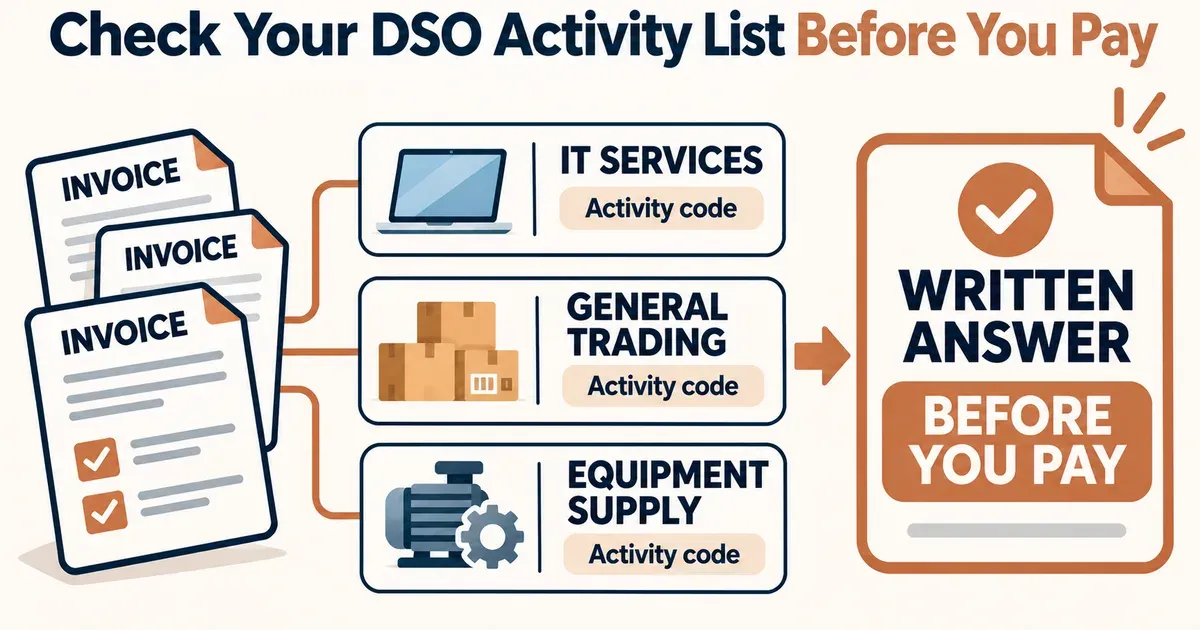
| How do I know my activity will be accepted? | Ask the authority in writing before you pay. We send a pre-approval enquiry built from your first invoices, and the reply usually comes in 2 to 3 working days |
| How many activities fit on one licence? | Several, if they sit in one segment. We plan on 5 and advise 3. Each extra activity costs about AED 1,000 to 2,000 |
| Does the activity change the licence? | Yes. The activities set the licence type. A trade licence adds about AED 3,000 a year over a service licence, and service plus trade about AED 5,000 |
| Are non-tech activities accepted? | Often, on an office licence: consultancy, marketing, e-commerce and, after closer screening, general trading. Recruitment and real estate brokerage go to the mainland |
| Which activities need outside approval? | Media, training, health, telecom devices, virtual assets, food and cosmetics, and industrial units |
| Can the activity reach the Dubai mainland? | Yes, through a DET permit or branch licence, but only with a real office or unit in the zone, not a flexi desk |
Search for the Dubai Silicon Oasis activity list and the first result is the authority’s own Business Activities page. Open it and there is no list. When we read it in October 2026, it held a heading, placeholder text and an enquiry button.
That is not a gap you can fix with a better search. The Dubai Silicon Oasis Authority (DSOA) does not keep a catalogue of its own. It takes activities from the Dubai mainland list and decides, file by file, which ones fit a knowledge and innovation zone. So the useful question is not “what is on the list?” but “will my business fit?”. This page answers that: which list applies, how many activities fit, what each choice does to your licence type, approvals and premises, and where to go if the answer is no.
A word on our position. Dubai Silicon Oasis is a zone we handle files for, and most of those files are companies registered with the IFZA free zone in Silicon Oasis, a different authority at the same address. We hold no partner or agent status with the DSOA. Where an example below comes from an IFZA file, we say so.
Where is the Dubai Silicon Oasis activity list?
There is no separate Dubai Silicon Oasis activity list. The authority selects activities from the Department of Economy and Tourism (DET) list, which is coded on the international ISIC system, and checks each one for fit with a knowledge and innovation zone. In practice, the Silicon Oasis list is the DET list minus what the reviewer will not accept.
The authority says as much on its own setup page. It asks applicants to choose a service, trade or industrial licence and to “determine the business activities for your company (please refer to ISIC and DED lists)”. DED is the old name for the Department of Economy and Tourism. How that list is built, and how to read an activity code, is covered in our guide to choosing a business activity from the DED list.
Three things follow from this:
- There is no official PDF. Any “DSO activity list” you can download is a consultant’s extract from the DET catalogue, and it is often out of date.
- The member portal will not help you decide. It only shows activities once an application is open.
- The activity is part of the application, not a form field. The DIEZA Implementing Regulations 2023 require the application to state the proposed activities and “the type and size of premises required” for them (Regulation 18.1), with a business plan (Regulation 18.2). Once licensed, a company may only conduct the activities on its licence (Regulation 20.2).
The DSOA operates under the Dubai Integrated Economic Zones Authority (DIEZ), and the company it licenses is a Free Zone Company (FZCO) or a branch. Its own licence types page now lists the old single-shareholder FZE as no longer in use.
Regulation 20.2 is why the choice matters. The free zone authority is not only approving a business activity. It is approving the activity, the premises and the plan together.
How we check an activity before you pay
Because nothing public tells you whether your activity will pass, we ask the authority directly. Here is how we do it before any money moves:
- We take the first three invoices you expect to issue.
- We match each one to a DET activity code.
- We send that activity set to DSOA licensing as a pre-approval enquiry, with a one-paragraph summary of the business.
- The reply usually comes in 2 to 3 working days.
No licence fee is paid until the answer is in writing. Where that check sits in the wider filing order is set out in Dubai Silicon Oasis Company Formation: What to Do, in Order.
How many activities one licence carries
Activities are counted per licence, not per premises. A flexi desk and an office file carry the same included number. The authority allows several activities on one licence fee as long as they sit in the same segment.
A segment means the same licence category (service, trade or industrial) and a related ISIC division. Two IT activities count as one segment. IT consultancy plus marketing counts as two.
Quotes in the market say 5 or 7 activities. We plan on 5, because the reviewer decides how far a segment stretches, not a fixed table. Each activity beyond the included set is charged per activity, not per group. We budget AED 1,000 to 2,000 for each one.
Our advice is to stay at 3. Three activities match what a bank compliance officer expects to see on a small company’s invoices. Every activity beyond that is one more line the bank will ask you to prove.
Your activities set the licence type
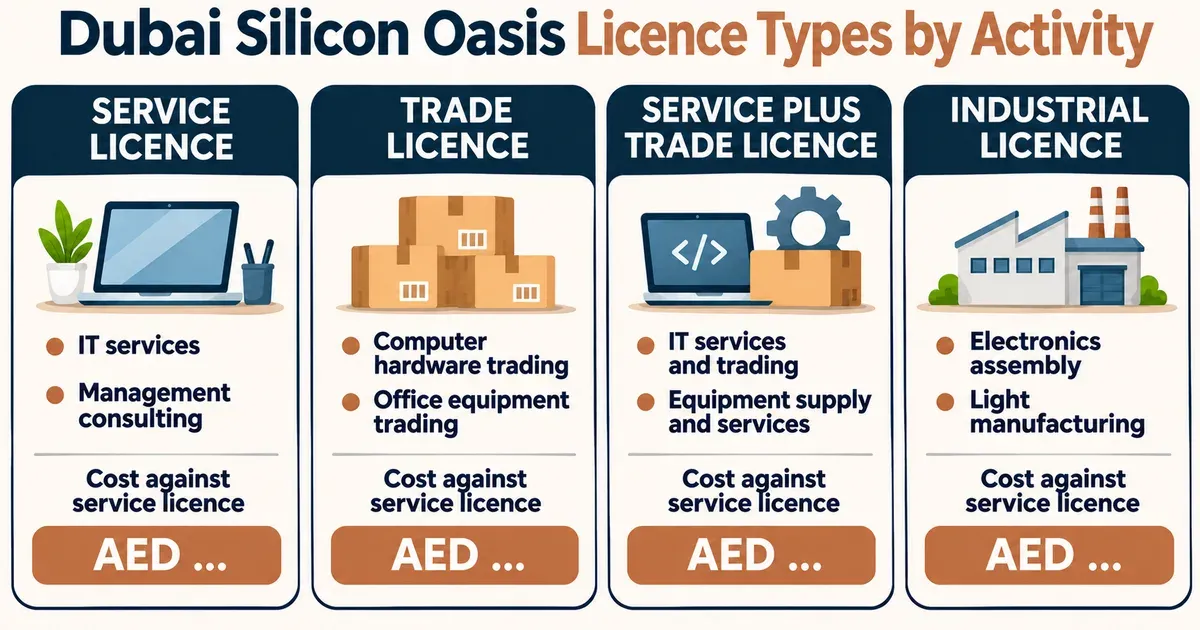
You do not pick the licence type separately. The activities decide it. Add a trading code and the file becomes a trade or combined licence, whatever the quote said.
| Licence type | What it covers, in the authority’s words | Typical activities at Silicon Oasis | Cost against a service licence |
|---|---|---|---|
| Service | “Only specified services” | Software development, IT services, research and development, consultancy, marketing | The base |
| Trade | Import, export and distribution of the goods named on the licence | Trading IT hardware or electronics | About AED 3,000 a year more |
| Service plus trade | Both, printed on one certificate | A software firm that also sells devices | About AED 5,000 a year more |
| Industrial | Import raw material, manufacture, process, assemble, package and export | Electronics assembly, PCB work, 3D printing at production scale | About AED 5,000 to 8,000 more, plus the unit rent |
Source: dso.ae licence types page, read October 2026, and our practitioner estimates. The industrial figure is our working estimate.
The two trade figures measure different things. A trade-only licence costs about AED 3,000 a year more than a service-only one. A licence carrying both service and trade costs about AED 5,000 a year more than service-only. The full cost build sits in Dubai Silicon Oasis Licence Cost: Three Years, Line by Line, and the general difference between licence types is explained in our guide to types of trade licence in Dubai.
An industrial licence can sit with service or trade activities, as long as the trade side sells what the unit makes. The real cost there is the premises, because industrial work needs a light industrial unit or warehouse, not a desk.
The combination the reviewer queries most is trading in goods unrelated to the service activity. A software firm adding garment trading is a typical case. The reviewer asks why, and the bank asks the same question later.
Does the authority take non-tech activities?
Often, yes. The answer depends on whether you take a Dtec desk or a DSOA office, because the two apply different screens to the same licence.
At Dtec
A Dtec company holds a Dubai Silicon Oasis licence on the same register as an office company. Dtec adds its own fit screen. A technology or digital service activity passes. A plain trading or general consulting company with no technology angle is redirected to a DSOA office or another zone. Dtec itself is covered in Dtec Dubai Silicon Oasis: A Licence That Comes With a Desk, and the wider picture in our guide to Dubai’s startup ecosystem.
In a DSOA office
Outside Dtec, a DSOA office licence is broader than the zone’s technology branding suggests. The authority’s own industry clusters include “Professional Services & Creative Industry” alongside AI, robotics and cybersecurity.
What a DSOA office licence usually accepts:
- Management consultancy
- Marketing and advertising, under the professional services and creative cluster
- E-commerce
- General trading, after closer screening
What it refuses or redirects:
- Recruitment. HR consultancy is accepted. Placing staff with mainland employers needs MOHRE approval, so it is redirected to a DET licence.
- Real estate brokerage or management of Dubai property. This needs RERA and Dubai Land Department registration, so it goes to the mainland.
The test is the activity code and the business summary read together. A plain activity is usually accepted when the summary gives it a technology or innovation angle, or when the premises fit the plan. A marketing firm that runs its own analytics platform clears easily. A one-person agency with no technology angle clears but takes longer, and we usually point that client to IFZA on cost.
From our IFZA files: a company holding digital marketing and advertising consultancy activities is the same mix we would expect the DSOA to accept on an office file. Software founders comparing zones can also use our guide to starting a software company in Dubai.
Which activities need a regulator’s sign-off?
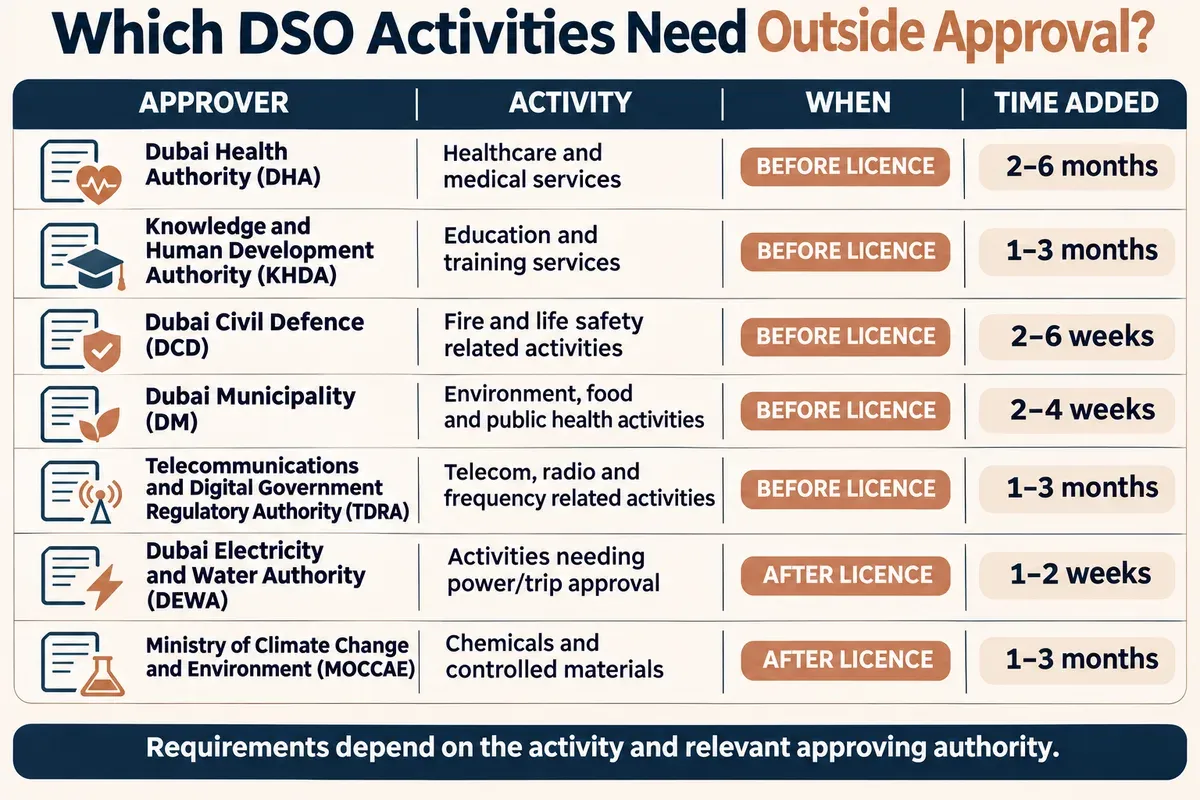
Some activities need a second approval from another authority. The table shows the ones we meet on Silicon Oasis files. The times are our practitioner estimates, not published service levels.
| Activity | Approver | Before or after the licence | Time added |
|---|---|---|---|
| Media, content production, publishing | UAE Media Council | Before | 2 to 4 weeks |
| Training and courses | KHDA | Before | 4 to 8 weeks |
| Health technology, health consultancy | Dubai Health Authority | Before | 4 to 10 weeks |
| Telecom or wireless devices | TDRA type approval | After the licence, before sale | 2 to 6 weeks per device |
| Virtual assets | VARA | Before | 6 to 12 months |
| Food, cosmetics | Dubai Municipality product registration | After the licence, before sale | 2 to 6 weeks per product |
| Industrial units | Civil Defence | After the licence, before operations | 1 to 3 weeks |
One line in that table needs stressing. Some agency pages list “blockchain and cryptocurrency services” as a Silicon Oasis activity with no mention of VARA. That is wrong for any activity that touches virtual assets. The VARA licence is needed wherever the company sits, and it takes months, not weeks.
A second flag sits on some activities. Dealing in precious metals and stones, real estate services, corporate service providers, and audit or accounting all count as a DNFBP, a designated non-financial business or profession. These carry a duty to register on goAML from day one, as part of wider AML compliance in the UAE.
The activity decides the premises
The rule we use is simple. If the activity needs equipment, stock or a regulator’s sign-off, it needs more than a flexi desk. Software, SaaS, digital services and IT consulting run on a desk. How a desk works as licence premises is explained in our guide to how a flexi desk works in Dubai.
Beyond the desk, the activity points to one of three spaces:
- Office: software, design and light prototyping.
- Light industrial unit: electronics assembly, PCB work, device repair beyond a counter service, 3D printing at production scale, and drone or robotics testing that needs bench space and power.
- Warehouse: stock-holding traders and e-commerce firms that fulfil their own orders.
Each step brings a check. Before the licence, the DSOA checks the unit lease and the floor layout against the activity. Before operations, Civil Defence inspects fire systems, storage of batteries or chemicals, and the electrical load. Before sale, any device with a radio needs TDRA type approval.
What the zone will not take is heavy manufacturing, chemical processing, and anything with emissions or hazardous storage at scale. Those go to JAFZA or Dubai Industrial City, or to Hamriyah if cost leads. Warehouse options across zones are planned as Free Zone Warehouse in Dubai (JAFZA, DIP, DSO), and the visa ceiling each kind of premises carries is set out in Dtec or DSO Office: Same Licence, Different Visa Ceiling. Our office setup service can find the space once the activity is settled.
Goods, general trading and a zone that is not designated
General trading is available on a DSOA licence. In a technology zone, though, the reviewer wants to know what you will trade and why here. Expect more questions than at IFZA.
On cost, a general trading licence adds the trade uplift, a warehouse if you hold stock, and Dubai Customs registration for imports. The bank is the larger cost. A DSOA general trading file gets the same enhanced checks as any general trader: supplier list, buyer list, goods and countries. Account opening often takes two to four weeks longer than for a service licence.
Tax is the second point. Dubai Silicon Oasis is not a designated zone for VAT, so goods there are treated as being in the UAE mainland. There is no “outside the UAE” treatment for stock held in the zone. Every sale to a UAE customer carries 5% VAT, and import VAT applies when goods come in, which a registered business accounts for through its VAT return.
From our IFZA files: a company pairing general trading with e-commerce is the mix we see most. On a DSOA file, the same mix would face this VAT treatment in full. Online sellers can compare routes in our guide to the e-commerce licence in Dubai.
Branches and the Business Operation Permit use other lists
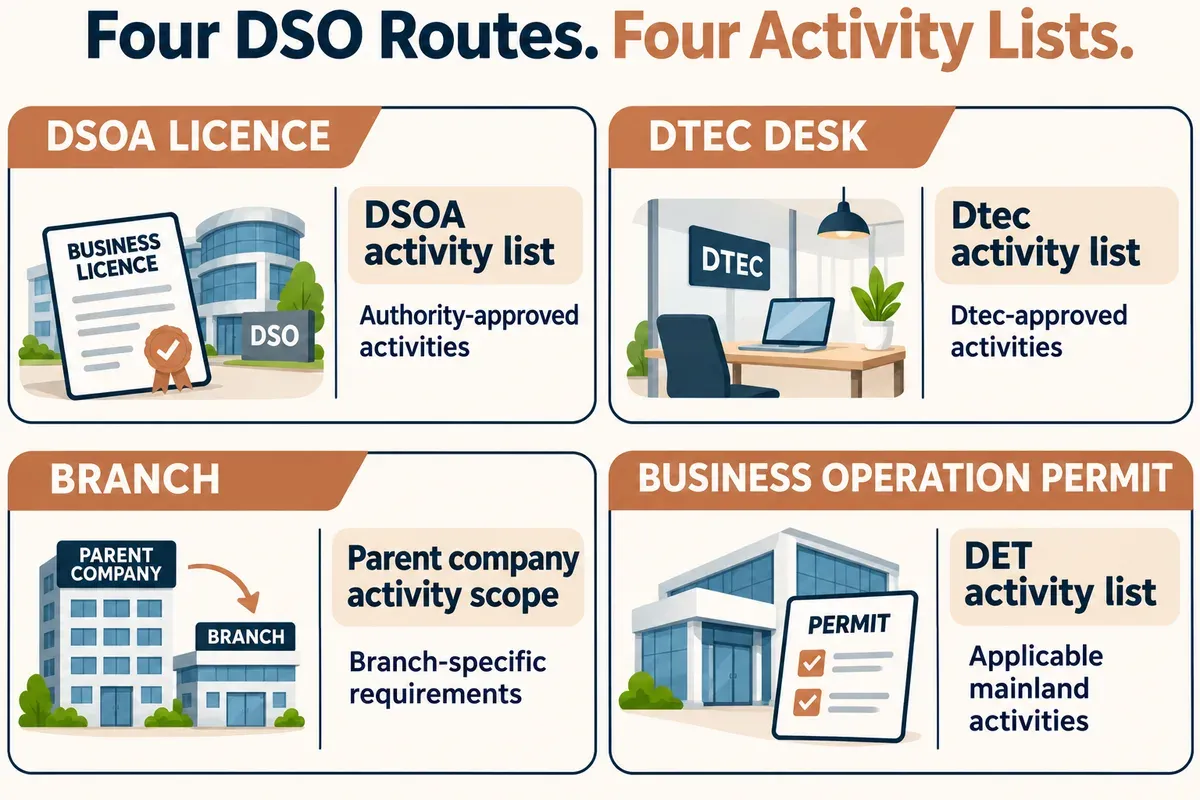
Not every company at Silicon Oasis takes its activities from the same place. Four routes sit at the address, and each uses a different list.
| Route | Issued by | Activity list used | Who it suits |
|---|---|---|---|
| DSOA licence (office, unit or warehouse) | DSOA | The DET list, screened for fit | Technology, R&D, light industry and selected services |
| Dtec desk | DSOA, at the Dtec campus | The same list, plus Dtec’s fit screen | Early technology startups |
| Branch | DSOA | Only what the parent company’s objects allow | Established companies adding a Dubai base |
| Business Operation Permit | A DET licence, with a DSOA permit | The full mainland DET list | Retail, cafes, clinics, salons, gyms and mainland-facing services |
These are not small side routes. The Ministry of Economy fact sheet for the authority counted 4,049 branches and 6,073 Business Operation Permits among 12,146 licensed entities (figures as of Q1 2021).
Branches. The authority matches the business, not the wording. The branch activity has to fall inside the parent’s objects. If the parent’s articles say “software development and IT services”, a branch doing SaaS sales clears. A branch doing equipment trading does not. A foreign parent provides its certificate of incorporation, memorandum and articles, board resolution and power of attorney, all legalised and translated into Arabic where required. A UAE parent needs no attestation. The most common refusal is a parent whose articles are narrow or old, written for one product line. The fix is to amend the parent’s articles first, which can take weeks abroad. Our guide to opening a foreign company branch in Dubai covers the parent documents, and a branch of an existing company is defined in our glossary.
The Business Operation Permit. This permit lets a DET-licensed company operate from the privately developed buildings of the zone, known as the Administrative Zone. It suits businesses that sell to the public on site, and service firms with mainland customers. Because it sits on a mainland licence, the business can invoice anyone in the UAE with no free zone limits, and no share capital is needed. Permit holders are taxed as mainland companies, so they cannot claim the free zone rate. A DSOA licence fits better for a technology company selling abroad or to other free zone firms. We file the permit a few times a year, usually for retail and food tenants in the residential parts of the zone.
To tell which one you have been quoted, look at two things. If the DSOA issues the licence, it is a free zone company. If the DET issues it and the DSOA adds a permit, it is the Administrative Zone route. And a quote with no share capital listed is almost always the permit. The difference is explained in full in What Is Dubai Silicon Oasis? Not Every Company Is Free Zone, and the general trade-off in our guide to free zone vs mainland in Dubai.
Adding an activity later: cost and paperwork
Businesses change, and the licence can follow. On our planning ranges:
- An activity inside the included set: an amendment fee of AED 1,000 to 2,000.
- An activity outside it: the same fee, plus the extra-activity charge of AED 1,000 to 2,000.
- Time: 3 to 7 working days, longer if the new activity needs an outside approval.
The amendment reaches beyond the licence certificate. The memorandum of association changes if its objects clause lists activities. Visa job titles that no longer match any activity need updating at renewal. The share certificate and establishment card stay the same unless something else changes.
Some additions force a bigger change. Adding a trading code turns a service licence into a combined one. Adding assembly work or stock moves you off a desk. Our trade licence amendment team handles the filing either way.
Then tell the bank. Send it the new licence within 30 days, with a one-line note on the new revenue line, because banks flag activity changes they cannot explain. What banks look for is set out in our guide to opening a business bank account in Dubai.
Can your activity reach the Dubai mainland?
Yes, through the DET. Executive Council Resolution No. 11 of 2025 covers every Dubai free zone except DIFC financial firms, so DSOA companies qualify. The resolution sets out three instruments:
- A DET branch licence in the emirate.
- A DET branch licence operating out of the free zone, at AED 10,000 a year.
- A temporary permit for specific activities, at AED 5,000 for up to six months.
Each needs the free zone authority’s approval, and the approval of the activity’s own regulator where one applies. The DSOA charges its own no-objection fee on top, which we budget at AED 1,000 to 2,000 until the authority publishes a figure. Our page on the Free Zone Mainland Operating Permit explains the route across zones.
Two limits matter. First, a flexi desk will not carry it. We file it only for clients with a real office or unit in the zone. Second, the activity must be on the DET’s published list. IT services, consultancy, marketing and design clear most easily, because the DET needs no other regulator for them. Anything that needs a mainland regulator, such as health, education, media or food, is slow or blocked.
Income earned on the mainland through this route is not qualifying free zone income for corporate tax, so it is taxed at the standard 9% rate rather than 0%. The conditions for the 0% rate are explained under Qualifying Free Zone Person.
Not sure your activity fits?
Send us your first three invoices, or drafts of them, and a short description of what you sell. We will match each one to a DET code, check it against the authority before you pay anything, and tell you whether a DSOA licence, Dtec or another route fits better. Call or WhatsApp +971 52 233 0011, or email connect@best-solution.ae. The consultation is free, and our free zone company formation service takes the file on from there.
Three activity mistakes that show up at the bank
Most of our Silicon Oasis files are IFZA companies, so this section comes from IFZA work. The pattern is the same under either authority: the licence says one thing and the invoices say another, and the bank notices.
The three mismatches we see most:
- Software subscriptions invoiced under a consultancy activity.
- Hardware or devices sold on a pure service licence.
- E-commerce sales run on a general trading licence with no e-commerce code, or the other way round.
Before choosing activities, we ask for three things: a draft of the first invoice, the first two customer contracts or proposals, and a one-line answer to “what does the customer pay for?”.
A case from our IFZA files shows why. A company came to us with data analysis and innovation consultancy activities. Its first contract was a monthly dashboard subscription. We caught that before the bank application and added a software activity, and the account opened without a source-of-funds query on the subscription income. The wider pattern of licence and bank refusals is covered in our guide to business licence rejection in Dubai.
Where we send activities the authority is wrong for
Some activities fit Silicon Oasis badly, even when the authority would consider them. This is where we send them, and why.
| Activity | Where we send it | Reason |
|---|---|---|
| Virtual assets | VARA through DWTC, or ADGM | A VARA licence is needed either way, and both have dedicated virtual asset ecosystems |
| Heavy manufacturing | JAFZA or Dubai Industrial City | Units, power and hazardous storage |
| Food production | Dubai Industrial City or JAFZA | Food-grade facilities and Dubai Municipality approval are routine there |
| Healthcare practice | Dubai Healthcare City, or a DET mainland licence | Patient-facing clinics belong in a health zone or onshore |
| Education institutions | Dubai Knowledge Park, or DET with KHDA | Institutions need a campus-style setting |
| General trading with stock | JAFZA or Dubai South | Designated zone status and port access |
| Non-tech services on a budget | IFZA | Lower cost and more visas per package |
The last row is the one we use most. IFZA sits at the same address, and its own searchable list of activities IFZA licensesis wider for non-tech services. How the two authorities compare is set out in Dubai Silicon Oasis or IFZA: Same Address, Two Licences, and the other technology zone founders weigh is compared in Dubai Internet City vs Silicon Oasis: Which Tech Zone.
Check the activity before you choose the desk
Most founders start with the premises and the price. At Silicon Oasis, that is the wrong order. The activity decides the licence type, the approvals, the premises and whether you can reach the mainland, and there is no public list to check it against. So start with what your customers will pay for, turn it into three activity codes, and get the authority’s answer in writing. Then choose the desk, office or unit that fits.
Best Solution has formed companies in the UAE since 2014. Our business setup in Dubai team runs the activity check on every Silicon Oasis file before anything is paid. For the zone as a whole, Dubai Silicon Oasis Free Zone: The Licence Needs a Lease covers every route at the address, and Dubai Silicon Oasis Business Setup: Route First, Then Filing describes our service. Book a free consultation on +971 52 233 0011 or connect@best-solution.ae, and send your first invoices with the enquiry.