Choosing a Dubai visa is rarely the hard part. Working out which one fits your situation is. An employer can sponsor you, but it ties your residency to one job. A freelance permit frees you, but you pay for it yourself. A Golden Visa gives ten years of security, if you qualify. Pick the wrong route and you can lose months and several thousand dirhams unwinding it. Sponsorship begins once the establishment card activates your immigration file.
This guide compares every residency visa available to entrepreneurs and employees in Dubai in 2026: what each one costs, how long it lasts, who it suits, and the mistakes that get applications rejected. It is written by a licensed business setup and visa consultancy that processed more than 3,000 applications in 2024, so the comparison is built on what actually clears, not on theory. Budgeting for hires? Check the employee visa cost before you sponsor.
Entry visa vs residence visa: the difference that trips people up
Before comparing options, clear up one distinction that confuses most newcomers. An entry visa lets you enter the UAE, often visa-on-arrival for 30 to 90 days depending on nationality. It is not residency. A residence visa is what lets you legally live, work, open a bank account and sponsor family. It is linked to your Emirates ID and to a sponsor, and it has a fixed duration.
When people ask about a Dubai visa, they almost always mean the residence visa. Residence visas are issued by the General Directorate of Residency and Foreigners Affairs (GDRFA), while work permits are handled by the Ministry of Human Resources and Emiratisation (MOHRE) or the relevant free zone authority. Every option below is a residency route.
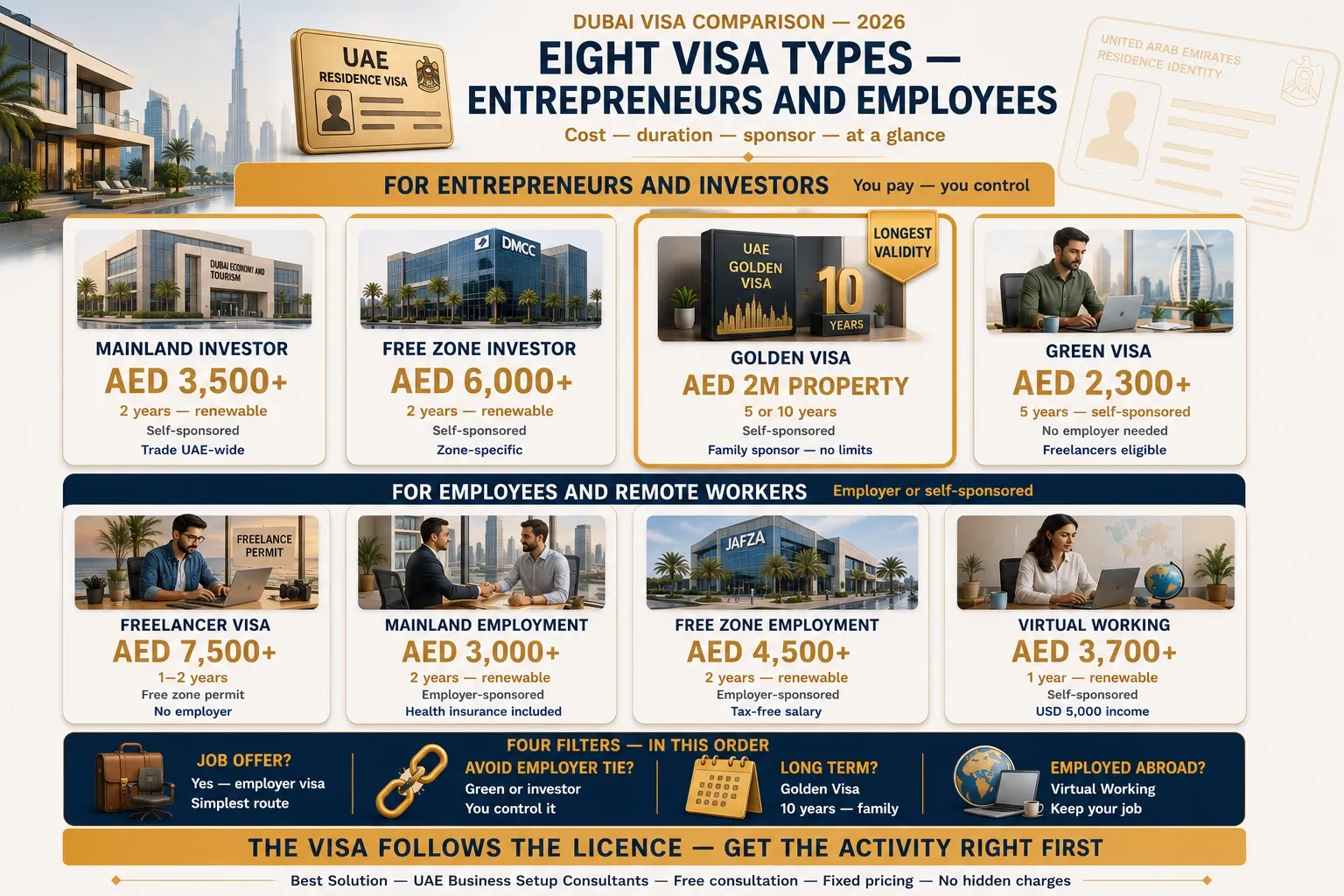
Dubai visa types at a glance
In short
Entrepreneurs typically choose a mainland or free zone investor visa, the Green Visa, or the Golden Visa. Employees usually hold an employer-sponsored mainland or free zone visa. Remote workers use the Virtual Working visa. The right one depends on whether you want an employer, how long you plan to stay, and your budget.
| Visa Category | Target Audience | Validity | Approx. Cost (AED) | Sponsor |
|---|---|---|---|---|
| Mainland investor | Company owners on the mainland | 2 years | ~3,500 | Self (own company) |
| Free zone investor | 100% foreign-owned company | 2 years | ~6,000 | Self (own company) |
| Golden Visa | Investors, founders, top talent | 5 or 10 years | Varies | Self |
| Green Visa | Skilled pros, freelancers, partners | 5 years | ~2,300 | Self |
| Freelancer | Independent professionals | 1-2 years | ~7,500 | Free zone permit |
| Mainland employment | Employees with a job offer | 2 years | ~3,000 | Employer |
| Free zone employment | Free zone staff | 2 years | ~4,500 | Employer |
| Virtual Working (remote) | Remote staff of an overseas firm | 1 year | ~3,700 | Self |
Figures are indicative all-in starting points and change with free zone, activity and add-ons. Always confirm current government fees before you commit.
Visa options for entrepreneurs and investors
If you are setting up or already own a company, your visa flows from that company. Four routes cover most founders.
Mainland investor (partner) visa
A mainland company can trade across the UAE and internationally without free zone restrictions. As the owner, the investor or partner visa lets you operate, hire staff and sponsor your family. It runs for two years and renews with the licence. Costs start around AED 3,500 and rise with licensing, immigration, the medical fitness test and Emirates ID fees. For the full picture on mainland licensing, see types of business visa in Dubai. Founders and staff each have different business visa options to weigh.
Free zone investor visa
Free zones allow 100% foreign ownership with no local partner, plus tax and customs advantages, and each zone specialises by sector. DMCC suits trade and commodities, SHAMS suits media and SMEs, Dubai South is cost-led for startups, and RAK DAO serves Web3 and digital assets. A free zone investor visa runs two years and generally starts near AED 6,000, depending on the zone, activity and package. One caveat: if you close the company, you cannot keep the visa to stay on a work permit.
Golden Visa for entrepreneurs and investors
The Golden Visa is a 5 or 10-year renewable residency for investors, founders and exceptional talent. The headline property route requires real estate worth at least AED 2 million on the full valuation recorded by the Dubai Land Department, and this threshold survived the April 2026 rule changes. Founders can also qualify through an approved startup or business incubator. Holders sponsor family with far fewer limits and are not tied to an employer. If this route fits, read Golden Visa for investors and entrepreneurs and the full UAE Golden Visa eligibility guide.
Green Visa: the self-sponsored route
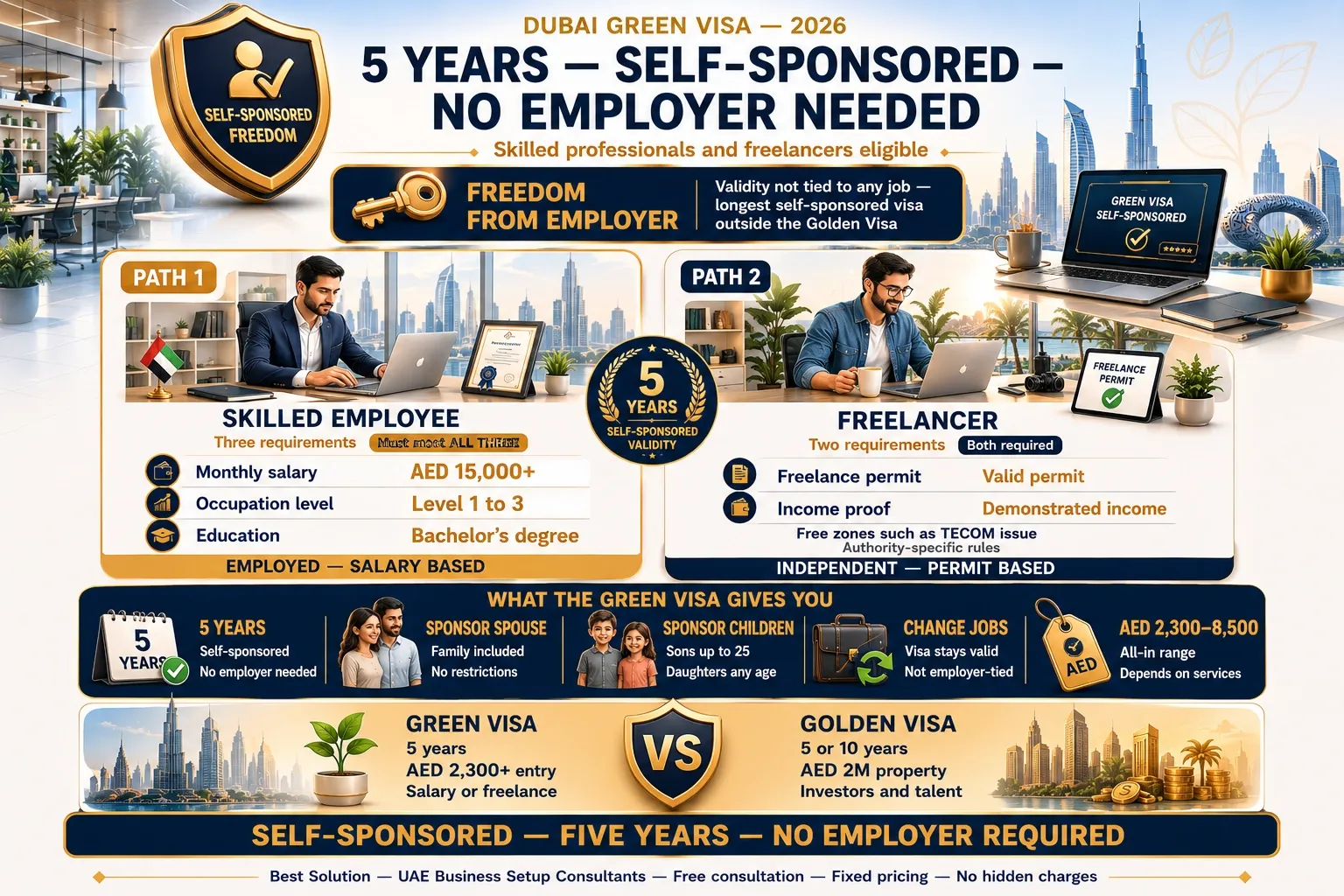
The Green Visa is a 5-year, self-sponsored residency for skilled professionals, freelancers, investors and partners, with no employer needed and validity no longer tied to a job. Skilled employees qualify with a monthly salary of at least AED 15,000, an occupational level of 1 to 3 and a bachelor's degree. Freelancers qualify with a permit and income proof. It lets you sponsor your spouse and children, including sons up to 25. Fees run roughly AED 2,300 to 8,500 depending on services and medicals.
Freelancer visa
For independent professionals, a freelancer visa lets you work legally without a local sponsor, issued through free zones such as TECOM. It typically runs one to two years and starts around AED 7,500, with processing in about 8 to 10 working days. Requirements vary by authority: some free zones want proof of income or experience, and mainland freelance permits run through MOHRE on different criteria. Check with the specific authority before applying.
Visa options for employees
If you are taking a job in Dubai, your employer drives the process. Many people arrive first on a visit visa to interview, then convert once they have an offer.
Mainland employment visa
The most common route. Your employer sponsors it once you have a confirmed offer from a UAE mainland company. It runs two years and renews while you stay employed, and it lets you sponsor dependents. Employers must provide a minimum level of health insurance. Employment visas are currently issued for two years, with a Federal National Council proposal to extend this to three years still pending. Best Solution can manage the residency side through its UAE residence visa service.
Free zone employment visa
For staff of free zone companies such as RAKEZ or Meydan, the free zone employment visa works much like the mainland version: two years, renewable, employer-sponsored. Costs vary by zone and typically start near AED 4,500. The draw is the free zone environment and tax-free salary.
Remote work (Virtual Working) visa
The Virtual Working visa lets you live in Dubai while employed by a company outside the UAE, which suits digital nomads who want to keep their job. It is valid for one year and renewable. As of April 2026 the income floor rose to USD 5,000 per month (up from USD 3,500), with mandatory health cover raised to AED 500,000 and six months of bank statements now required. Some official pages still list the older USD 3,500 figure during the transition, so confirm with GDRFA before applying. Starting fees are around AED 3,700.
How do I choose the right Dubai visa?
This is the question generic guides skip. Use four filters, in order.
- Do you have a job offer? If yes, the employer-sponsored employment visa is the simplest and usually free to you. Everything else is for people without an employer.
- Do you want to avoid being tied to one employer? If yes, look at the Green Visa (salaried or freelance) or a free zone investor visa. You pay the costs, but you control the visa.
- Are you staying long term or investing? If you can meet the AED 2 million property threshold or run a qualifying business, the Golden Visa gives ten years and the strongest family sponsorship.
- Are you employed abroad and just relocating yourself? The Virtual Working visa keeps your overseas job while you live in Dubai.
A common mistake we see: founders pick a cheap free zone package, then discover the activity they selected does not match what they actually do, which blocks the visa. Match the business activity to your real operations first. The visa follows the licence, not the other way around.
How to apply for a Dubai visa, step by step
- Choose your visa based on your goal: employment, investment or remote work.
- Check eligibility, especially salary and income thresholds, which decide several routes.
- Gather documents: passport valid for at least six months, photos, and route-specific items (business plan, job contract, or proof of funds).
- Submit online or through a PRO, after company registration for entrepreneurs or after hiring for employees.
- Complete the medical fitness test and biometrics for your Emirates ID.
- Pay fees, which range from roughly AED 1,000 to AED 15,000 or more by visa type, then track and receive the visa electronically.
Processing usually takes 2 to 4 weeks for entrepreneurs through the DED or free zone authorities, 1 to 3 weeks for employees through GDRFA, and as little as 10 days for remote workers. Rules shift often, so check the latest UAE government guidance or our 2026 UAE visa rule changes before you start.
Why Dubai visa applications get rejected
Across 3,000-plus applications in 2024 we held a 94% approval rate, which means we also see exactly why the other applications stall. The recurring triggers, most of which applicants never anticipate:
- Inconsistent documents, especially mismatched job titles across CV, contract and application.
- Insufficient financial proof for investor, freelance or remote-work routes.
- Unverified degrees, still one of the top rejection reasons.
- Incorrect activity selection during company setup, creating eligibility conflicts later.
- Past immigration issues, such as overstays or unpaid fines.
One more that quietly catches people: the MoFA attestation step, around AED 350 including delivery, is needed for documents to be recognised in Dubai and is easy to forget. Knowing these in advance is usually the difference between approval on the first attempt and a costly second round.

Have questions?
Contact our visa consultants for expert help every step of the way!
What a Dubai visa actually costs
The sticker fee is rarely the full cost. A realistic budget includes the visa fee, the medical fitness test, Emirates ID, and for entrepreneurs the trade licence and immigration card. Add MoFA attestation where documents need it. As a guide, employment visas land near AED 3,000, mainland investor visas from AED 3,500, free zone investor visas from AED 6,000, and freelancer visas from AED 7,500. Golden Visa costs depend on the qualifying route. Timing matters too: applying late in the first quarter, the peak season, can add delays around public holidays.
A note on honesty: any single number you see online is a starting point. The all-in figure depends on your free zone, your activity and your add-ons. A short assessment of your specific case is the only way to get a real number, which is why a reputable consultancy quotes after understanding your plan, not before.
Not sure which visa fits your plan?
Best Solution Business Setup Consultancy, led by Mr Essa Al Harthi and Mr Vipin Kumar, has guided thousands of entrepreneurs and professionals through the exact decision on this page. Book a free assessment and we will match you to the right visa, give you a real all-in number, and handle the paperwork end to end.
Ready to take the next step?
Contact us today for expert guidance