Key takeaways
| Question | Short answer |
|---|---|
| Where do I check? | The Dubai business directory on the Invest in Dubai platform, run by Dubai’s Department of Economy and Tourism (DET). It is free and needs no login |
| What should I search with? | The Dubai Unified Licence (DUL) number. It returns one company. A name search can return thousands |
| Does it cover free zones? | Yes, Dubai’s. Mainland and Dubai free zone companies sit in the same directory. DIFC and other emirates do not |
| What does the record show? | Status, expiry and issue dates, licence type, legal type, issuing authority, each licensed activity with its own status, sector and address |
| What does it not show? | Owners, the manager, fines or violations. A licence with unpaid fines still reads Active |
| What proves there are no open violations? | A DET status certificate, the “To Whom It May Concern” letter. DET will not issue it while fines are unpaid. We accept one no more than 60 days old |
| Is the old DED search still live? | The old DED e-services enquiry page refused access when we tried it in November 2026. Use Invest in Dubai |
A Dubai trade licence check tells you more than the same check in any other emirate. One free search shows a company’s status, its expiry date, its legal form, every activity it is licensed for and who issued the licence. The catch is the search box. Type a company’s name and you can get thousands of results. Type its DUL number and you get one.
Most people run the check for one of two reasons. A Dubai supplier wants a deposit, and you want to know the company is real and licensed for the job. Or a bank, client or landlord has asked for your own licence details, and you want to see what they will see. This guide covers both. We ran the searches ourselves in November 2026, and we say plainly where the free record stops.
How do I check a Dubai trade licence online?
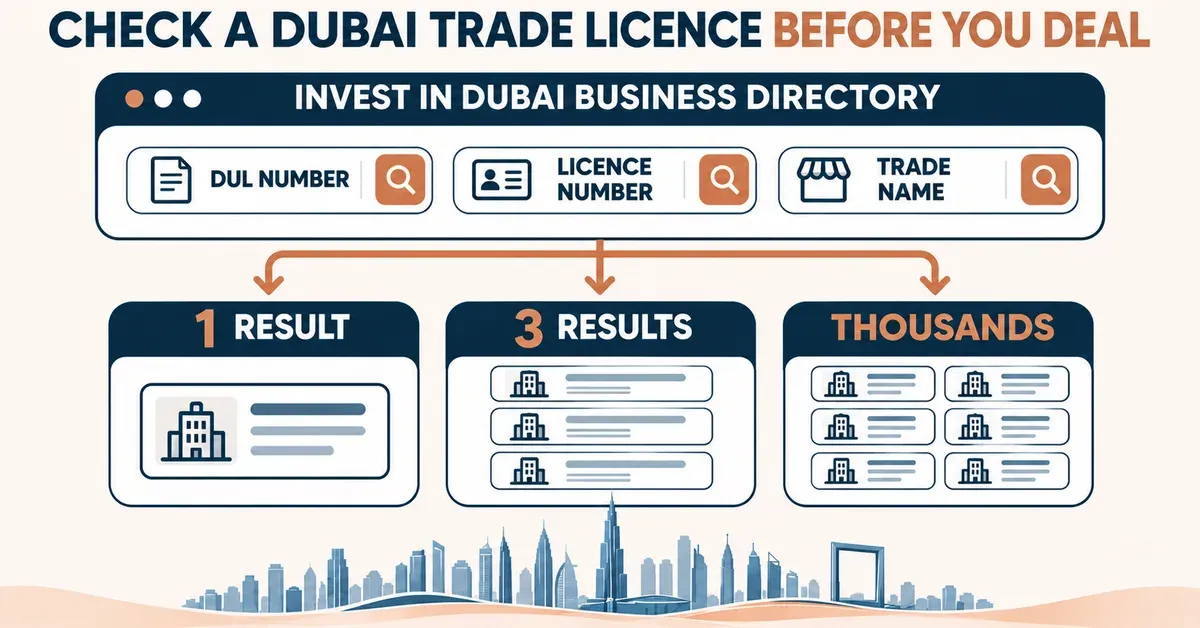
Open the Dubai business directory on the Invest in Dubai platform. Type the company’s DUL number, licence number or trade name, and keep both the Mainland and Free Zones filters on. Open “View details” on the matching result. The record shows the licence status, expiry date, legal type, issuing authority and licensed activities. The search is free.
- Go to Invest in Dubai, open Business set-up and choose Dubai business directory.
- Type the DUL number into the search box. If you do not have it, use the licence number or the trade name.
- Leave both filters, Mainland and Free Zones, switched on, then run the search.
- Open “View details” on the result whose name and number match.
- Read the licence details, the activity list and the address, then compare them with the paperwork you were given.
The directory replaced the licence enquiry that used to sit on the old DED e-services site. Many guides still send readers there. When we tried that page on 9 November 2026, it returned an access-denied error. Dubai’s licensing authority now trades as DET, and its public company search lives on Invest in Dubai. So if you searched for a DED licence check, the Invest in Dubai directory is the same check under the new name. The old DED licence number still works as a search term there.
Why the DUL number beats the name
We tested the three ways in. A DUL number returned exactly one result. A DET licence number returned three, because the search also matched other records that contain the same digits. A two-word trade name returned results in the thousands, ranked by relevance, with the company we wanted nowhere near the top.
There is a reason for this. Invest in Dubai explains that a licence number belongs to the authority that issued it, while a DUL is one identifier for a company across all of Dubai. So the same licence number can exist at a free zone and at DET. The DUL cannot repeat.
The rule is simple. Ask the company for its DUL number before you search. If you only have a name, search in English and in Arabic, then confirm the result by licence number and issuing authority before you trust it. If you cannot find the company at all, our rule is to treat it as cancelled until the supplier gives you a DUL number that brings up a record.
Where do you find a company’s DUL number?
DET launched the Dubai Unified Licence in December 2023 with the Dubai Free Zones Council. Every Dubai business, mainland or free zone, gets a DUL number and a QR code. Companies are told to show the QR code at their premises, on their website and on social media. Scanning it takes you to the same verified record.
The rollout runs in stages, and Invest in Dubai says using the DUL is not yet mandatory. A genuine company may not have its number to hand. In that case, ask for the licence number and the name of the issuing authority, and search with both. A company that refuses to give either is telling you something.
Reading the DET record, field by field
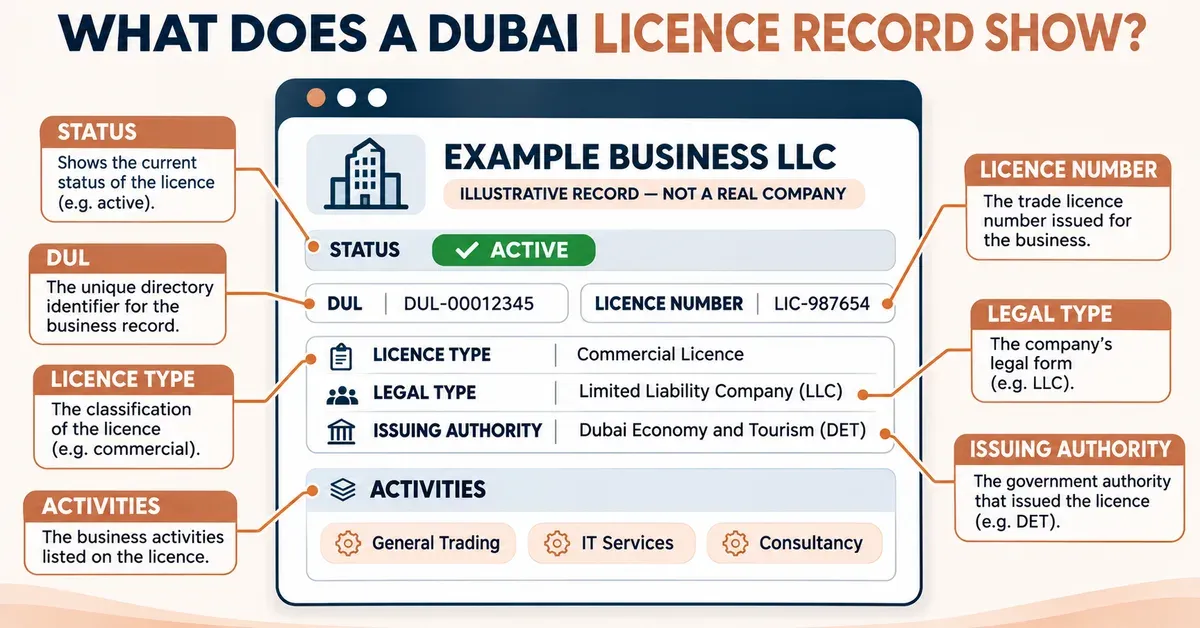
The search result card shows the basics: Mainland or Free Zones, the status badge, the DUL number, the year of incorporation, the issuing authority, the expiry date, the trade name and the address. The “View details” page adds the rest. Here is what each line tells you.
| Field on the record | What it tells you | What to check |
|---|---|---|
| Licence status | Whether the licence is current | It should read Active. Any other badge changes what you do next |
| Expiry date | When the licence runs out | It should run past the end of your contract, or you should see a renewal |
| Issue date | How long the licence has existed | A very new licence is not a problem. A new licence with an old company story is |
| DUL number | The company’s single Dubai identifier | Match it to the QR code or the number the company gave you |
| Licence number | The number held by the issuing authority | Match it to the licence copy and the invoice |
| Licence type | Professional, Commercial, Industrial, Tourism and others | The type should fit the work. A consultancy licence does not cover goods trading |
| Legal type | The legal form, for example “Limited Liability Company - Single Owner (LLC - SO)” | Tells you who is liable and who can sign |
| Issuing authority | DET, or the free zone that licensed the company | Tells you whose rules apply and where to complain |
| Licence activities | Every licensed activity, each with its own status | The activity you are buying must be listed and active |
| Business information | Trade name, sector and address or service area | The trade name should match the invoice and the bank account name |
What each status badge means for your money
Active is the badge you want. On the records our PRO desk handles, a DET licence can show five others, and each one calls for a different response:
- Expired. The licence passed its expiry date and was not renewed. The company cannot legally trade, and its invoices are not valid trade documents. Pay nothing in advance. Ask for the renewed licence, then search again.
- Frozen. DET only freezes a licence that has already expired, and only after every visa on it has been cancelled. A frozen company has no staff and is not trading, so an invoice from one is a stop.
- Under Liquidation. A liquidator has been appointed and the company is closing. Place no new orders. Money owed to the company goes through the liquidator, not into the old company account.
- Cancelled. The company no longer exists. Never pay.
- Suspended, or closed after an inspection. DET has stopped the company trading. Stop until the supplier shows you the decision lifting it.
Expired and frozen records stay visible in the search. We saw Expired badges in the public results on 9 November 2026. Cancelled licences usually still appear when you search the DUL or licence number, but they can drop out of a name search.
Every activity carries its own status
This is the line most people skip. On the detail page, each licensed business activity has its own badge. A company can hold an active licence and still lack the one activity your deal needs.
So read the activity list against the work. A contractor should hold a contracting activity, not just general services. A trader should hold the trading activity for the goods it is selling. If the activity is missing, the company is not licensed for that work until it files a trade licence amendment. How DET groups activities into licence categories is covered in Dubai DED Licence Types: Commercial to Industrial, and the activity list itself in Dubai DED Activity List: 2,000+ Mainland Activities.
The legal type tells you who stands behind the company
The legal type line names the form, such as a limited liability company, a sole establishment, a civil company or a branch. It matters if something goes wrong. An LLC limits what its owners can lose. A sole establishment does not separate the owner from the business. A branch belongs to a parent company elsewhere.
The difference is set out in our guide to sole proprietorship vs LLC in Dubai. For a single owner, the record now reads “LLC - SO”, which is DET’s own label for a one-shareholder LLC. Since June 2021 most mainland activities allow full foreign ownership, so an LLC with one foreign owner is normal and not a warning sign. The background is in our guide to the local sponsor in Dubai, and the DET side of full ownership is in Dubai Mainland 100% Ownership: Three Tests Before You File.
What doesn’t the Dubai licence check show?
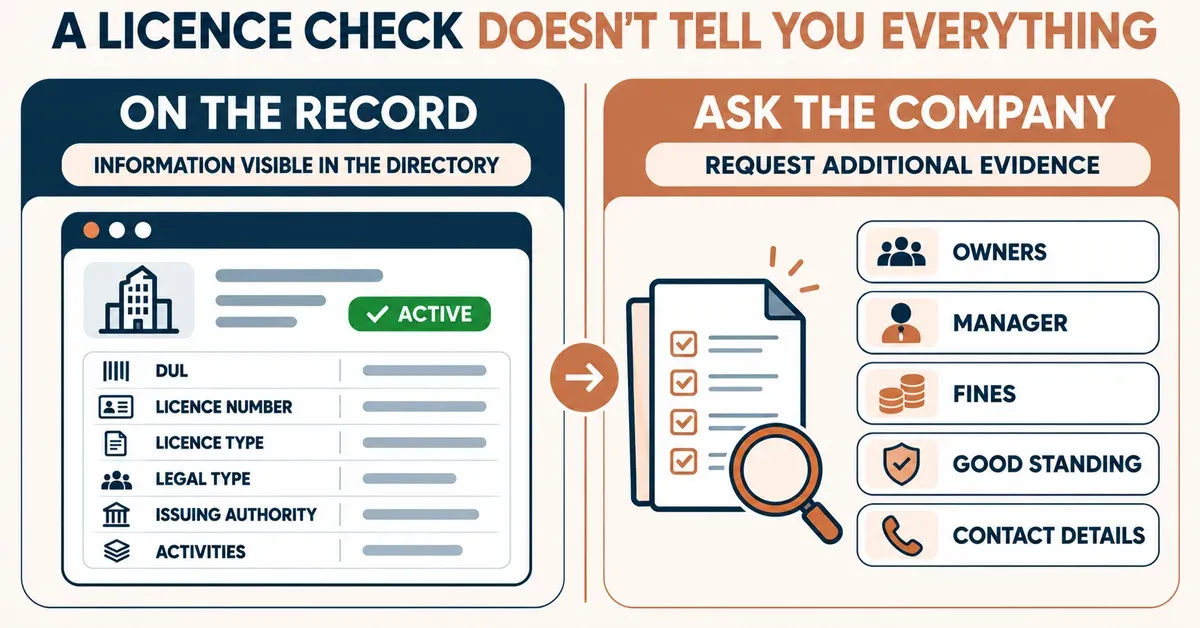
The directory is a licence record, not a company file. It does not show:
- Owners or shareholders. You will not see who owns the company or in what shares.
- The manager or signatory. The record does not say who can sign for the company.
- Fines and violations. A licence with unpaid fines still reads Active until its expiry date. Fines on their own do not change the badge.
- Contact details. There is no phone number or email, only an address.
So Active is where a buyer’s check starts, not where it ends. Two documents from the company fill the gap.
Ask for the DET status certificate
The one document worth asking for is the DET status certificate. It is the “To Whom It May Concern” letter the licence owner requests through their Invest in Dubai account. It matters because DET will not issue it while the licence has unpaid fines. A certificate that exists is the proof.
Our rule is that the certificate must be dated after the supplier’s latest renewal and be no more than 60 days old. For a large advance, ask for one issued that week. The 60 days is our own working rule, not a DET validity period. DET charges a fee for each certificate, and the supplier pays it. We do not quote a figure, because DET revises its service fees.
Two things it will not cover. It shows DET violations only, so labour fines from MOHRE, tax penalties from the FTA and municipality fines sit outside it. And we do not accept the alternatives suppliers sometimes offer. A screenshot of the owner’s account is too easy to edit. A commercial register extract shows who owns the company, not whether it has fines.
Read the licence copy, then check it is current
The current DET licence copy still lists the manager and the partners or owners by name and role. Ownership percentages are not on it. They sit in the memorandum of association.
The risk is an old copy. PDFs keep circulating after partners change. Before you rely on the names, scan the QR code or match the DUL number to the live record. If the numbers match and the badge reads Active, the paper and the record agree.
A check that caught a mismatch
This case is built from our Dubai practice, not a single client record. A café LLC on the Dubai mainland was about to pay a 50 per cent advance on a coffee machine and its opening stock. The trade name on the supplier’s invoice matched an Active LLC in the directory, with the right activities.
The bank account on the invoice did not. It belonged to a different business, a sole establishment with its own DUL number and no listed link to the LLC. Our client asked for an invoice and a bank account in the same legal name. The supplier reissued both under the LLC, and the advance went to the LLC’s own account.
Had the money gone to the sole establishment, our client would have paid a business it had no contract with. If the order had never arrived, there would have been no one to claim against.
One directory for all of Dubai, none for the other emirates
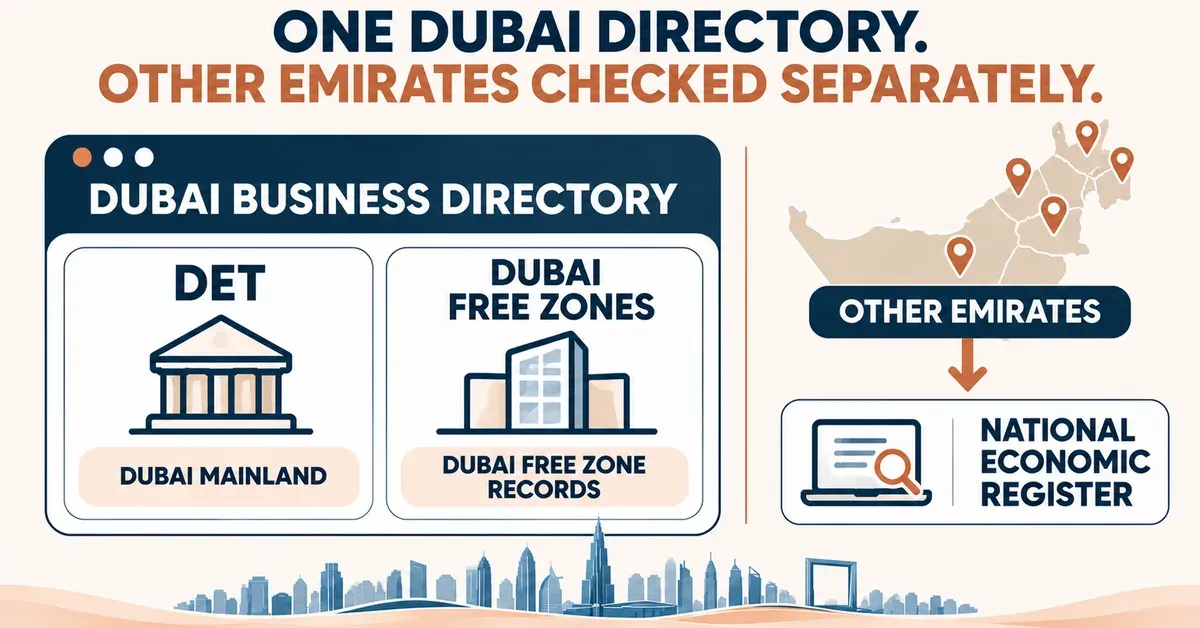
Dubai is the easy case. The directory holds Dubai mainland and Dubai free zone companies side by side, and the issuing authority line tells you which is which. A free zone company shows its zone’s authority. A mainland licence shows DET.
There are gaps. Check a DIFC company on the DIFC’s own public register, not in the directory. DIFC licences are issued by the DIFC Registrar of Companies under DIFC law, and the DUL launch covered mainland and free zone companies without naming the DIFC. If a DIFC firm provides financial services, also check the DFSA public register, because a DIFC licence alone does not mean the firm is authorised. Two other kinds of company can be missing too: a free zone company that has not yet completed the data update that gives it a DUL number, and a business trading under a brand name rather than its registered trade name. In both cases, ask for the DUL number and the issuing authority, then check that authority’s own register.
The directory does not cover other emirates. A Sharjah, Ajman or Abu Dhabi licence will not appear, however you spell the name. Our Ajman trade licence check and Umm Al Quwain trade licence check cover those portals. The Sharjah version is in Sharjah Trade Licence Check: Expiry, Fines, Clean Record. When you do not know which emirate issued a licence, the federal National Economic Register, now run by the Ministry of Economy and Tourism under the name Growth, is the cross-emirate route. The country-wide picture sits in How to Check a UAE Trade Licence: Verification by Emirate.
A free zone licence for mainland work
Here is a check worth adding. If a free zone company wants to deliver work on the Dubai mainland, its free zone licence alone does not cover it. Since October 2025, eligible free zone companies holding a DUL can apply for a Free Zone Mainland Operating Permit through Invest in Dubai. Ask to see it. The wider difference between mainland and free zone is set out separately.
Before you sign: matching the record to the deal
A clean search result is the start, not the end. Before money goes to a Dubai company, line the record up against the deal:
- Search by DUL. Confirm one result, with a trade name that matches the invoice.
- Read the status and the expiry date. The badge should read Active, and the licence should run past your payment milestones.
- Ask for the DET status certificate. It should be dated after the latest renewal and be no more than 60 days old.
- Match the activity to the work. The service or goods you are buying should appear as an active activity.
- Check who signs. The person signing should be the manager or authorised signatory named on a current licence copy, or hold a power of attorney from them.
- Check the bank account name. It should be in the same legal name as the invoice and the record. An account in another company’s name is a stop, even if the two look related.
- Check the tax number. If the company charges VAT, verify its TRN before you accept its tax invoice.
If any line fails, hold the payment and ask why. Most gaps have an honest answer: a renewal in progress, an amendment not yet filed, an invoice raised by the wrong entity. Get the fix in writing before you pay.

Want us to run the check?
Send us the company’s DUL or licence number. Our PRO team reads the record against your contract and tells you what to ask for before you pay. On your own licence, we check how your record reads and fix what does not match.
When the record is your own
Other people run this check on you too. On our files, the one that catches owners out is vendor onboarding: a procurement team asks for the DET licence number before it issues a purchase order. Government tenders come second. So search your own company, as an outsider would, and look for three things.
First, the expiry date. If it is close, start the renewal now. Our guide to renewing a trade licence in Dubai covers the steps and the blockers, and Dubai Trade Licence Renewal: DET Fees and Steps will cover DET’s renewal fees. A lapse is felt in weeks, not months. Before the bank reacts, an expired licence blocks your MOHRE and immigration transactions: no new work permits, no visa renewals, and the establishment card cannot be renewed. The bank follows. On the accounts we have handled, banks tend to hold incoming payments and block transfers out somewhere between 60 and 90 days after expiry, and can close the corporate bank account at around six months.
Second, the activity list. If you have started work your licence does not list, the record will show it to anyone who looks. File the amendment before a client spots the gap.
Third, the address. If you have moved office, the record should follow. An address that does not match your Ejari causes trouble at renewal and at the bank.
Where to find your own fines
Your fines are not on the public record, but you can see them. The company’s manager signs in to Invest in Dubai with UAE PASS. Fines and violations appear on the licence dashboard and can be paid there. You do not have to wait for the renewal, but the renewal will not go through until they are paid.
Clear them as soon as they appear. Since Dubai Law No. 6 of 2026, issued in March 2026, every administrative penalty must rest on a violation written into legislation, and early correction counts in the owner’s favour when the penalty is set. A clear record also lets you hand a buyer a status certificate on the day they ask for one.
What if the status is not Active?
If you are the owner and the badge has changed, find out why before you act. An Expired licence needs a renewal, and the fines on it come first. A Frozen licence was frozen after expiry with every visa cancelled, so reviving it means rebuilding the staff file too. A suspension or an inspection closure needs DET’s decision lifting it. Talk to your PRO before you renew blindly, because each status has its own fix. If you would rather close the company than renew it, Trade Licence Cancellation in Dubai: The Steps covers the route, and our company liquidation service runs it.
Keeping your Dubai record clean
A Dubai trade licence check takes a minute and shows a stranger most of what they need. That cuts both ways. Your record is your shop window to every bank, landlord and client who looks you up.
Keep it accurate. Renew before the expiry date, not after it. File amendments when your activities, partners or address change, so the licence copy and the live record never disagree. Put your DUL QR code where clients will see it, on your website, your invoices and your office door. When a supplier sends you their DUL in return, you will both have saved a day.
Best Solution has formed and renewed companies in the UAE since 2014 and licenses on the mainland in all seven emirates. Our PRO services keep a Dubai record current, and our trade licence renewal service handles the renewal in one run. If you are starting from scratch, our mainland licence service handles a new DET file, and the full route is in our guide to starting a business in Dubai mainland. The wider picture is in Dubai Business Setup: A DET Licence With Full Access. Book a free consultation on +971 52 233 0011 or connect@best-solution.ae.