| Question | Short answer |
|---|---|
| Who sets the licence fee? | Meydan Free Zone. It is the same number whether you apply direct or through any partner |
| What does the zone and government side cost? | AED 22,600 to 23,600 on a one-person company with one investor visa |
| What do we charge on top? | AED 3,000 to 6,000 plus VAT on a one-visa file, fixed in writing before we start, and shown on its own line |
| What do you get for our fee? | Activity wording checked against your invoices, the filing, the establishment card, the visa run, corporate tax registration and the bank file |
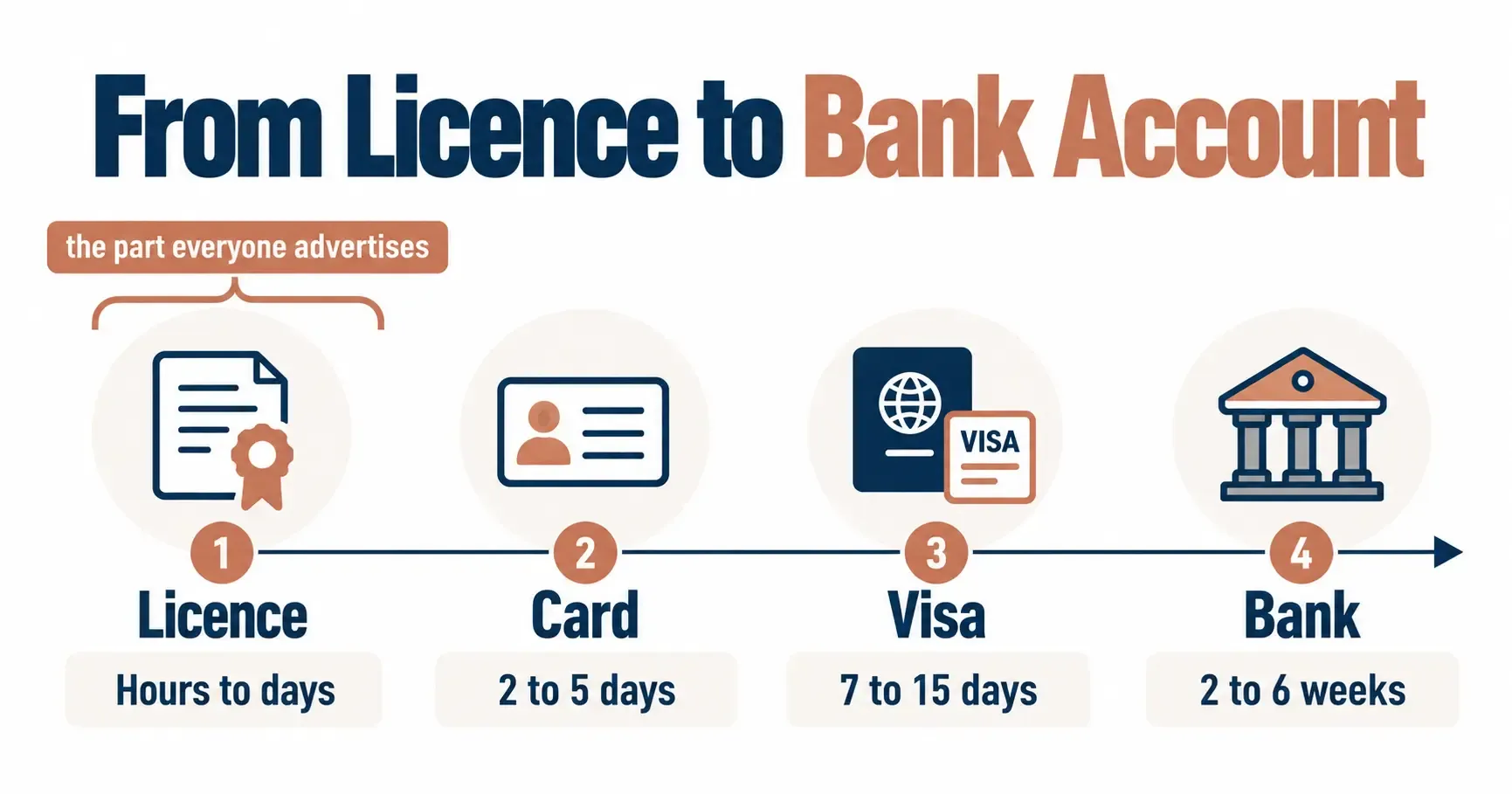
| How long until the company can operate? | Four to seven weeks. The licence takes a day or so. The card, visa and bank account take the rest |
| Do you need to be in Dubai? | Not for the licence. Yes for the visa medical and biometrics, and usually for bank activation |
| What will we not promise? | A bank account. The bank decides |
| Can you move an existing Meydan file to us? | Yes. The company belongs to its shareholders, not to the partner that filed it |
Meydan Free Zone will license your company without us. You can apply on its portal, and you will pay exactly the same licence fee we would. So the only thing you buy from any Meydan business setup service is the work around that fee. That work should be priced where you can see it.
Our quote shows the zone and government lines first, then our fee on its own line. On a one-visa file, our fee is AED 3,000 to 6,000. Below, you can see what that pays for, what it does not, and how the file runs from the first call to a working bank account.
We are a registered Meydan channel partner, and we hold more than 60 Meydan files. Partner status lets us file through the zone’s consultant login, and it gives us a contact at the zone when a file needs fixing. It does not buy a lower licence fee, for us or for anyone else.
The licence fee is the same whoever files it
Meydan sets the licence price. A partner cannot discount it, and any quote that shows a licence below the zone’s price has moved the difference somewhere else in the file. The zone runs its own promotions from time to time. Those belong to the zone, and they apply whether you file direct or through us.
That leaves three things a partner actually changes: the service fee, the order the work happens in, and how fast a rejected document is fixed. Those are what you should compare.
In our view, filing direct makes sense for a simple file. One shareholder who is also the manager, an activity with no outside approval, already resident in the UAE, and no visa needed on the new company. That founder can do most of the work alone.
Everything else is where our fee earns its place: a corporate shareholder, two or more shareholders, any visa, or an activity with an approval attached. Most of the Meydan founders we meet came through a consultant. The minority who start direct usually get stuck in one of three places. The activity was picked for speed and the bank later questions it. The medical and Emirates ID steps sit unbooked. Or the bank application has no business profile behind it. If you are still weighing firms rather than zones, choosing a business setup consultant in Dubai sets out what to ask anyone you shortlist.
Where your money goes on a one-visa Meydan file
Here is a standard one-person company with one investor visa. The first six lines go to the zone and the government in full.
| Line | Paid to | AED |
|---|---|---|
| Standard licence, licence only, no visa | Meydan Free Zone | 12,500 |
| Establishment card, including e-channel activation | Meydan Free Zone | 2,000 |
| Visa allocation, paid once per slot | Meydan Free Zone | 1,850 |
| Investor visa and stamping | Immigration | 4,000 to 5,000 |
| Medical and Emirates ID | Government | 2,250 |
| Zone and government subtotal | 22,600 to 23,600 | |
| Our professional fee | Best Solution | 3,000 to 6,000 |
| Year one, all in | roughly 26,000 to 30,000 |
Two lines sit outside that table. If you are already in the UAE on another visa, the change of status adds about AED 1,500. Health insurance is compulsory before the visa is stamped and runs about AED 800 to 1,500 a year for basic cover. Neither is in any Meydan price.
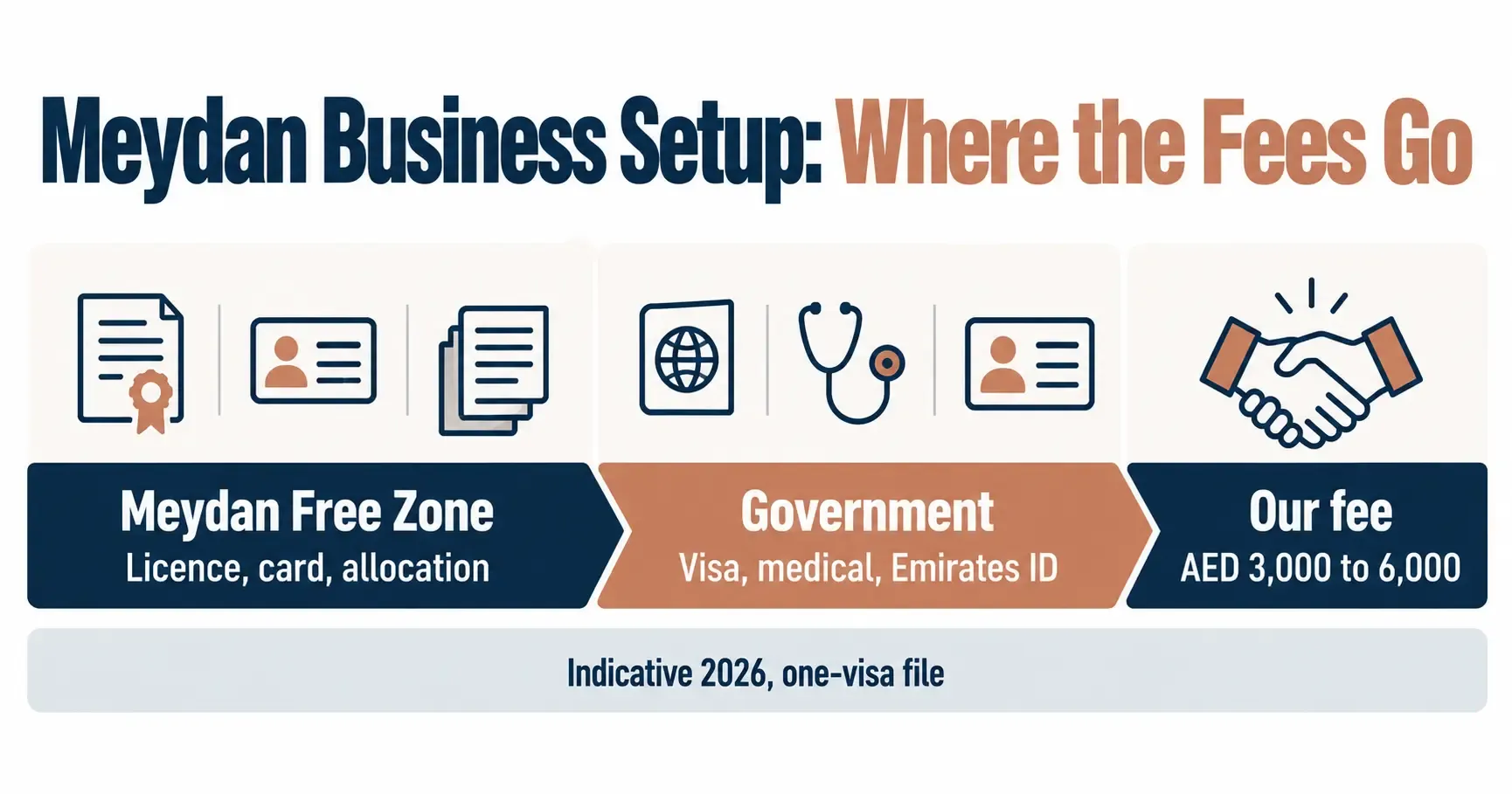
Our fee carries 5% VAT, shown on the quote. The zone and government lines are passed on at cost, exactly as Meydan and the authorities invoice them, with nothing added.
Where you land inside our band depends on the work on your file, not on the headline. A file sits at the bottom when it has one individual shareholder already in the UAE, one visa done by change of status, and activities that match what the business actually sells. Three things push it toward the top:
- A corporate shareholder. Board resolutions, attestation in the home country, then embassy and ministry legalisation. That is weeks of follow-up.
- More than two shareholders, or a founder abroad. Every extra person means more KYC and another e-signature session, often across time zones.
- An activity that needs extra checks. If it needs a third-party approval or extra compliance screening, we prepare that file too.
Extra visas do not move our fee. They are quoted as separate lines. You get the number in writing before anything is filed, and it does not move afterwards unless the scope does.
A quote that bundles all of this into one figure is not proof of overcharging. It is just a quote you cannot check. The full year-one and year-two build, including the audit that renewal depends on, is set out in Meydan Free Zone Licence Cost: What You Pay in Year One and Year Two, and the partner model behind these numbers in Meydan Free Zone Channel Partners: What You Are Paying For.
The work behind our fee, line by line
This is the split on a standard one-visa Meydan file.
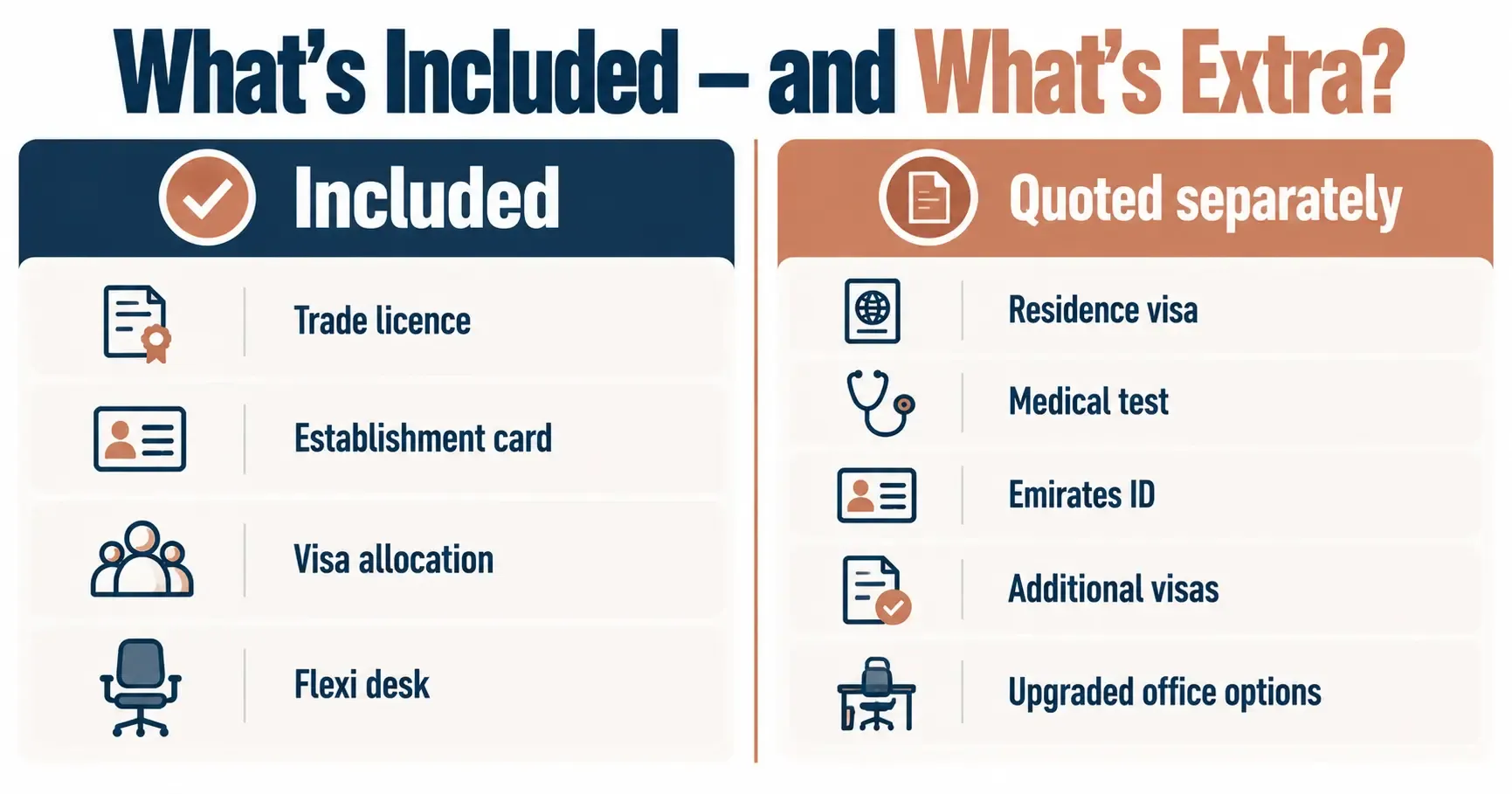
| Line | Status |
|---|---|
| Activity check against your real invoices | Included |
| Trade name options and pre-check | Included |
| Document pack, and legalisation coordination for a corporate shareholder | Included, embassy and ministry fees at cost |
| Filing through the zone’s consultant login | Included |
| E-signature sessions for every shareholder and the manager | Included |
| Establishment card and e-channel activation | Included, zone and government fees at cost |
| Visa allocations for the visas in your quote | Included |
| Entry permit or change of status, medical, biometrics, stamping | Included for the visas in your quote, government fees at cost |
| Emirates ID | Included |
| Beneficial owner details inside the application | Included |
| Corporate tax registration, inside the three-month deadline | Included |
| Bank file and introduction to a bank | Included. We prepare the file and introduce you; the bank decides |
| Health insurance sourcing | Included. We source the quotes; the cost of cover is quoted separately |
| Renewal reminders | Included |
| Extra visas beyond the quote | Quoted separately |
| Family visas, one line per dependant | Quoted separately |
| VAT registration | Quoted separately |
| Bookkeeping | Quoted separately |
| Audited financial statements for renewal | Quoted separately |
| Renewal filing | Quoted separately, when it falls due |
Two lines need a word of explanation. On banking, we build the file, with the business plan, invoices, KYC and source of funds, and put it in front of a bank that suits the activity. We do not promise the account will be approved. On insurance, sourcing is part of our fee, but insurers price cover by age and plan, so the cost of the policy itself sits outside it.
Family visas are quoted one line per dependant: the spouse, each child, and a parent where the sponsor meets the rules. Budget from about AED 6,000 per dependant, plus a refundable deposit of about AED 3,000, with health insurance for each dependant on top. A dependant is sponsored under the founder’s own residence visa, so the family files start after the founder’s visa is stamped, not alongside it.
Two things stay with you whatever we are paid. You supply the documents. And you attend the medical and the Emirates ID biometrics in person. Neither can be handed to anyone else.
Four commitments come with every engagement. A fixed fee, agreed in writing before work starts. A reply on WhatsApp within 24 hours. One named coordinator on your file. And the same in-house team on your renewal filing, establishment card and visas. A WhatsApp reply is a reply time, not a promise that the issue is resolved in 24 hours.
Before we file: matching your activity to your invoices
The Meydan file that causes us the most trouble is not a refused one. It is the one where the licence activity does not describe what the client really does. It passes the zone. Then it stalls at the bank, when the compliance team compares the licence with the business plan and the invoices. The fix is an activity amendment, another fee and several lost weeks.
So before we submit anything, we ask for three to five recent invoices or quotes, your product or service list, and your website or pitch deck. We match the wording on those against the exact activity names on the zone’s list. Near enough is not a match, because banks read the printed licence line by line.
A Meydan licence carries up to three activity groups. A group is a numbered set of related activities, so three groups cover more ground than most founders expect. Activities outside those groups cost AED 1,000 each. The mistake we see is picking three groups defensively to cover everything, then finding the activity you actually invoice under sits in none of them. We pick groups around the next twelve months of invoices, not year three. The general logic is in our guide to choosing a business activity in Dubai, and the Meydan list itself in Meydan Free Zone Activity List: Multi-Activity Licences.
The trade name gets the same care. Names that suggest a regulated activity the licence does not cover, such as Capital, Investment or Exchange, are the most common refusals. So are words like UAE, Emirates or Group without the structure to back them. We submit three options and keep the activity word in at least one. The general rules sit on our page on trade name registration in Dubai.
Fawri or standard: settled at intake, not after payment
Meydan has two routes to a licence. Fawri issues the licence document in under 60 minutes, but only when every condition holds: one shareholder who is also the manager, director and beneficial owner, an activity with no outside approval, a clean passport scan, and cleared payment. The standard digital licence usually issues the same day to three working days after a complete application.
Most Fawri conditions break before anyone pays. A co-founder joins, the activity needs an approval, or the shareholder is a company. We catch those at intake and put the file on the standard route from the start. When a condition breaks after payment, in our files the zone has moved the file to the standard route and credited the difference against the new invoice.
The route also decides when money moves. On the standard route, Meydan raises its invoice only after screening clears, so nobody pays the zone for a file that is about to be refused. On Fawri, payment is taken at submission, and the zone’s own refund guarantee covers a licence that does not issue on time.
From first call to a working account: our clock
The licence is the quick part. Our fee is earned in the weeks after it.
| Stage | Working time |
|---|---|
| Activity check, trade name options, document pack | About one to two days on our files |
| Licence, standard route | Same day to three working days |
| Licence, Fawri route | Under 60 minutes, eligible files only |
| Establishment card, including e-channel activation | Two to five working days |
| First residence visa, applicant in the UAE | Seven to 13 working days |
| First residence visa, applicant abroad | Ten to 15 working days, including travel |
| Emirates ID card | A few days after stamping |
| Corporate bank account | Two to six weeks |
Put the stages that run in order end to end and a typical file goes from licence to operating in four to seven weeks. The bank account is the longest step. Every speed claim on this page, including ours, applies to the licence alone, never to the visa, the Emirates ID or the bank.
On a multi-shareholder file, each person is screened and signs separately. The screenings run at the same time, so two or three individual shareholders usually take three to five working days rather than one to three. The extra time comes from the slowest signer. A corporate shareholder is different, and adds weeks rather than days.

Want your Meydan file priced line by line?
Tell us what you will invoice for, how many shareholders you have, where each one lives, and how many people need visas in the next six months. You get a written quote with the zone lines, the government lines and our fee shown separately.
Running your Meydan setup from outside the UAE
You can reach a Meydan licence without flying in. Signing is an e-signature inside the zone’s portal. UAE residents sign through UAE PASS. Founders abroad sign through a link sent to their registered email and mobile, confirmed by a one-time code. On a sole-founder file, the whole signing usually takes under ten minutes.
The residence visa is where you need to travel. Book seven working days in Dubai, which is about ten calendar days, timed to arrive after the entry permit is issued. That covers the medical and the Emirates ID biometrics, and the stamping that follows. The bank rarely fits into that first trip, because most banks want the Emirates ID or at least the stamped visa before they activate the account. So plan a second trip of two or three days, about three to five weeks later. A founder who can only travel once should stay two weeks, and accept that the bank may still finish after they leave.
A corporate shareholder adds the one step that cannot be rushed. The parent company’s documents are notarised at home, then legalised through the home country’s foreign ministry, the UAE embassy there and the Ministry of Foreign Affairs here. Allow two to four weeks. A parent registered in the UAE, on the mainland or in another free zone, skips the embassy step and usually clears in three to five working days. Some founders start with one of Meydan’s partners in their home city. That partner can get the licence issued remotely, but the visa, Emirates ID and bank account need someone in Dubai. We regularly take those files over from the establishment card onwards: the entry permit, medical, biometrics, Emirates ID, stamping, and the bank file and introduction. Most of those founders then move the renewal to us too, because renewal means visas and the audit, both handled here.
Our UAE document attestation team runs that chain, with legal translation where papers are not in English or Arabic.
If Meydan screening stops the file
Most vendor pages skip this. It is the question clients ask us most before they pay.
On the standard route, you pay the zone after approval, so a file that fails screening has not paid the licence fee. A refused trade name is not a refused application either. We put in the next option and the file keeps moving. Screening covers every shareholder, the manager and the beneficial owners, and clean files move through quickly.
Government fees for the establishment card and each visa are generally not refunded once each application is submitted. If Meydan refuses the file at screening, we refund our service fee in full. We keep only third-party costs already paid on your behalf, such as legalisation or courier charges, and we show those with receipts. The other option is to move the file to a zone that will accept the activity or the shareholder profile. Then our fee carries over and you do not pay us twice. You choose which. In practice, refusals at screening are rare, because we check activities and shareholder documents before anything is filed.
The best protection is the first two days. Activities that match your invoices, a name that fits them, a clean ownership chain and papers legalised before you apply. In our files, refusals nearly always trace back to one of those four being rushed.
Your corporate account: prepared by us, decided by the bank
No partner controls a bank’s decision, and anyone promising a guaranteed account is promising something they do not control. What we control is the file.
We match your profile to a bank whose appetite fits before anything is submitted. We prepare the business summary, the source of funds note and the ownership pack, arrange the introduction and get you ready for the compliance interview. What opens the account is a clear source of funds, a clean chain of beneficial owners, an activity that matches the business, and at least one real contract or invoice. The zone name is the smallest variable in that decision.
The application is remote at every bank we use. The KYC interview is usually a video call or a relationship manager’s visit. Activation is where the signatory almost always has to appear in person, with the original passport, the Emirates ID or visa, and a wet signature. Plan your travel around activation, not the application.
Two to six weeks is the range to plan around. Our own group holds a live Meydan licence, and its account opened two days after the licence issued. That is our fastest result, not our average. One more point: Meydan Pay is an e-wallet and payments product, not a bank account. It helps a digital business collect money early, but it will not satisfy a counterparty that asks for a bank reference. What a strong file looks like is set out in how to open a business bank account in Dubai.
Do not take client payments into a personal account while the corporate account is pending. That money then has to be explained twice, once to the bank’s compliance team and once in your books, where revenue outside the company weakens the qualifying income position for a Qualifying Free Zone Person at year end.
After the first year: the renewal we plan from day one
Renewal reminders and corporate tax registration come with every engagement. For a company incorporated from 1 March 2024, registration is due within three months of incorporation, and missing it carries an AED 10,000 penalty. We file it well inside that window. The beneficial owner details go in with the licence application, so that register is complete the day the licence issues.
The renewal itself is where most Meydan budgets break. Meydan asks for audited financial statements before it renews, from an auditor on its approved list who is also registered with the Ministry of Economy. If the first financial year has not closed by the first anniversary, the zone accepts a declaration form instead, still signed by an approved auditor. The deadline that governs you is the licence anniversary, not your financial year end. Separately, under Ministerial Decision No. 84 of 2025, audited statements are mandatory for any company claiming Qualifying Free Zone Person status, with no revenue floor, and the two-tier financial statement rule in force since 30 September 2025 applies alongside it.
Year two on the same one-visa file looks like this:
| Line, year two | AED |
|---|---|
| Licence renewal, licence only, no visa (our quote figure) | 12,500 |
| Establishment card renewal | 2,200 |
| Audited financial statements | 3,000 to 6,000 |
| Corporate tax return filing | 1,200 to 2,500 |
| Year two total | about 19,000 to 23,000 |
Excludes health insurance. Visa renewals fall in year three, not year two. The licence line is the figure we quote, not a rate Meydan publishes.
The establishment card renews every year with the licence. Meydan residence visas run for two years, so the first visa renewal lands in year three. The renewal notice arrives 30 to 60 days before expiry, and we start the file at 60 days. Any activity change you need is best filed with the renewal, where swapping or removing activities inside the package costs nothing.
Missing the date has two clocks. The licence has a 30-day grace period, then a one-off late fee of AED 500. The establishment card has no grace period, and its fee of AED 250 a month starts on the day of expiry. Immigration work stops on that day too. We work with auditors on Meydan’s approved list and introduce you to one. You sign the engagement letter with the auditor and pay them directly, because the auditor has to stay independent of whoever keeps the books. Our audited financial statements team closes the books and prepares draft statements early enough for the auditor to sign before your licence expires. The audit covers your financial year, which may not match the licence date, so we plan backwards from whichever date comes first. Your part is to keep bookkeeping from day one, send bank statements, sales and purchase invoices and contracts on time, and sign the auditor’s engagement early. The full picture is in Meydan Free Zone Licence Renewal: Why the Audit Comes First, and our trade licence renewal service handles the filing when it falls due.
Switching to us partway through a Meydan file
You are not tied to the partner that filed your company. The company belongs to its shareholders. On the zone’s portal, the filing partner stays linked to the file as its servicing account, but that link is a portal setting. It is not ownership, and it is not written into your licence or memorandum of association.
To move, the authorised signatory or a shareholder writes to the zone asking to change the servicing partner, with a passport copy and the licence details. The zone may ask the outgoing partner to confirm there are no unpaid zone dues. On the files we have taken over, the move took a few working days and the zone charged no separate fee. That is our experience, not a zone commitment.
Before you move, get these into your own hands: the licence, the certificate of incorporation, the memorandum of association, the share certificate, the establishment card, copies of every live visa, and the company’s own portal login.
We charge no takeover fee. When a file comes to us, we first review it: licence status, visa expiry dates, whether the establishment card is still valid, corporate tax registration and filing status, and any penalties. We tell you what we find, whatever you decide next. After that, our normal fee applies to the work that follows, usually the renewal or a visa. Most files that reach us have an expired card or a corporate tax registration that was never done.
Then check the new quote against what the company already holds. The visa allocation, a live establishment card and a reserved trade name are the lines most often billed a second time when a file changes hands. We check what is already paid before we quote.
One Meydan file, first call to a working account
Two founders ran a computer hardware business supplying laptops and networking equipment to small offices. One was in Dubai, the other abroad. They planned to take the Fawri licence the same day, with general trading plus consultancy as the activities.
- Week 1. We checked their last six months of invoices. More than 90% were hardware sales, with a small amount of installation work and no consultancy. We changed the activities to computer and peripheral equipment trading plus installation. With two shareholders the file did not qualify for Fawri, so we moved it to the standard route before anything was paid.
- Week 2. Name approval, the document pack, and e-signature sessions across two time zones.
- Week 3. Licence issued, then the establishment card and e-channel.
- Weeks 4 to 5. Change of status for the founder in Dubai, then medical, biometrics and Emirates ID.
- Weeks 5 to 9. Bank file built around the supplier contracts and invoices. The bank asked for proof of where the stock came from, and the account opened in week 9.
They expected a licence in an hour and a bank account the next week. The licence took three weeks and the account nine. But the activities matched their invoices, so the bank asked nothing about the licence. The weeks above are representative of how this file ran, not dated records.
Files we steer away from Meydan
Meydan is a low-cost zone with a real Dubai address and no premises. That suits consultants, agencies, software founders and e-commerce sellers who fulfil outside the UAE. It does not suit everyone, and we would rather say so at the first call than file the wrong company.
- Goods that land and sit in the UAE. Meydan is not a VAT designated zone, so import VAT and customs treatment work as they would onshore. A trader holding stock belongs in a zone with the facility, such as JAFZA or DAFZA.
- Anyone needing real premises. Staff on site, an inspection or storage. The flexi desk is a licence address, not a workplace.
- Regulated financial services. Those belong in DIFC or ADGM, and the conversation should end on the first call.
- Physical commodity trading with documentary credit. DMCC, where the infrastructure is the product.
- Customers who are Dubai government or walk-in retail. A Dubai mainland licence fits better than a patch on a free zone company.
- Seven or more visas from day one. Six is the licence ceiling at Meydan, and only a dedicated office can go past it, with approval. At five or more visas, price IFZA as well, because the per-head cost compounds there differently. Our IFZA business setup services page shows that route.
A food business is a two-part answer. Meydan can issue the licence, but a cloud kitchen needs an approved food premises that a flexi desk cannot provide. That split is set out in Meydan Cloud Kitchen Licence: The Half Nobody Explains. If you are still choosing a zone, how DAFZA, DMCC, IFZA and Meydan compare sets them side by side.
Selling into Dubai mainland from a Meydan company
Selling to a mainland business from Meydan is usually fine, as long as the customer can accept a free zone invoice. Most business customers can. The question changes when a procurement team asks for a DET licence, or when you sell to Dubai government or the public.
The answer then is the Free Zone Mainland Operating Permit or a branch licence, and both need a real office inside the zone. A flexi desk does not qualify. We compare the office step against the value of the mainland contract before either fee is paid, and we stop the file if the contract does not cover the rent. The routes and their costs are in Selling to Dubai Mainland from Meydan: Permit or Branch Licence.
Choosing who files your Meydan company
Every Meydan quote contains the same zone fee. So choose on the part that differs: what the service covers, whether it is itemised, and how the firm behaves when a document comes back or a bank asks a question.
Ask for the zone lines, the government lines and the service fee on separate lines. Check that the activity will match your invoices before anything is filed. And keep your company’s documents and portal login in your own hands from day one.
Best Solution has formed more than 5,000 UAE companies since 2014 and supported more than 4,500 corporate bank account applications. Our free zone licence team files Meydan every week. For the zone itself, start with Meydan Free Zone Business Setup: Dubai Licence, No Office, and the order of events is set out in Meydan Free Zone Company Setup: The Licence Is the Fast Part. When you are ready for a quote, call or WhatsApp +971 52 233 0011, or email connect@best-solution.ae.