Most people who want to open a veterinary clinic in Dubai already know three names: the Department of Economy and Tourism (DET), the Ministry of Climate Change and Environment (MOCCAE), and Dubai Municipality (DM). What they do not know is how those three fit together, or which one decides the day your doors actually open.
That gap is where money is lost. A vet with the right degree gets stuck for six weeks over one certificate. An investor signs a lease, starts the fit-out, and then learns the clinic was licensed for the wrong activity. None of this is about effort. It is about sequence.
This guide lays out the full path to a licensed veterinary clinic in Dubai in 2026: the authorities, the order of approvals, the real costs, the timeline, and the specific points where setups go wrong. It reflects current MOCCAE rules and the six-permit Dubai Municipality structure, written from hands-on regulatory coordination, not theory.
The essentials
| Question | Short Answer |
|---|---|
| Who licenses it? | DET (trade licence), MOCCAE (federal veterinary establishment licence), Dubai Municipality (facility), plus Civil Defence. |
| Mainland or free zone? | Mainland. A free-zone trade licence alone cannot run a public clinical facility. |
| What does it cost? | Community clinic: AED 150,000-350,000 all-in (year one). Full hospital: AED 500,000-1.2M. |
| How long? | Roughly 4-8 weeks from a clean application; delays come from activity errors and vet paperwork. |
| Activity code | 7500.94 (veterinary). Choosing “Services” vs “Hospital” correctly matters. |
| Biggest hidden cost | The DM-approved medical-waste disposal contract (AED 5,000-15,000/yr), required before inspection. |
How do you start a veterinary clinic in Dubai?
To start a veterinary clinic in Dubai, reserve a trade name and get initial approval from the DET, secure premises and sign an Ejari lease, obtain Dubai Municipality facility and Public Health approval, get the federal veterinary establishment licence from MOCCAE, pass Civil Defence fire-safety inspection, and license each vet with MOCCAE. The process usually takes four to eight weeks.
Why Dubai is a strong market for a veterinary clinic in 2026
Dubai treats pets as family. The city’s large expat population, pet-friendly residential communities, and rising spend on animal health have turned veterinary care into one of the more durable healthcare niches to invest in.
The numbers back it up. The UAE pet-care market was valued at roughly USD 360-400 million in 2024, and the pet-services segment (which includes veterinary care) is growing at an estimated 13-17% a year. Industry counts put 70+ veterinary facilities in Dubai against a pet population heading well past half a million animals. Demand is steady year-round, and convenience-led models such as mobile vet visits have grown sharply.
Two practical takeaways follow. First, location density matters: high-pet areas such as Jumeirah, Al Barsha, Arabian Ranches, Mirdif and Dubai Marina drive repeat visits. Second, the market rewards clinics that look and operate like proper medical facilities, because that is exactly how the regulators treat them.
If you are weighing this against other ventures, see our overview of starting a pet care business in Dubai for the wider sector picture. The licensing groundwork follows our guide on how to start a business in Dubai. Many clinics expand into a pet care business, which shares a similar licensing path.
Which authorities regulate a veterinary clinic in Dubai?
A veterinary clinic is not a normal trade licence. It is regulated as a medical facility for animals, so four authorities sit in the path, each controlling a different gate.
- Department of Economy and Tourism (DET): issues the mainland trade licence and approves your business activity.
- Dubai Municipality (DM): approves the physical facility - hygiene, drainage, ventilation, medical-waste flow, layout - through its Public Health & Safety Department.
- Ministry of Climate Change and Environment (MOCCAE): issues the federal veterinary establishment licence and the professional licence for each vet. Veterinary practice is federally regulated, so this applies on mainland and in free zones.
- Dubai Civil Defence (DCD): clears fire safety and emergency systems before the licence is issued.
You can read DM’s remit directly on the Dubai Municipality veterinary services section, and MOCCAE’s on the MOCCAE veterinary establishment licence service. The point is the interaction, not the list: DET licenses the business, but DM and MOCCAE decide whether the facility and the vets are allowed to operate, and Civil Defence holds the final safety gate. Miss the order and you wait.
How to start a veterinary clinic in Dubai: the 8-stage process
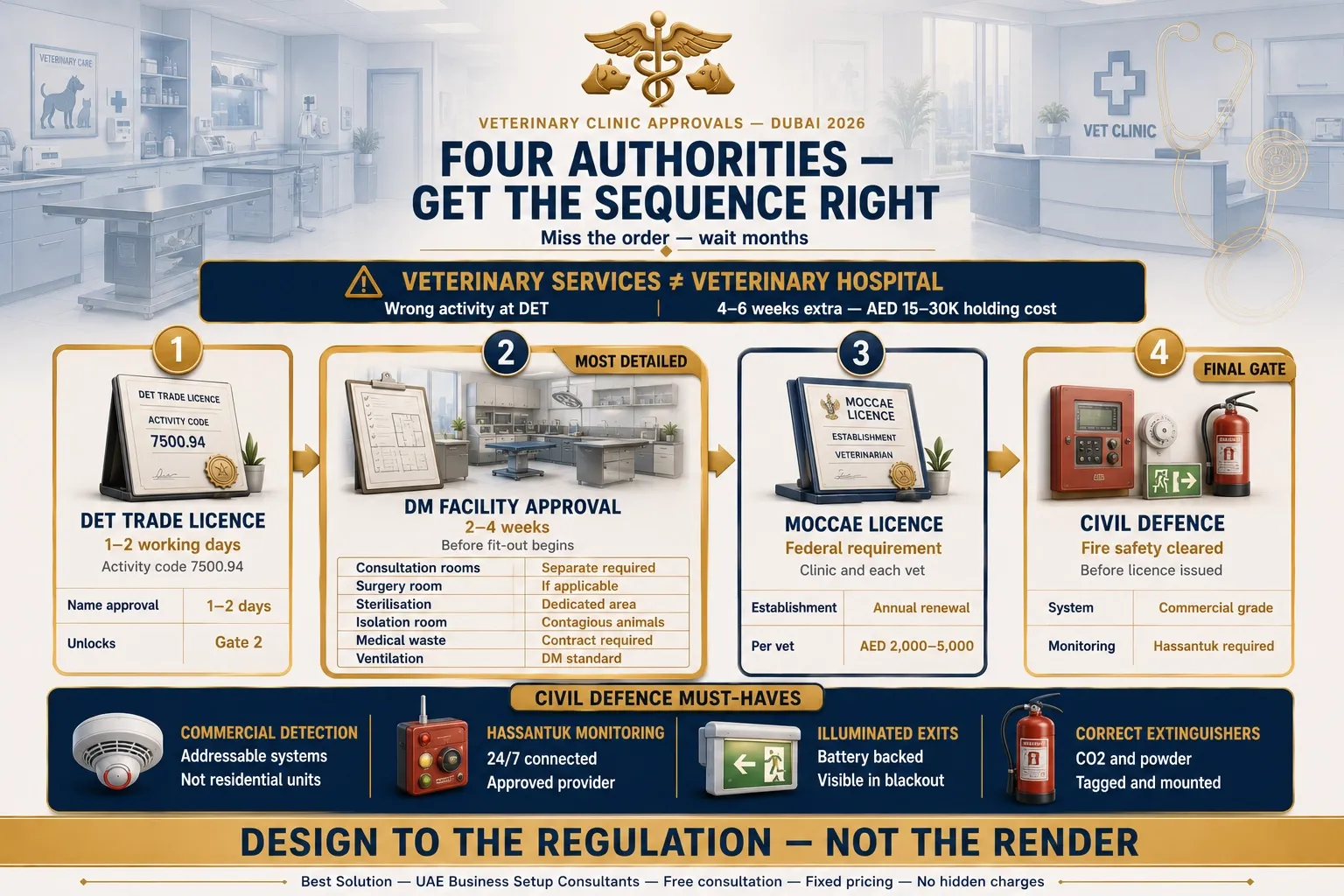
The twelve-step version you will see elsewhere collapses into eight stages once you group them by which authority is in control.
- Define the model and the activity. Community clinic, specialised hospital, exotic-pet clinic, mobile service, or 24/7 hospital. This decides facility size, equipment and, critically, the licensed activity (see the next section).
- Reserve the trade name and get DET initial approval. Name approval is usually 1-2 working days. Initial approval confirms the activity and structure in principle.
- Secure premises and sign the Ejari lease. You need the registered tenancy before the regulatory applications. Choose a high-pet-density, accessible location with parking.
- Get Dubai Municipality facility approval. DM reviews your layout before fit-out: infection control, drainage, ventilation, medical-waste flow and (if relevant) radiology shielding.
- Complete the compliant fit-out. Build to the approved drawings, not to a contractor’s aesthetic preference. This is where compliance-first design saves months.
- Pass Civil Defence fire-safety inspection. Commercial-grade detection, illuminated exits, monitored alarm, correct extinguishers and the documentation folder.
- Obtain MOCCAE licences. The federal veterinary establishment licence for the clinic, plus a professional licence for every practising vet.
- Apply for the final DET trade licence. Submitted once DM, Civil Defence and MOCCAE approvals are in hand. Mainland issuance is typically 3-7 working days after that.
For the underlying business-formation mechanics that apply to any Dubai company, our guide to starting a business in Dubai mainland covers the shared steps in more depth.
“Veterinary Services” vs “Veterinary Hospital”: the activity mistake that costs weeks
This is the single most common, and most expensive, error we see. Founders pick the activity that sounds right - usually the broad “Veterinary Services” - when their actual model needs “Veterinary Hospital.”
Here is why it bites. The mismatch does not surface at DET. It surfaces at Dubai Municipality, which cross-references your licensed activity against your facility scope and services list. When they do not match, DM either rejects the application or holds it pending an amendment. That amendment means going back to DET, correcting the activity, and restarting DM’s approval chain.
What the mistake actually costs
Choosing the right activity from the start is the cheapest insurance in the whole setup. Our how to choose a business activity in Dubai explains the classification logic in detail.

Ready to Launch Your Clinic?
Navigating four distinct government entities can easily stall your launch by months if your documentation or layout sequences fall out of line. Let our structural licensing experts align your approvals perfectly so your clinic opens on schedule.
Mainland vs free zone for a veterinary clinic: which should you choose?
For a veterinary clinic, the answer is almost always mainland, and it is worth understanding why, because the free-zone pitch can be misleading.
A mainland clinic, licensed by DET and regulated by DM, can open anywhere in Dubai, serve walk-in patients, and sit inside the residential communities where pet owners live. There are no geographic restrictions and no operational ceiling on growth.
Free zones do issue trade licences for veterinary businesses. But a free-zone trade licence covers only the commercial and administrative side. The physical clinic, where animals are examined and treated, still has to meet mainland regulatory requirements and obtain DM and MOCCAE approvals. In practice, a free-zone licence alone does not let you run a public clinical facility, and many free zones do not permit client-facing animal-care operations at all. If you are running a hands-on clinic, mainland is the simpler and cleaner path.
Thanks to recent reforms, 100% foreign ownership is now available for veterinary activities on the mainland, subject to regulatory approval, so the old reason to choose a free zone (ownership) has largely disappeared for this sector. For a full side-by-side, see our free zone vs mainland in Dubai comparison.
Facility and design requirements Dubai Municipality checks
Designing a clinic is not like fitting out a shop. DM reviews the layout against healthcare-compliance standards before fit-out begins, and again at a pre-opening inspection. Core requirements are broadly the same whether mainland or free zone:
- Separate consultation rooms
- A dedicated surgery room (if your model includes surgery)
- Sterilisation and laboratory areas
- An isolation room for contagious animals
- Pharmacy and medication storage
- A medical-waste disposal system and clear clean/dirty workflow separation
- Proper ventilation, drainage slopes and hygiene controls
Floors and walls must be easy to clean and resistant to acids, chemicals and disinfectants. The 2026 health and technical requirements for veterinary establishments are set out in MOCCAE’s Ministerial Resolution No. 27 of 2026, which is worth checking before you finalise drawings.
Expert tip - design to the rule, not the render
Never sign a fit-out contract off aesthetics or contractor advice alone. Align the architectural drawings with regulatory standards first. A pre-approval consultation with the authorities can save months of delay and thousands in redesign. In Dubai’s healthcare-licensing environment, compliance-driven design is the smartest money you spend.
MOCCAE licensing: establishment licence vs vet professional licence
Two separate MOCCAE licences trip people up because they sound similar.
The veterinary establishment licence
This is the federal licence for the clinic itself. It is valid for one year, renewed annually, and is issued electronically (typically within a few working days) once inspections and approvals are complete. Veterinary care is federally regulated, so this is mandatory on mainland and in free zones alike.
The professional licence for each vet
Every practising vet needs their own MOCCAE professional licence. The experience rule is tiered, and it is more nuanced than the flat “5 years” figure you will see on other sites:
- General practice (non-UAE nationals): at least 1 year of experience, or pass the MOCCAE exam.
- Specialists (surgery, lab diagnostics, artificial insemination, scientific consultation): at least 3 years.
- UAE nationals and certain government-employed vets may be exempt from the experience requirement.
You can confirm the current criteria on the MOCCAE veterinarian licensing service. A recognised veterinary degree (attested if earned abroad) and a Good Standing Certificate are required.
Where this actually goes wrong: the Good Standing chain
X-ray rooms: DM shielding approval and when FANR applies
If your clinic will run X-ray equipment, the operative approval for a standard setup is Dubai Municipality’s radiology room approval: DM reviews shielding specification, wall thickness and layout. The gotcha is sequencing. DM must approve the shielding design before the equipment is installed. Clinics that install first and apply second either demolish and redo the shielding or absorb weeks on a remediation plan. Declare the specific equipment model at the start of the DM process, not after fit-out.
The Federal Authority for Nuclear Regulation (FANR) is a separate question. FANR approval becomes relevant when a facility plans radioactive-isotope equipment or radiation therapy - specialist hospital territory, not a community clinic. If that applies to you, build the FANR application into the timeline from day one rather than treating it as an afterthought. For a standard X-ray room, DM shielding approval is the path that controls your opening date.
How much does it cost to open a veterinary clinic in Dubai?
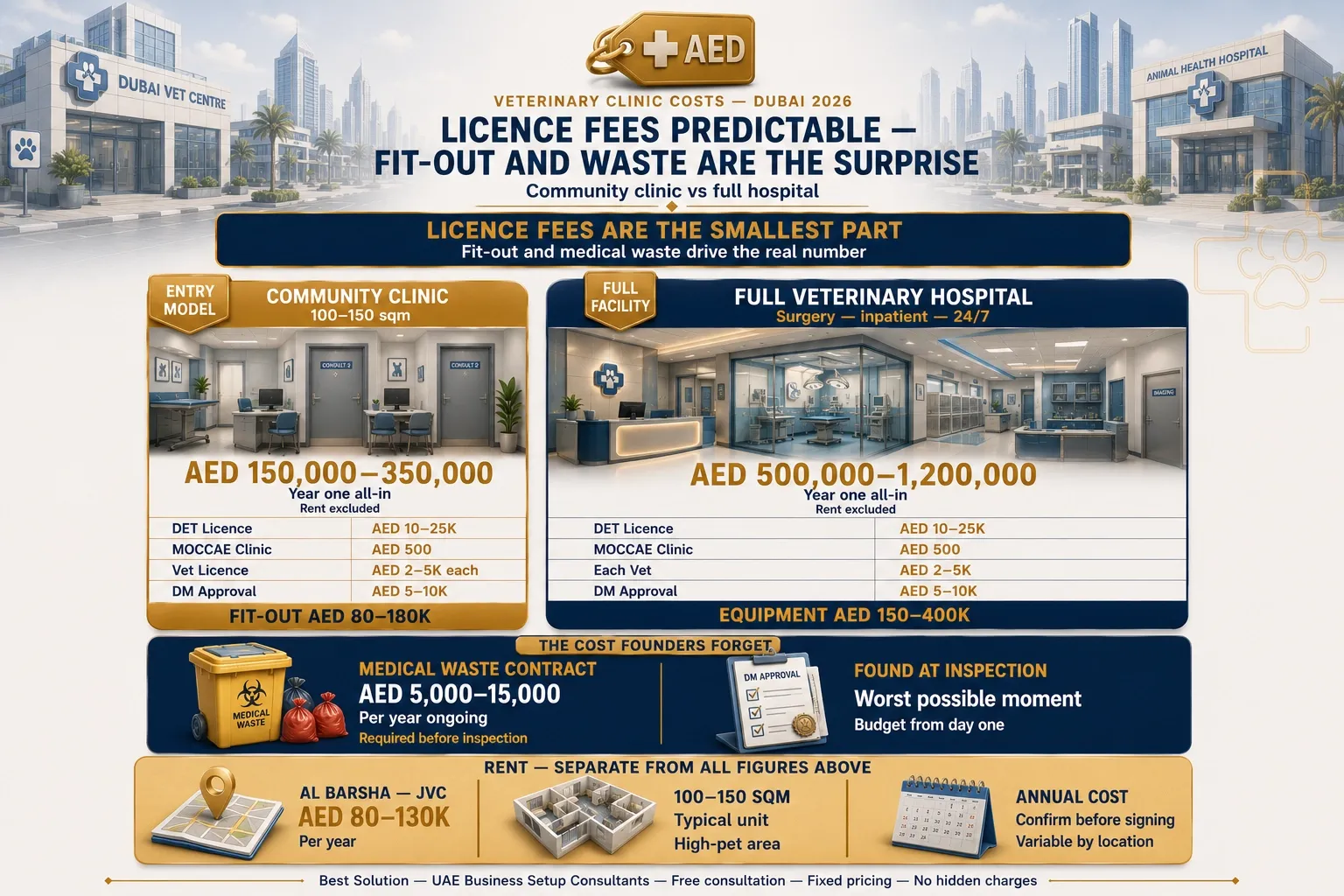
Licence fees are predictable. The total budget is not, because it depends on clinic size, location, fit-out standard and equipment. Here is the realistic picture from actual setups, not just the government line items.
Licence and approval fees
| Item | Typical Cost (AED) | Issued By |
|---|---|---|
| Trade licence (activity 7500.94) | 10,000 - 25,000 / year | DET |
| MOCCAE establishment licence | ~500 per activity / year | MOCCAE |
| Vet professional licence | 2,000 - 5,000 per vet | MOCCAE |
| DM facility approvals | 5,000 - 10,000 | Dubai Municipality |
| Ejari registration | ~200 | DET / RERA |
All-in budget by clinic type (year one)
| Clinic Type | All-In Year One | What It Covers |
|---|---|---|
| Community clinic (100-150 sqm) | AED 150,000 - 350,000 | Licences, DM approvals, 2 visas, compliant fit-out (AED 80,000-180,000). Rent excluded. |
| Full veterinary hospital | AED 500,000 - 1,200,000 | Surgery suite, inpatient, 24/7, radiology, multiple vets. Equipment alone AED 150,000-400,000. |
Rent is the big variable held outside those figures: a 100-150 sqm unit in Al Barsha or JVC typically adds AED 80,000-130,000 a year.
The cost founders forget
The DM-approved medical-waste disposal contract. It is required before you can pass the pre-opening inspection, and it runs AED 5,000-15,000 a year ongoing. People budget carefully for fit-out and equipment, then discover this at the inspection stage - the worst possible moment to find a missing requirement.
For how clinic costs fit into the wider picture of setting up in Dubai, see our cost of starting a business in Dubai breakdown.
How long does it take, and why clinics get delayed
From a clean application, budget 4-8 weeks: roughly one week for initial approval, two to four weeks for fit-out and facility inspection, and a final week for licence issuance once DM, Civil Defence and MOCCAE sign off. Delays almost always come from one of three places: the wrong activity, vet paperwork, or fire safety.
A real fire-safety delay: “We Care Veterinary Clinic”
A client came to us after their clinic was built and ready, but stuck without final approval. The block was Civil Defence fire compliance. The fit-out was high quality, but they had installed residential-grade smoke detectors instead of approved commercial systems. Emergency signage was not illuminated, and the alarm was not connected to a certified monitoring company. Civil Defence rejected the application.
The cost: mandatory system replacement, extra contractor charges, re-inspection fees, and a five-week operational delay. We coordinated a Civil Defence-approved fire contractor, upgraded the system, assembled the documentation (AMC contract, drawings, test certificates), and scheduled a pre-inspection. On re-application, clearance was granted without objection. The lesson: fire safety must match Civil Defence standards from day one.
Civil Defence pre-inspection checklist
| Category | Requirement | Critical Detail |
|---|---|---|
| Detection | Commercial grade | Addressable commercial smoke/heat detectors. Residential battery units are prohibited. |
| Alarm | 24/7 monitoring | Connected to the Hassantuk smart-monitoring system via an approved provider. |
| Signage | Illuminated exits | Internally illuminated, battery-backed, visible during a power cut. |
| Suppression | Extinguishers | Correct types (CO2 for electrical, powder for general), mounted at regulated heights, tagged. |
| Documentation | The compliance folder | AMC with a DCD-approved contractor + Civil Defence completion certificate. |
| Architectural | Fire-rated doors | Surgery and medical-gas storage often need 60-120 min fire-rated doors. |
Why work with Best Solution
A veterinary clinic setup is not one approval. It is four authorities - DET, Dubai Municipality’s Public Health & Safety Department, MOCCAE and Civil Defence - that have to be sequenced so each one’s output feeds the next. Run them as a hand-off and you wait. Run them as a coordinated process and you open on time.
Best Solution was founded in 2014 by Emirati CEO Essa Al Harthi, a former PRO who built the firm specifically around Dubai’s regulatory framework. The track record: 5,000+ company formations, a 99% approval rate, 50+ in-house professionals, based in Business Bay.
For regulated facilities specifically, the value is knowing where inspections fail. We recently caught a fit-out gap for a specialty food-and-beverage client whose design failed DM ventilation and zoning rules. We revised the layout and activity classification before construction, saving an estimated AED 40,000-80,000 in rework. The authority chain there - DET, DM facility approval, Public Health & Safety, Civil Defence - is the same one a veterinary clinic runs. We know the DM pre-opening criteria in detail: drainage slopes, clean/dirty separation, sterilisation flow, ventilation, isolation-room configuration and medical-waste documentation.
This guide was authored by Abdulla Al Harthi, Business Development Manager at Best Solution (May 2026), and reflects current MOCCAE tiers, the six-permit DM structure and the activity distinctions covered above.
Quick-reference summary
| Stage | Authority | Watch-Out |
|---|---|---|
| Activity + name | DET | Pick Hospital vs Services correctly up front |
| Facility approval | Dubai Municipality | Approve layout before fit-out; X-ray shielding before install |
| Fire safety | Civil Defence | Commercial detection + monitored alarm from day one |
| Establishment + vet licence | MOCCAE | Start Good Standing for every jurisdiction early |
| Final trade licence | DET | Issued only after all approvals are in hand |
Ready to start?
Best Solution coordinates all four authorities as one process so your clinic opens on schedule. Book a setup consultation and we will map your activity, facility and licensing path before you commit to a lease.