| Question | Short answer |
|---|---|
| Can a Meydan company sell to a mainland business? | Usually yes, with no permit, when the customer accepts a free zone invoice |
| When does a customer force the issue? | Most often when a procurement team asks for a DET licence number before issuing a purchase order. Government tenders come second |
| Is there a Meydan dual licence? | Not on a flexi desk. With a real office inside the zone, both the operating permit and the branch licence are open |
| Permit or branch licence? | The permit suits short mainland work. Once the work outlasts one permit, the branch licence usually costs less and carries less renewal risk |
| Which office qualifies? | We file on a dedicated office, AED 30,000 a year. DET rules out flexi desks, business centres and virtual offices |
| DET fees | AED 5,000 for a permit of up to six months, or AED 10,000 a year for the branch, under Resolution No. (11) of 2025. A Meydan NOC comes with each one |
| Tax | Mainland income is taxed at 9% and needs separate records |
| When to move onshore | When most customers are on the mainland. The Meydan company can own the new mainland company outright |
Most Meydan companies that sell to Dubai mainland businesses need no permit at all. The trouble starts when a customer’s procurement team asks for a DET licence number before it will issue a purchase order. That is the moment a Meydan free zone mainland question stops being theory.
Across more than 60 Meydan files, this is the question our clients raise most often after the licence is issued. Most of the time the answer is to do nothing. Sometimes it takes a permit. Sometimes a branch licence is the better buy. And once in a while, the honest answer is that the business now belongs on the mainland.
This guide sorts those cases, explains what DET and Meydan check, and shows where the permit stops making sense and the branch licence takes over. As a registered Meydan channel partner, we file both routes for clients. For how the Free Zone Mainland Operating Permit works across Dubai, including the full activity list, our general guide covers the instrument itself. This page covers the Meydan decision.
Can a Meydan company sell to Dubai mainland customers?
Yes, in most cases. A Meydan free zone company can invoice a mainland business from the free zone without an extra licence, as long as that customer accepts a free zone supplier. A DET permit or branch licence is only needed when the customer, the activity or the delivery requires the company to operate on the mainland itself.
The line between free zone versus mainland in Dubai is about where a company is licensed to operate, not a ban on trade. Sort your customer into one of the three cases below before you pay for anything.
When you need nothing extra
Most Meydan clients are service firms, and most of their customers are businesses that accept a free zone invoice. A consultancy advising a mainland company, an agency running campaigns for a mainland brand, or an IT firm billing a mainland client usually does this every month from Meydan.
Founders sometimes take a permit they did not need. A customer’s accounts team asks whether the supplier is mainland licensed, nobody checks the written policy, and the founder pays to answer a question that was never a rule. Ask for the customer’s supplier requirement in writing first.
When a customer asks for a DET licence
The trigger we see most is corporate vendor onboarding. A procurement team asks for a licence number from the Department of Economy and Tourism before it will issue a purchase order. Government and semi-government tenders come second. Retail consumers are rare, because Meydan clients are mostly service firms.
When the requirement is real, the answer is one of the two DET routes below. Which one depends on how long the mainland work will last.
When goods have to move onshore
Meydan has no storage, so any goods business there already relies on a partner on the mainland. There are two models.
- A mainland distributor buys and resells the goods. Expect to give up roughly 15 to 25 percent of margin.
- A licensed logistics provider (3PL) stores and delivers under your own sale. Budget a monthly storage fee plus a charge per delivery.
The 3PL model keeps the customer relationship with you, which matters if you plan to take a DET permit later. Service businesses billing mainland companies need neither model. The wider options are compared in Free Zone Sales to Mainland: Branch, Distributor, Dual.
Is there a Meydan dual licence?
Not on a flexi desk. A Meydan company cannot get mainland access from a flexi desk. With a real office inside the zone, both the operating permit and the branch licence are available, and Meydan issues the no objection certificate for either.
Both routes come from Executive Council Resolution No. (11) of 2025, in force since 3 March 2025. It lets a Dubai free zone company work on the mainland through three instruments issued by DET, each needing the free zone’s prior approval.
| DET instrument | What it allows | DET fee | Validity |
|---|---|---|---|
| Temporary permit, known as the Free Zone Mainland Operating Permit | Named activities on the mainland without a new company | AED 5,000 | Up to six months, renewable subject to DET approval |
| Branch operating out of the free zone, the route most people mean by “dual licence” | The same company licensed to trade onshore, run from its office in the zone, with no mainland premises | AED 10,000 a year | One year, renewable |
| Branch within the emirate | A branch office with its own mainland premises | Mainland premises and fees on top | One year, renewable |
The office rule belongs to DET, not Meydan. DET’s own notice on the permit excludes flexi desks, business centres and virtual offices. The branch operating out of the zone is run from your zone office, so it carries the same real-office test. The framework across all Dubai zones is set out in Dual Licensing in the UAE: Free Zone to Mainland, and the DAFZA dual licence with DET shows the same rule applied in another zone.
Permit or branch licence: which one fits?
The permit is the right buy for short mainland work. Once the work will outlast one permit, the branch licence usually wins.
The statutory fees make the point. Two six-month permits cost AED 10,000 in DET fees across a year, which is the same as one year of the branch licence. But each permit cycle also needs a fresh Meydan NOC, and each renewal goes back to DET for approval. So a year on permits costs more than a year on the branch, and it carries a renewal risk the branch does not.
We move a client from the permit to the branch licence when any of these happens:
- They sign a mainland contract longer than six months.
- They sign a second recurring mainland customer.
- Mainland revenue passes about a fifth of their turnover.
A renewal refused halfway through a year-long contract is not a risk worth carrying. If the contract runs past six months, start on the branch licence.
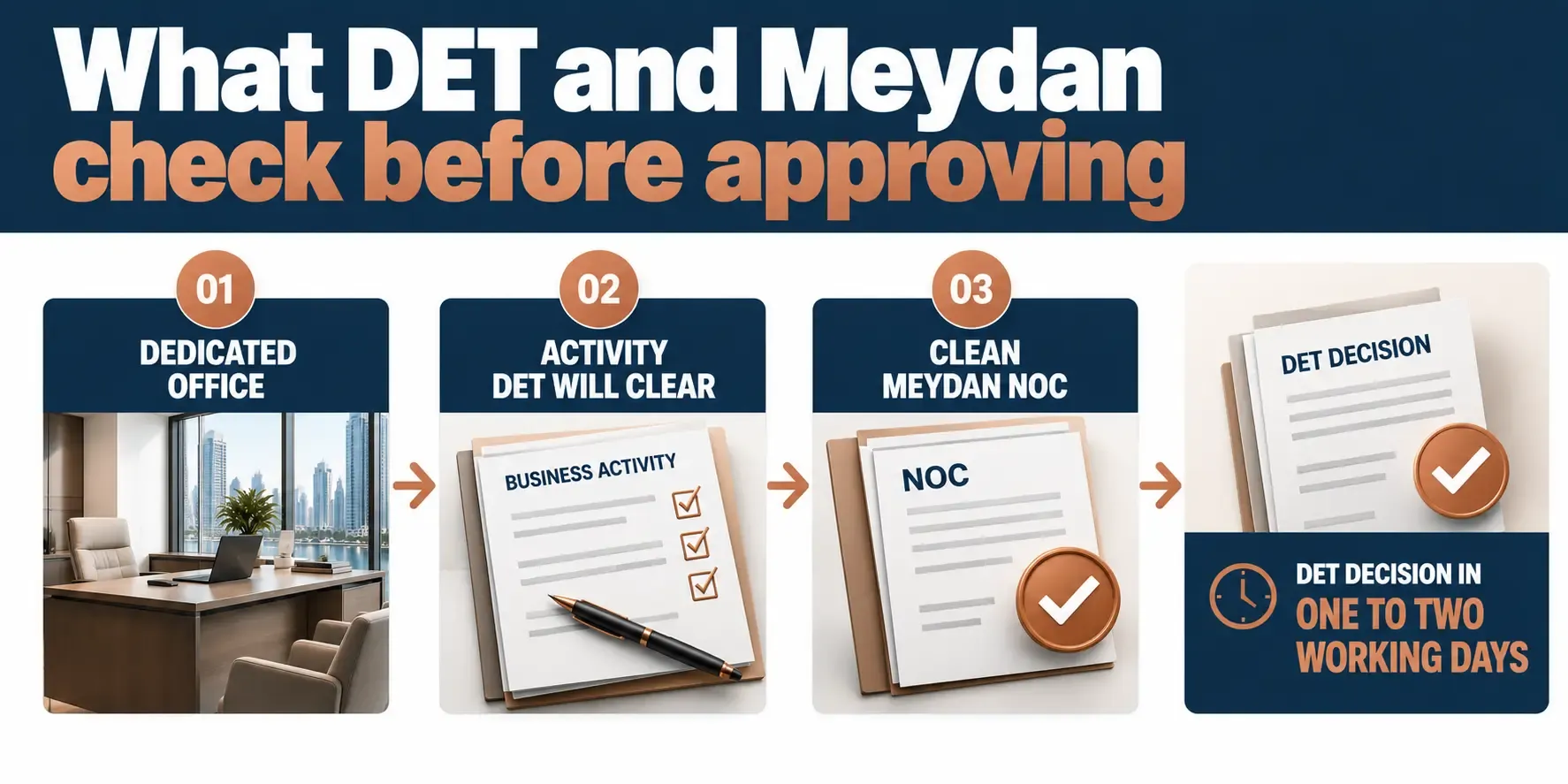
What DET and Meydan check before approving
Three gates sit between a Meydan licence and either DET route. Clear them in this order, because the first one decides the budget.
A dedicated office inside the zone
The Meydan licence includes a flexi desk, which carries up to six visa allocations. It does not carry mainland access.
The smallest option we file on is the dedicated office, at AED 30,000 a year. The shared office and the monthly dedicated desk both look too much like business-centre seats to risk. A flexi-desk file does not get a clean “no” from Meydan. It gets rejected at DET’s review, after the NOC fee is already spent. We stop these files before either fee is paid.
For a flexi-desk client, we compare the office upgrade against the mainland contract. If the contract does not cover the rent, they do not need mainland access yet. This is also the line that can change which zone you belong in. If you already know you need a real office for the mainland route, compare office costs in Meydan and the IFZA free zone before you choose.
An activity DET will clear
The activity must sit on DET’s list for free zone companies, and it must already be on your Meydan licence. If it is not, amend the licence first.
The refusals we see come from activities that look like plain consultancy but touch a regulator:
- Training and coaching. Some of it needs KHDA approval.
- HR consultancy that drifts into recruitment. That needs MOHRE approval.
- General trading of food or cosmetics. That needs Dubai Municipality approval.
Anything involving a customer-facing location also fails. The permit does not cover shops or walk-in premises. Our guide to choosing a business activity in Dubai sets out how to word an activity so it matches what you really do, and which Meydan activities sit where is covered in Meydan Free Zone Activity List: Multi-Activity Licences.
A clean Meydan NOC
Meydan must consent before DET will act, through a no objection certificate. A flat refusal is rare. Holds are common, and the usual causes are:
- A licence renewal due soon. Meydan will not clear mainland activity that outruns the licence, so renew first.
- Unpaid Meydan invoices or fines, which freeze the account.
- UBO or KYC updates not filed.
- An activity mismatch between the permit request and the licence.
On paperwork, three things hold files up: a board resolution drafted on the client’s own format instead of Meydan’s template, corporate shareholder documents that have not been legalised, and a certificate of incumbency too old for the checks Meydan runs.
What the Meydan mainland route costs
The DET fee is rarely the largest line. On a flexi desk, the office is.
| Cost line | Indicative cost, 2026 | Notes |
|---|---|---|
| DET operating permit | AED 5,000 per cycle | Statutory fee, Resolution No. (11) of 2025. A cycle is up to six months, and renewal costs the same |
| DET branch licence operating out of the zone | AED 10,000 a year | Statutory fee. No mainland premises needed |
| Meydan NOC | Charged with each permit cycle, or once a year for the branch | Meydan issues a fresh NOC for every permit renewal [NEEDS CLIENT INPUT: NOC fee and all-in total per cycle, to be checked against a real receipt, compliance flag 2] |
| Dedicated office inside the zone | AED 30,000 a year | Only if you are on the flexi desk today |
| Separate books for mainland income | Depends on volume | Required by the resolution |
Budget the DET fee and the Meydan NOC together for every permit cycle, and ask for both on your written quote. For the rest of the year-one and year-two bill, see Meydan Free Zone Licence Cost: What You Pay in Year One and Year Two.
How to apply, step by step
- Confirm the requirement. Get the procurement or tender condition in writing.
- Check the activity. Make sure it is on your Meydan licence and on DET’s list, and flag any regulator.
- Fix the workspace. Move to a dedicated office if you are on the flexi desk.
- Clear the account. Renew the licence if renewal is close, pay any Meydan invoices, and file UBO and KYC updates.
- Request the Meydan NOC. We file it through Meydan’s partner portal with a board resolution on Meydan’s template.
- Apply to DET. The application goes through the Invest in Dubai platform. Only the company manager can apply, so the manager needs working UAE PASS access, and the company needs an active Dubai Unified Licence number.
- Receive the permit or branch licence. Issue takes one to two working days once approved.
- Open separate books. Record mainland income apart from free zone income from the first invoice.
Diary the renewal the day the permit arrives. It runs for up to six months, not a year.

Not sure your customer needs it?
Send us the customer’s supplier requirement and your licence activity. We will tell you whether you need nothing, the permit, the branch licence or a mainland company, and quote each line separately.
One file we talked out of the permit
A marketing agency on a Meydan flexi desk won a one-off AED 60,000 project with a Dubai semi-government body. The vendor registration asked for a DET licence.
Qualifying meant upgrading to a dedicated office at AED 30,000, then paying for the permit and the NOC on top. That came to more than half the contract. We had the client deliver as a subcontractor under a mainland-licensed partner for a fixed fee. They kept the flexi desk, and filed for the permit only when recurring mainland work arrived.
Tax and records on mainland income
Mainland income is taxed at 9% under UAE corporate tax. The resolution also requires separate financial records for activity outside the free zone, so plan bookkeeping with a mainland ledger from day one.
VAT does not change. Meydan is not a VAT designated zone, so a Meydan company already charges 5% VAT like a mainland business. The detail sits in Is Meydan Free Zone a Designated Zone? VAT for Goods Traders.
When to move onshore instead
A permit or branch licence extends a free zone company. It is not a structure for a business that lives on mainland revenue.
If most of your customers are on the mainland, register a Dubai mainland licence, usually as a mainland LLC. Our guide to starting a business on Dubai mainland covers the route. Some clients also use the DET route when the team outgrows the zone, and we have clients who opened mainland office space this way for teams of more than 100 people.
Most clients keep the Meydan company for at least one more cycle. It can be the 100 percent shareholder of the new mainland LLC, and it keeps foreign client contracts and the existing bank history.
Close it when every customer is local. Closing means cancelling visas and producing final audited accounts, so time company liquidation with the two-year visa expiry rather than mid-term.
One limit applies to every route on this page. The permit and the branch licence are Dubai instruments. They do not cover Abu Dhabi, Sharjah or any other emirate.
Getting mainland sales right from a Meydan licence
Start with the customer, not the licence. Most mainland businesses can buy from a Meydan company as it stands. A procurement team or tender that needs a DET licence calls for the permit, or the branch licence if the work will outlast six months. A business that lives on mainland revenue belongs on the mainland.
Three numbers do most of the work: AED 5,000 per permit cycle, AED 10,000 a year for the branch licence, and AED 30,000 a year for the dedicated office a flexi-desk company needs first. Put them against your mainland contracts and the answer is usually clear.
Best Solution has formed companies in the UAE since 2014 and is a registered Meydan channel partner. Book a free consultation on +971 52 233 0011 or connect@best-solution.ae, and we will map your customers to the right route before you file. What a partner-run file includes is set out in Meydan Free Zone Setup Services: One Team, All Steps. For the full zone picture, start with Meydan Free Zone Business Setup: Dubai Licence, No Office, and for how the budget and airport zones compare, see how DAFZA, DMCC, IFZA and Meydan compare.