Key takeaways
| Question | Short answer |
|---|---|
| How fast is the licence? | One to three working days on the standard route for a single founder. Under 60 minutes on Fawri, when the file meets every Fawri condition |
| How long until the company can operate? | Four to seven weeks in a typical file, because the card, the visa and the bank account come after the licence |
| What is the slowest step? | The corporate bank account, at two to six weeks |
| Do I need to visit Dubai? | Not for the licence. Yes for the visa medical and biometrics, and usually again to activate the bank account |
| What legal form do I get? | A free zone LLC, with the suffix L.L.C-FZ, for one shareholder or several |
| Is capital paid in? | No. Capital is declared in the memorandum, not deposited. AED 50,000 declared per shareholder is the investor visa threshold |
| What slows a file most? | A licence activity that does not match the invoices, and corporate shareholder papers that are not legalised |
| What must be done after the licence? | Corporate tax registration within three months, books kept from day one, and audited statements ready for the first renewal |
Meydan’s 60-minute licence is real. It is also the shortest step in a Meydan free zone company setup. The licence arrives fast, and then the establishment card, the visa, the Emirates ID and the bank account take the next four to seven weeks.
That gap is where most founders get caught out. They book flights, sign a client and promise invoices for the week the licence lands, then find they cannot pay a salary, sponsor themselves or receive money into a company account for another month. None of that is a delay. It is the normal sequence, and nobody explained it before they paid.
This guide walks the full company formation in Meydan Free Zone in the order it actually happens, from the activity choice to a working bank account. It shows how long each stage takes, who acts at it, what you need in hand, and where files stall. As a registered Meydan channel partner, we file these for clients every week, so the timings below come from our own files, not from the zone’s marketing.
How long does Meydan free zone company setup take?
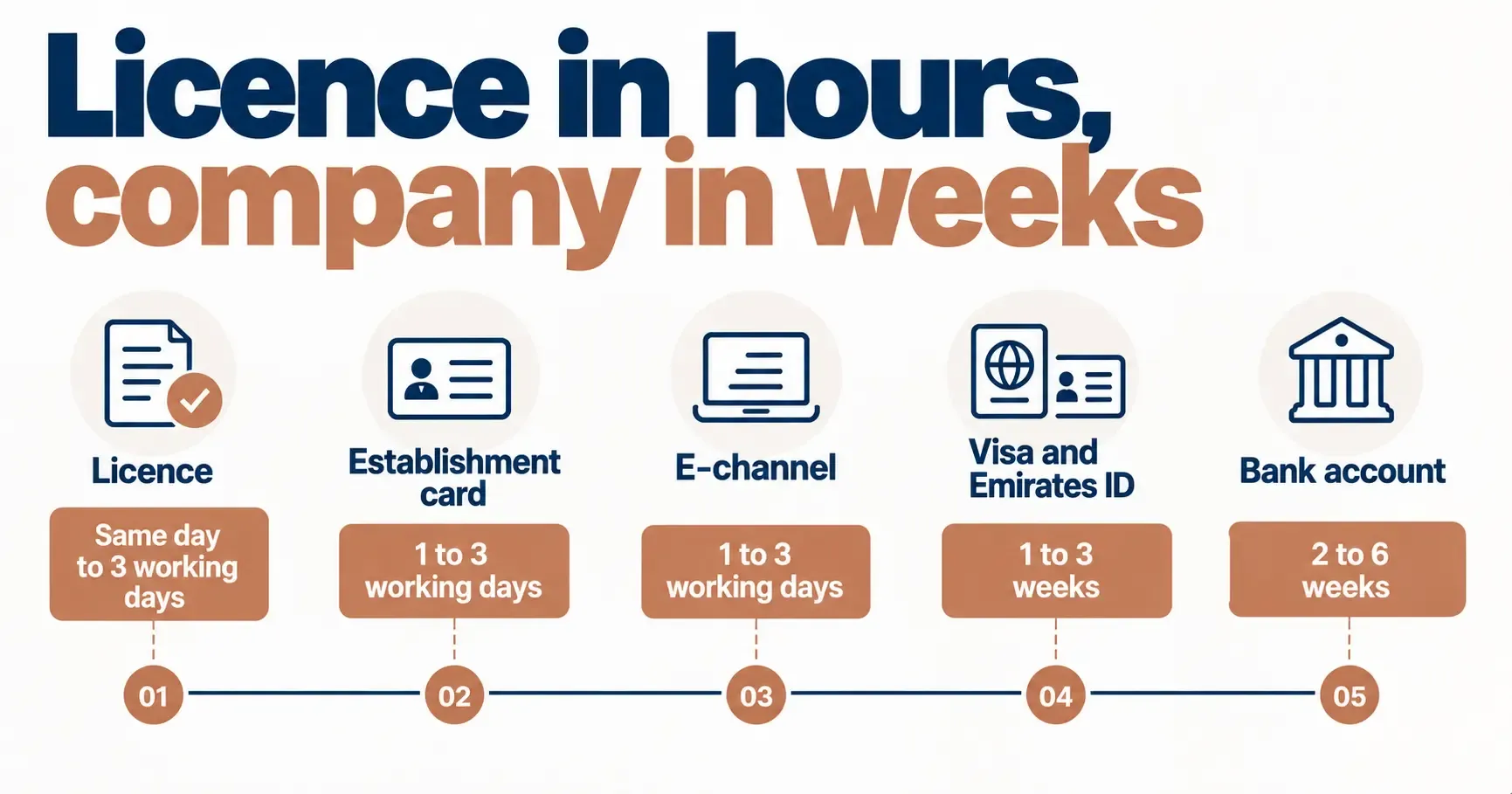
A standard Meydan licence issues one to three working days after a complete application from a single founder. Getting the company fully operating takes four to seven weeks. The establishment card, the first residence visa, the Emirates ID and a corporate bank account all follow the licence, and the bank account is the longest step.
The table below is the clock we give clients. The zone publishes faster figures for some steps. We publish ranges built from our own files, because a founder planning cash flow needs the realistic number, not the best case.
| Stage | Working time | Who acts |
|---|---|---|
| Activity check and trade name | One to two days, before you apply | You and your adviser |
| Licence, standard route, one founder | One to three working days | Meydan Free Zone |
| Licence, standard route, two or three individual shareholders | Three to five working days | Meydan Free Zone, and every shareholder signing |
| Licence, Fawri route | Under 60 minutes, eligible files only | Meydan Free Zone |
| Establishment card, with e-channel activation | Two to five working days, one request | Meydan Free Zone and immigration |
| First residence visa, applicant in the UAE | Seven to 13 working days | Immigration, medical centre |
| First residence visa, applicant abroad | Ten to 15 working days, including travel in | Immigration, medical centre |
| Emirates ID card | A few days after the visa is stamped | Immigration |
| Corporate bank account | Two to six weeks | The bank, with you in person at activation |
Add the stages that must run in order and the licence-to-operating time lands between four and seven weeks. The licence is the only part measured in hours. Every speed claim you read about Meydan, including ours, applies to the licence alone, never to the visa, the Emirates ID or the bank.
Fawri or the standard licence: which route your file takes
Meydan offers two ways to reach the licence. Fawri is the instant route. The standard digital licence is the route most files take. You do not fully choose between them. The shape of your company decides.
When Fawri works
Fawri issues the licence document in under 60 minutes, but only under narrow conditions. Every one of these must hold:
- One shareholder, who is also the manager, the director and the ultimate beneficial owner.
- An activity that needs no outside approval before the licence issues.
- A clean, readable passport scan.
- Payment that has cleared.
On Fawri, payment is taken when you submit, and the zone’s refund promise covers the case where the licence is not issued on time. The Fawri price sits above the standard licence, and like the standard price it is a licence only, no visa figure. Fawri also includes one free amendment in the first year. Use that single amendment for every change you need, because spending it on one activity means paying for the next.
When the file moves to the standard route
A second shareholder moves the file to the standard route, whatever the activity. So does a branch registration, a corporate shareholder, or an activity that needs a regulator’s approval first. Training, healthcare consultancy and financial advisory are the activities we see fail Fawri’s eligibility check most often.
Most of these breaks show up before anyone pays: a co-founder joins, the activity needs an approval, or the shareholder turns out to be a company. We catch them at intake and start the file on the standard route. When a condition breaks after payment, in our files the zone moves the file to the standard route and credits the price difference against the new invoice. The Fawri refund promise does not apply then, because the founder changed the file, not the zone.
The standard route is still fast. A single-founder licence usually issues one to three working days after a complete application. With two or three individual shareholders, each one is screened at the same time and each signs separately, so the file takes three to five working days. The extra time comes from the slowest person to sign, not from the number of shareholders.
Three decisions to settle before you apply
Most delays at Meydan start before the application goes in. Three choices set the pace of everything after them.
The activity your invoices will actually show
A Meydan licence carries up to three activity groups. A group is a numbered set of related activities, so three groups cover more ground than most founders expect. Activities outside those three groups cost AED 1,000 each.
Pick activities around what you will invoice in the next twelve months, not what you might do in year three. The licence prints named activities, and banks read that printed list line by line. Before we submit, we ask for three to five recent invoices or quotes, the product or service list, and the website or pitch deck, then match the invoice wording against the exact activity names. Near enough is not a match. Our guide to choosing a business activity in Dubai explains the logic, and the Meydan list itself is covered in Meydan Free Zone Activity List: Match Groups to Invoices.
Shareholders and declared capital
Every Meydan company is a free zone LLC with the suffix L.L.C-FZ. One shareholder or five, it is the same legal form. A branch of an existing company is also available on the standard route, though few clients need one.
Meydan sets no minimum share capital, and nothing is deposited. The capital is declared in the memorandum of association and on the share certificate. The number that matters is AED 50,000 declared per shareholder, which is the threshold for an investor visa. A shareholder below it can still take an employment visa. Declaring enough on day one costs nothing. Amending the capital later means a fee and a re-issued memorandum and share certificate.
The trade name
Meydan runs an online name check, so you can test a name before you apply. Submit three options, keep the activity word in at least one, and expect the L.L.C-FZ suffix on the one that is approved. The names we see refused most often at Meydan are:
- Names that suggest a regulated activity the licence does not cover, such as Capital, Investment, Exchange, Bank or Insurance.
- Words that suggest government status or scale, such as UAE, Emirates, Dubai, Federal or Group, without the licence or parent structure to back them.
- Names that clash with an existing trade name or a registered trademark.
- Bare initials or a single generic word.
- Religious, political or offensive terms.
A reserved name holds while the application is live. If the file sits with requirements outstanding for 60 days, the zone cancels the application and the name goes back into the pool. The general rules are set out in our page on trade name registration in Dubai.
The Meydan setup sequence, from application to operating company
This is the order a Meydan free zone company setup moves in once the three decisions are made. The first five stages produce the licence. The rest turn a licence into a company that can hire, sponsor and trade.
- Submit the application online. The application, passport copies, shareholder details and the details of every ultimate beneficial owner go in through Meydan’s online portal. Registered partners file through the zone’s consultant login.
- Screening and approval. Meydan screens each shareholder, the manager and the beneficial owners, with the checks running at the same time, and reviews the activity.
- Pay the zone invoice. On the standard route the zone raises its invoice only once screening clears, so nobody pays for a file that is going to be refused. The licence is a single up-front payment, and it cannot issue until the payment clears.
- Sign the incorporation documents. Signing is an e-signature inside the Meydan portal. UAE residents sign through UAE PASS. Founders abroad sign through a link sent to their registered email and mobile, confirmed by a one-time code. Every shareholder signs the articles and the shareholder resolution, and the appointed manager signs an acceptance. On a sole-founder file one person does all of it in one sitting, usually in under ten minutes.
- Receive the licence pack. The zone issues the trade licence, the certificate of formation, the memorandum of association, the share register and the lease agreement for the included flexi desk.
- Request the establishment card. The establishment card opens the company’s immigration file. From the founder’s side it is one request, which produces two records: the card itself, and the e-channel activation that lets the file transact with immigration. Meydan runs the visa process itself, so the zone submits both, and you never open a separate e-channel account. No visa can be filed without the card.
- Buy the visa allocations you need now. Each allocation is bought once per slot, up to six on a Meydan licence.
- File the residence visa. An entry permit for an applicant abroad, or a change of status for one already in the UAE, followed by the medical fitness test, biometrics and visa stamping.
- Collect the Emirates ID. The Emirates ID card usually arrives a few days after stamping.
- Open and activate the corporate bank account. The application carries the licence pack, the shareholder papers, a business profile and real contracts or invoices. It can go in during the first week. Activation comes later, once the bank has your visa or Emirates ID.
Stages 6 to 10 are where the four to seven weeks go. None of them can start before the licence, and the visa cannot start before the establishment card.
The flexi desk that comes with the licence is a real registered address, backed by a lease agreement registered with the free zone. There is no Ejari, which is a mainland registration, and you do not need a separate office lease. What a flexi desk is, and what it is not, is worth reading before you sign anything that promises otherwise.
A founder abroad, from application to active account
A recent Meydan file shows how the stages stack up. It was a motor vehicle trading company with one individual shareholder, set up while the founder lived abroad. It ran on the standard route, because the activity sits outside the solo consultancy profile that Fawri is built for. The timeline below is reconstructed from our handling of the file.
| Week | What happened |
|---|---|
| Week 1 | Application submitted. Licence issued three days later. Establishment card and e-channel activation the next day. Bank application submitted the same week |
| Week 2 | Entry permit issued |
| Week 3 | Founder flies in. Express medical and biometrics in the first two days. Bank video KYC the same week |
| Week 4 | Visa stamped. Founder leaves |
| Week 5 | Emirates ID delivered and sent to the bank |
| Week 7 | Founder returns for three days, signs at the branch, account active |
Licence to operating account took six and a half weeks. The licence took days. The bank took six weeks, partly because banks treat vehicle trading as a higher-risk activity.
The documents that decide how fast you move
An individual shareholder needs very little. A corporate shareholder needs a lot more, and it is the corporate papers that push a file off the fast track.
| Shareholder type | What to have ready | Time it adds |
|---|---|---|
| Individual, living abroad | Passport copy with good validity, digital photo, contact and address details | None if the scan is clean |
| Individual, UAE resident | The same, plus a copy of the UAE residence visa and Emirates ID | None |
| Corporate shareholder registered outside the UAE | Certificate of incorporation, memorandum and articles, a recent certificate of incumbency, a board resolution on Meydan’s template, and passport copies of the people appointed, all legalised | Two to four weeks |
| Corporate shareholder registered in the UAE (mainland, DIFC, ADGM or another free zone) | The same documents, issued by the UAE authority | Three to five working days |
| Every file | Details of each ultimate beneficial owner, the natural person who owns or controls the company | None if collected at the start |
The foreign corporate row is the one that surprises people. Every parent company registered abroad goes the full legalisation route: notarisation, the home country’s foreign ministry, the UAE embassy, then the Ministry of Foreign Affairs in the UAE. There is no shortcut for any country. That adds two to four weeks and real cost, and it takes the file off the same-day route entirely. A parent registered in the UAE skips the embassy step, because its documents already come from a UAE authority. Our UAE document attestation service handles the legalisation.
A UAE resident employed elsewhere can hold shares in a Meydan company. What they cannot do is hold two residence visas at once, so they usually keep their employer’s visa and take the company without one.
After the licence: card, visa and Emirates ID
The licence gives you a company. The establishment card and the first visa give you a company that can sponsor people. This is the stretch founders under-plan.
The establishment card comes first
Request the establishment card as soon as the licence issues. It takes two to five working days, and the e-channel activation comes with it in the same request. On our Meydan files the only line is the card itself, at AED 2,000 on first issue. The e-channel registration fee and deposit you may see quoted online belong to the mainland route, where a company registers on e-channel directly. A founder who waits a week to start the card has added a week to the whole setup.
The first visa, in the UAE or from abroad
A founder already living in the UAE on another visa changes status. That route takes seven to 13 working days from application to stamping, and the change of status is an extra line of about AED 1,500. A founder applying from abroad receives an entry permit, flies in, and completes the medical and biometrics here. That takes ten to 15 working days, including the window to travel.
Health insurance must be in place before the visa is stamped. A file that reaches stamping without it stalls. It costs days rather than dirhams, but it holds up the bank account too. What each visa costs part by part, and why the allocation is not the visa, is covered in Meydan Free Zone Visa Cost: The Allocation Is Not the Visa.
The bank account is the long pole
A Meydan company opens its corporate bank account in two to six weeks in most of our files. Digital-first and mid-tier banks sit at the fast end. Tier-one banks, and any file with a non-resident shareholder, sit at the slow end or longer.
Our own group holds a live Meydan licence, and its corporate account opened two days after the licence issued. That is our fastest result, not our average, and the two-to-six-week range is the one to plan around.
Where you have to be in person
The application is remote at every bank we use. The KYC interview is usually a video call or a visit from a relationship manager, though a few banks still ask to see you in the branch for it. Activation is where the signatory almost always has to appear in person, with the original passport, the Emirates ID or visa, and a wet signature on the account mandate. Digital-first banks accept video KYC end to end, but they generally want a UAE residence visa first. Either way, plan your travel around activation, not the application.
What actually opens the account
The zone name is the smallest variable in the bank’s decision. What opens the account is a clear source of funds, a clean ownership chain, an activity that matches what the company really does, and at least one real contract or invoice. The file that causes us most trouble at Meydan is the one where the licence activity does not describe the actual business. It passes the zone, then stalls when the bank’s compliance team compares the licence with the business plan and the invoices. The fix is an activity amendment, another fee and several lost weeks, which is why we check activity wording against invoices before submission.
Meydan Pay is an e-wallet and payments product, not a bank account. It can collect and pay from day one, which helps a digital business early on, but it will not satisfy a counterparty that asks for a bank reference. Our guide on how to open a business bank account in Dubai covers the documents banks ask for.
Setting up a Meydan company from abroad
You can reach a Meydan licence without visiting the UAE. The application, the e-signature and the licence pack are all online, and most of our Meydan clients have never been to the Meydan Grandstand in Nad Al Sheba, where the zone sits.
The residence visa is different. The medical fitness test and the biometrics for the Emirates ID happen in the UAE. For the visa trip, book seven working days, which is about ten calendar days. Medical and biometrics take two days on the express medical and four or five without it, and stamping follows. Time the trip to the entry permit, once the establishment card is issued.
The bank rarely fits into that first trip, because most banks want the Emirates ID, or at least the stamped visa, before they activate the account. So plan two trips: the first for the visa, and a second of two or three days for bank signing about three to five weeks later. A founder who can only travel once should stay two weeks, and accept that the bank may still finish after they leave. These day counts are planning advice from our files, not a service promise.
Ownership is 100% foreign, with no local partner and no nationality requirement in the zone’s rules. A small number of nationalities attract additional security clearance at the name-approval and immigration stages. That is a federal timing issue, not a Meydan refusal, and it rarely affects whether the licence issues. It more often affects how long the bank takes.
Where Meydan files stall, and the fix for each
Almost every stalled Meydan file we take over has the same few causes. Each one costs less to prevent than to repair.
| Where it stalls | What it costs | Fix before you file |
|---|---|---|
| Licence activity does not match the invoices | An activity amendment, a fee and several weeks at the bank | Match three to five real invoices to the exact activity names |
| Foreign corporate shareholder papers not legalised | Two to four weeks, and the file leaves the fast route | Start legalisation before the application, not after |
| Trade name uses a regulated or status word | A refusal and a resubmission | Avoid words such as Capital, Bank, UAE or Group unless the licence backs them |
| Requirements left outstanding on a live application | After 60 days the application is cancelled and the name is released | Answer zone queries the same week |
| A shareholder expected an investor visa with under AED 50,000 declared | A capital amendment, or an employment visa instead | Set declared capital per shareholder on day one |
| Visa reaches stamping with no health insurance | Days, and a held-up bank file | Buy the insurance when the entry permit or change of status is filed |
| Six visa allocations bought on day one “to be safe” | AED 1,850 per unused slot, not refundable | Buy for the next six months and add later |
Starting direct and handing over midway
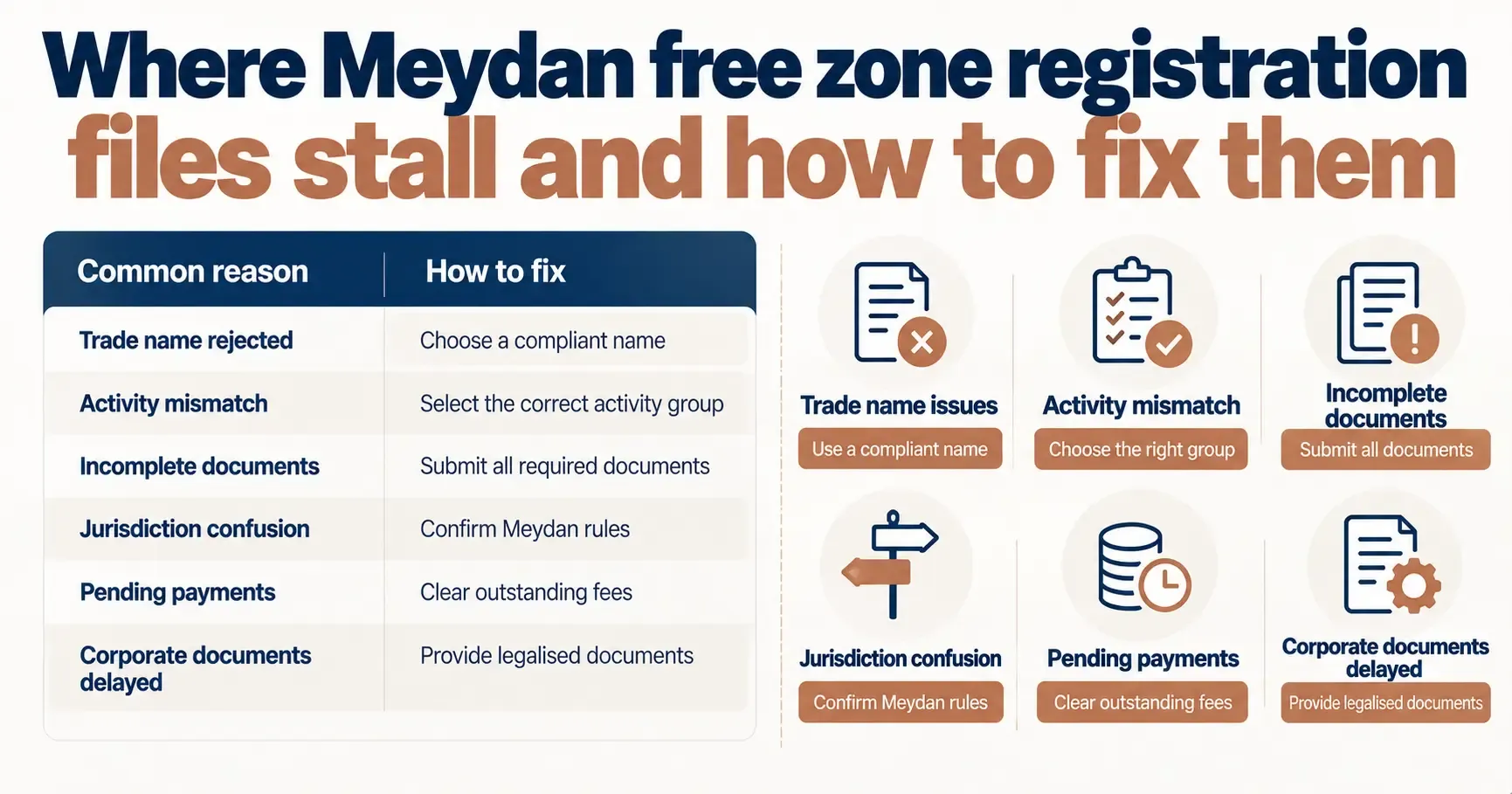
Meydan’s digital setup makes a direct application easy to start and harder to finish. Some founders start alone and come to us mid-file. The stuck point is then usually one of three: an activity picked for speed that the bank later questions, the visa medical and Emirates ID steps sitting unbooked, or a bank application with no business profile behind it.
When a file changes hands, check what has already been paid. The visa allocation, a live establishment card and a reserved trade name are the lines most often billed a second time by the new provider. How partner filing works at Meydan, and what a partner can and cannot change, is explained in Meydan Free Zone Channel Partners: What You Are Paying For.
What you pay at each stage
Money moves in the same order as the paperwork. On the standard route the licence fee is paid after screening clears and before the licence issues. The card, the allocations and the visas are paid as each one is filed.
| When | Line | Indicative cost, 2026 |
|---|---|---|
| After screening, before the licence issues | Standard digital licence, licence only, no visa | AED 12,500 |
| After the licence | Establishment card, first issue, including e-channel activation | AED 2,000 |
| Before the first visa | Visa allocation, per slot, paid once | AED 1,850 |
| At the visa | Investor visa and stamping | AED 4,000 to 5,000 |
| At the visa | Medical and Emirates ID | AED 2,250 |
| At the visa, UAE residents only | Change of status | About AED 1,500 |
| Before stamping | Health insurance, per person, per year | AED 800 to 1,500 |
On a one-visa file, the zone and government lines come to AED 22,600 to 23,600 in year one. With consultancy and PRO handling, the file typically lands at roughly AED 26,000 to 30,000. The full year-one and year-two bill, including the audit that renewal depends on, is set out in Meydan Free Zone Licence Cost: What You Pay in Year One and Year Two.

Want the sequence planned for your file?
Send us your activity, the number of shareholders and whether each is in the UAE. We will map your file to Fawri or the standard route, list the documents, and give you a dated plan from application to bank activation, including when you need to be in Dubai.
Deadlines that start the day your licence issues
The licence date starts several clocks. Missing them costs more than any setup fee.
- Beneficial owners, already on file. Meydan requires every licensee to record its ultimate beneficial owners within 60 days of the company coming into existence. At Meydan the details go in with the incorporation application, so the register is complete when the licence issues and nothing is left for the 60-day window. Our UBO compliance team keeps it current when ownership changes.
- Corporate tax registration, within three months. Under Federal Tax Authority Decision No. 3 of 2024, a company incorporated from 1 March 2024 must register for corporate tax within three months of its incorporation date, and a late registration carries an AED 10,000 penalty. Registration is a separate filing on EmaraTax, because it needs the issued licence. We complete corporate tax registration within 30 days of the licence date.
- Books from day one. Meydan asks every licensee for audited financial statements at renewal. Under Ministerial Decision No. 84 of 2025, audited statements are also mandatory for any company claiming Qualifying Free Zone Person status, with no revenue floor. An auditor working from clean monthly bookkeeping costs less and finishes faster than one reconstructing a year from bank statements in month eleven.
- The first renewal. The licence renews on its anniversary, and the audit has to be ready by then, not by the financial year end. Residence visas at Meydan run for two years, so the first visa renewal falls in year three. Renewal timing and cost are covered in Meydan Free Zone Licence Renewal: Why the Audit Comes First.
Getting your Meydan company operating, not just licensed
Plan the setup around the operating date, not the licence date. The licence takes hours or days. The card, the visa, the Emirates ID and the bank take the next four to seven weeks, and they run in a fixed order.
Four habits shorten that stretch or protect it more than anything else:
- Match your activity to your real invoices before you apply.
- Start any foreign corporate shareholder legalisation first.
- Request the establishment card the day the licence issues.
- Keep early client payments out of your personal account. Because the bank is the longest step, founders often start invoicing before it opens. That money then has to be moved across and explained twice. The bank’s compliance team will ask where the early revenue went, and in the books, revenue sitting outside the company weakens the qualifying-income position at year end. Delay the first invoice, or date it for after activation.
Do those four things and the only waiting left is the waiting nobody can remove.
In our experience, Meydan suits founders who run the business from a laptop and invoice their customers: consultants, agencies, software founders and e-commerce sellers fulfilling outside the UAE. If you sell mainly to Dubai mainland customers, read Selling to Dubai Mainland from Meydan: Permit or Branch Licence before you file, because that answer can change the structure. For the full picture of the zone, start with Meydan Free Zone Business Setup: Dubai Licence, No Office. If you are still choosing a zone, read how DAFZA, DMCC, IFZA and Meydan compare. The same sequence in a neighbouring zone is set out in our guide to IFZA company setup.
Best Solution has formed companies in the UAE since 2014. Book a free consultation on +971 52 233 0011 or connect@best-solution.ae, and we will give you a dated plan from application to bank activation before you pay anything. What our Meydan service covers, with our fee shown as its own line, is set out in Meydan Business Setup Services: Our Fee on Its Own Line.