The FZE vs FZCO question in JAFZA is rarely about how many owners you have today. It is about who will hold equity in 18 to 24 months. Get that one answer right and the structure falls into place. Get it wrong and you pay to convert later, with a bank re-check at the worst moment. Best Solution has set up Jebel Ali Free Zone companies since 2014, as an authorised JAFZA channel partner. This guide explains the three structures, the real deciding question, and the rules competitors keep getting wrong.
An FZE is a single-shareholder company. An FZCO has two to fifty shareholders. A JAFZA Offshore company is a non-resident vehicle for holding assets, not for trading. This is general guidance, not legal advice, so confirm your own position with an adviser first. The wider mainland vs free zone in Dubai choice sits above this one, and the full JAFZA Business Setup hub covers cost, licences, and visas.
Key Takeaways: JAFZA Business Setup What it is: Dubai's first free zone, set up in 1985 and owned by DP World. It turned 40 in 2025 and adds about $104.2 billion a year to the economy. Best fit: Businesses that move goods. Import, export, re-export, warehousing, and light manufacturing. Consultants and online founders usually fit a cheaper zone like IFZA or RAKEZ. Licence from: around AED 5,000 to 5,500 for a Type 1 trading licence. But a real first-year all-in starts near AED 40,000 to 55,000, because a physical facility is required. There is no virtual-office route. Ownership and tax: 100% foreign ownership and full profit repatriation. The 0% corporate-tax rate applies only to qualifying income under the QFZP rules. Why traders pick it: Jebel Ali Port next door, an in-zone customs gateway with bonded storage, real warehousing, and Etihad Rail links inland.
FZE vs FZCO vs Offshore in JAFZA at a Glance
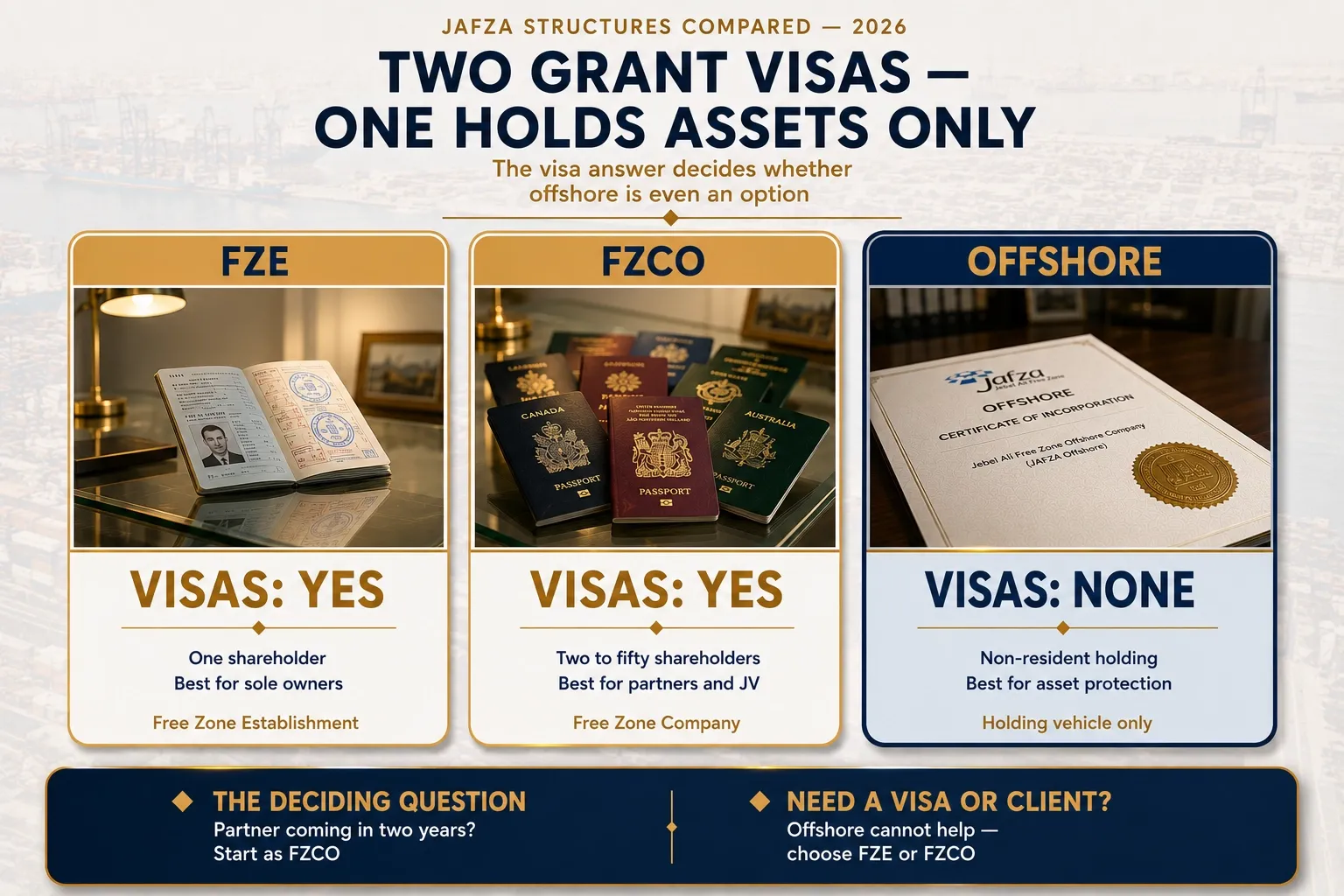
All three give 100% foreign ownership. The differences are who can own them, whether they grant visas, and what they are built to do.
| Factor | FZE | FZCO | JAFZA Offshore |
|---|---|---|---|
| Shareholders | Single shareholder only | 2–50 shareholders | One or more non-resident shareholders |
| Residence Visa Eligibility | Yes | Yes | No |
| Trading Within the UAE | Permitted through an authorised local distributor | Permitted through an authorised local distributor | Not permitted |
| Best Suited For | Individual entrepreneurs and sole owners | Business partners, joint ventures, and SMEs | Holding companies, international asset protection, and overseas investments |
| Dubai Property Ownership | Eligible to own approved Dubai property through the company | Eligible to own approved Dubai property through the company | Yes, for DLD-approved properties |
| Liability | Limited liability | Limited liability | Limited liability |
What Is a JAFZA FZE?
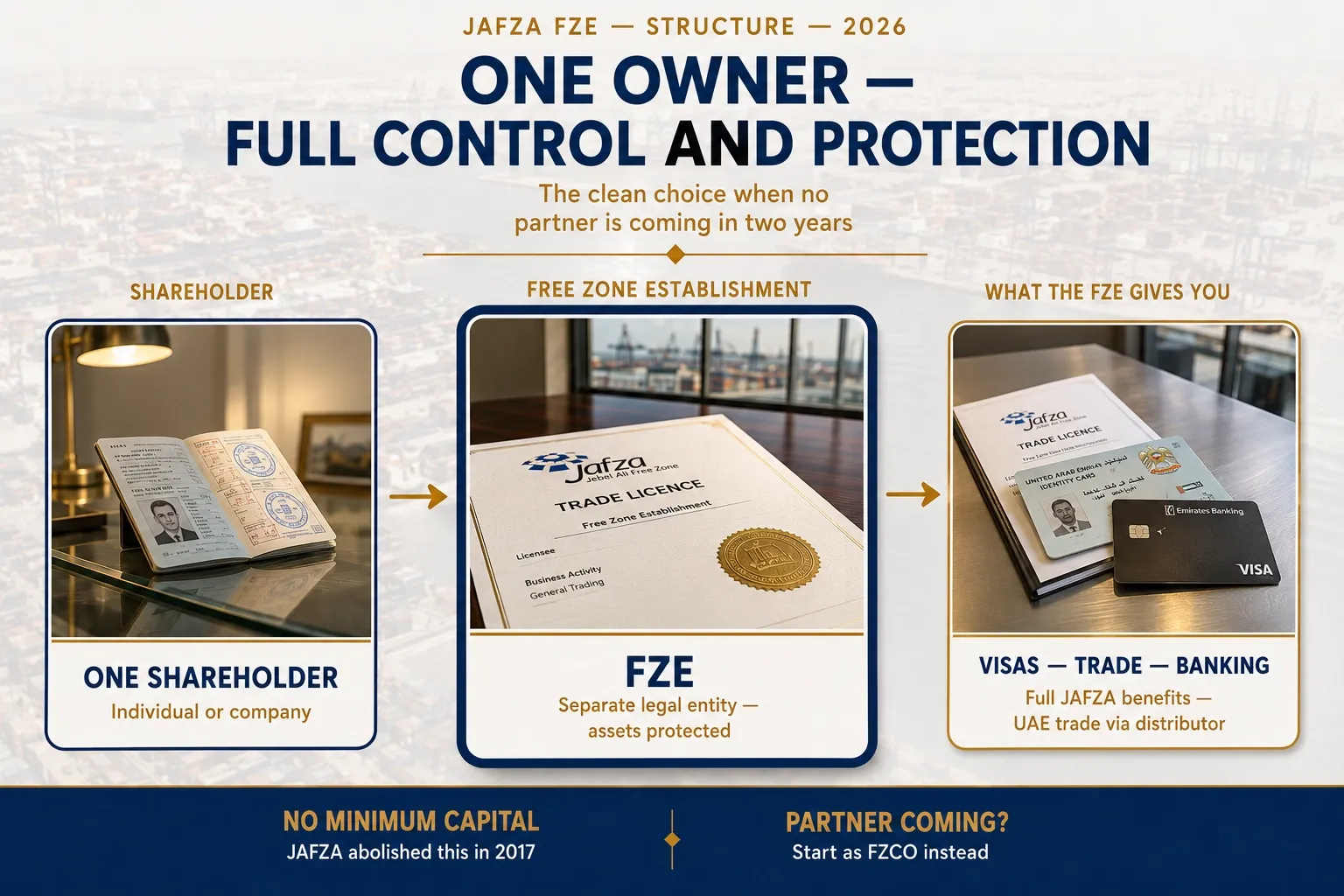
An FZE, or Free Zone Establishment, is a company with one shareholder. That shareholder can be an individual or another company. The owner has full control and full decision-making power. It is a separate legal entity, so personal assets are protected.
An FZE suits a sole owner who has no partner or investor on the horizon. Governance is simple: the same person can be shareholder and director. The Free Zone Establishment entry in our glossary covers the basics.
What Is a JAFZA FZCO?
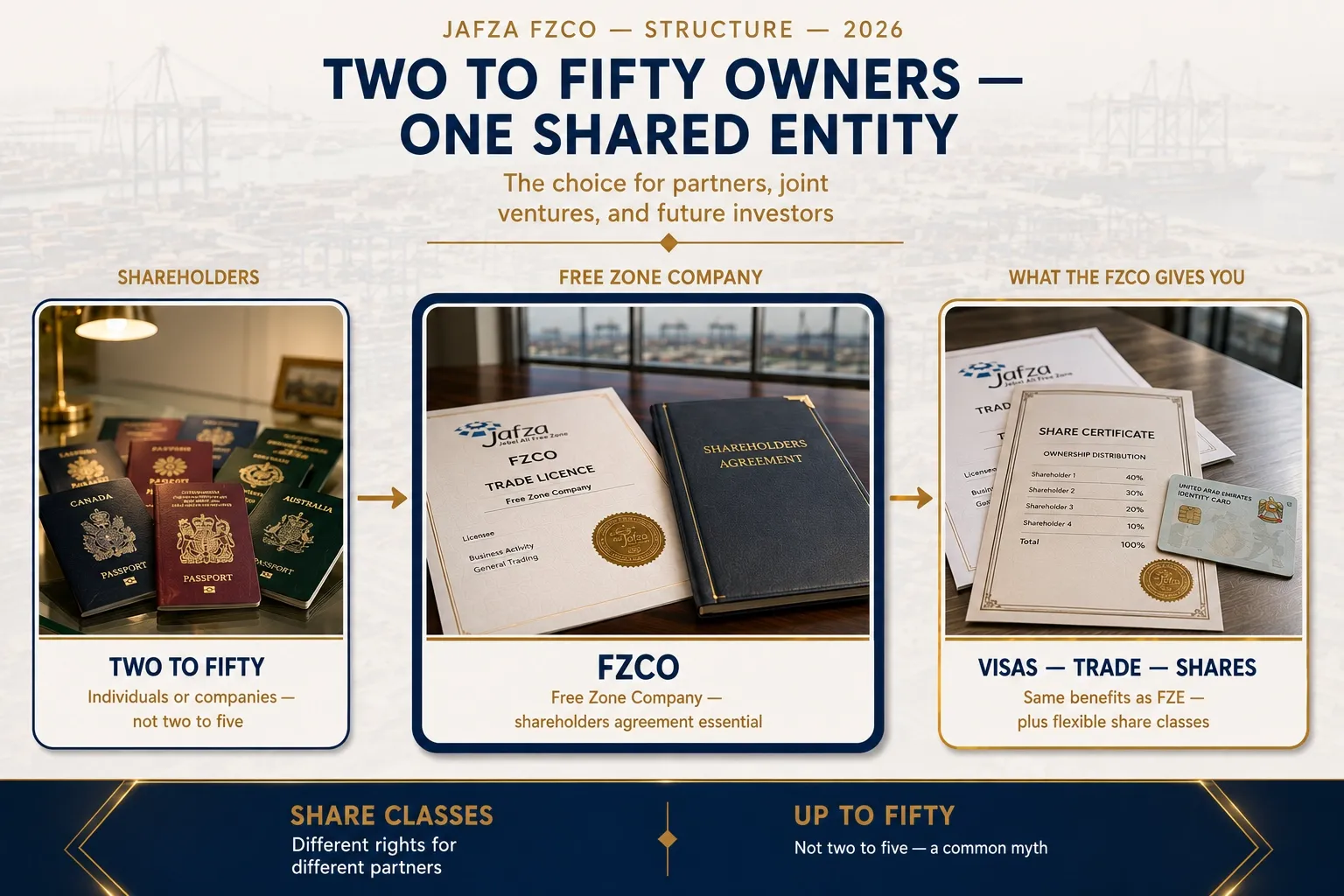
An FZCO, or Free Zone Company, has between two and fifty shareholders. They can be individuals, companies, or a mix. It is the structure for partnerships, joint ventures, and businesses that expect outside investment.
Note the real cap: up to 50 shareholders, not the "two to five" some guides still quote. An FZCO can also issue different share classes. It should have a shareholders' agreement that sets out splits, exits, and decision rights. The Free Zone Company entry has more.
What Is a JAFZA Offshore Company?
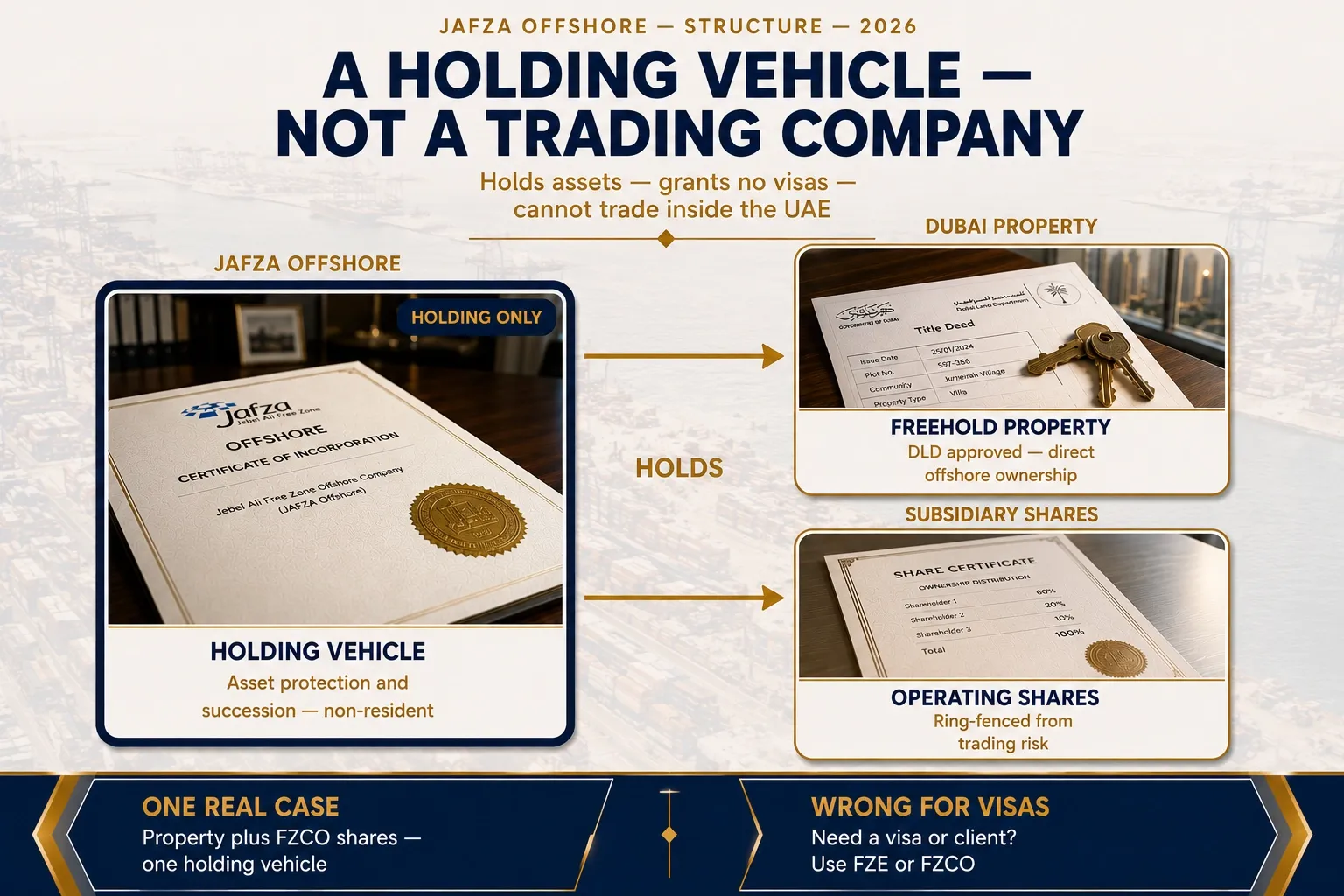
A JAFZA Offshore company is a non-resident vehicle. Its job is holding assets, not running an operating business. It grants no residence visas. It has no physical office in the zone. It cannot trade inside the UAE market.
Treating offshore as a cheaper onshore licence is the most common mistake we correct. It is a different tool for a different job. An offshore company setup makes sense for a holding company, asset protection, or succession planning, never for someone who needs a visa or a local client.
FZE vs FZCO: The Real Deciding Question
Liability does not decide this. Both are limited-liability entities with their own legal personality, so personal assets are protected either way. Cost, visa quota, licence options, and bank treatment are also the same. Banks scrutinise substance and activity, not the FZE or FZCO label.
What decides it is the ownership horizon. Ask one question: will anyone else hold equity within the next 18 to 24 months?
- No partner coming: an FZE is cleaner. One shareholder, simple governance.
- A co-founder, family member, or investor is realistically coming: start as an FZCO.
Starting as an FZCO when a partner is likely saves the rework of a later conversion. You can even hold 100% at first and allot the partner's shares later. Deciding who owns what, and when, before incorporation is the cheapest this will ever be.

Not Sure Which JAFZA Structure Fits Your Ownership Plan
We check your ownership horizon, shareholder setup and activity before you incorporate — so you never pay to convert the structure later.
Where Offshore Fits, and Where It Does Not
JAFZA Offshore is right for one job: holding assets. Four use cases come up again and again:
- Holding Dubai freehold property. JAFZA Offshore is one of the few offshore regimes the Dubai Land Department allows to own property directly.
- Acting as a holding company over operating subsidiaries, with the parent ring-fenced from trading risk.
- Asset protection and succession planning, separating ownership from operations.
- Holding intellectual property or international investments invoiced outside the UAE.
Here is a real case. A European family owned two Dubai apartments and shares in a UAE trading FZCO, all held personally. We placed the property and the shareholding under one JAFZA Offshore holding company. The result was cleaner succession, ring-fenced liability, and a tidier ownership chain for the bank. The operating company kept trading. The offshore held the assets. If you need a visa or a UAE client, though, offshore is the wrong tool. An FZE is the fix. For a parent-and-subsidiary plan, see how to set up a subsidiary in the UAE.
Can You Convert an FZE to an FZCO Later?
Yes. You convert by transferring or issuing shares to the new partner, then amending the memorandum and articles of association and the share register, with JAFZA approval. It is workable, but it is not free.
Expect amendment fees, processing time, and often a bank re-KYC, because the shareholding has changed. That re-check can briefly freeze account operations, usually just as you are scaling. So if a partner or investor is genuinely likely within two years, start as an FZCO and set the share split from day one.
Corporate vs Individual Shareholders
The entity type does not change with shareholder type. An FZE or FZCO is valid whether the owner is a person or a company. What changes is the paperwork.
A corporate shareholder must supply its certificate of incorporation, its MOA and AOA, and a board resolution that authorises the new entity and names a signatory. If the parent is foreign, these are notarised and attested through the UAE Embassy and the Ministry of Foreign Affairs. That attestation chain is the biggest cause of delay we see, and name mismatches across the parent documents are where files stall. We pre-check the parent pack before submission. That discipline is how we set up one foreign subsidiary, WEATHERTECH Engineering's UAE entity, in 18 days, when attestation usually drags these out. A branch of a foreign company follows a similar document path.
JAFZA Rules People Get Wrong
Three assumptions are usually wrong, and competitor guides keep repeating them:
- Shareholder cap: an FZCO allows up to 50 shareholders, not "two to five".
- Officers: every FZE and FZCO must appoint at least one director, a manager, and a secretary. The manager named on the licence is expected to hold a residence visa issued under the zone, which is stricter than lighter free zones.
- Share capital: JAFZA abolished its statutory minimums in 2017. Many guides still quote AED 1 million for an FZE or AED 500,000 per shareholder for an FZCO. Those no longer apply. The rule today is capital sufficient for your licensed activities, with no fixed floor for standard activities.
We see clients over-fund based on stale advice. Correcting that one myth frees real working capital.
Common Structure Mistakes We Fix
- Offshore for the wrong reason: chosen to save money, then the owner needs a visa or a UAE client and the entity cannot deliver it.
- FZE when a partnership was the plan: incorporate solo to move fast, add the co-founder six months later, and pay for a conversion plus bank re-KYC.
- FZCO with no shareholders' agreement: two partners, an unwritten 50/50, and no exit or deadlock mechanism. That is where disputes get expensive.
Each one traces back to skipping the ownership-horizon conversation. We run it first, every time
Quick Decision Guide
Which JAFZA Structure Is Right for You?
The structure decision comes down to two things: who owns the company, and what the company is for. A sole owner who trades picks an FZE. Partners who trade pick an FZCO. An owner who only holds assets picks offshore. The expensive mistakes happen when the entity does not match the real plan.
Best Solution is an authorised JAFZA channel partner, with a 50+ specialist team and more than 5,000 companies formed since 2014. Tell us who will own the business and what it will do. We will recommend the structure that fits, and set the share split and documents correctly from day one. You can book a free consultation or meet the Best Solution advisory team.