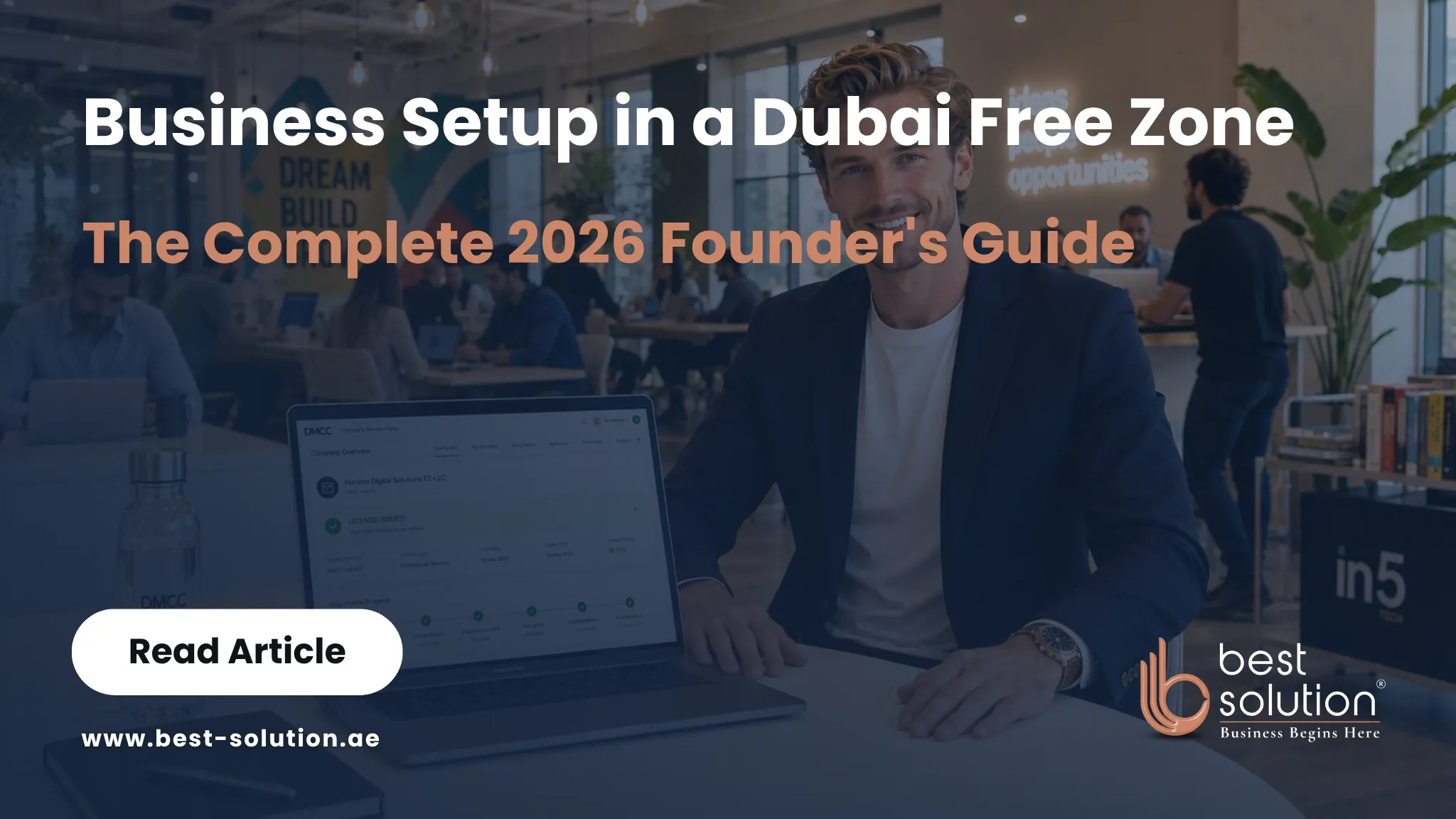
Most guides open the same way: a free zone means 100% ownership and 0% tax. In 2026, that is the wrong place to start. The smarter question is not whether you pay 0%, but whether your income stays "qualifying" once your business is actually running. A free zone company that wins a few mainland clients in its second year can quietly change its own tax position while the founder keeps invoicing exactly as before. A free zone offers several types of business structures to choose from. Your package size drives the business visa options you can sponsor.
Business setup in a Dubai free zone is still one of the fastest, most cost-efficient ways to launch in the UAE. But the zone you pick, the structure you choose, and the way you plan for banking and tax decide whether that setup still fits you after you grow, or becomes an expensive thing to unwind. This guide walks through the full process, the real 2026 costs, how to choose between zones, and the banking and tax realities that most free zone pages skip. The same business licence essentials apply inside the free zone.
Free zone setup in 2026
How to set up a business in a UAE free zone: 7 steps
In short
To set up a business in a UAE free zone, define your activity, choose a free zone that supports it, pick a legal structure, reserve your trade name, secure office space (often a flexi-desk), obtain initial approval and your trade licence, then apply for visas and open a corporate bank account. Most free zone licences are issued within a few days; the full setup, including visas and banking, usually takes two to three weeks.
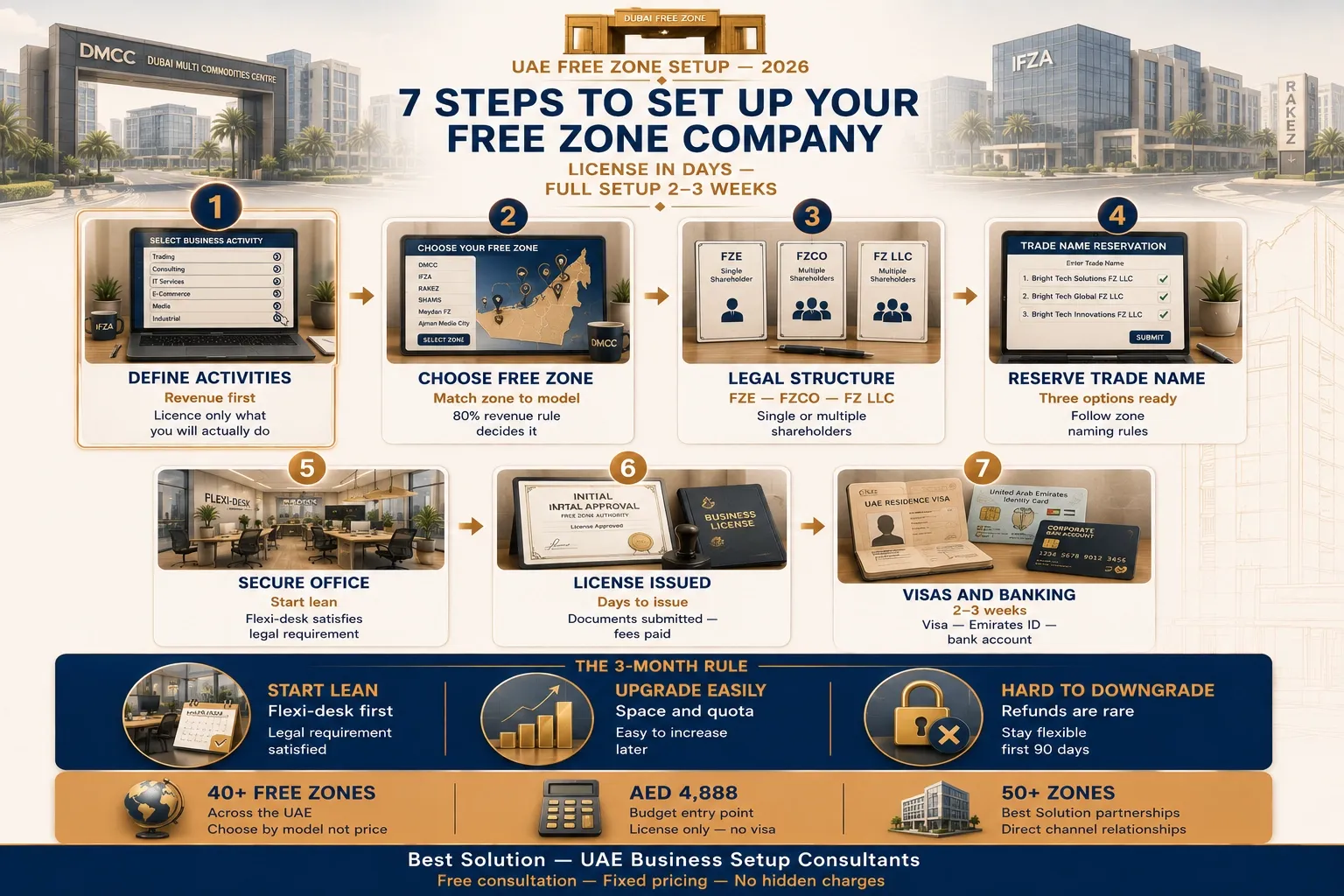
Step 1 - Define your business activities
Your business activity is the legal foundation everything else is built on. It shapes your licence type, your costs, your visa eligibility and how banks read you. Start with what your business actually does, then rank your activities by revenue potential, primary first.
Free zones group activities into a few licence families:
- Commercial / trading licence - buying and selling goods, import/export, e-commerce.
- Professional / service licence - consultancy, marketing, IT, accounting and other fee-based services.
- Industrial licence - manufacturing, processing and assembly.
- Freelance, innovation and media licences - for independent professionals, R&D and tech ventures, and content businesses.
Most free zone packages let you hold several activities on one licence, and unlike the mainland you can often mix activities from different groups. The discipline that saves money: licence only what you will actually do. Adding "general trading" when you sell one product category inflates the fee and, as you will see, raises your risk profile with banks.
Step 2 - Choose the right free zone
There are more than 40 free zones across the UAE, each with its own sector focus, cost base and rules. Some are broad (IFZA, Meydan, SHAMS, RAKEZ); others are sector-specific (Dubai Media City for media, DIFC and ADGM for finance, Dubai South for aviation and logistics, RAK DAO for digital assets). The full selection logic is below in "Which free zone should you choose?" - but the short version is to match the zone to your activity and your customers, not to the headline package price.
Step 3 - Decide your legal structure (FZE, FZCO, FZ LLC)
UAE free zones offer a few core legal forms:
- Free Zone Establishment (FZE) - a single shareholder (individual or corporate). Simple to set up.
- Free Zone Company (FZCO) - two or more shareholders; better suited to partnerships and bringing in investors, with more governance and documentation.
- Free Zone LLC (FZ LLC) - a limited-liability structure that caps shareholders' exposure to their capital contribution. SHAMS is notable for issuing the plain "LLC" suffix, which some international banks and partners find more familiar.
If you intend to raise funding or add partners, the structure decision matters more than the setup fee - getting it right now avoids a restructuring later. Free zones still involve critical tax structuring decisions once you scale.
Step 4 - Reserve your trade name
Shortlist three name options that fit your brand and the zone's naming rules. Some zones follow the broader UAE Department of Economy and Tourism (DET) conventions; others set their own (DMCC, for instance, restricts certain abbreviations). Avoid offensive terms and references to religion or government bodies, check availability, then reserve the name with the free zone authority.
Step 5 - Secure office space (flexi-desk and the 3-month rule)
A registered address is mandatory, and free zones offer everything from flexi-desks and co-working seats to fitted offices, warehouses and industrial land. Critically, the free zone authority prepares your lease and supplies proof of address with the licence, so there is no separate Ejari step as on the mainland. Your office size also sets your visa quota (more on that in Step 7).
The 3-Month Rule - from our setup desk
"I always advise founders to start lean on office space. Most zones offer flexi-desk packages that satisfy the legal requirement. Unless you are hiring a physical team on day one, stay flexible for the first 90 days and give the business time to find its rhythm before locking into a 12-month commitment. In this market it is far easier to upgrade your space and visa quota than to downgrade and chase a refund." - Best Solution setup team
Step 6 - Get initial approval and your trade licence
Initial approval signals the authority has no objection to your business. You submit an application form, passport copies for shareholders and the manager, a business plan or CV where required, proof of address, and proof of funds. Most initial approvals come back within a business day, though zones run due-diligence and background checks and certain nationalities can face deeper review.
Some activities still need third-party sign-off even in a free zone: tourism through the relevant council, health activities through the local health authority (such as the Dubai Health Authority), and finance, education or media through their regulators via a No Objection Certificate (NOC). Once approved, you pay the registration fee and the trade licence is issued - in some zones, such as Ajman Free Zone, within the same day.
Step 7 - Apply for visas and open your corporate bank account
With the licence issued, the zone sponsors residence visas for you and your team. The visa run is an entry permit, a medical fitness test, Emirates ID registration and visa stamping. Visa quota is tied to office size - Meydan Free Zone allocates roughly one visa per 5 sq m, DMCC about one per 9 sq m, and flexi-desk packages typically cap you at two to three visas. The corporate bank account is the second half of setup and deserves its own planning, covered below.
How much does business setup in a Dubai free zone cost in 2026?
In short
A budget free zone package with no visa starts around AED 4,888-12,000; a professional service business with a flexi-desk and one visa runs about AED 13,000-22,000; and a trading company with two visas typically lands between AED 18,000 and AED 35,000+ in the first year, depending on zone, activity and facility.
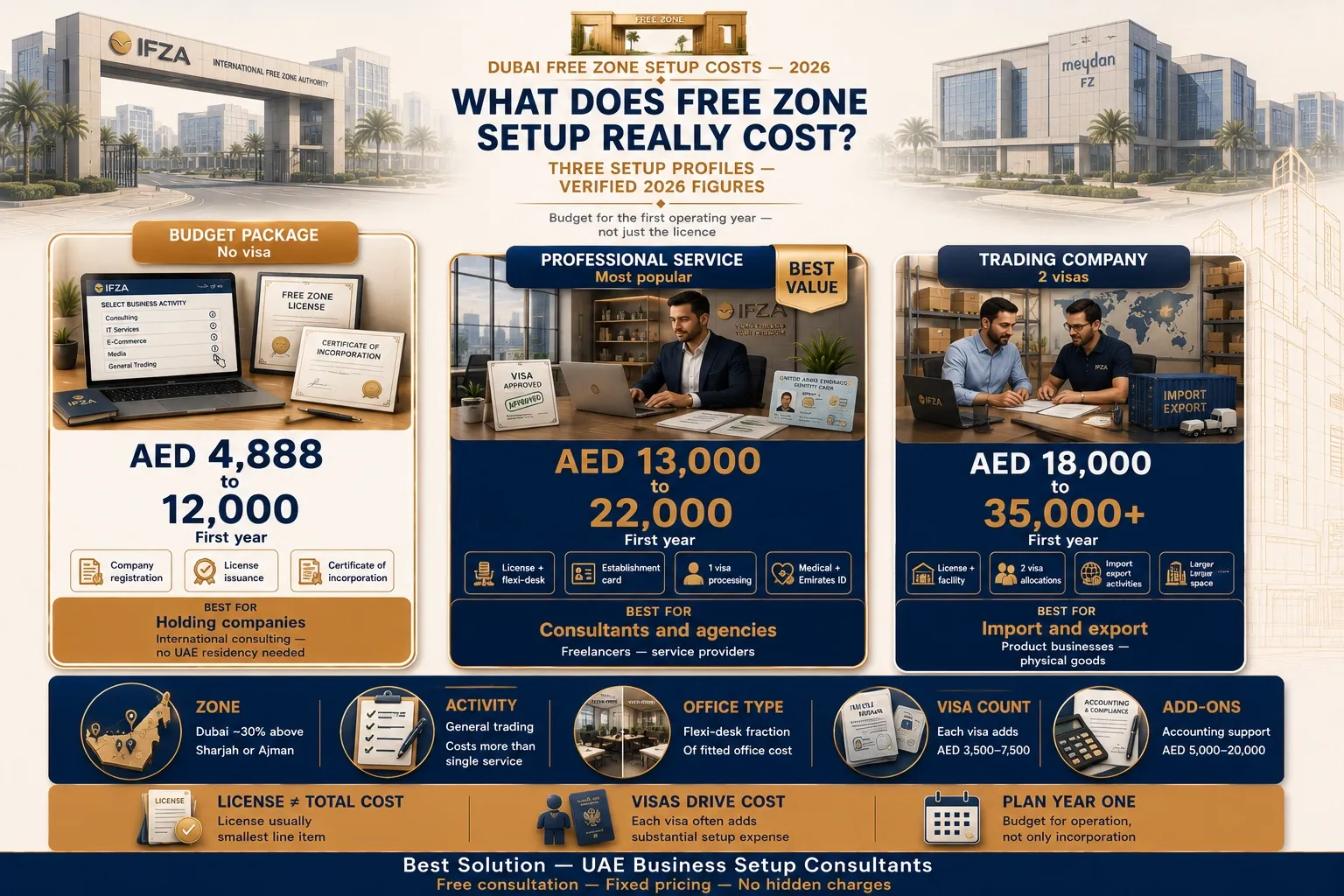
Free zone setup costs are fairly predictable. What surprises founders is what comes after the licence - banking, staffing and growth - so budget for the first operating year, not just the licence.
| Setup Profile | Typical First-Year Range | Best Fit |
|---|---|---|
| Budget package, no visa | AED 4,888 - 12,000 | Holding companies, side businesses, international consulting, founders not needing residency. |
| Professional service + flexi-desk + 1 visa | AED 13,000 - 22,000 | Consultants, agencies, freelancers, service providers. |
| Trading company + 2 visas | AED 18,000 - 35,000+ | Import/export and product businesses needing facilities and quota. |
The main cost drivers are the zone (Dubai zones often run ~30% above Sharjah or Ajman for comparable packages), the activity (general trading costs more than a single service activity), office type (a flexi-desk is a fraction of a fitted office), and visa count. Add-on services such as accounting or corporate-tax compliance typically run AED 5,000-20,000. Figures are indicative and move with each zone's policy; for a wider view across structures see our full breakdown of business setup costs in Dubai . Many free zone packages bundle a virtual office or flexi-desk. Watch for hidden operational costs like renewals and visa quotas.
Which free zone should you choose?
This is where most founders lose time - comparing IFZA, Meydan, RAKEZ and SHAMS on price before they have defined the business. We compare zones by business model instead, and almost every consultation turns on a single question.
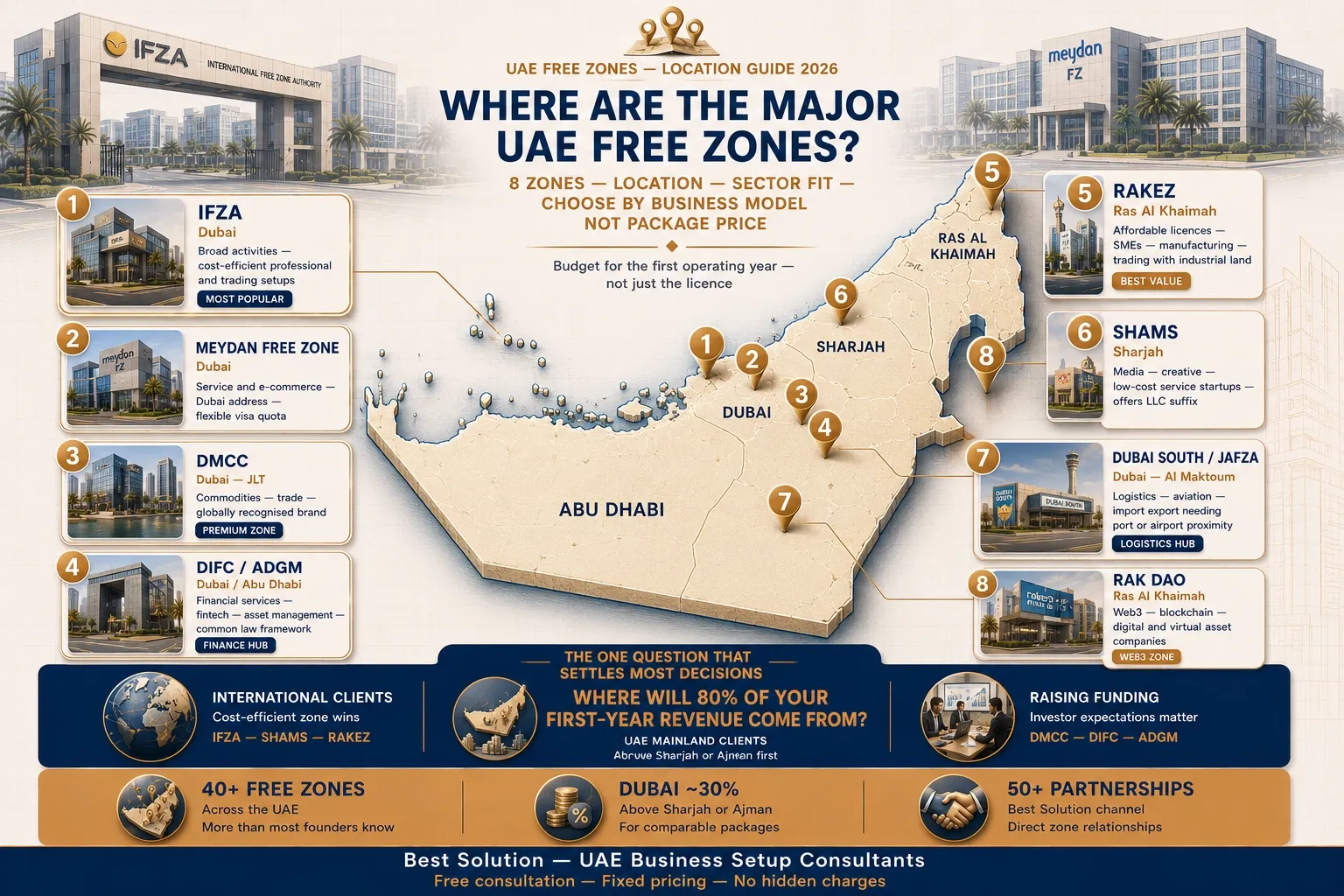
The one question that settles most decisions
"Where will roughly 80% of your first-year revenue come from?" If revenue is international, a cost-efficient zone usually wins. If it is UAE mainland, we immediately discuss mainland access, permits, tax and banking before picking a zone. If you plan to raise funding, investor expectations matter more than setup cost. If you will trade physical goods, warehousing, customs and logistics drive the choice. Most people compare packages; the right answer comes from the business model.
The table below orients you across commonly chosen zones. Treat it as a starting shortlist, not a ranking - the best zone is the one that fits your activity, customers and growth plan.
| Free Zone | Location | Strong Fit For |
|---|---|---|
| IFZA | Dubai | Broad activities, cost-efficient professional and trading setups. |
| Meydan Free Zone | Dubai | Service and e-commerce businesses wanting a Dubai address and flexible visa quota. |
| DMCC | Dubai | Commodities, trade and firms that value a globally recognised free zone brand. |
| DIFC / ADGM | Dubai / Abu Dhabi | Financial services, fintech and asset management under common-law frameworks. |
| RAKEZ | Ras Al Khaimah | Affordable licences, SMEs, manufacturing and trading with industrial land. |
| SHAMS | Sharjah | Media, creative and low-cost service startups (offers the LLC suffix). |
| Dubai South / JAFZA | Dubai | Logistics, aviation, and import/export needing port or airport proximity. |
| RAK DAO | Ras Al Khaimah | Web3, blockchain, digital and virtual-asset companies. |
Free zone companies and corporate tax: staying a Qualifying Free Zone Person
Here is the part most free zone guides skip. Since UAE corporate tax took effect, a free zone company is not automatically tax-free. The 0% rate applies only to a Qualifying Free Zone Person (QFZP), and only on its qualifying income. Everything else is taxed at the standard 9%.
To be a QFZP, a company must satisfy five conditions, all at once, for the whole tax period:
- Adequate substance in the UAE (real people, premises and activity).
- Qualifying income earned mainly from other free zone persons or from customers outside the UAE.
- The de minimis test - non-qualifying income must stay below the lower of 5% of total revenue or AED 5 million.
- No election to be taxed as a mainland (standard-rate) business.
- Arm's-length pricing and proper transfer-pricing documentation on related-party transactions.
Miss any one of these - even temporarily within a period - and the company can lose QFZP status for that tax period and the four periods that follow. The Federal Tax Authority's position in 2026 is also blunt on proof: audited financial statements are required to claim the 0% rate, regardless of company size.
The risk we see most often
The biggest threat to a free zone company's 0% rate is rarely aggressive planning. It is ordinary growth. A consultancy starts with international clients, everything works, then six months later it adds a handful of mainland clients and keeps invoicing exactly as before. The free zone has not changed - the business model has. That is why we review where revenue is likely to come from over the next 12 to 24 months, not just on day one.

Consultant, Best Solution
If your revenue is mostly international or B2B with other free zone companies, qualifying income is usually straightforward. If you expect meaningful mainland sales, plan the structure around it now. For the official conditions, see the UAE Federal Tax Authority and the government's free zone setup overview. Note too that Small Business Relief is currently available for tax periods ending on or before 31 December 2026 - a timing detail worth factoring into early-stage planning.
Opening a corporate bank account as a free zone company
Opening a corporate account is the step that derails more free zone setups than any other - and the common myth is that you simply "choose the best free zone" to fix it. In practice, banking outcomes are driven by your business model and documentation far more than by the zone's name.
Properly structured businesses tend to bank smoothly when set up in zones such as IFZA, Meydan, DMCC and RAKEZ. Activities that usually progress without friction include software development, technology services, consulting, marketing and other B2B professional services. Activities that draw more scrutiny include crypto and fintech, high-risk payment services, precious metals, commodity and broad general trading, and any business with unclear transaction flows.
Banks approve clarity, not jurisdictions
The fastest approvals come from companies that can explain, in one breath, what they do, who pays them, where the money comes from and why the transactions make commercial sense. A clean, specific activity and a simple revenue story beat a prestigious zone every time. Banks approve clarity.

General Manager , Best Solution
Banks typically ask for the trade licence, share certificates, the Memorandum and Articles of Association, shareholder passports and a lease or address proof, plus evidence that supports your business story (a CV, sample invoices or contracts). Digital banks such as WIO and Mashreq Neo have lighter documentation than traditional banks and can open accounts for flexi-desk businesses, sometimes within days. Getting the licence is only half the job; being able to operate commercially is the half that matters.
Can a free zone company do business in the UAE mainland?
This is where the worst advice online lives. "Free zone companies can't sell in the mainland" and "just use a distributor" are both half-truths. The real question is not legal, it is commercial: how much mainland revenue do you expect?
- Occasional mainland revenue - a distributor or local logistics agent is often enough.
- Growing mainland revenue - evaluate a mainland operating permit, dual-licensing or a branch, and weigh the tax and banking impact.
- Mainland becomes core revenue - at some point, forcing a free zone structure to behave like a mainland company creates years of avoidable complexity. That is the moment to reconsider the structure itself.
A structure that is perfect at 5% mainland revenue can be inefficient at 70%. Decide based on where your customers actually are, because customer location ultimately drives licensing, banking, tax and scalability.
Free zone vs mainland: which is right for you?
Free zones win on cost, speed, 100% ownership and international-facing businesses. The mainland wins when you need to sell directly to UAE customers, bid for government contracts or build a large local team. The 80% revenue question settles most of it: if the bulk of year-one revenue is inside the UAE, look hard at the mainland; if it is international or B2B with other free zone firms, a free zone usually fits. For a side-by-side view, see our free zone vs mainland comparison .
The most common free zone mistakes (and how to avoid them)
- Choosing a zone before understanding the business. Founders compare IFZA, Meydan, SHAMS and RAKEZ on price before defining revenue source, customers, banking and growth - then discover six months in that the structure does not fit.
- Over-licensing activities. Adding "general trading" or unrelated activities inflates the fee and raises bank scrutiny. Licence what you actually do.
- Treating 0% tax as automatic. It is conditional on QFZP status and qualifying income; growth can quietly break it.
- Locking into a big office on day one. Start lean; upgrading space and visa quota is easy, downgrading is not.
- Ignoring banking until after the licence. Plan the activity and documentation around bankability from the start.
The question that prevents most of these is simple: not "which zone is cheapest?" but "which structure will still make sense after my business grows?"
Why set up your free zone company with Best Solution
Best Solution has worked across more than 50 UAE jurisdictions and free zones, assisting with the formation of over 5,000 companies and the opening of more than 4,500 corporate bank accounts. We hold direct channel relationships with leading free zones, including IFZA, Meydan Free Zone, DMCC, RAKEZ, SHAMS, SRTIP, Ajman NuVentures and Dubai South.
The number we find most telling is not licensing speed - it is more than 4,500 bank account applications supported. Getting the licence is the easy half; making the company able to operate, bank and stay compliant as it grows is the half that decides whether your setup was a good decision. That is the conversation we start with. To see how we work with founders at this stage, visit our business setup consultants in Dubai. For the end-to-end view, see our guide on how to start a business in Dubai.
Ready to choose the right free zone?
Tell us where roughly 80% of your first-year revenue will come from, and we will map the zone, structure, banking and tax setup that still fits after you grow. Book a free consultation with the Best Solution team.