Key takeaways
| Question | Short answer |
|---|---|
| Who forms the company? | The Dubai Silicon Oasis Authority (DSOA), through its customer portal. Dtec companies go through the same authority and the same register |
| What is the order? | Activity check, application, initial approval and invoice, payment and legal documents, lease, then the e-licence. Visas and the bank come after |
| When should money move? | Only after the activity is accepted in writing. We do not pay rent or licence fees for a client before initial approval |
| How long does it take? | About one to two weeks from complete documents to licence on an office file, and three to four weeks at Dtec. Visas and banking are extra |
| Can it issue without premises? | No. Every DSOA licence sits on a leased desk, office or unit |
| What about share capital? | You declare it in the articles. The legal floor is AED 1, and shares must be at least 25 per cent paid up when allotted. Nothing is parked in a bank before approval |
| Do I need to be in the UAE? | Not for the licence. Signing is digital. Your first trip comes after the licence, for the visa, Emirates ID and the bank |
| What comes after the licence? | The establishment card, residence visas, the bank account, corporate tax registration within three months, and an audit every year |
The authority’s own process page says the licence and lease are issued within two days of receiving all legal documents and payment. That is accurate. It is also the last two days of the process, not the first.
Dubai Silicon Oasis company formation is mostly about what happens before those two days: picking activities the authority will accept, writing a business profile it can approve, choosing the premises the licence will sit on, and getting the papers into the order the authority wants them. Get the order wrong and you pay for a desk you cannot use, or wait on a document you could have prepared weeks earlier.
This guide walks through each step in sequence, who acts at each one, and where the time actually goes. Dubai Silicon Oasis is a zone we handle files for, though most of our files at Silicon Oasis addresses are IFZA companies; Best Solution is an authorised IFZA Professional Partner and holds no partner or agent status with the Dubai Silicon Oasis Authority.
How does Dubai Silicon Oasis company formation work?
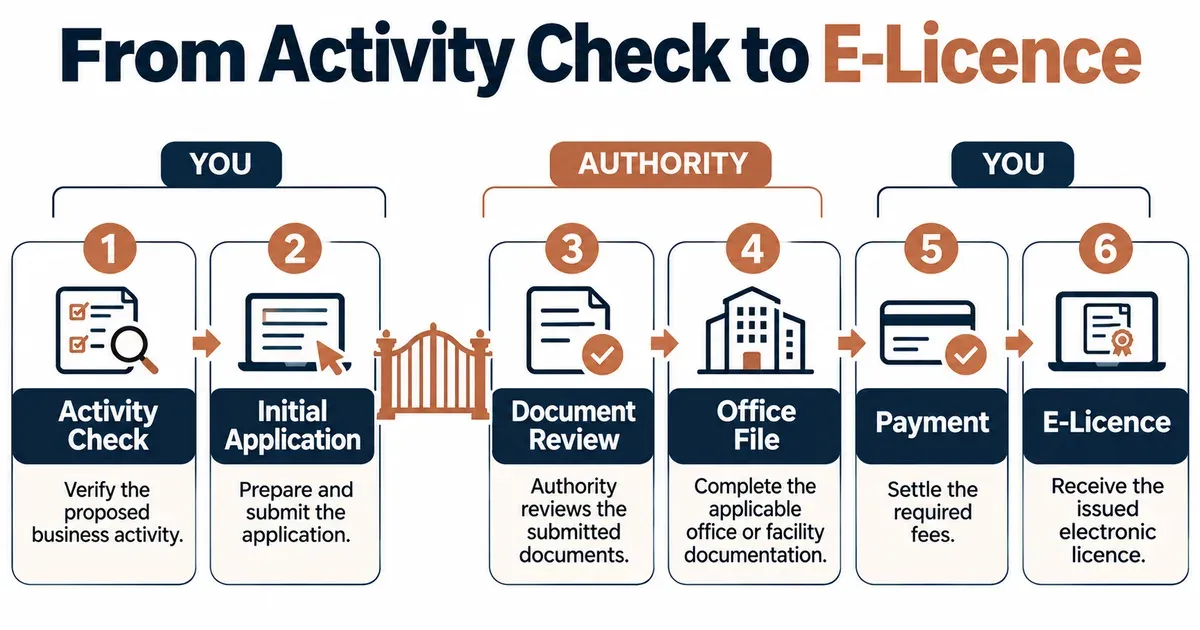
A Dubai Silicon Oasis company is formed through the DSOA customer portal in six stages: an activity and security review, initial approval with invoices, payment and legal documents, a lease agreement issued by the authority, then e-registration and the e-licence. The establishment card, visas and bank account follow the licence.
Here is who does what at each stage.
| Stage | Who acts | What happens | What it needs from you |
|---|---|---|---|
| 1. Activity pre-check | You, or your consultant | Activities matched to your first invoices and checked with DSOA licensing | Draft invoices, a short business summary |
| 2. Application | You | Account opened on the DSOA customer portal and the application submitted | Passport copies, business profile and plan, beneficial owner declaration, three name options |
| 3. Initial approval | DSOA | Activity fit, security and the company name checked, then initial approval and invoices issued | Nothing new, unless the authority queries the file |
| 4. Payment and legal documents | You | Fees paid; corporate and branch documents submitted, notarised and attested | Corporate documents, a power of attorney if used |
| 5. Lease | DSOA, then you | Lease and memorandum issued as an e-agreement and signed online | Your digital signature |
| 6. E-licence | DSOA | E-registration and e-licence uploaded to the portal | Nothing |
Source: dso.ae business setup process page, read October 2026. Stage 1 is our own step, not an authority requirement.
First, confirm you are filing with the DSOA
The phrase “Dubai Silicon Oasis company” covers more than one route, and each route has its own steps. Check which one you are on before you collect a single document.
- A DSOA free zone company or branch. The authority licenses it and leases it a desk, office or unit. This guide covers this route, including Dtec.
- A mainland company with a Business Operation Permit. It holds a licence from the Department of Economy and Tourism and works from a privately developed building in the zone’s Administrative Zone. Its initial approval asks for the manager’s passport, the mainland licence and the unit’s title deed, and no share capital.
- An IFZA company. It shares the address but not the issuer. The IFZA free zone in Silicon Oasis runs its own nine-stage process, set out in our guide to IFZA company setup.
If you are not sure which of these a quote describes, look at who issues the licence. The difference is explained in full in the planned What Is Dubai Silicon Oasis? Not Every Company Is Free Zone, and the two free zone routes are compared in Dubai Silicon Oasis or IFZA: Same Address, Two Licences.
From portal account to e-licence
The six stages below follow the authority’s own sequence, with the step we add at the front.
Check the activity before anything is paid
The DSOA has no activity catalogue of its own. It takes activities from the Department of Economy and Tourism list and checks each one for fit with a technology zone. Software, SaaS, digital services and IT consulting pass easily. Consultancy, marketing and e-commerce are usually accepted on an office licence, but draw more questions.
So we start from the invoice, not the activity list. We take the first three invoices the client expects to issue, match each one to an activity code, and send that set with a one-paragraph business summary to DSOA licensing as a pre-approval enquiry. The reply usually comes in two to three working days. No licence fee is paid until it is in writing.
Two more points shape the file at this stage:
- How many activities. Activities in the same segment can share one fee. We plan on five per licence and advise three, because three is what a bank expects to see on a small company’s invoices. The general rules are in our guide to choosing a business activity in Dubai.
- Outside approvals. Media, training, health and telecom activities need a regulator’s sign-off, and anything that touches virtual assets needs VARA approval wherever the company sits. These add weeks, so they belong in the plan from day one.
The full activity view is planned as Dubai Silicon Oasis Activity List: Will Your Business Fit?.
Open the application on the customer portal
Once the activity set is cleared, you register on the DSOA customer portal and submit the application. This is also the point to fix four choices that are hard to change later.
- The company form. Every new company here is a Free Zone Company (FZCO), or a branch of an existing company. The older single-owner form was folded into the FZCO under the 2023 regulations. An FZCO can have one shareholder or several, so you do not need a second shareholder to use it.
- The company name. There is no separate name reservation, no separate fee and no validity window to watch. You propose names in the application, the authority checks them during initial approval, and the name is fixed when the licence is issued. We submit three names in order of preference, so a rejection does not cost a resubmission. Names are refused most often when they contain a country or city name, a regulated word such as “bank” or “holding”, or a close match to an existing company.
- The premises. A DSOA licence is only issued with a lease. The entry route is a desk on the coworking plan, which runs one price card across DSO HQ, Dtec Technohub and Dtec A5. One of our clients, an FZCO, took an HQ desk because the founder wanted to walk in and resolve things face to face, paid the same as at Dtec, and got faster in-person handling. On cost the two are often level, so choose on service. Offices and light industrial units are leased separately and carry their own visa quota. How the lease shapes the licence is covered in the planned Dubai Silicon Oasis Free Zone: The Licence Needs a Lease.
- Dtec or not. Dtec is a DSOA campus, not a separate issuer, so a Dtec company sits on the same register. It screens the people behind the idea, so it asks for CVs and attested degree certificates for every shareholder and manager. Only Dtec asks for these; a standard desk or office file does not. That is the main reason a Dtec file takes longer. The campus is covered in the planned Dtec Dubai Silicon Oasis: A Licence That Comes With a Desk, and the choice between a desk and an office in Dtec or DSO Office: Same Licence, Different Visa Ceiling.
Initial approval and the invoice
The authority reviews the documents for activity fit, checks the proposed names and runs a security check on the people behind the company. If all of that passes, it issues initial approval and the invoices.
This is the line we hold for every client. We do not let a founder pay desk rent or licence fees until initial approval is in hand. The authority’s own sequence puts the invoice after the review, and there is no reason to pay ahead of it.
The most common reason a file is held here is a business profile that is too thin. It names the activity but does not say what the company will sell, to whom, or how it will earn. Founders usually call us and say, “They’re asking what my company actually does,” or “I already picked the activity, why do they want more?” Two short paragraphs fix it: name the product or service and the type of customer, and use the same words as the activity you selected. Files we rewrite this way usually clear on the next review.
Pay, then submit the legal documents
After approval you pay the invoiced fees and submit the legal documents. For an individual shareholder, this is light: no notary is needed. For a corporate shareholder or a branch, it is where most of the waiting happens, because documents issued abroad have to be notarised and attested before the authority accepts them.
A corporate shareholder or a parent company usually needs its certificate of incorporation, memorandum and articles, and a board resolution approving the new company. Documents from abroad go through notarisation and MOFA attestation, with an Arabic translation where required. A UAE parent needs no attestation.
For a branch, the authority checks that the branch activity falls inside the parent’s objects. A parent whose articles were written for an older product line is the most common reason a branch is held up. The fix is to amend the parent’s articles first, which can take weeks abroad. The wider process is in our guide to opening a branch of a foreign company.
Sign the e-agreement the authority sends you
The authority emails an e-agreement to the address registered on the portal, and you sign it online, from anywhere. That covers the lease and the memorandum of association. On the coworking plan, the lease is a desk lease agreement rather than a tenancy contract, and it matters later: immigration needs it for the establishment card, and banks ask for it during account opening.
If you rent a privately owned unit inside the zone instead, ask the owner for a copy of the title deed before you sign. A missing deed stops the licence at the final step.
E-registration and the e-licence
Once the signed agreement and every legal document are in, the authority completes the e-registration and uploads the e-licence to the portal. This is the two-day step on the authority’s page. Your company now exists, and the clock starts on everything in the sections that follow.
The papers the DSOA asks for
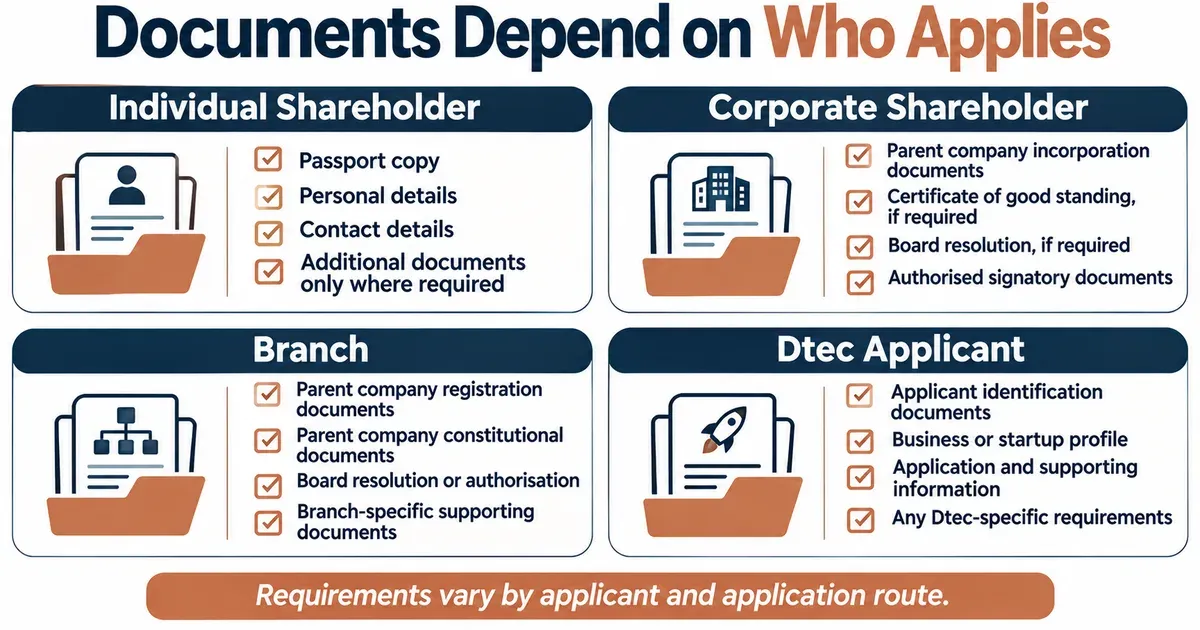
The authority’s checklist depends on who owns the company and where it sits. Here is the full set in one place.
| Document | Who needs it | Notes |
|---|---|---|
| Application form and letter of intent | Every applicant | Submitted on the customer portal |
| Passport copies | Every shareholder and the manager | Use the latest passport; a renewed passport number must match on every record |
| Business profile and business plan | Every applicant | Two short paragraphs on what you sell and to whom, in the words of your activity |
| Beneficial owner declaration | Every applicant | Names the people who ultimately own or control the company |
| Bank statement, bank reference letter or audited financial report | Every applicant | Shows the shareholder’s financial standing |
| No objection certificate | UAE residents only | From the current sponsor |
| Power of attorney | Anyone signing on behalf of a founder | Notarised, and attested if signed abroad |
| Memorandum and articles, certificate of incorporation | Branches and corporate shareholders | Notarised and attested |
| Trade licence of the parent or shareholder | UAE companies only | No attestation needed |
| Unit title deed | Privately owned units and Business Operation Permit files only | Not needed when the authority is your landlord |
| CVs and attested degree certificates | Dtec applicants only | Dtec’s own screening step |
Source: dso.ae business setup process page, read October 2026; our expert team’s file practice, October 2026.
Two documents slow files more than the rest. Attested corporate documents hold up branch and corporate-shareholder files, so start those before you apply. Degree certificates hold up Dtec files, and a degree can also come up later at the visa stage, if the manager’s visa job title calls for a qualification. Attesting a degree from abroad takes two to four weeks, so we match the job title to the documents the founder already holds rather than trigger an attestation nobody needs.
Share capital: declared in the articles, not parked in advance
Every new company here is formed under the DIEZA Implementing Regulations 2023. Those regulations set the floor at AED 1 and require shares to be at least 25 per cent paid up when they are allotted. Higher minimums still quoted on some websites belong to the system that applied before 2023, and we do not plan new files around them.
In practice, the capital works like this:
- You declare it in the articles. As practice guidance, our founders usually declare between AED 10,000 and AED 50,000. That is our working range, not a rule.
- You keep the paid-up part ready. At least 25 per cent of the declared amount should be ready to show.
- You open the corporate account after the licence. A UAE bank will not open an account for a company that does not legally exist yet, so nothing is parked in a bank before approval.
A mainland company on a Business Operation Permit needs no share capital at all.
How long does it take to form a company in Dubai Silicon Oasis?
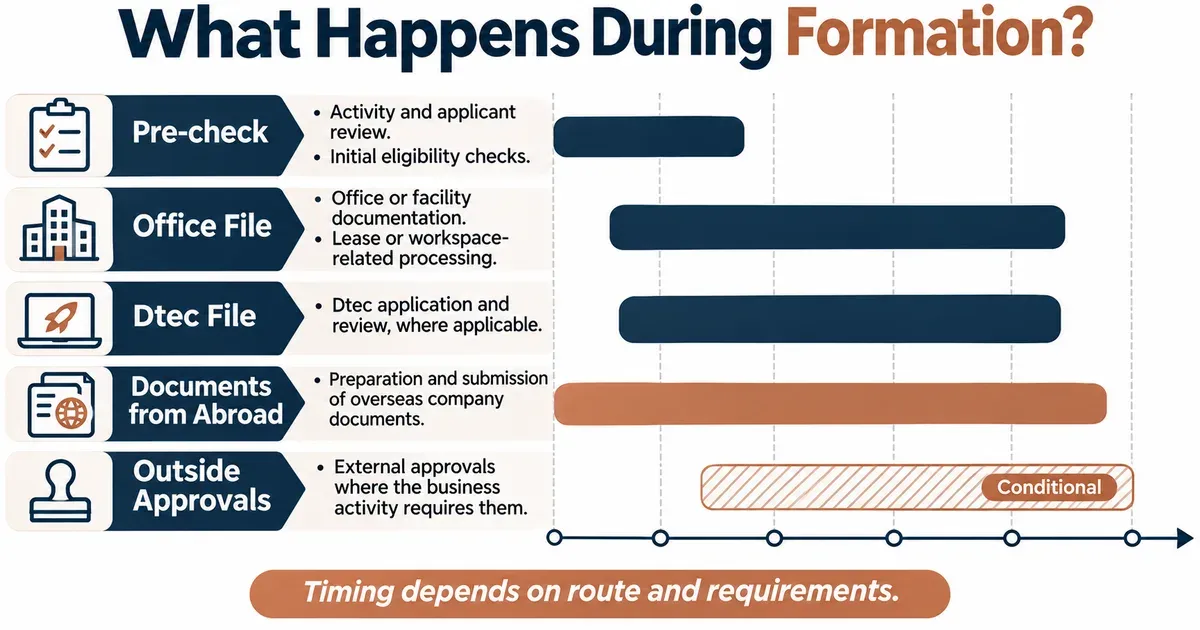
On a clean DSOA office file, allow about one to two weeks from complete documents to the licence in hand. A Dtec file takes three to four weeks, mostly because of degree attestation. The establishment card adds about three to five working days, and visas, Emirates ID and the bank account come after that.
The authority’s “within two days” is the licence step alone, measured from the day the last document and payment arrive. The time before that goes on things the authority cannot speed up for you.
| Stage | What sets the pace | Our planning range |
|---|---|---|
| Activity pre-check | DSOA licensing reply | 2 to 3 working days |
| Application to licence, office file | Unit allocation, lease signing, office approval | 1 to 2 weeks |
| Application to licence, Dtec desk | Degree attestation | 3 to 4 weeks |
| Corporate or branch documents from abroad | Notarisation and attestation in the home country | Weeks, by country |
| Power of attorney signed abroad | Notarisation and attestation | 1 to 3 weeks |
| Outside regulator approval | The regulator | 2 weeks to several months, by activity |
| Establishment card after the licence | Arabic name and passport data matching | 3 to 5 working days, typical |
Source: our expert team’s planning ranges, not published service levels or guarantees.
For comparison, IFZA issues in about two working days on a clean solo file. The difference is the premises: an IFZA licence needs no lease approved before it issues, while a DSOA licence cannot issue without one.
After the licence: the card, visas and the bank
The licence lets the company exist. These three steps let it hire, pay and get paid.
The establishment card
The establishment card registers the company with immigration and opens its visa quota. No visa application can start until it is issued, so a lost week here pushes every visa back a week.
It typically takes three to five working days on a clean file and costs about AED 2,000. The most common delay is a mismatch between the licence and the immigration record: usually the Arabic spelling of the company name, or a manager’s passport number that changed after a renewal. Each correction adds a few days. We check the Arabic name and the latest passport copies before the licence is issued, not after, and that prevents most of the delays we see.
On a desk, the quota is fixed by the plan: two visas on a flexi desk, three on a fixed desk. On an office, the authority sets it from the space.
Residence visas
Each investor visa or employment visa runs for two years. The applicant enters on an entry permit, or changes status if already in the UAE, then completes the medical fitness test and Emirates ID biometrics.
On our current figures, visa processing runs AED 3,100 for an applicant outside the UAE and AED 4,750 inside, with the change of status included. Medical, Emirates ID and insurance add AED 1,500 to 2,500. Founders who want to bring family sponsor them personally through a family visa, so dependants do not use the company’s quota.
The bank account
The address makes little difference to a bank on its own. Banks look at the activity, the shareholder’s profile and where revenue will come from. That is why the invoice-first activity check matters twice: the same invoices you used to choose activities are what the bank will compare against the licence.
This is also the account the share capital goes into. Before you apply, prepare the licence, the memorandum, the lease, passport and Emirates ID copies, the business profile you used at approval, and the paid-up amount. Our guide to opening a business bank account in Dubai covers the bank side in full.
The first year’s deadlines nobody puts on the setup quote
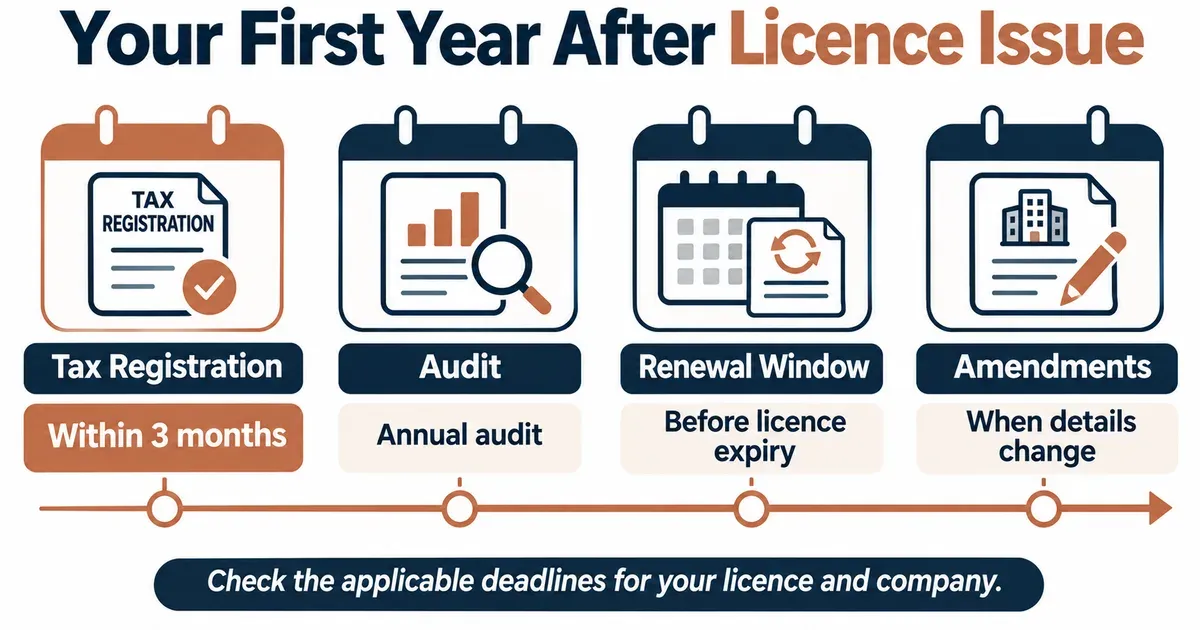
Formation does not end with the bank account. Four dates follow from the licence date.
- Corporate tax registration. Apply to the Federal Tax Authority within three months of the issue date on your licence, whether or not the company has revenue yet. It applies even if you expect the 0 per cent free zone rate, because that rate is earned through the annual filing and does not excuse registration. Late registration carries an AED 10,000 penalty. Our corporate tax registration team files it right after the licence is issued. VAT is a separate registration, required only once taxable supplies pass AED 375,000.
- The audit. Every DSOA company has its accounts audited each year, and the audit comes up at renewal. A company that wants the 0 per cent rate as a Qualifying Free Zone Person needs audited accounts in any case.
- Renewal. Renewal opens about 30 days before the licence expires. Under DIEZ’s April 2026 relief measures, late-renewal penalties for DSOA companies are waived until further notice, so check the position at renewal rather than relying on a figure from an older quote.
- Changes. Adding an activity or moving premises is a licence amendment. Send the bank the amended licence within 30 days, with a line on what changed.
The full three-year budget, with these lines priced, is in the planned Dubai Silicon Oasis Licence Cost: Three Years, Line by Line.
What you can do from abroad, and the one trip that matters
The licence stage runs fully remotely. The authority emails the e-agreement and you sign the memorandum and lease online, from anywhere. An individual shareholder needs no notary. Notarisation and embassy attestation apply only to corporate shareholders’ documents.
You can appoint someone to sign for you instead, but a power of attorney signed abroad must be notarised and attested before the authority accepts it. That adds one to three weeks, so signing digitally yourself is faster.
Your first trip to the UAE comes after the licence. In that one visit we combine the specimen signature, the visa medical, the Emirates ID biometrics and the bank meeting. Most clients do it in four to six working days on the ground.
The mistakes we see most on this route are not exotic. They are an activity chosen before the invoice was drafted, a business profile too thin to approve, a desk paid for before approval, and an Arabic company name or passport number that does not match the immigration record. Our list of common company formation mistakes covers the rest.

Want us to run the sequence for you?
Send us your first three invoices, your shareholder list and how many people need visas. We will run the activity pre-check, draft the business profile, tell you whether a desk, an office or Dtec fits, and set out the order of your file before you pay anything.
Get the order right, and the speed follows
Forming a company in Dubai Silicon Oasis is not slow. The licence itself takes two days once everything is in. What takes the weeks is everything the authority needs before that point, and almost all of it can be prepared in advance: the activity set, a clear business profile, three name options, the premises choice and any attested documents.
So work in the authority’s order, and add one rule of your own: nothing is paid until the activity and the initial approval are in writing. Then plan the one trip, the bank application and the tax registration around the licence date, not after it.