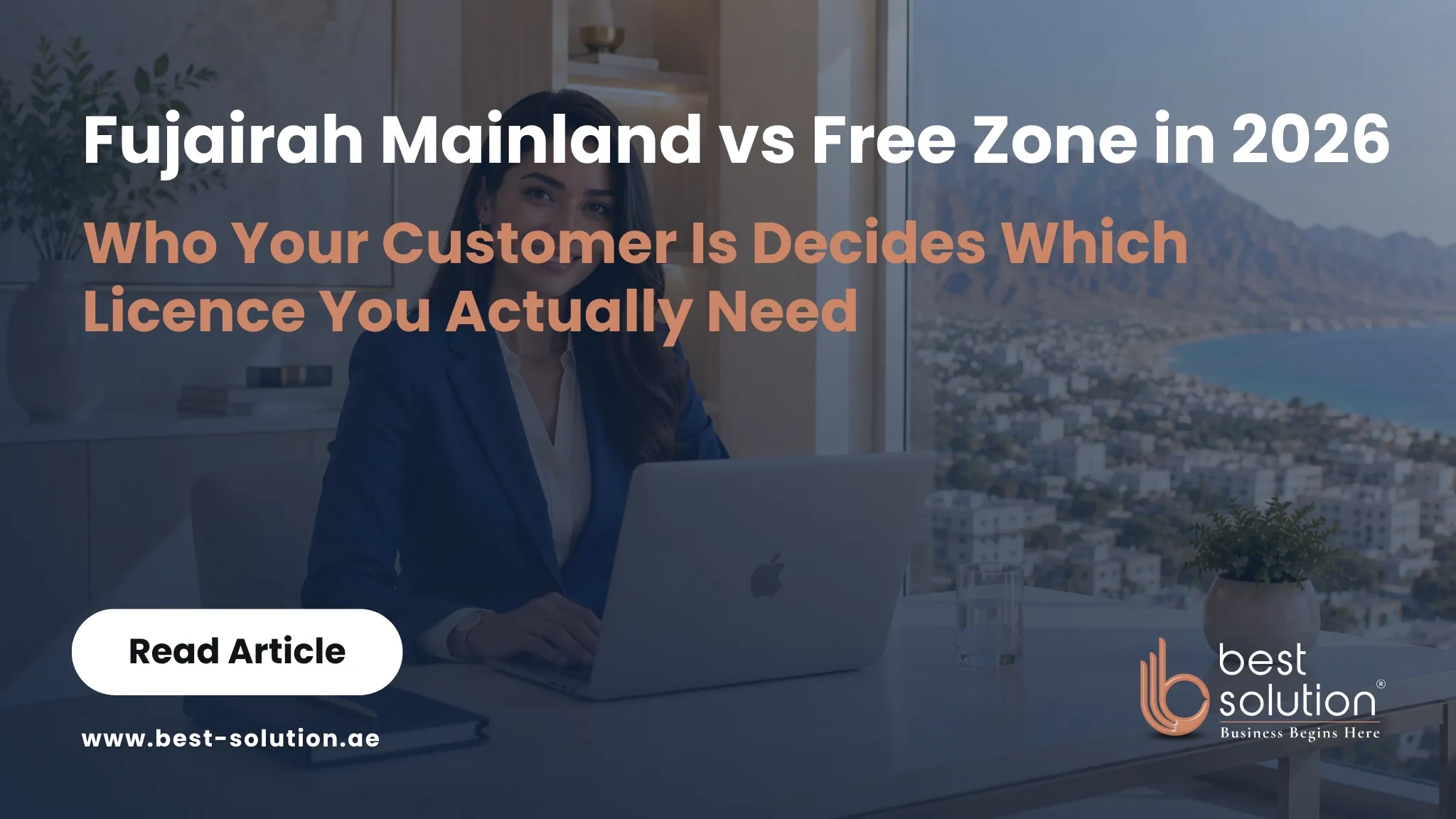
One question settles the Fujairah mainland vs free zone choice faster than any price list: who is your customer? If you plan to sell to people and businesses inside the UAE, the licence you pick decides whether you can invoice them at all. Pick the cheap option for the wrong reason and you can end up with a licence that cannot serve the customers you just won.
Fujairah gives you three sensible routes. A Fujairah mainland licence from the Fujairah Economic Department (FED). A licence from the Fujairah Free Zone (often shortened to FFZA). Or a low-cost media and freelance licence from Creative City. They look similar on a brochure. They are not the same when it comes to selling inside the UAE, paying corporate tax, or renting an office. This guide shows when each one wins, in plain terms, from work we do every week.
Fujairah mainland vs free zone
- A free zone or Creative City company cannot sell directly to UAE mainland customers. It needs a distributor, a commercial agent, or a mainland branch to reach that market.
- Mainland (FED) wins when your customer is local: retail, food, walk-in trade, or government work. It needs a real office, which is its biggest cost.
- Fujairah Free Zone (FFZA) wins for logistics, export trading and oil or marine services. Creative City wins for media, marketing, consulting and freelancers.
- The office rule swings the cost most. A free-zone flexi-desk saves roughly AED 15,000 to 25,000 a year against a mandatory mainland office.
- The 0% corporate tax does not survive mainland sales. Selling onshore is taxed at 9% and can cost a free zone its 0% status entirely.
Fujairah mainland vs free zone at a glance
Here is the short version before the detail. Figures are typical first-year, single-visa estimates and should be confirmed against current rates.
| What matters | Fujairah Mainland (FED) | Fujairah Free Zone (FFZA) | Creative City Fujairah |
|---|---|---|---|
| Sell direct to UAE mainland? | Yes, full onshore access | No, needs distributor or branch | No, needs distributor or branch |
| Physical office | Required (attested office) | Flexi-desk allowed | Virtual or flexi, none required |
| Typical all-in, 1 visa | AED 30,000 to 50,000 | AED 20,000 to 30,000 | From around AED 10,000 |
| How visas scale | By office size (square metres) | By package tier | By package tier (often 1 to 4) |
| Annual audit | Often applies | Applies in many cases | Not required |
| Tax on UAE-mainland sales | 9% corporate tax | 9%, and can break 0% status | 9%, and can break 0% status |
| Best for | Local retail, F&B, trade, government | Logistics, export trade, oil/marine | Media, marketing, consulting, freelance |
The one question that decides it: who is your customer?
The hard limit is simple. A free zone or Creative City company cannot sell goods or services directly to customers inside the UAE mainland the way a mainland company can. It can invoice UAE clients in many service cases. It cannot act as an onshore trader: no retail shop serving walk-in customers, and no direct distribution of physical goods to the local market.
So the first fork is about your buyer, not your budget. If your customer is the UAE domestic market, walk-in shoppers, local consumers, or government bodies, you are looking at a mainland licence. If your customer is international or other businesses buying a service, a free zone is open to you.
Everything else in this guide hangs off that one answer, so it is worth being honest about where your revenue will really come from. The general version of the trade-off, applied to Dubai, is covered in our guide to free zone versus mainland in Dubai, and the same principle holds on the east coast.
What a free zone company cannot do onshore, and the three workarounds
Say you set up in a free zone, then win mainland customers. You are not stuck, but every fix has a price. There are three, and we rank them in this order.
The distributor route
You appoint a mainland distributor who buys from you and resells onshore. There is no government fee, but the distributor takes a margin on every sale. That is a permanent cost, and you lose direct control of your customer relationship.
The commercial agent route
You appoint a registered commercial agent. We warn clients hard here. A registered commercial agency can be exclusive and genuinely difficult to terminate, so a poor agent can lock up your market for years. Treat this one with care.
The mainland branch route
This is the cleanest fix. A mainland branch gives your free zone company a real onshore licence without dissolving the free zone entity. You register it through a mainland economic department, the FED in Fujairah or another emirate's, and it trades as an extension of the parent. The mechanics mirror opening a mainland branch of a foreign or free zone company. Budget broadly the cost of a fresh mainland licence, around AED 15,000 to 30,000 or more in year one once you add the branch licence, approvals and the mandatory office, over a few weeks once documents are clean.
The catches founders miss: the branch needs the economic department to approve the activity, it needs a physical office with no flexi-desk shortcut, and you now run two renewals and two sets of compliance. The honest read is that a branch means you are paying for mainland anyway. That is why getting the jurisdiction right the first time usually beats setting up cheap and bolting a branch on later.
If your model genuinely needs both markets, the role of a local service agent on the mainland is worth understanding before you commit.
When the Fujairah mainland (FED) licence wins
Mainland is the right answer when your business touches the local market. That means a retail shop, a food and beverage outlet, anything serving UAE walk-in customers, government and local-contract work, and trading that sells directly to the domestic market. These all need onshore access a free zone cannot give. A Fujairah mainland trade licence gives you that access across the country.
One old reason to avoid mainland has gone. 100% foreign ownership is now standard across most mainland activities, so you no longer go free zone simply to dodge a local partner. Mainland companies also serve all seven emirates under a streamlined cross-emirate framework, which strengthens the case for anyone selling broadly across the UAE.
The catch is the office. Mainland requires a real, attested office, and that is its biggest cost. If your business needs premises anyway, a shop, a showroom, an operational base, the office mandate is no penalty. The full mainland picture, including the FED process and ownership rules, ties together in the Fujairah mainland setup hub.
When Fujairah Free Zone (FFZA) wins
Fujairah Free Zone fits businesses aimed at international or business-to-business markets rather than the local shopper. Think logistics, export and re-export trading, import-export, light manufacturing, and oil and marine services. It sits on the Gulf of Oman, outside the Strait of Hormuz, which is a real draw for traders moving goods. A Fujairah free zone licence lets you run that activity at a lower entry cost than mainland.
The cost advantage is mostly the office. FFZA allows a flexi-desk for most commercial and professional licences, so you skip the mandatory mainland office. One specialist note: oil, bunkering and storage activities belong in the Fujairah oil zone, not general FFZA, a difference we cover in the Fujairah oil, bunkering and marine company setup guide. The broader free-zone option is set out in the Fujairah Free Zone (FFZ) setup guide.
When Creative City Fujairah wins
Creative City is built for one kind of founder: the service professional who invoices rather than runs a shopfront. Media, marketing, content, design, consulting and freelance work all fit here. It permits a virtual or flexi setup with no physical office and no audit requirement, which makes it the leanest entry of the three, often from around AED 10,000.
If your clients are international or business-to-business, and you will never seat staff at a desk, the office mandate alone usually rules out mainland and points you here. The full media-licence detail sits in the Creative City Fujairah setup guide.
The cost difference, honestly
We earn the same fee whichever route you pick, so here is the plain math on a small single-visa setup.
| Route | Licence | Office | Realistic all-in (1 visa) |
|---|---|---|---|
| Fujairah mainland (FED) | AED 4,500 to 12,000 | Mandatory, AED 15,000+ | AED 30,000 to 50,000 |
| Fujairah Free Zone (FFZA) | AED 7,000 to 15,000 | Flexi-desk allowed | AED 20,000 to 30,000 |
| Creative City Fujairah | From AED 10,000 | Virtual or flexi, none | From around AED 10,000 |
The licence is never the bill. The office (on mainland) or the package tier and visa count (on the free zones) is where the real money sits. That single office difference is worth roughly AED 15,000 to 25,000 a year. The hidden costs are predictable: on mainland, the establishment card, e-channel registration and any deposits; on the free zones, assuming a bundled package covers visas it does not, or forgetting insurance and per-visa fees. We break down the wider picture in our guide to the real cost of starting a business in the UAE. A cost-only view of the FED route is covered in the Fujairah mainland licence cost guide.

Not sure which Fujairah route fits your customers?
Tell us who you sell to and what you do. We will tell you honestly whether the FED mainland licence, FFZA or Creative City is right, and what it really costs in year one.
The corporate tax myth that costs the most
This is the most expensive misconception in the whole comparison, so read it twice.
No, a free zone company does not automatically keep 0% tax on income from mainland customers. The 0% rate applies only to a Qualifying Free Zone Person's qualifying income. Income earned from selling to mainland UAE customers is generally non-qualifying, taxed at 9%. The rules sit in the UAE corporate tax law (Federal Decree-Law No. 47 of 2022). You can check the basic terms in our corporate tax glossary entry.
There is also a limit, and this is the part that catches people. A free zone company can earn only a small amount of non-qualifying income. The cap is broadly the lower of AED 5 million or 5% of total revenue. Go over it, and you do not just pay 9% on the mainland sales. You lose 0% status on everything, even the income that would have been 0%.
So the myth that a free zone company pays 0% no matter who it sells to is wrong twice over: mainland income is taxed, and too much of it breaks your whole 0% position. If a meaningful share of your sales will be mainland, the free zone tax advantage may be illusory, and a mainland structure, taxed at 9% but with full market access, can be the cleaner answer. We handle the filing either way through corporate tax registration. The deeper treatment of qualifying income sits in our guide to UAE free zones and the 0% corporate tax.
A real example: the saving that reversed
Here is a representative case, illustrative rather than a named client. A trading founder went free zone to save money, drawn by the lower all-in and the 0% headline. Within months he had signed UAE mainland customers. Then he discovered he could not invoice and supply them directly as a free zone entity, and that the mainland sales were knocking him out of his tax assumptions anyway.
The fix was a mainland branch: a second licence, a mandatory office and a second renewal cycle. He effectively paid for the mainland setup he had tried to avoid, plus the months lost while he could not service the customers he had won. All-in, the saving reversed into a higher total cost than going mainland from day one.
The mirror-image mistake is just as common. A consultant overpays for a mainland licence and office when every client is international, where a Creative City flexi-desk would have served at a third of the cost. Both directions teach the same lesson: the cheapest jurisdiction is the one that matches your customer and your activity, not the one with the lowest sticker price.
Our three-question decision rule
We place around ninety percent of clients with three questions.
- Who is your customer? If it is the UAE domestic market, walk-in retail, local consumers or government, you are mainland. If it is international or business-to-business service clients, a free zone is open to you.
- Do you need physical premises anyway? If yes, mainland's office mandate is no penalty. If no, the office cost pushes you to a free zone.
- What is the activity? Media, marketing and consulting point to Creative City. Logistics, export trading and oil or marine point to FFZA or the oil zone. Local trading and retail point to mainland.
We only go deeper when the answers conflict, for example a founder who serves both mainland and international markets. There, the right answer is often a free zone plus a mainland branch, rather than forcing one structure to do both jobs badly.
What changed for 2026
A few current rules sharpen this choice. The corporate tax rules are now fully live and checked. So 0% status, the small-sales limit and audited accounts are real tests now, not theory. Any claim of 0% forever is riskier than it sounds.
You can now own 100% of most mainland firms. That removes one old reason to choose a free zone. Mainland firms also trade across all seven emirates. One myth to drop: IFZA is no longer a Fujairah zone. It moved to Dubai years ago, so any guide that still lists it under Fujairah is out of date. The FED, FFZA and Creative City fees also change from time to time, so check the latest before you commit.
Getting your Fujairah jurisdiction right
The Fujairah mainland vs free zone choice is not really about price. It is about who you sell to. If your customer is inside the UAE, the FED mainland licence earns its higher cost by giving you full onshore access. If your customer is international or business-to-business, FFZA or Creative City will serve you for far less, as long as you understand the limits before you sign.
Best Solution sets up all three routes, and we will tell you the honest answer for your business, including whether a free zone plus a mainland branch is the smarter structure. Talk to our team for a free consultation: call or WhatsApp +971 52 233 0011, or use the contact form.