Key takeaways
| Question | Short answer |
|---|---|
| Are DIFC and ADGM the same kind of centre? | Both are financial free zones with their own courts, regulator and company law. DIFC is in Dubai. ADGM is in Abu Dhabi |
| How does English law reach each one? | DIFC enacts its own laws, modelled on English law. ADGM applies English common law directly |
| Which one charges more in registry fees? | It depends on the structure. An operating company pays at least USD 20,000 in DIFC registry fees in year one against USD 5,800 in ADGM. A holding SPV runs the other way: USD 1,100 in DIFC against USD 2,200 in ADGM |
| Is the registry fee the real cost? | No. For a holding SPV our all-in quotes overlap: AED 30,000 to 50,000 in DIFC and AED 28,000 to 45,000 in ADGM. The service provider and the premises set the bill |
| Which suits a family office? | ADGM licenses a single family office from USD 10 million in family net assets. DIFC has its own regime, and we are confirming its terms before we quote them |
| Can either sell to mainland customers? | Not on the free zone licence alone. Each centre has a mainland route, and each route spends the 0 per cent tax allowance as mainland sales grow |
| How should you choose? | Start from the structure and the regulator you need. The city comes last |
Most pages on DIFC vs ADGM ask which centre is better. The registries’ own fee tables show why that question has no single answer. ADGM charges less for an operating company. DIFC charges less for a holding SPV.
Law does not settle it either. Both centres run on English-based law and have their own English-language courts. What separates them is the structure you need, the regulator you answer to, how you reach mainland customers, and the thresholds for family wealth. Those are the points this page compares.
Every government figure comes from the DIFC Registrar’s Table of Fees (updated 31 December 2025), the DIFC Private Company Handbook, and the ADGM Registration Authority fee schedule in force from 1 January 2025. We read all three in October 2026.
What DIFC and ADGM share, and where they split
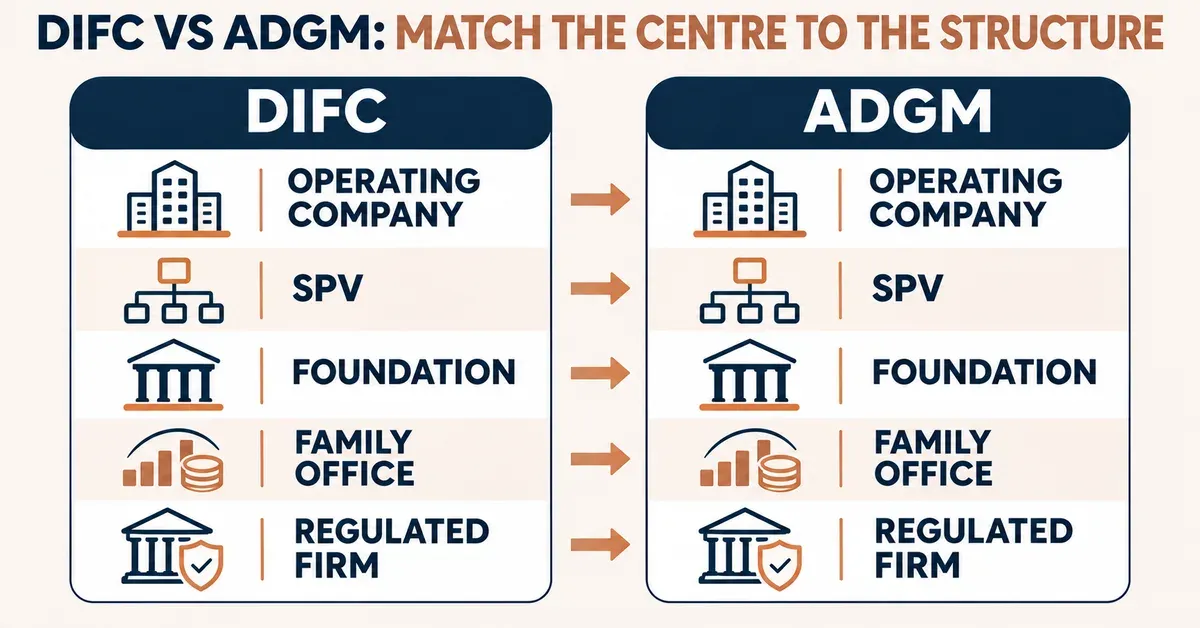
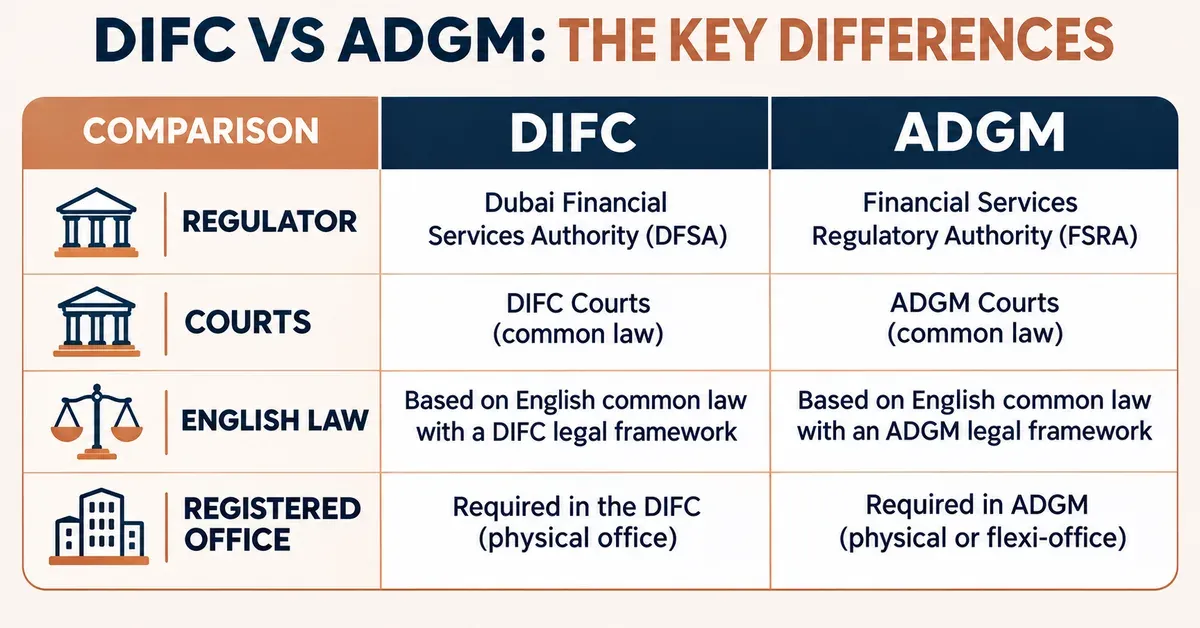
DIFC and ADGM are the UAE’s two common-law financial free zones. Each has its own courts, regulator and company law. DIFC sits in Dubai under the DFSA. ADGM sits in Abu Dhabi under the FSRA. The split is how English law applies: DIFC enacts its own laws, while ADGM applies English common law directly.
| Factor | DIFC | ADGM |
|---|---|---|
| Emirate and site | Dubai | Abu Dhabi: Al Maryah Island and Al Reem Island |
| Financial regulator | Dubai Financial Services Authority (DFSA) | Financial Services Regulatory Authority (FSRA) |
| Courts | DIFC Courts, in English, with an opt-in jurisdiction | ADGM Courts: Court of First Instance and Court of Appeal |
| How English law applies | DIFC statutes modelled on English law, including Companies Law No. 5 of 2018 | English common law applied directly under the Application of English Law Regulations 2015 |
| Registry size, as published | 8,844 active companies, 2025 | 11,128 active licences and 2,972 operational entities, first half of 2025 |
| Registered office | Shared, co-working or DIFC Investments space is accepted | An address inside ADGM is required |
Sources: DIFC Registrar of Companies and DIFC Courts (read October 2026); ADGM Registration Authority, ADGM Courts and ADGM half-year results (read October 2026).
The two size figures do not measure the same thing. DIFC counts active companies at the end of 2025. ADGM counts licences at mid-2025 and reports a smaller number of operational entities, 308 financial and 2,664 non-financial. Neither is a ranking. Both centres host thousands of firms, so ecosystem size is rarely the deciding factor.
Our glossary entry on ADGM defines the Abu Dhabi centre. The full DIFC route starts with DIFC Company Formation: Common Law in Central Dubai.
Common law reaches each centre by a different route
DIFC writes its own civil and commercial laws and models them on English law. Its courts work in English and offer an opt-in jurisdiction, so parties from outside DIFC can choose them by contract. In the first half of 2026 about 30 per cent of the court’s caseload came from opt-in parties, 243 of 810 cases, from the UAE and 22 other jurisdictions.
ADGM goes one step closer to the source. It applies English common law directly, and its Court of First Instance and Court of Appeal hear disputes. A shareholders’ agreement drafted for ADGM can rely on English authority without a translation layer.
For most trading and holding contracts, the day-to-day difference is small. It matters when a lender, fund or co-investor has a view. Some want a specific statute, such as the DIFC Companies Law. Others want English law itself. Ask the lawyers who will read your documents which they prefer before you pay for either licence.
The deeper explanations sit on their own pages: DIFC Common Law: What Its Courts Mean for Contracts and Why ADGM Runs on English Common Law.
Fees flip by structure
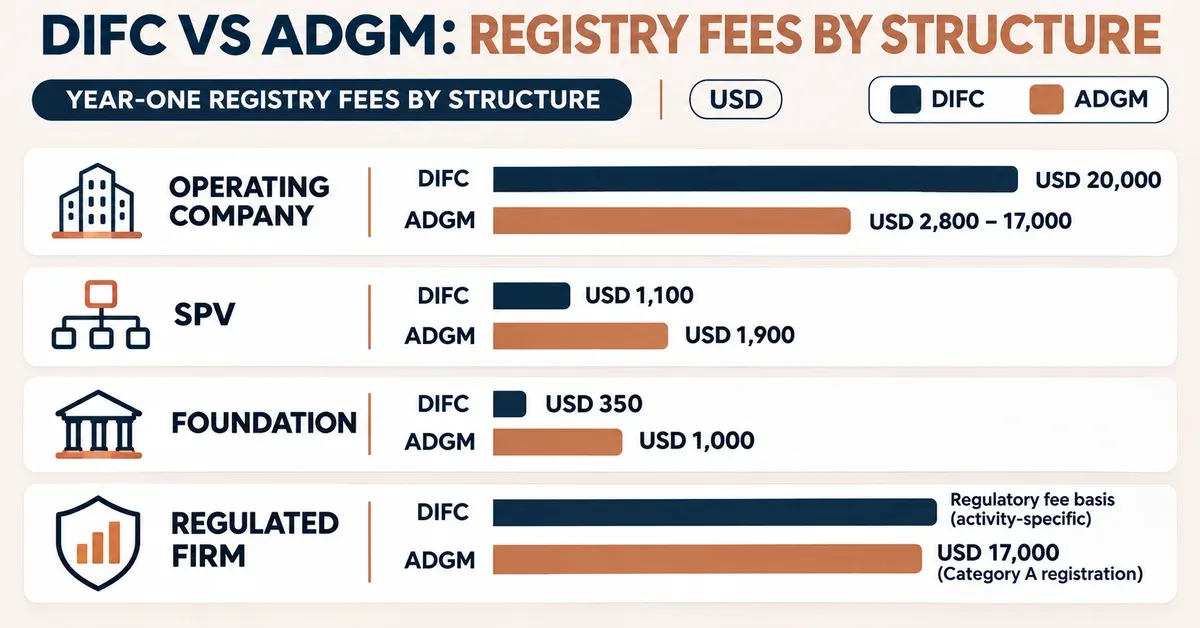
DIFC’s registry fees are higher for an operating company: at least USD 20,000 in year one against USD 5,800 in ADGM. For a holding SPV they are smaller in DIFC: USD 1,100 against USD 2,200. The direction depends on the structure, so compare the structure you need, not the centre.
| Structure | DIFC year one (USD) | DIFC renewal (USD) | ADGM year one (USD) | ADGM renewal (USD) |
|---|---|---|---|---|
| Operating company, non-financial | 20,000 before extras: registration 8,000, licence 12,000 | 12,000, plus a 300 annual confirmation statement | 5,800, including 300 for data protection | 5,300 |
| Holding SPV (DIFC Prescribed Company, ADGM SPV) | 1,100: registration 100, licence 1,000 | 1,000, plus a 300 annual confirmation statement | 2,200: licence 1,900, data protection 300 | 1,400 before data protection |
| Foundation (ADGM DLT Foundation line) | 350: licence only, no registration fee | 350 | 1,000 | 500 |
| Innovation or tech start-up | 1,600: registration 100, licence 1,500, at the discounted rate | 1,500 while the discount applies, then 12,000 | 1,500 | 1,500 for three years, then the operating company fee |
| Regulated financial firm, after regulator approval | DFSA fees, not compared here | Not compared | 17,000 | 16,500 |
Sources: DIFC Registrar of Companies Table of Fees, document DIFC-CS-GL-03, revision 16, updated 31 December 2025; ADGM Registration Authority schedule of fees, in force from 1 January 2025. Figures are government fees only. DIFC also charges name approval (USD 800 for a company) and a data protection notification at the start, and ADGM’s year-one figure already includes its USD 300 data protection fee.
At the dirham peg of 3.6725, the DIFC operating company bill in year one is at least AED 73,450 and ADGM’s is about AED 21,300. Renewals run at about AED 44,070 and AED 19,460. For a holding SPV the registry lines are about AED 4,040 in DIFC and AED 8,080 in ADGM.
The registry fee is the smaller part of the bill
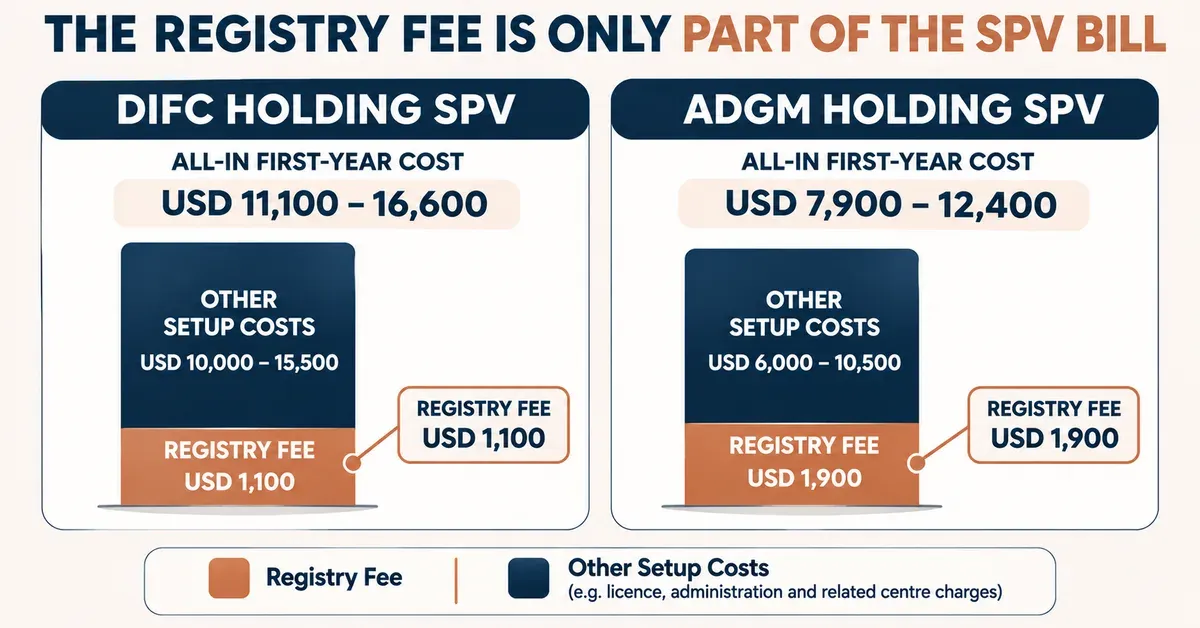
For a holding SPV, the registry line is only 8 to 29 per cent of what clients pay. Our guide to SPV versus holding company sets out the full numbers, offshore routes included. A licensed company service provider must act as registered office and filing agent in both centres, and that fee, plus our own, makes up most of the total. These are our representative quotes for a passive holding vehicle, all-in:
| Holding SPV, all-in | DIFC Prescribed Company | ADGM SPV |
|---|---|---|
| Year one | AED 30,000 to 50,000 | AED 28,000 to 45,000 |
| Renewal | AED 20,000 to 35,000 | AED 18,000 to 28,000 |
| Typical setup time | 2 to 3 weeks | 2 to 4 weeks |
| Registry line as a share of year one | About 8 to 13 per cent | About 18 to 29 per cent |
Source: Best Solution representative fee quotes for holding structures, not client invoices. Registry lines converted at 3.6725.
The ranges overlap, so the all-in cost does not pick a winner. A matched operating company bill is not on file for either centre yet. The planned cost pages are DIFC Company Formation Cost: USD 1,000 to Regulated and ADGM Setup Cost: SPV, Tech Startup, and Regulated Firm Fees.
Holding company or SPV: where each one fits
A DIFC Prescribed Company and an ADGM SPV do the same job. Each is a passive vehicle that holds shares, property or intellectual property. Neither can trade, invoice customers or employ staff. In DIFC, every non-exempt Prescribed Company must appoint a DFSA-licensed corporate service provider from 24 July 2026, and existing ones have until 24 January 2027. The same amendments opened it to any applicant. In ADGM, a licensed company service provider is required.
Banks read both well. In our experience, DIFC and ADGM vehicles bank more easily than offshore companies, because the registry is regulator-supervised and the documents are ones banks know. Onboarding runs 3 to 6 weeks for an operating company and 6 to 12 weeks for a passive SPV, because banks ask more questions of a company with no activity.
Tax is the same in both. Under the federal rules, a Qualifying Free Zone Person can pay 0 per cent on qualifying income, and holding shares for investment can qualify with a 12-month minimum holding period.
For joint ventures, both centres allow the terms. A DIFC Prescribed Company can also carry share classes and custom articles, so veto rights and profit sharing can sit in the documents. ADGM adds English common law applied directly and a Restricted Scope Company option with more limited public disclosure. Our rule: if the other side is an international party that wants English law directly, we choose ADGM. If both sides are comfortable with the DIFC courts, DIFC works, and in our quotes it costs a little more to hold. Client preference breaks ties, not the banks.
If the vehicle must hire, invoice or sponsor visas, neither fits and you need an operating company. The wider decision is covered in Which UAE Holding Structure? LLC, DIFC or Offshore. The vehicle pages are DIFC Prescribed Company: The USD 1,000 SPV Structure and The ADGM SPV: Common-Law Holding Vehicle. A holding company on the mainland is a third option when the entity needs to trade.
Family office and foundation: the threshold gap
ADGM licenses a single family office from USD 10 million in family net assets. The registry fee is USD 5,600 at the start and USD 5,300 each year. A multi-family office is a different product. It needs an FSRA Category 4 permission and registry fees of USD 16,800 at the start and USD 16,500 a year.
Foundations are the other wealth structure. DIFC’s foundation licence is USD 350 a year with no registration fee. The ADGM schedule lists a DLT Foundation line at USD 1,000 and USD 500, and we compare only the lines both registries publish. Both centres use a foundation to hold assets, not to provide services, so a foundation is often paired with a holding company.
Corporate tax rules still apply. A family office earns 0 per cent only as a Qualifying Free Zone Person on qualifying activity, and income from dealings with individuals is generally non-qualifying. See DIFC Family Office: Governing Wealth Under DIFC Law, DIFC Foundation: Common-Law Wealth Structure From $200 and The ADGM Foundation: Wealth and Succession.
Regulated firms: DFSA or FSRA
A firm that manages funds, advises, deals or runs a platform needs a regulator’s approval before the registry licence. In DIFC that is the DFSA. In ADGM it is the FSRA. After approval, the ADGM registry fee for a financial firm is USD 17,000 at the start and USD 16,500 a year. The regulators’ own fees and capital rules are separate.
FSRA base capital requirements range from USD 50,000 for Category 4 to USD 10 million for Category 1. FSRA publishes no service level for authorisation, and we have not found one for the DFSA. Any claim online of “weeks against months” between the two is an estimate, not a published figure. In our experience, plan in months, not weeks. The time depends mostly on how complete the application pack is and how clean the firm’s ownership is. We refer regulated firms to a law firm for the licence application and to a regulatory consultant for the compliance manuals.
Virtual asset firms in our routing go to VARA in Dubai or to ADGM. Securities, fund management and brokerage go to the Securities and Commodities Authority or to a financial free zone, DIFC or ADGM. The process is in DFSA Licence in DIFC: Setting Up a Regulated Firm and FSRA Licence in ADGM: Setting Up a Regulated Firm.
Selling onshore: the route and the tax cost
Neither licence lets a financial centre company invoice mainland customers by itself. Each centre has a route on paper, and the conditions differ.
In Abu Dhabi, ADGM and the Department of Economic Development agreed in 2017 that an ADGM company can also hold an ADDED licence, supported by one office on Al Maryah Island. That arrangement is explained in ADGM vs Abu Dhabi Mainland: Two Legal Systems, One City.
In Dubai, a 2017 agreement between DIFC and Dubai Economy is the established route for non-regulated DIFC companies that want a licence to operate in mainland Dubai. Regulated and financial firms, Prescribed Companies, SPVs and holding entities cannot use it. It needs a real DIFC office lease, not a bare flexi desk, and a Dubai premises if the activity requires one. Our working estimate is government fees of AED 10,000 to 30,000 and about one to two weeks.
Dubai’s 2025 free zone mainland operating permit is a separate route. We have not confirmed that it applies to DIFC companies, so this page does not rely on it. The UAE-wide view is planned as Dual Licensing in the UAE: Free Zone to Mainland.
The tax rule is the same on both sides, and it sets the real cost of selling onshore. A Qualifying Free Zone Person needs audited financial statements every year, whatever the revenue. Mainland revenue is generally non-qualifying. Non-qualifying revenue is tolerated only up to the lower of 5 per cent of revenue or AED 5 million.
So a DIFC or ADGM company that wins a lot of mainland work through a second licence spends that allowance quickly. Past it, the 0 per cent rate on qualifying income can be lost, whichever centre you chose. Neither centre carries a tax edge here. Our corporate tax registration team can model where the line falls for your revenue mix.
Office, visas and the bank
Premises differ in kind. DIFC accepts a flexi desk or co-working space for the registered office. Budget about AED 22,000 to 30,000 a year, our estimate, with USD 500 a month plus VAT as the published flexi price. A flexi desk is enough to register, but not for a Dubai mainland licence through the DIFC route, which needs a real office.
ADGM needs a physical address inside ADGM, and a Dubai or Abu Dhabi mainland address does not count. A business centre desk is workable for an operating company. Budget about AED 20,000 to 40,000 a year, our estimate, usually for one visa. More visas need a bigger lease.
The visa sequence is the same in both: licence, then establishment card, then the owner’s investor visa and employee visas.
Banks look at your customers, contracts and where the work happens, not the centre’s name. Our working times for a clean operating company are 3 to 6 weeks in DIFC and 4 to 8 weeks in ADGM. ADGM files get more questions about the UAE link, and banks usually ask for a signed customer contract or invoices, proof of source of funds and a short note on why Abu Dhabi. These are observations, not bank policy. Best Solution has helped open more than 4,500 corporate accounts, and preparation beats centre choice.Our guide on how to open a business bank account covers the standard file.
When neither centre is the right answer
DIFC and ADGM are built for finance, holding and wealth structures. If you sell services to UAE customers, a financial centre is usually the wrong place to start.
| What you do | Where it usually belongs |
|---|---|
| Consulting, agencies, trading or software sold to UAE customers | A mainland licence or a business free zone such as IFZA, Meydan or DMCC. A financial centre adds cost they never use |
| Tech or advisory firm whose clients are banks, funds or large corporates | DIFC, where the clients like the DIFC courts |
| Holding shares, IP or a joint venture | A DIFC Prescribed Company, an ADGM SPV, or a UAE holding company |
| Joint venture SPV or family wealth structure | ADGM in most of our enquiries. DIFC where both sides prefer the DIFC courts |
| Single family office | ADGM from USD 10 million in family net assets. DIFC terms being confirmed |
| Fund, asset or wealth management, brokerage, banking | DIFC under the DFSA, or ADGM under the FSRA. Choose by regulator and investor base |
| Virtual asset services | VARA in Dubai, or ADGM |
| Tech or fintech start-up | DIFC Innovation Licence or ADGM tech start-up licence. Both list about USD 1,500 |
This table reflects our own enquiries, not a ranking of the centres. In our client list, Dubai mainland is the biggest authority by far, and ADGM brings very few operating businesses.
If the answer is the mainland, our guide to free zone vs mainland in Dubai sets out the revenue test.
Not sure which centre fits your structure?
Tell us what the company will hold or sell, who will own it, and who will bank it. We will tell you whether DIFC, ADGM or neither fits, and why.
Three questions before you choose
The decision comes down to three questions, asked in this order.
- What goes inside the company? Shares, IP or family wealth point to an SPV or a foundation, where DIFC’s registry line is smaller. An operating company with staff points to ADGM’s smaller registry line, or away from both centres.
- Who has to approve or read it? If a regulator licenses you, the DFSA or FSRA decides the centre. If a lender or co-investor insists on a statute or on English law itself, that decides it.
- Who pays you? Customers abroad fit a free zone. Customers in the UAE cost the 0 per cent rate, wherever the company sits.
A representative case. This is a representative case, not a client file. A software consultancy founder asked for DIFC because of the address. Their customers were UAE mid-size firms, and they needed two visas. We moved them to the mainland, which gave the same right to invoice local customers at roughly a third of the first-year cost. They kept DIFC in mind only for a later holding company. The question that changed the choice was who pays you.