Key takeaways
| Question | Short answer |
|---|---|
| What is it? | DIFC’s special purpose vehicle: a private company that holds assets and does nothing else. No trading, no staff, no visas |
| Who can set one up? | Since 24 July 2026, any person or company, resident anywhere, who clears a licensed provider’s checks. The GCC and DIFC connection tests are gone |
| What is the condition? | A DIFC-licensed Corporate Service Provider (CSP) must be appointed, unless the company is an Exempt Prescribed Company |
| What does it cost? | DIFC charges USD 100 to apply, USD 1,000 a year for the licence and USD 300 a year for the confirmation statement. The CSP’s fee, typically AED 15,000 to 25,000 a year through our partners, is the larger line |
| Does it need an office? | No lease. The registered office is the CSP’s address, or an affiliate’s address for an exempt company |
| Can it hold Dubai property? | Yes. The Dubai Land Department registers DIFC entities as owners under a standing arrangement with the DIFC Registrar |
| What about tax? | It registers for UAE corporate tax like any company. The 0% free zone election needs audited accounts and often saves nothing on a holding company |
Most pages about the DIFC Prescribed Company are now out of date. Until July 2026 you needed a GCC owner, a DIFC parent, a regulated firm behind you, or a Gulf asset to hold. Those tests have been removed. Anyone who clears a licensed provider’s checks, from any country, can now form one.
That is the good news, and it is real. The condition that came with it is the part the headline price hides. In most cases the company must appoint a DIFC-licensed Corporate Service Provider. That provider becomes its registered office, its filing agent and its link to the Registrar. The provider’s screening is the real gate, and its fee is the real cost. The DIFC licence is USD 1,000 a year. The provider’s fee is the number that decides whether the structure makes sense for you.
This page sets out what a DIFC Prescribed Company is in October 2026 and who can hold one. It covers what the provider does and roughly costs, what the vehicle can and cannot hold, and how tax and banking work for a passive company. Government figures come from the DIFC’s own pages and the published commentary on the amended regulations, read in October 2026. Where our team’s figures are quoted, they are labelled as ours.
What is a DIFC Prescribed Company?
A DIFC Prescribed Company is a private company registered in the Dubai International Financial Centre for the sole purpose of holding assets. DIFC calls it its special purpose vehicle. It cannot trade, employ staff or sponsor visas. It pays a reduced annual licence fee of USD 1,000 instead of the standard DIFC licence fee.
The vehicle was introduced in 2019. It sits under the DIFC Companies Law as an ordinary private company, with a special set of regulations on top. In practice it does the same job as an offshore SPV or a holding company. One difference matters to lenders and co-investors. It lives under English common law, with its own courts.
What it holds is up to you. Shares in operating subsidiaries, Dubai and overseas property, intellectual property, investment portfolios, aircraft, ships, and the special-purpose vehicles behind a bond or sukuk are the uses DIFC itself lists. What it may not do is run a business.
What the 2026 rules changed
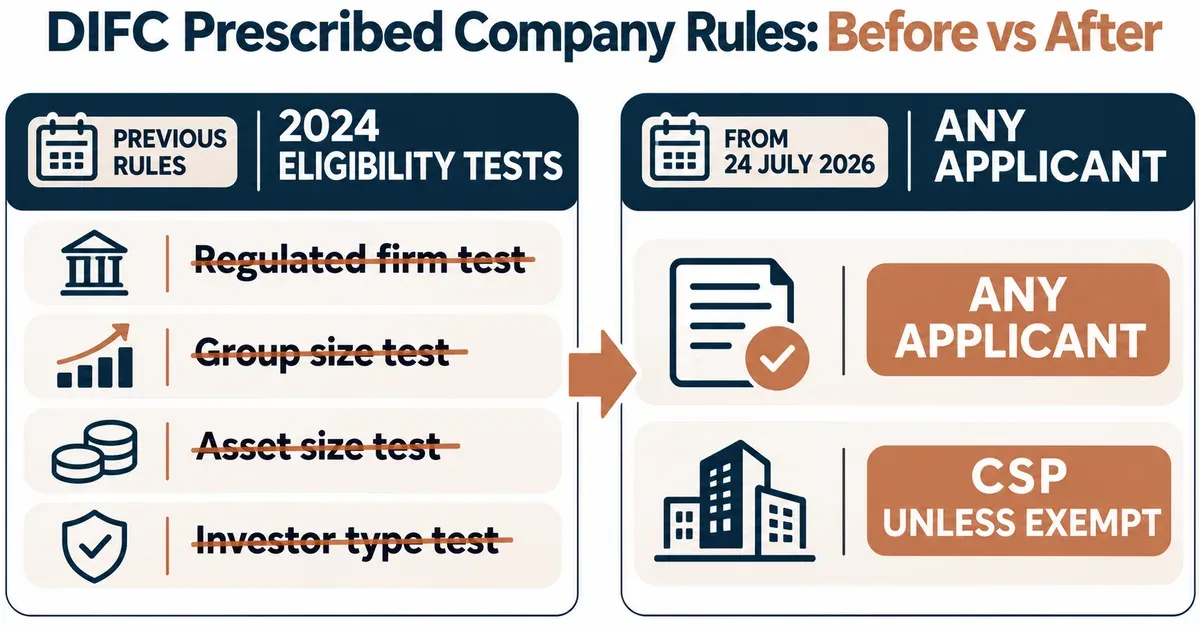
On 24 July 2026 the DIFC brought amended Prescribed Company Regulations into force. The change removes every qualifying test that stood between an applicant and the vehicle. DIFC’s own page now says the regime is open to any applicant.
Here is the before and after, because the difference explains why so much published advice is wrong.
| Rule | Before 24 July 2026 (2024 Regulations) | From 24 July 2026 |
|---|---|---|
| Who could apply | A company controlled by a GCC citizen or GCC entity, by a DIFC-registered company, or by a DFSA-authorised firm | Any natural or corporate person, resident anywhere |
| Or, by what it held | A company set up to hold a GCC Registrable Asset: Gulf land, shares, partnership interests, IP, aircraft or vessels | No asset test. Assets may be anywhere in the world |
| Or, for what purpose | A Qualifying Purpose: aviation, maritime, intellectual property, crowdfunding or structured financing | No purpose test for eligibility |
| Or, by appointment | Any applicant, if a director employed by a DFSA-registered CSP was appointed | A DIFC-licensed CSP must be appointed in most cases |
| Licensed activity | Holding company | Holding company, or the named Qualifying Purpose |
Source: Morgan Lewis on the 2024 Regulations (August 2024); Clyde & Co, Gibson Dunn and Walkers on the 2026 amendments (August 2026); difc.com SPV page, read October 2026.
Three points follow from the table.
- The GCC nexus is gone. A European family holding European property, or an Indian group holding shares in Singapore, can now hold them through a DIFC company. Before July 2026 that file would have been refused or pushed into the CSP-director route. A RAK ICC holding company that owns a UK subsidiary is the kind of file that failed the old test and qualifies now.
- The asset can be anywhere. DIFC’s page says the vehicle can hold any registrable asset from around the world.
- The purpose list no longer opens the door. Aviation, maritime, IP, crowdfunding and structured financing were routes in under the 2024 rules. A family or a private company no longer needs any of them.
The condition: a Corporate Service Provider, unless you are exempt
Every Prescribed Company must now appoint a Corporate Service Provider licensed in the DIFC, unless it is an Exempt Prescribed Company. That is the sentence to read twice, because it changes what the vehicle costs and how it runs.
What the CSP does
The regulations give the provider a statutory role. It lodges documents, forms and fees with the DIFC Registrar of Companies. It makes the company’s filings each year. It keeps the company’s records available to the Registrar and retains them for six years after it stops acting. Its address is the company’s registered office. In practice it also runs the identity and beneficial ownership checks on every shareholder, director and controller. That is because a CSP is a DNFBP registered with the DFSA for anti-money-laundering purposes.
The company owes the provider cooperation in return. The published penalties are up to USD 20,000 for failing to appoint a CSP. They rise to USD 100,000 for failing to give an appointed CSP the information it needs. The Registrar can inspect a CSP, report it to the DFSA, and refer a suspected offence to the police.
So the provider is not a formality you can shop for once and forget. It signs your filings, holds your records and answers to the Registrar for you. Choose it the way you would choose an auditor.
How a file runs: our desk, then the provider
We prepare the file and a licensed provider lodges it. The order matters, because the provider will not start until the pack is complete.
- Asset list and ownership chart. We confirm what the company will hold and who sits above it, down to each individual owner.
- Source of wealth. We collect evidence for each owner. A bank statement is not enough. The provider wants the story behind the balance, such as a sale agreement or audited accounts.
- Name and Articles. We check the proposed name against registered DIFC entities and settle whether the standard Articles of Association will do.
- Hand-over. The complete pack goes to the provider, which runs its own checks.
- Lodgement. The provider files through the DIFC Portal, the Registrar issues the licence, and the provider’s address becomes the registered office.
On a clean file we now plan for three to four weeks from complete documents to licence. The provider’s own onboarding takes one to two weeks before anything reaches the Portal, because the provider is the party the regulator holds responsible. The Portal step itself takes days once the provider is satisfied.
Four things hold a file, in the order we see them:
- an owner from a country the provider treats as high risk, which adds enhanced checks and sometimes a decline before the DIFC sees the file;
- source-of-wealth evidence that stops at a bank statement;
- a corporate shareholder whose documents are not apostilled or legalised for the UAE, which adds two to three weeks of courier time alone;
- a name that clashes with a registered DIFC entity.
A trust anywhere in the chain adds its own layer. The provider needs the trust deed and checks on the trustee, so budget about two more weeks and a higher provider fee. On an earlier holding-vehicle file of ours, a two-layer corporate shareholder from Europe took seven weeks because the legalisation ran twice. These are our observations, not a service level.
Who is exempt
An Exempt Prescribed Company is one whose controller is:
- a DIFC Registered Person, excluding another Prescribed Company, a Variable Capital Company, a non-profit organisation or a Foundation;
- an Authorised Firm licensed by the DFSA or a recognised financial services regulator;
- a Government Entity, which since July 2026 includes the government of a Recognised Jurisdiction, not only the UAE and its emirates; or
- a Publicly Listed Entity on a recognised exchange.
An exempt company may use a consenting DIFC affiliate’s registered office instead of a CSP, and may appoint a CSP anyway if it wants the administration done. Using an affiliate’s address needs the affiliate’s written consent and the Registrar’s acceptance, and the affiliate then takes on the filings. There is a trap in limb one. A company controlled by a DIFC Foundation is not exempt on that ground. So a Foundation-and-Prescribed-Company stack needs a provider, unless the Foundation’s own controller qualifies another way.
If you are reading this as an individual investor, a family group or a private company outside the financial sector, assume you are not exempt. The provider is part of your structure. The exemption is written for a DIFC-licensed group adding a holding vehicle under a company it already runs. A group licensed in another free zone, such as DMCC, does not qualify, because its parent is not DIFC-registered. No client of ours qualifies today.
What a Prescribed Company can hold, and what it cannot do
The licensed activity is holding. DIFC’s published use cases are investment holding, asset holding, securitisation and structured financing, including bond and sukuk issuances. Published commentary adds family wealth and succession structures, property holding, IP holding, investment portfolios and group reorganisations.
The restrictions are as firm as the uses are broad.
- No commercial or operational activity. A Prescribed Company cannot invoice for services or goods. If it needs to trade, DIFC’s Active Enterprise route or an ordinary licence is the vehicle, and that needs an office in the Centre.
- No employees. It may appoint directors and engage third-party providers, and that is all.
- No residence visas. The vehicle sponsors no one, and an investor visa cannot be issued against it. An owner who needs UAE residence attached to a holding structure should look at a free zone establishment licensed for holding activity, which carries a visa allocation, before choosing DIFC.
- Not a fund, fund manager, trustee or general partner. It may hold assets for a fund or a family office, but it does not act as one. Financial services activity is allowed only where it complies with legislation the DFSA administers.
Our team sees one failure pattern across every passive vehicle, and it applies here. The structure fails the day it is asked to do a job it was never licensed to do. Unwinding invoices issued from a holding company costs more than the operating licence would have.
What the DIFC charges, and what the CSP charges
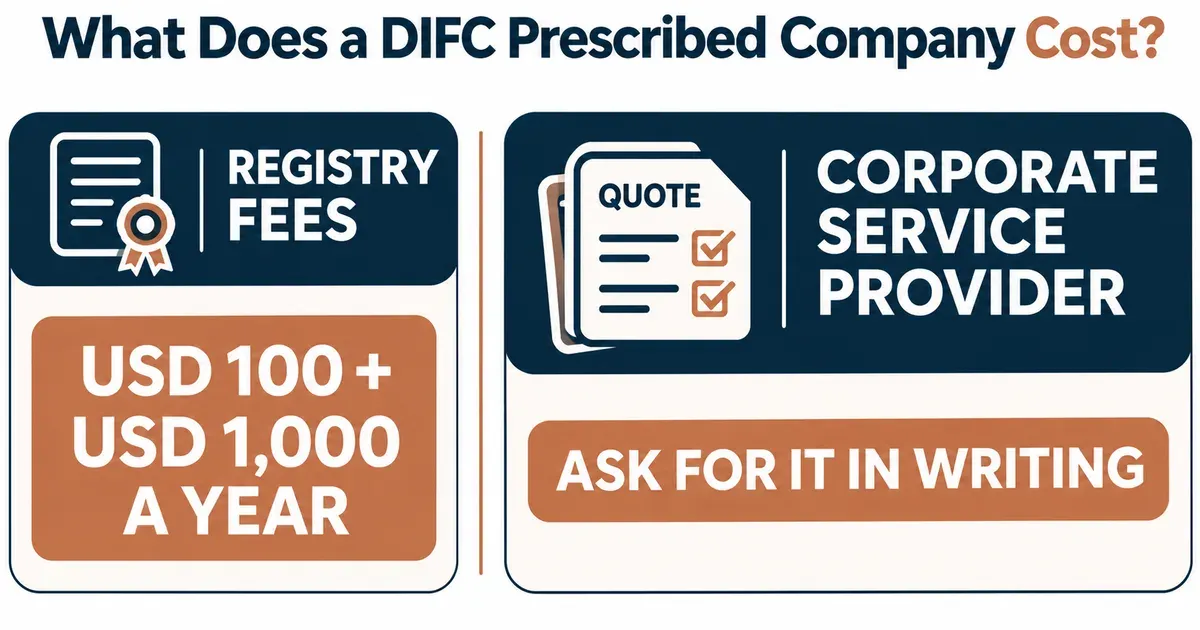
The DIFC lines are short and published. The provider’s line is not published, and it is the larger of the two.
| Fee | Amount | Note |
|---|---|---|
| Application for incorporation | USD 100 | One-time |
| Commercial licence, grant and each annual renewal | USD 1,000 plus AED 20 Knowledge and Innovation Dirham | Every year |
| Data protection notification | USD 0, or USD 750 | Yearly. USD 750 only if the company processes personal data |
| Confirmation statement | USD 300 | Annual filing |
| Continuation into DIFC from another registry | USD 1,000 | On transfer in |
| Transfer out of DIFC | USD 1,000 | On exit |
Source: difc.com SPV page and the DIFC Registrar of Companies table of fees, read October 2026; Morgan Lewis, August 2024; Gibson Dunn, August 2026.
So a new company’s registry bill in year one is about USD 1,100, and about USD 1,300 a year after that once the confirmation statement is counted. That is the figure every advert quotes, and it is accurate as far as it goes.
What it leaves out is the Corporate Service Provider, and since July 2026 nobody can file on the registry lines alone. Through our partners, the provider’s fee is typically AED 15,000 to 25,000 a year. On a standard file that covers:
- the registered office;
- the statutory registers;
- the licence renewal and confirmation statement lodgements;
- the yearly refresh of shareholder and director checks;
- dealing with the Registrar.
A director or authorised signatory is not in that fee. The 2026 rules do not require a provider-supplied director, so most owners act as director themselves. Where a bank or a counterparty wants a UAE-resident director, our partners charge it separately.
All in, we plan a Prescribed Company at AED 30,000 to 50,000 in year one and AED 20,000 to 35,000 a year after that. The reform did not move those figures, because a provider was already on almost every file we scoped. A resident director, a trust in the chain or corporate shareholders several layers deep push a file from the bottom of that band to the top. Ask for the provider’s fee in writing before you pay the DIFC application fee, not after.
Not sure whether the vehicle fits the asset?
Tell us what you want to hold, where it is, who will own the company and whether anyone needs a visa. We will tell you whether a DIFC Prescribed Company, an ADGM vehicle, an offshore company or a free zone holding licence suits the file. We quote the all-in figure, not the registry line. Call or WhatsApp +971 52 233 0011, or email connect@best-solution.ae. The consultation is free.
Does a Prescribed Company need an office in DIFC?
No. A Prescribed Company does not lease premises. Its registered office is the address of its Corporate Service Provider, or the registered office of a consenting DIFC affiliate if the company is exempt. The regulations exempt it from the rule that a DIFC company must carry on its principal business from the Centre.
That exemption is what makes the vehicle inexpensive to hold compared with a licensed DIFC company, which needs an office in the Centre from day one. It also means the registered office moves if the provider changes, and changing provider is a chargeable registry step that both the old and new CSP must cooperate on.
The office rule and the fee rule point the same way. A Prescribed Company is a company that lives at its provider’s address. If what you need is a Dubai presence, a desk and a visa, the vehicle is the wrong product. The cost of a licensed DIFC company is set out in DIFC Company Formation Cost: USD 1,000 to Regulated.
Holding Dubai property through a Prescribed Company
A DIFC company can own real estate in Dubai, under an arrangement older than the Prescribed Company itself. A memorandum between the DIFC and the Dubai Land Department sets the process:
- the company notifies the DIFC Registrar of Companies;
- the Registrar issues a no-objection letter to the Land Department;
- the Land Department assesses the transfer and collects its fee;
- the Registrar records the change.
The foreign ownership rules on designated areas still apply. A non-GCC owner holds through the company only where a non-GCC owner could hold directly.
The fee is the Land Department’s decision, not the owner’s choice. The Land Department assesses the transfer and applies 0.125 per cent where it is satisfied the beneficial owner is unchanged, as when an individual moves their own apartment into a company they wholly own. Where it sees a change of ownership, it charges the full 4 per cent. Moving a title you already hold into a new DIFC vehicle is a transfer the Land Department reviews, so budget for the review even if you expect the lower rate.
That is why a property structure is usually built around the existing owner first and the incoming partner second. Bring a partner into the company after the property sits inside it, and the share transfer is a company filing. Bring the partner into the property first, and you face 4 per cent on the way in.
Readers often ask about foundations. The Land Department does not accept foundations registered in other emirates as Dubai property owners, which is part of why the DIFC route exists for family structures.
Our own property files run through other registries, and we have not yet registered a Dubai title in a DIFC entity’s name. Treat the sequence above as the published process, not a count of our filings. [NEEDS CLIENT INPUT: not blocking. Swap in the firm’s own sequence and the rate applied once a DIFC title file exists.] A personal property investor visa is assessed on title held in the applicant’s own name, so settle the visa question before the title moves.
Corporate tax, audit and the filings that still apply
A passive company is not an exempt company. These federal and DIFC obligations survive the simplification. The tax positions below are Moideen Kutty’s, our Tax Consultant.
Corporate tax registration. Every UAE juridical person, including a Prescribed Company with no income, must register with the Federal Tax Authority and file a return. Late registration carries a fixed AED 10,000 penalty. The rate is 9 per cent on taxable income above AED 375,000. Our team files the corporate tax registration alongside the incorporation, not after it.
Dividends and gains. Dividends from a UAE resident company are exempt from corporate tax with no conditions. Foreign dividends and gains on a share sale rely on the participation exemption. That needs at least 5 per cent held for twelve months in a participation taxed at 9 per cent or more. For tax periods from 1 January 2025, an acquisition cost of AED 4 million or more also qualifies. The vehicle does not create the exemption. The income qualifies or it does not.
The 0 per cent free zone election. Holding shares and securities for investment is a qualifying activity, so a DIFC company can elect to be a Qualifying Free Zone Person. Under the financial statement rules in force since 30 September 2025, every Qualifying Free Zone Person must hold audited statements, whatever its size. Our tax team’s rule is to elect only where the election saves tax the law does not already give away.
- Do not elect where the company holds UAE subsidiaries, or foreign subsidiaries that pass the participation test. Those dividends and gains are already exempt. The election would buy an audit you do not need and lock the company into the free zone rules for five years.
- Elect where foreign holdings fail the participation test, such as a stake under 5 per cent, one held under twelve months, or a subsidiary taxed below 9 per cent at home. The case is strongest where a large gain on such a holding is expected.
A dormant holding company external audit runs at AED 3,000 to 5,000 a year in our files, and up to AED 6,000 if the bank wants a DIFC-registered audit firm on the report. One IFZA holding company of ours, with two foreign subsidiaries both taxed above 9 per cent abroad, stayed outside the election and saved the audit.
Family Foundation vehicles. A company wholly owned by a DIFC Foundation that is itself tax transparent can apply to be treated as transparent too, so it is not a separate taxable person. Our position is to use that only where the company holds family assets alone. It is one or the other: a transparent company cannot also elect Qualifying Free Zone Person status. We have not yet filed this election on a live vehicle.
Accounts and audit under DIFC law. The company must keep accounting records. It files audited accounts unless it qualifies under the small companies regime. In the DIFC that means annual turnover below USD 5 million and no more than twenty shareholders. A structured financing vehicle is exempt from both filing and audit. A crowdfunding vehicle with more than twenty shareholders keeps the exemption if turnover stays under USD 5 million. The statutory audit rule and the corporate tax rule are separate, which is why a company can be exempt under one and need the audit under the other.
Beneficial ownership. Beneficial ownership disclosure at 25 per cent remains mandatory to the Registrar and the provider. A nominee changes what a public search shows. It changes nothing about what the Registrar, the bank and the FTA see. Directors and shareholders of a DIFC company sit on the public register. Beneficial owners do not.
Opening a bank account for a passive vehicle
The incorporation takes weeks. The account is the part to budget months for.
A Prescribed Company has no trading, no office and no staff. That is the profile a bank’s compliance team is trained to slow down. We have not yet opened an account for a Prescribed Company. Our passive-vehicle banking comes from RAK ICC holding companies and free zone holding licences, and the expectation carries over: six to twelve weeks, at least one decline, and a minimum balance that is not small.
The provider helps in one specific way. A bank sees a DFSA-registered administrator behind the company and treats the ownership information as verified, which cuts the back-and-forth. It does not shorten the bank’s own queue, and it does not help where the owner’s country is the problem.
What moves the file is prepared before the application, not during it:
- a one-line statement of what the company holds and why;
- the audited financials of the operating company underneath it, where there is one;
- an ownership chart that ends in named individuals;
- source-of-wealth evidence for each of those individuals;
- the provider’s appointment letter and the DIFC licence.
On our holding-company files, banks have also asked for:
- two years of the underlying company’s audited accounts, not one;
- a written explanation of why the holding sits in the UAE at all, when the asset and the owner are both abroad;
- evidence of expected flows: the dividend or sale proceeds, and where they go next.
One RAK ICC holding company owned by an Asian family received two declines and an approval in week eleven. The approving bank wanted the subsidiary’s accounts, not the holding company’s.
Our guide on how to open a business bank account in Dubai covers the standard file. For a holding vehicle, start the bank conversation the week the application goes in, not the week the licence arrives.
DIFC, ADGM or offshore: four questions, in order
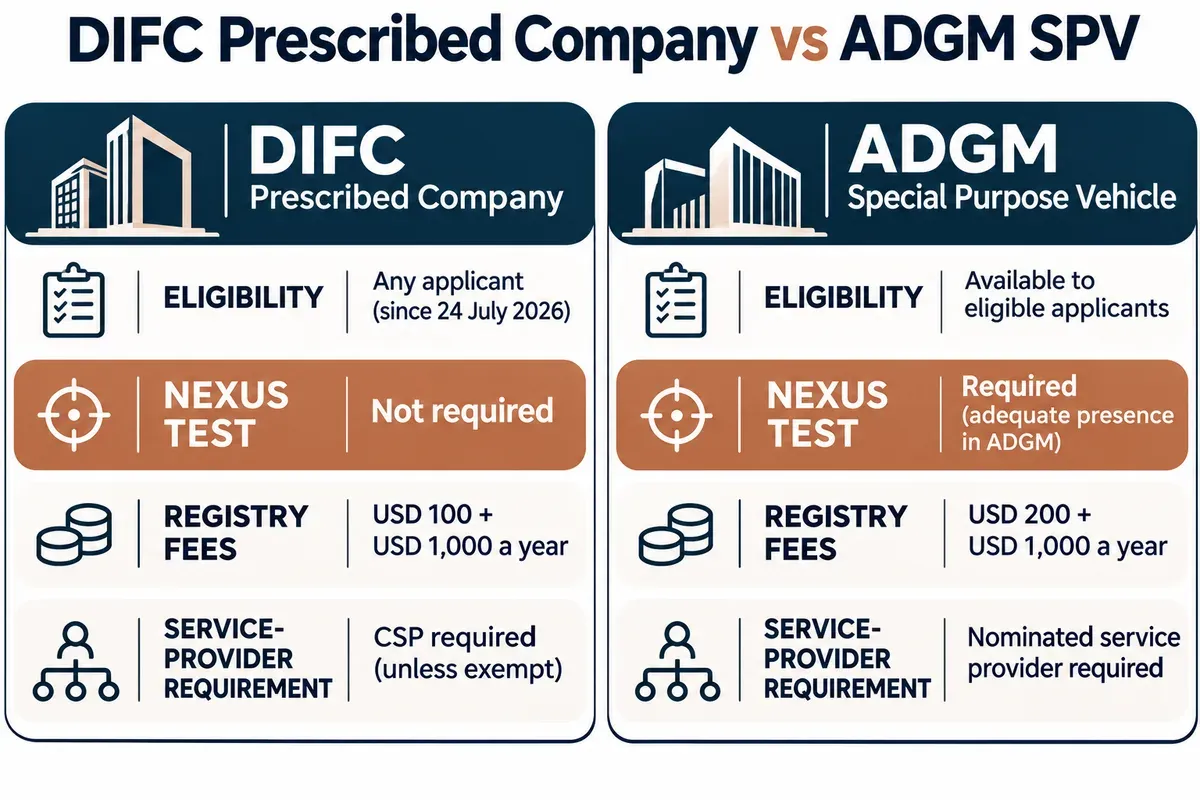
Until July 2026 the honest answer to “DIFC or ADGM?” was often “ADGM, because DIFC will not take your file.” That has changed. Both centres now take foreign holdings, so access is no longer the question. Our team now runs four questions, in this order.
- Does anyone need a visa from the structure? If yes, use a free zone holding licence. The Prescribed Company, the ADGM SPV and the offshore companies issue no visas.
- Will the vehicle hold Dubai freehold title? If yes, use the DIFC, the financial-centre registry the Land Department works with under its memorandum.
- Is the asset base foreign, with no UAE or GCC link? Both centres now accept it. The choice then rests on cost, the regulatory options each offers, and Dubai property.
- What is the budget against the asset? A single foreign shareholding worth less than a few million dirhams does not justify AED 30,000 a year in the DIFC. It goes to RAK ICC, at about a third of the cost.
Confidentiality is the one exception to the order. If the owners need to stay off the public register, the ADGM Restricted Scope Company publishes less than a DIFC company does, subject to its own eligibility.
Since July one client, a family office, has asked about continuing a RAK ICC holding company into the DIFC. None has moved yet. We expect the first moves from owners who failed the old DIFC test and settled for RAK ICC.
| DIFC Prescribed Company | ADGM SPV | |
|---|---|---|
| Regional connection | None since 24 July 2026 | Registration Authority guidance looks for one, at the Registrar’s discretion |
| Service provider | DIFC-licensed CSP unless exempt | ADGM CSP unless exempt; a UAE parent with real substance can also exempt it |
| Registry fees | USD 100 application, USD 1,000 licence a year, USD 750 data protection if applicable | USD 200 name, USD 700 registration including data protection, USD 1,000 licence a year |
| Small company audit relief | Turnover under USD 5 million and up to 20 shareholders | Turnover up to USD 13.5 million and up to 35 employees |
| Private register option | None in general; a family-business private register exists on application | Restricted Scope Company keeps directors and shareholders off the public register |
Source: Gibson Dunn, August 2026; difc.com, read October 2026.
The registry lines are within a few hundred dollars of each other, so the fee table rarely decides. The full comparison is planned as DIFC vs ADGM: Picking a Common-Law Financial Centre, and the Abu Dhabi vehicle has its own page planned as The ADGM SPV: Common-Law Holding Vehicle.
Existing Prescribed Companies: the 24 January 2027 deadline
If you already hold a Prescribed Company incorporated before 24 July 2026 and it is not exempt, you have six months from that date to appoint a provider. The transition window closes on 24 January 2027 unless the Registrar grants an extension, which an owner can request.
The published consequence of missing it is loss of Prescribed Company status. The company becomes an ordinary DIFC company, with an office requirement, the full DIFC licence fee and the full compliance load. A company formed under the 2024 Regulations through a CSP-employed director already has a provider relationship. Ask that provider to confirm it has been appointed in the prescribed form. A company that qualified through a GCC owner or a Gulf asset should not assume the old ground still carries it; it does not.
When a Prescribed Company is the wrong vehicle
The vehicle is a good answer to a narrow question. Look elsewhere if any of these describes you.
- You need to invoice. A holding company that trades is a licensing breach waiting for a bank review. Form an operating company, or use DIFC’s Active Enterprise route if the business belongs in the Centre.
- You or a family member needs a visa from the structure. The vehicle sponsors no one. A free zone establishment licensed for holding activity carries a visa allocation; an offshore company and a Prescribed Company do not.
- The asset is small against the running cost. A single foreign shareholding worth less than a few million dirhams does not justify AED 20,000 to 35,000 a year. A RAK ICC or JAFZA offshore company holds it for about a third of that, and our offshore company setup team files both.
- Your real question is succession, not liability. A company has shares, and shares are inheritable, which means contestable. A Foundation owns itself. The usual architecture is a Foundation on top and a Prescribed Company beneath it for each asset. The Foundation side is planned as DIFC Foundation: Common-Law Wealth Structure From $200.
- You want to escape a creditor already at the door. Moving an asset into a vehicle after a claim exists can be challenged everywhere. Structuring protects you going forward.
- You want a confidential register. DIFC directors and shareholders are public. If confidentiality is the point, the ADGM Restricted Scope Company is built for it, subject to its own eligibility.
None of these makes the Prescribed Company a weak product. Since July 2026 it is the only common-law holding vehicle in the UAE with no nexus test, and that is a real advantage for a cross-border owner.
The USD 1,000 licence is the easy part
A DIFC Prescribed Company gives a cross-border owner three things at once. A common-law company with its own courts. A registry fee that is small. And, since July 2026, a door that is open to anyone. The condition is the provider, and the provider is the cost. Price the structure on the all-in figure. Confirm who will be exempt and who will not. Decide on the asset and the exit, not on which vehicle sounds the most serious.
Best Solution has formed holding structures for UAE families and investors since 2014. Best Solution is a business setup consultancy. We are not a DIFC-licensed Corporate Service Provider and not a DFSA-regulated firm. Prescribed Companies are filed through our licensed provider partners, and we handle the rest: the corporate tax registration, the UBO filing, the financial statements a 0 per cent election needs, and the bank file. If the question is which vehicle, our guide to the SPV versus holding company decision in the UAE is the place to start, and the wider map of UAE holding vehicles is planned as Which UAE Holding Structure? LLC, DIFC or Offshore.