An Ajman trading licence can print in three days. An Ajman industrial licence takes four to eight weeks, and the licence is the last thing to arrive, not the first. That gap is the most expensive misunderstanding in this topic. Founders plan a production start date around the trading number. Then they lose a quarter waiting on approvals nobody mentioned.
A trading licence is issued against a desk and a tenancy. An industrial licence is issued against a building. Before the Ajman Department of Economic Development prints anything, other departments have to agree that the building suits what you plan to do inside it. Get that sequence right and Ajman is a strong industrial base. Get it wrong and the rent starts before the licence does.
The Ajman industrial licence in one table
| Question | Short answer |
|---|---|
| Who issues it | Ajman Department of Economic Development (Ajman DED) |
| Government licence fee | AED 600 a year, the same base as any Ajman licence, plus registers and Chamber membership |
| What drives the real cost | The unit, not the licence. Rent is the dominant line by a wide margin |
| Al Jurf built units, older stock | Roughly AED 18 to 30 per sq ft a year, achieved |
| Al Jurf built units, new-build | Roughly AED 30 to 40 per sq ft a year, with office and heavy power |
| Al Jurf land | Roughly AED 12 to 20 per sq ft for a bare plot, AED 25 to 32 for a walled, levelled yard with power |
| Premises | Mandatory. No desk, no shared address, no virtual option |
| Key approvals | Municipality planning, Civil Defence, environmental permit, power connection |
| Federal step | MOIAT industrial registration for real manufacturing. No capital floor |
| Realistic timeline | Four to eight weeks, set by approvals and power, not by paperwork |
| Visas on a 2,000 sq ft unit | About 6 to 8 for storage, about 10 to 14 for production |
| Ownership | 100% foreign ownership for ordinary industrial activities |
| Best for | Light manufacturing, assembly, packing, and storage-heavy trading serving the northern emirates, Sharjah and Dubai |
| Poor fit for | Heavy or hazardous processing, and any operation whose site has to be in Dubai |
Rates and quota bands are practice figures observed in September 2026, not published rules.
What an Ajman industrial licence covers
An Ajman industrial licence lets you make, process, assemble or pack goods inside the emirate. It sits alongside the commercial and professional licence types Ajman DED issues. It carries the same federal trading rights as any other Ajman mainland licence. You can contract with and invoice customers in all seven emirates without an extra permit.
What separates it is not the paper. It is the condition attached to it. An industrial activity has to happen somewhere the authorities can inspect. So the licence is issued against a specific unit or plot, and against a use approved for that address. A desk cannot carry it. Nor can a shared unit that somebody else’s licence already sits on.
Here the difference between an industrial licence and an ordinary trade licence turns practical. A trading company can move address and update a licence. A manufacturer is tied to a building that has been signed off for its process.
Ajman DED licenses it, MOIAT registers it
Two bodies are involved. They do different jobs.
Ajman DED is the licensing authority. Federal Decree-Law No. 25 of 2022 is the law on industry. Under it, each emirate’s own authority issues and manages industrial licences inside that emirate. The Ministry of Industry and Advanced Technology sets policy and keeps watch. So the licence itself is an Ajman document.
MOIAT runs the national Industrial Registry. It is a federal list of makers. Signing up is separate from your Ajman licence. MOIAT calls it a yearly filing: what you buy in, what you make, the energy you use, and your numbers. Each licence gets its own entry. The law reaches free zone sites too, so a free zone factory is not outside it.
Skipping the licence is not a paperwork matter. Running a factory without one carries prison and a fine of up to AED 1,000,000 under the same law. A site that fails to fix a breach can also be billed the cost of enforcement, plus a fee of 20% on top.
How much does an Ajman industrial licence cost?
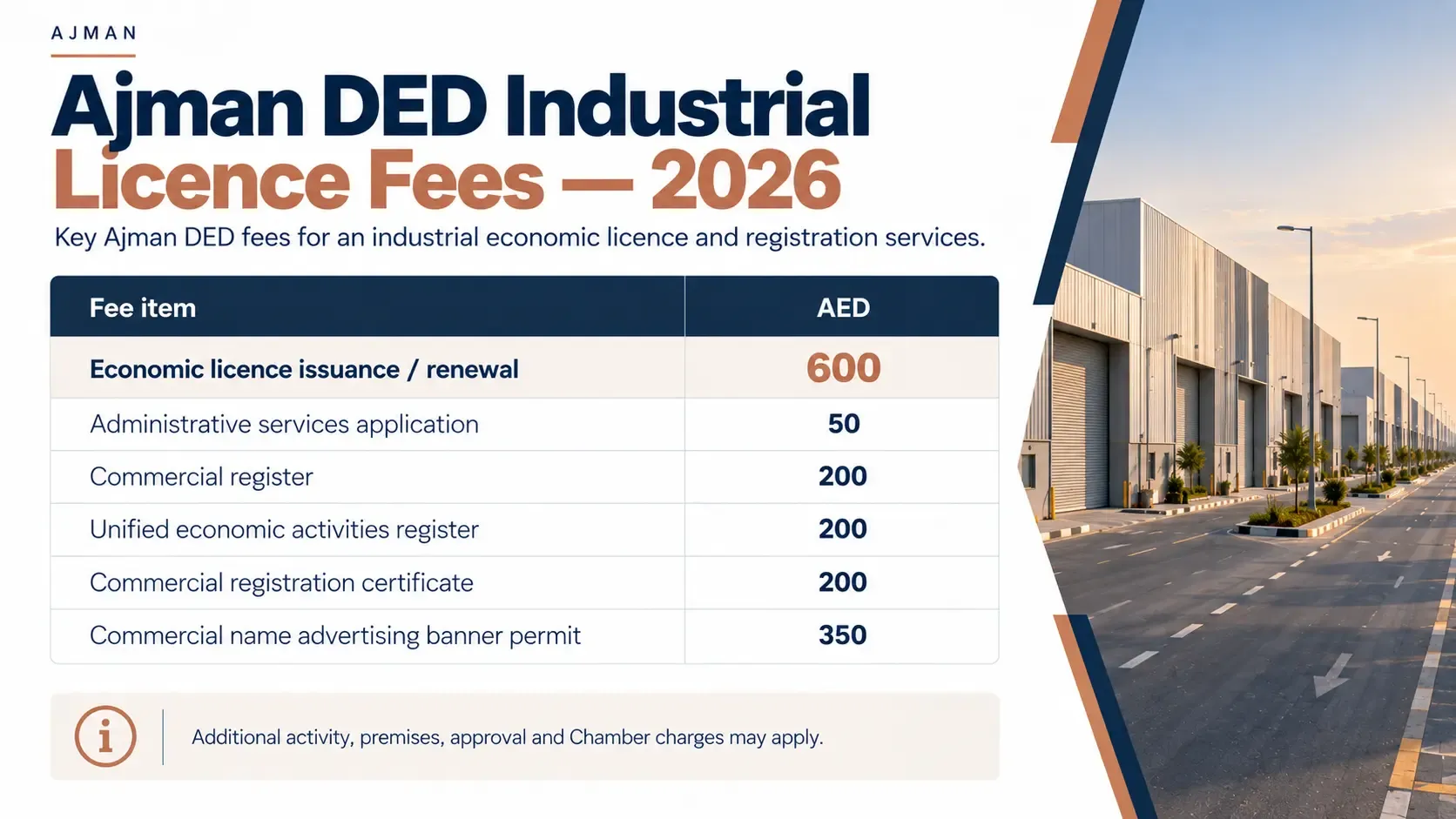
The Ajman DED fee base is identical to every other Ajman licence type. The economic licence is AED 600 a year, and the registers around it are fixed.
| Ajman DED line item | Fee (AED) |
|---|---|
| Economic licence issuance or renewal | 600 |
| Administrative services application | 50 |
| Commercial name banner permit | 350 |
| Banner specification form approval | 100 |
| Commercial register registration | 200 |
| Unified economic activities register | 200 |
| Commercial registration certificate | 200 |
| CSR UAE Fund contribution | 1,500 |
| LLC official document publication | 3,000 |
| Contract translation to English | 50 per page |
Source: Ajman DED, Commercial Licenses Issuance Service and Commercial License Renewal Service, read 14 September 2026.
Two of those lines surprise first-time applicants. The CSR contribution is charged on every renewal, not only at setup. There is no small-company waiver and no proration for a short first year. Carry AED 1,500 in the annual budget permanently. It is the line clients query most often at first renewal, because the setup quote presented it as a one-off.
Ajman Chamber of Commerce and Industry membership is billed separately, by class. It runs from AED 500 at Class Five to AED 5,500 at Class One. Most small trading and consultancy clients land at Class Four or Five. Industrial applicants should budget differently. Class One is where large-capital contracting, industrial and general trading entities sit. Class is assigned by the authority on activity and declared capital. It is not chosen and not negotiated.
Then there are the costs that are not DED fees at all. They are the ones that decide your number. The environmental permit. Civil Defence sign-off and the fire system behind it. The power connection and its deposit. Machinery. Staff accommodation. And above all, the unit.
One case from our northern-emirates practice makes the point. A building materials trading company took an Ajman licence, one visa and a 2,000 sq ft Al Jurf unit. The all-in first year came to roughly AED 62,000. Of that, AED 45,000 was the unit. The comparable Dubai setup, same activity and a similar unit, came to roughly AED 135,000. Nearly all of that AED 73,000 gap is rent. Ajman’s advantage is a property advantage with a licence attached, not a discounted licence.
The Ajman trade licence cost page carries the fee-by-fee build for year one and year two across Ajman activity types.
What industrial space in Al Jurf actually rents for
Al Jurf holds Ajman’s industrial stock. It is the reason the emirate reaches a manufacturer’s shortlist at all.
Our own completed files give four working bands, and which one applies depends on what you are taking.
| What you are taking | Our files, achieved, AED per sq ft per year |
|---|---|
| Bare industrial plot | 12 to 20 |
| Walled, levelled yard with power | 25 to 32 |
| Built unit, older Al Jurf 1 stock | 18 to 30 |
| Built unit, new-build with office and heavy power | 30 to 40 |
On the older-stock band, a standard 2,000 sq ft unit lands at AED 40,000 to 55,000 a year. What moves a unit inside its band is age, eave height, power load, and whether there is an office and WC block inside.
Listed asking rents sit above the achieved bands, and the reason is not that the market has run away from them. The two sets of figures describe different buildings. Advertised stock skews to newer Al Jurf 2 and 3 units with mezzanine offices, boundary walls and higher power. Our bands are achieved rents on older Al Jurf 1 stock, on a one-year tenancy, negotiated.
In September 2026, Bayut listed around 1,240 Al Jurf warehouses. Examples included 1,500 sq ft at AED 75,000 and 2,300 sq ft at AED 120,000. Property Finder listed a further 433, from AED 60,000 to AED 515,000 a year, mostly between 1,200 and 3,000 sq ft, with power from 15 kW to 100 kW. Asking rents across that stock ran from about AED 34 to AED 57 per sq ft, with most standard units between AED 38 and AED 50. Land listings are thinner. Around 13 at the same date, with a fenced 5,000 sq ft yard advertised at about AED 150,000, which is roughly AED 30 per sq ft.
So read a listing against the right band. If the unit is old, plain and unfitted, the achieved band is what it should let. If it is new, walled, and carries a mezzanine office and heavy power, the higher band is the honest number and the asking rent is close to it. Date-stamp whatever you plan on. We refresh the listed figures quarterly and our own achieved figures after each renewal season, which falls in the fourth quarter and again in the weeks after Ramadan.
Al Jurf Industrial 1, 2 and 3
The three zones run along the E311 corridor. Plots get larger the further out you go. Ajman Port is minutes from Industrial 1. Sharjah is a short run down the E11, and most of Dubai is inside an hour. That is the real argument for Ajman. A unit at a fraction of the Dubai rate, with the northern emirates, Sharjah and Dubai all inside a delivery radius.
Choose the zone by what your operation needs, not by price alone. Inner zones sit closer to the port and to Sharjah. Outer zones are quieter and larger, and they suit yards, heavier loads and vehicle movement. Power catches people out. A storage operation on 5 kW and a production line needing 100 kW are looking at different buildings, not different tariffs.
The approvals a factory file carries that a trading file does not
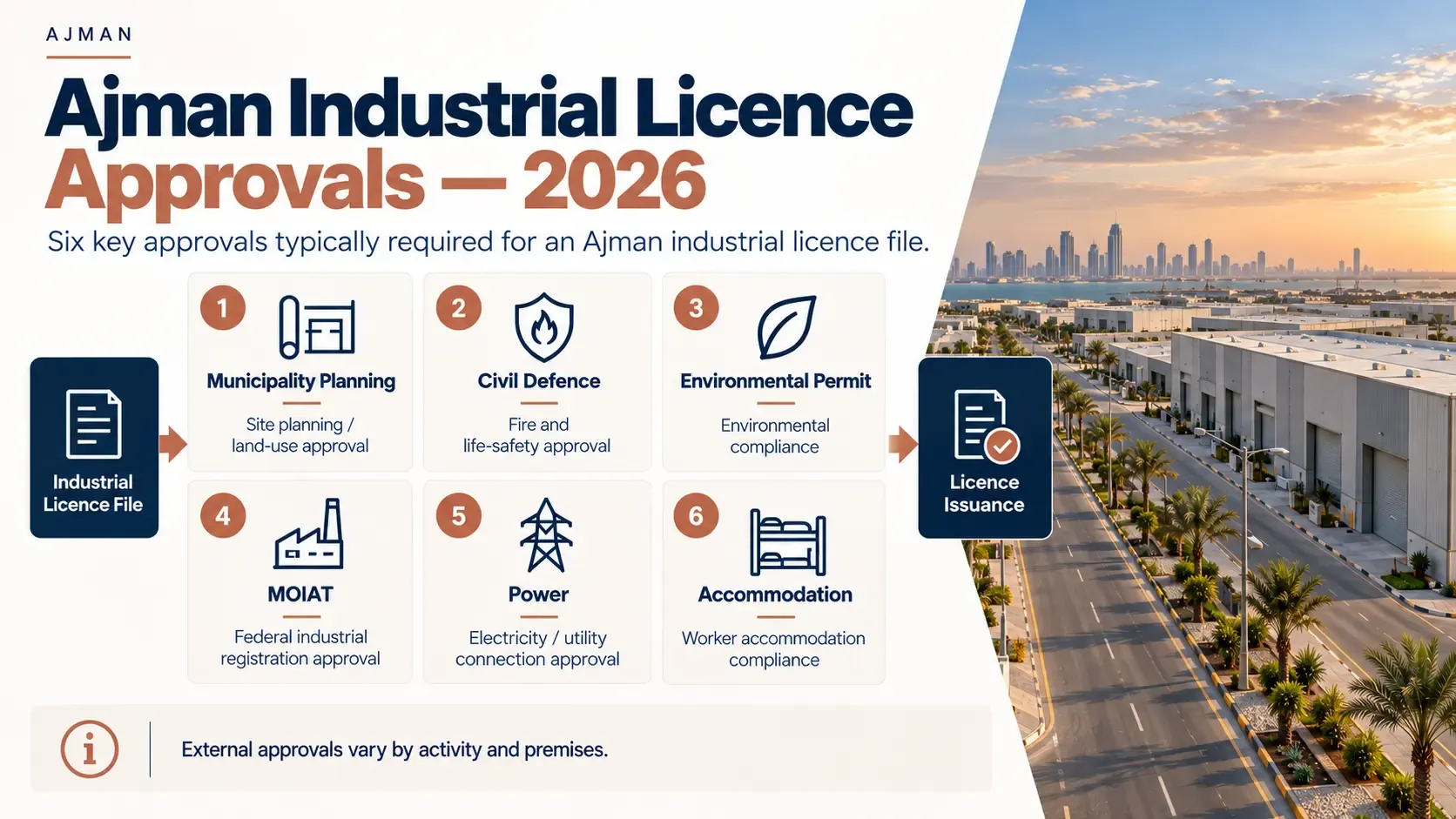
This is what sets an industrial file apart from everything else Ajman DED issues. Six items sit on it that never appear on a trading file.
- Municipality planning approval tying the unit to the use. The Municipality and Planning Department has to agree that your work is allowed at that address.
- Civil Defence approval and fire system sign-off, done before the licence issues. Not after you move in. Not as a follow-up.
- Environmental clearance wherever there is a process, an emission, an effluent or hazardous storage. Ajman’s Municipality and Planning Department issues the permit. It covers industrial and professional facilities, chemicals trade, scrap trade and environmental-impact activities. It is priced by risk band: AED 300 low risk, AED 500 medium risk, AED 1,000 high risk. Stated service duration is two working days.
- MOIAT industrial registration for real manufacturing. It is a separate federal file from the DED licence.
- A power connection in the company name, with the load set out. This is the item that sets the critical path.
- Labour accommodation wherever you have staff on site.
The size of the environmental fee is not the point. The sequence is. Civil Defence sign-off comes before inspection, and inspection comes before the licence. So the fire system has to be installed and commissioned in a unit you are already paying rent on. Plan the lease and the approvals together, not one after the other.
A regulated activity grows the stack again. Food, medicines and farming all bring in their own watchdogs. A MOCCAE approval or a health authority file then sits on top of everything above.
Municipality planning approval, and what gets refused
On a unit already zoned industrial, with an activity on the standard list, planning approval takes 5 to 10 working days. That is the normal case and it is not the step that hurts.
Refusals fall into four groups:
- The activity sits outside the zoning of that block. Food processing or chemical work in a general light-industrial block is the common one.
- The layout has no route to a fire NOC.
- The request splits one unit between two licences.
- Paints, gas or chemicals are to be stored with no Civil Defence file behind them.
Notice what those have in common. Three of the four are about the building, not the business. So the fix is almost always a different unit, not a different activity. We check the block before the tenancy is signed, because a refusal after signing means paying rent on a unit you cannot license.
Power is the critical path
The tenant applies to Etihad Water and Electricity, and only after the tenancy is attested. The landlord’s existing connection transfers to you. It does not grow. Reconnecting on the load that is already there takes days.
The under-order is almost always the same. A client accepts the 20 to 30 kW the unit came with. Then the compressors, the injection moulding, the ovens or the cold room turn out to need 60 to 100 kW. A deposit is charged per kVA on the load you request, so the load is a cash decision as well as a technical one.
Upgrade timelines split in two. If the block’s transformer has spare capacity, budget 3 to 6 weeks. If it does not, the upgrade waits on new cabling or a substation, and that is 3 to 6 months. Which side you land on depends on the block, so it is not something anyone can promise you.
The rule we give every client is short. Get the equipment load from your machinery supplier before you sign the lease. File the upgrade in the week the tenancy is attested. Order it late and it becomes the only thing standing between you and production.

Planning Your Factory Setup in Ajman? Avoid Expensive Approval Delays
Don't start paying rent on an Al Jurf unit before your approvals and power connections are mapped out. From Municipality zoning checks and Civil Defence sign-offs to MOIAT industrial registration, our expert team handles your setup end-to-end.
How long does an Ajman industrial licence take?
Budget four to eight weeks. That is against three to five days for a trading licence issued at a desk.
The gap is approvals and utilities. Ajman DED gives ten minutes as the service duration for issuing a licence. That figure is accurate and routinely misread. It measures counter time, once your name, your approvals and your attested tenancy are all in hand. On an industrial file, assembling those is the project.
Clients told that Ajman is fast apply the number to the wrong file type constantly. The fast number is real. It belongs to a consultancy on a desk. Plan your production start from the approval calendar.
An eight-week file, week by week
This is one of our own files, representative of our northern-emirates practice. A food-packaging producer, single-shareholder LLC, on a 3,500 sq ft unit in Al Jurf.
| Week | What happened |
|---|---|
| 1 | Trade name and initial approval from Ajman DED, with the manufacturing activity on the application |
| 2 | Municipality planning approval tying the unit to that activity |
| 2 to 3 | Tenancy attested with the Municipality, then Civil Defence inspection of the fire system |
| 2 to 3 | Power upgrade filed the same week, because it sets the critical path |
| 4 | Ajman DED licence issued |
| 4 onward | Chamber registration and visa quota release, running in parallel |
| 6 to 8 | Machinery installed, then MOIAT site inspection and registration |
Eight weeks end to end. The power upgrade was the only item that could have stretched it, and it did not, because it was filed in week two rather than after the licence printed.
How to get an Ajman industrial licence, step by step
The sequence below is how an industrial file really runs. It is not the generic licence flow.
- Fix the activity first. Your industrial activity code sets your approvals, your Chamber class and what premises will be accepted. Choosing the business activity accurately here saves a re-file later.
- Reserve the trade name with Ajman DED, in a form that fits the activity and the legal structure. Trade name registration sets out what gets rejected.
- Take initial approval for the activity before you commit to a building. Initial approval tells you the activity can be licensed in the form you want.
- Find the unit and check the block. Existing power load, fire systems, the zoning of the block, and whether the landlord already has an approved industrial use on the address.
- Attest the lease with the Municipality and Planning Department.
- Run the approvals in parallel. Municipality planning, Civil Defence and fire sign-off, and the environmental permit. File the power upgrade this week, not later.
- Issue the memorandum of association for a company, and complete the DED fees.
- Collect the licence, with the Ajman Chamber membership certificate and the signboard permit.
- Install the machinery, then register federally with MOIAT. The order matters, and the next section explains why.
- Open the establishment card and apply for visas. This is where quota is set.
Steps four to six are the project. The rest is paperwork.
Do you need MOIAT industrial registration?
If you make things, yes. The MOIAT Industrial Registry covers factories across the UAE, mainland and free zone alike. Each licence gets its own entry, branches included. Federal Decree-Law No. 25 of 2022 applies to every industrial site, free zones included.
Storing, picking, packing for onward sale, or running a warehouse behind a trading licence usually keeps you out of the registry. The line matters in money terms. The federal file is what makes you a recognised producer, and it is what opens the customs relief and the support schemes that come with that.
Now the part that gets quoted wrong everywhere. You will read that MOIAT requires AED 250,000 of capital and ten registered employees. That figure comes from the 1979 industry law. The 2022 decree replaced that law and sets no capital floor and no headcount floor.
What MOIAT actually looked at on our Ajman registrations was three things: the Ajman industrial licence, the attested tenancy, and machinery physically installed at the site inspection. No capital certificate was asked for, and one of the units we registered was well under AED 250,000 in fit-out.
So the thing to budget is the timing, not the threshold. MOIAT will not register a unit until the production line is installed and inspected. The rent and the machinery spend come before the certificate, not after it. That is our own reading of the 2022 decree and our own registration experience, and it is worth confirming against MOIAT for your activity.
How many visas will an Al Jurf unit carry?
Floor area sets the starting point. Activity sets the ceiling.
On a 2,000 sq ft unit, storage typically opens at 6 to 8 visas. The same unit licensed for production opens at 10 to 14. The difference is evidence. A production file carries a machinery list and a Civil Defence certificate, and together they show that labour is actually needed on the floor.
The two move in different directions from there. Storage is presumed low-labour, so the opening figure is effectively the ceiling unless you can justify more. Production can go above its opening figure on application, backed by the machinery list and a staffing plan.
Two things catch people out. Quota is only released after the tenancy is attested with the Municipality, so it is not something you can confirm before you sign. And a mezzanine office inside the unit counts toward the area, so declare it.
Treat all of that as how files behave rather than as a published formula, because Ajman does not publish one. The licence is issued against a Municipality-attested tenancy, and immigration then sets the quota against the demised area, the activity and the stated headcount together.
The planning rule follows from it. Size the unit to your eighteen-month headcount before signing. A lease that is right for the machinery and short on quota means paying twice. Each residence visa carries its own cost on top. The establishment card is the file everything else hangs from.
Ajman DED or Ajman Free Zone for manufacturing?
Both license manufacturing in the same emirate. The right answer follows your customer.
| Ajman DED mainland | Ajman Free Zone | |
|---|---|---|
| Sell finished goods directly to UAE customers | Yes | Not directly. Needs a distributor, branch or permit |
| Government tenders | Yes | No |
| Premises | Industrial unit or plot, leased on the open market | Customisable warehouses, land to build, onsite accommodation |
| Import of raw materials | Standard customs treatment | Free zone treatment, duty deferred until goods enter the mainland |
| Corporate tax | 9% above the threshold | Possible 0% qualifying treatment on qualifying activity |
| Best fit | Supplying UAE contractors, retailers and buyers | Export-oriented production and machinery-import-heavy operations |
The rule is short. Making goods to sell inside the UAE, or to win local contracts, goes mainland. Making goods for export, or bringing in heavy machines and raw materials, usually wins on duty and tax inside the free zone. Ajman Free Zone says its own industrial licence covers three things: bringing in raw materials, making listed goods, and shipping them abroad. It offers warehouses, land and staff housing on site.
The full decision, including what the distributor route actually costs, sits in Ajman Free Zone versus Ajman mainland. If the jurisdiction question is still open more broadly, free zone versus mainland is the place to start, and the manufacturing setup at Ajman Free Zone page will cover the zone side in detail.
Which activities belong in Ajman, and which we send elsewhere
We license some industrial activities in Ajman routinely. Others we route to another emirate, and we say so at the enquiry rather than after the lease is signed.
What we license in Ajman:
- Packaging and plastic bags.
- Food repacking.
- Furniture and joinery assembly.
- Aluminium and glass workshops.
- Electrical panel assembly.
- Garment stitching.
- Cosmetics filling.
- Printing.
What we route elsewhere, and where to:
- Paint and chemical manufacturing goes to Hamriyah.
- Steel fabrication, recycling and anything with heavy waste goes to RAKEZ Al Ghail.
- Export-led food manufacturing goes to Hamriyah or Sharjah, for the port.
- Oil and gas equipment goes to Hamriyah.
The test is emissions, waste and export weight. It is not company size. A ten-person paint plant belongs in Hamriyah and a forty-person packing operation belongs in Al Jurf, because what decides it is what comes out of the building and how it leaves the country.
Two more categories fall outside Ajman for different reasons. Heavy or hazardous processing faces far stricter environmental scrutiny and usually belongs in a purpose-built industrial zone. And any operation whose site genuinely has to be in Dubai should license in Dubai. An Ajman licence lets you invoice a Dubai customer. It does not let you run a physical place of business at a Dubai address.
Ajman, Sharjah or Ras Al Khaimah for a factory?
Three northern options compete for the same founder. They are not the same.
Sharjah changed the comparison in 2026. The Sharjah Economic Development Department, with Ruwad, announced an instant industrial licence at AED 1,000. It covers all permitted industrial activities in the emirate, and it was unveiled at Make it in the Emirates in May 2026. That is a licence-fee story, not a premises story. Sharjah industrial rents run above Ajman’s. So the question is whether the licence saving survives the rent difference over a five-year lease. For most small operations it does not. Hamriyah, inside Sharjah, is a different proposition, and it is where we send chemical, paint and export-led food work.
Ras Al Khaimah is the stronger choice for heavy industry and bulk materials. Saqr Port is the region’s largest bulk-handling port. The ceramics, cement, glass and quarrying base there is real infrastructure, not branding. Much of it sits inside RAKEZ zones rather than pure mainland, which is a jurisdiction decision of its own. The published RAK industrial licence guide covers the DED route there. RAK mainland versus RAKEZ covers the choice between them.
Ajman wins on a combination the other two cannot match. A small government fee base. Industrial rents that sit below both. And a location a short drive from Sharjah, inside an hour of most of Dubai. For light manufacturing, assembly, packing and storage-heavy distribution serving that catchment, it is hard to beat.
Three more pages set out what each northern emirate is actually good at: the Umm Al Quwain mainland licence, the Ras Al Khaimah trade licence and the Fujairah trade licence.
Tax, customs and banking for an Ajman manufacturer
The licence opens the compliance file. It does not close the job.
Corporate tax is federal and the emirate does not change it. UAE corporate tax is charged at 9% on taxable income above AED 375,000. Registration is required whether or not you expect to pay. Corporate tax registration covers the filing side. VAT registration becomes mandatory once taxable supplies pass AED 375,000 in a twelve-month period. Voluntary registration is available from AED 187,500.
Customs treatment matches any other UAE mainland company. Your Ajman licence carries the same customs code position as a Dubai one. The MOIAT route is where treatment differs. Recognised industrial-producer status is what opens duty relief on machinery and inputs, not the emirate you licensed in.
Banking is workable with preparation. No bank operates an Ajman policy. They operate a substance policy, and the emirate on the licence is an input to it, not the decision. Four things open an account on a normal timeline. A real unit. A manager who lives here, named on the licence. An activity that matches the money coming in. And a clear story about who you buy from and sell to. The genuine Ajman friction is geography. Several banks want the signatory at a branch, and Ajman clients get routed to Sharjah or Dubai. That adds a trip and about a week. Start the business bank account conversation before signing the lease, not after the licence prints.
Miss a renewal and the order of pain is predictable. There is a one-month grace period after expiry. Then late fines run. The fine is rarely what hurts. The establishment card lapses with the licence, which freezes staff visa transactions. The bank moves the account to restricted once the licence copy on file expires. For a manufacturer that also means the machinery sits idle while the file is fixed. Trade licence renewal covers handing that cycle over.
The bottom line
Ajman’s industrial case is not the licence fee. That is AED 600 here, and a small number almost everywhere. The case is the unit. Al Jurf space at a fraction of the Dubai rate, minutes from Ajman Port, a short run from Sharjah, inside an hour of most of Dubai. And a mainland licence that lets you sell to all seven emirates.
What it asks in return is patience and sequencing. Four to eight weeks. An approval stack that runs alongside the lease rather than after it. A power connection filed in the week the tenancy is attested. Machinery installed before MOIAT will look at you. Plan for that and the saving is real, and it repeats every year you hold the lease.
And be honest about the activity. If it makes paint, or heavy waste, or ships most of its output abroad, we will tell you to license it somewhere else, because a low rent in the wrong emirate is not a saving.
Want the Ajman route handled end to end? Our mainland licence setup service covers exactly this. The activity code, the unit, the approvals and the visas. We quote the approval calendar alongside the fees, rather than the licence timeline on its own. The Ajman trade licence guide covers the wider emirate picture, and Ajman mainland business setup covers steps and timing for the non-industrial route.