You do not have to live in the UAE to qualify. That single fact surprises most people who hear about the country’s newest Golden Visa route. Since 17 October 2025, donors who endow an approved Waqf (Islamic endowment) can earn a renewable 10-year UAE Golden Visa under the category of “financial supporters of humanitarian work.” Residents and non-residents are both eligible, which means a philanthropist in London, Lagos or Lahore can begin the process from home.
The catch is not the residency. It is the detail. A qualifying Waqf donation is a permanent, irrevocable commitment of at least AED 2 million, the applicant must hold a university degree, and the file passes through two separate authorities on two separate timelines. This guide lays out exactly who qualifies, what it really costs beyond the donation, how long it actually takes, and the mistakes that send applications back. The philanthropy is yours to give. The paperwork is what we make sure does not get in the way.
At a glance
| Question | Short Answer |
|---|---|
| Minimum donation | AED 2 million (about US$545,000) to an Awqaf Dubai-approved Waqf project |
| Visa granted | 10-year renewable Golden Visa, no UAE sponsor required |
| Other key requirement | University degree (bachelor’s or higher), attested with UAE MoE equivalency |
| Can non-residents apply? | Yes, residents and non-residents both qualify |
| Realistic timeline | 6 to 12 weeks end to end; budget around 10 weeks |
| Cost beyond the donation | Roughly AED 8,000 to 16,000 in government and document fees |
| Is the donation refundable? | No. A Waqf is permanent and irrevocable under Sharia |
What is the UAE Golden Visa for Waqf donors?
The Waqf donor Golden Visa is a long-term residency permit granted to people who make a major charitable endowment in the UAE. It was created through a cooperation agreement between the General Directorate of Residency and Foreigners Affairs in Dubai (GDRFA-Dubai) and the Endowments and Minors Affairs Foundation, known as Awqaf Dubai, signed on 17 October 2025 during GITEX GLOBAL at the Dubai World Trade Centre.
A Waqf is an Islamic philanthropic tradition: a person dedicates an asset or sum of money to a charitable purpose in perpetuity, and the proceeds fund public benefit such as schools, clinics and community services. The endowment cannot be taken back. By tying this enduring act of giving to residency, the UAE has added philanthropy to the list of contributions, alongside investment, entrepreneurship and exceptional talent, that can earn the UAE Golden Visa.
The legal basis is Cabinet Resolution No. 65 of 2022, which opened the Golden Visa to “financial supporters of humanitarian work.” A joint committee from GDRFA-Dubai and Awqaf Dubai oversees how the route is run and monitors its social impact.
Who qualifies? Waqf donor Golden Visa eligibility
To qualify, you must satisfy three core conditions: the donation, the degree, and the nomination. All three apply together. Meeting one generously does not waive the others.
The AED 2 million donation requirement
The endowment must be at least AED 2 million (approximately US$545,000), contributed to a Waqf project that Awqaf Dubai has approved for this purpose. The amount has to be a single qualifying commitment. It cannot be pledged in instalments over several years, split across different organisations, or directed to a charity that sits outside the Awqaf-managed framework. A donor who has given generously to a non-Awqaf cause, or who has promised multi-year giving rather than a completed endowment, has not yet met the threshold.
The university degree requirement (and MoE equivalency)
Applicants must hold at least a bachelor’s degree from an accredited university. This requirement is easy to underestimate, and it is the step that delays more non-resident files than any other. A degree earned abroad is not accepted on its own. It must be attested and carry a UAE Ministry of Education equivalency certificate, a process that typically takes four to eight weeks and has to be started before the visa application is submitted. A reputable degree from a well-known international university still needs this equivalency. The requirement holds regardless of how large the donation is.
Nomination by Awqaf Dubai
You cannot apply directly. After the endowment is registered, Awqaf Dubai reviews it and, if it qualifies, nominates you to GDRFA-Dubai and issues a supporting letter confirming the donation, the project, the irrevocability of the gift and your identity. That nomination letter is what makes a Golden Visa application possible. Without it, there is nothing for GDRFA to approve.
Can non-residents apply from abroad?
Yes. Both UAE residents and non-residents qualify, and the donation itself can be initiated remotely for a cash Waqf. This is one of the route’s genuine advantages: you do not need an existing UAE residence visa, a local sponsor or an employer to begin. Independent advisers and government bodies confirm the same point. As KPMG’s mobility alert on the scheme notes, the category is open to donors regardless of current residency status.
There is one part of the process that cannot be done from overseas: the medical fitness test and Emirates ID biometrics must be completed inside the UAE. A non-resident donor who assumes the entire application can be finished remotely will hit this wall mid-process. In practice you plan one short visit (two to three days is usually enough) timed to the GDRFA stage, with the medical appointment pre-booked and the file pre-verified.
How to apply: the four-stage process
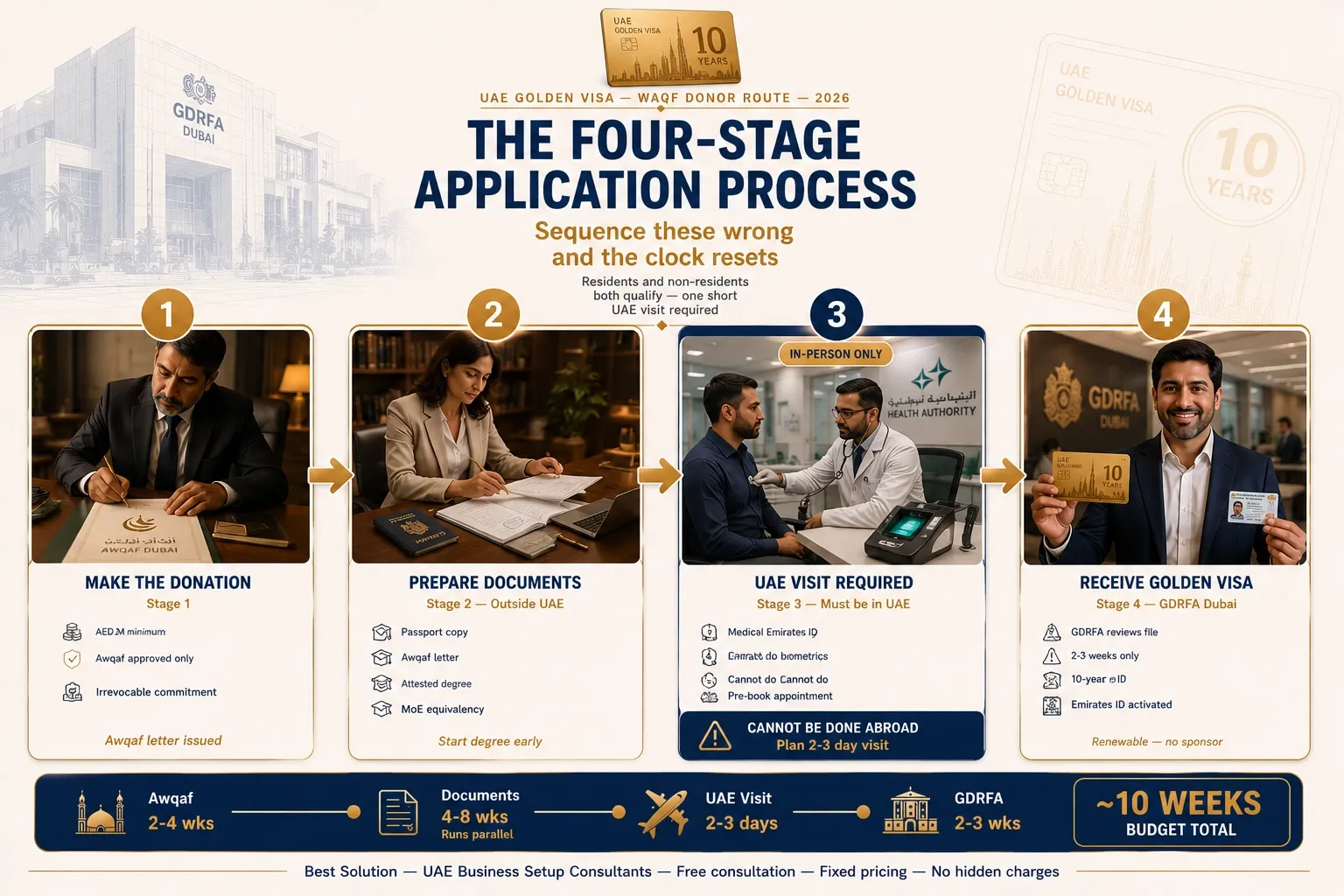
For an overseas donor, the application runs in four stages that have to happen in the right order. Sequencing them wrong is the most common self-inflicted delay.
- Make the donation and secure the Awqaf endorsement. Complete the Waqf contribution through Awqaf Dubai’s designated channels, register the endowment, and obtain the Awqaf supporting letter. Cash donations can be initiated remotely, though in-person engagement speeds the documentation.
- Prepare documents outside the UAE. Passport, proof of donation, the Awqaf letter, and your attested degree with MoE equivalency. Start the degree equivalency early; it is the long pole in the tent.
- Visit the UAE for the medical and Emirates ID. The medical fitness test and biometric registration require physical presence. A pre-verified file and a pre-booked medical appointment keep this to a short trip.
- Submit to GDRFA and receive the visa. With the nomination and complete file, GDRFA-Dubai reviews the application, and on approval issues the 10-year residence permit and activates the Emirates ID.
How long does it really take?
You will see other pages promise “a few weeks.” That figure describes only the GDRFA processing stage, which is genuinely fast, usually two to three weeks once a complete, verified file is submitted. It quietly ignores everything that happens before submission. The honest, end-to-end range is six to twelve weeks, and we tell clients to budget ten weeks and treat anything faster as upside.
The reason is that two authorities work on two independent clocks:
- Awqaf Dubai nomination: about two to four weeks for a straightforward cash endowment to an established project, and four to eight weeks where the endowment involves property, business assets or a structured giving arrangement.
- Document preparation: the MoE degree equivalency alone can take four to eight weeks, and it must finish before submission.
- GDRFA processing: two to three weeks once the verified file lands.
Run those in the correct sequence and ten weeks is realistic. Run the medical too early or start the degree equivalency too late, and the clock resets on the slowest item.
Start with a Private, No-Pressure Consultation
A Waqf endowment is a serious commitment, and the residency that follows should be handled with the same discretion. We'll review your eligibility against the AED 2 million donation, degree, and Awqaf nomination requirements, give you an honest timeline, and outline the full cost before you commit. Every conversation is confidential.
What does it cost beyond the AED 2 million donation?
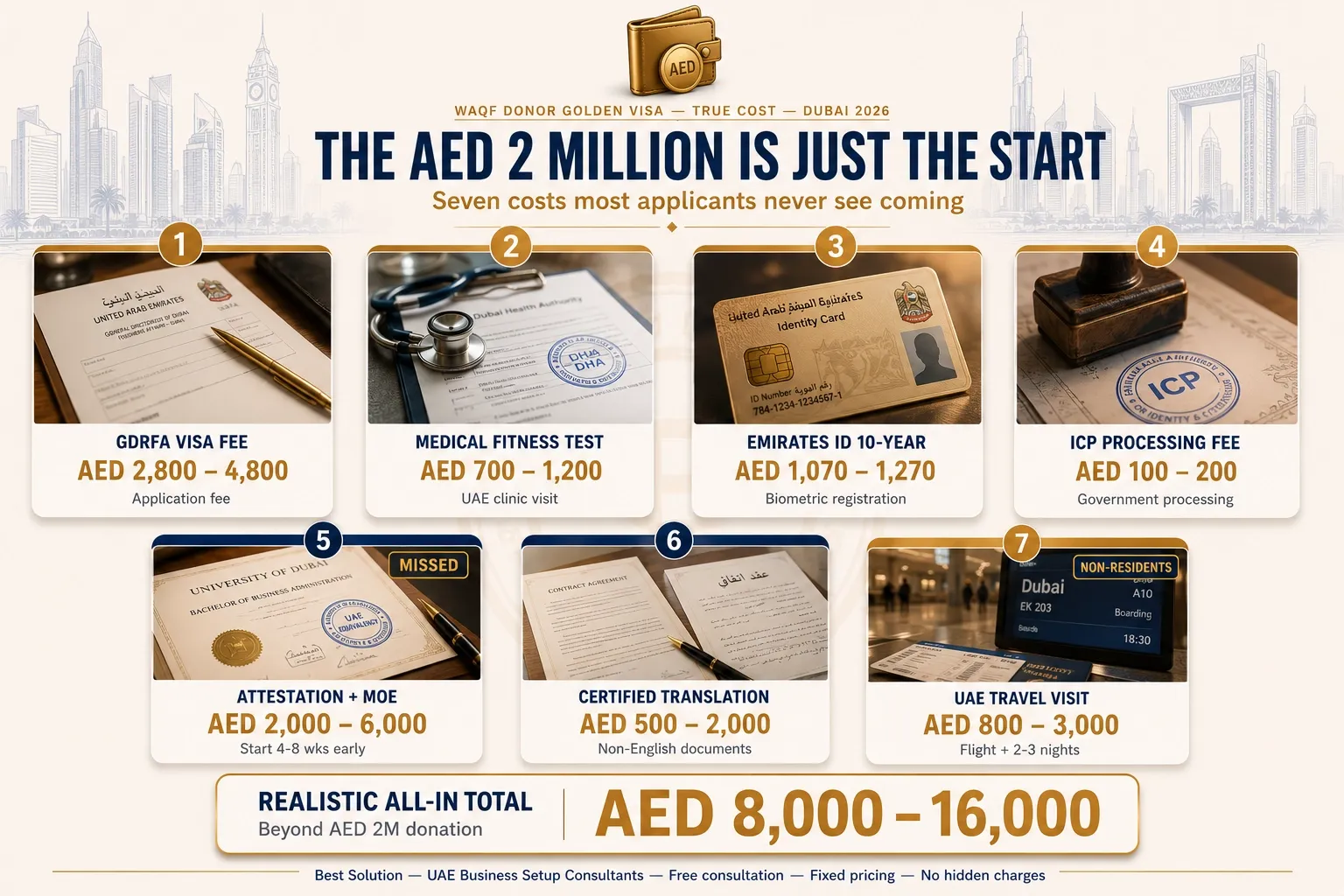
The donation is the headline number. The administrative cost of the application is separate, and most competitor pages leave it out. Here is the honest breakdown.
| Line Item | Approx. Cost (AED) |
|---|---|
| GDRFA Golden Visa application fee | 2,800 to 4,800 |
| Medical fitness test | 700 to 1,200 |
| Emirates ID (10-year) | 1,070 to 1,270 |
| ICP processing fee | 100 to 200 |
| Document attestation and MoE equivalency | 2,000 to 6,000 |
| Certified translation (non-English documents) | 500 to 2,000 |
| UAE travel for medical and biometrics (non-residents) | Variable |
| Realistic all-in beyond the donation | 8,000 to 16,000 |
The three costs competitors most often omit are the MoE degree equivalency, certified translation for documents not already in Arabic or English, and the travel a non-resident needs for the in-person medical stage. Both numbers belong on the page: the AED 2 million endowment, and the AED 8,000 to 16,000 it costs to process the residency.
Common mistakes donors make
Three misunderstandings account for most rejected or stalled files.
- Treating the AED 2 million as flexible. It is not a pledge you can spread over years or split between causes. It is a single, completed, irrevocable endowment to an Awqaf-approved project.
- Assuming the degree is optional. A bachelor’s degree with MoE equivalency is mandatory. We have met donors ready to give well above the threshold who still did not qualify because they held no recognised academic credential.
- Assuming any charitable project counts. Awqaf Dubai’s approved-project list is specific and updated periodically. A cause that qualified a year ago may not today, and a project off the list cannot be made to count by redirecting the gift.
How Best Solution de-risks your application
The endowment is between you and Awqaf Dubai. We do not touch it. What we manage is the administrative process that follows, so a document format issue or a missed attestation stamp does not delay residency you are entitled to. Before any Waqf donor file is submitted, we run six specific checks.
- Awqaf letter format. We confirm the supporting letter contains every field GDRFA verifies (donation amount, project reference, irrevocability confirmation, applicant identification), because a correctly issued letter missing a field is still held for clarification.
- Name consistency. Passport, Awqaf letter, degree, attestation and Emirates ID application must carry exactly the same name in the same format. One transliteration variant triggers a hold.
- MoE equivalency status. We confirm the degree equivalency is current and correctly categorised, so it does not fail verification and force a four to eight week reissue.
- Medical test timing. We sequence the medical to the expected submission date, not the start of preparation, so the certificate has not expired by the time the file is ready.
- Project eligibility. We verify the specific project is on Awqaf Dubai’s current approved list rather than assuming last year’s status still holds.
- Attestation chain. For degrees issued abroad, we confirm the full chain (home-country ministry, UAE embassy, UAE MOFA) is complete and stamped, so the document does not have to travel back through attestation mid-application.
Waqf donor visa vs other Golden Visa routes
The Waqf route sits at the same financial level as property and investment categories, but the nature of the contribution is different: there is no financial return, only social impact. If your goal is an investment yield, the investor and entrepreneur Golden Visa categories may fit better. If your goal is enduring philanthropy that also secures residency, the Waqf route is purpose-built.
| Route | Financial Requirement | Degree? | Primary Benefit |
|---|---|---|---|
| Waqf philanthropist | AED 2M donation (irrevocable) | Yes | Humanitarian recognition |
| Real estate investor | AED 2M property | No | Investment returns |
| Entrepreneur | AED 500k+ capital | Sometimes | Business growth |
| Skilled professional | High salary + degree | Yes | Career mobility |
Start with a private, no-pressure consultation
The UAE has turned an enduring act of giving into a path to long-term residency, and it has done so with real requirements behind it: a AED 2 million irrevocable endowment, a recognised degree, an Awqaf nomination, and a document trail that two authorities will check. Get the sequence right and a non-resident donor can hold a 10-year Golden Visa in around ten weeks. Get it wrong and the slowest document resets the clock.
Best Solution handles the paperwork so your philanthropy stays exactly that. Conversations in this category are confidential by default, and we never reference a client’s case without written consent. To see where you stand against the criteria, start with our Golden Visa eligibility guide , then reach out for a private consultation tailored to your profile.