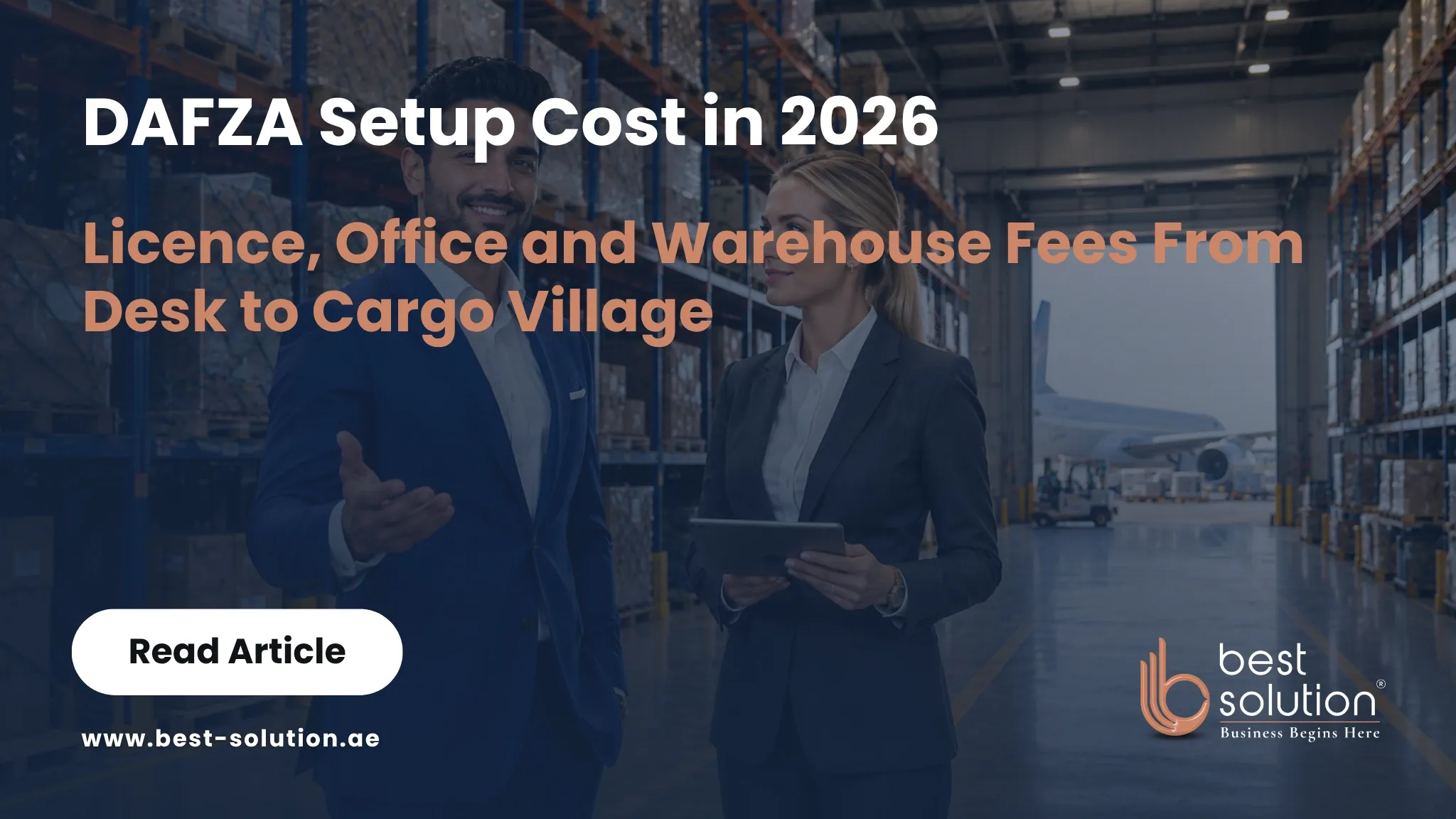
The dubai airport free zone license cost is the first thing most founders ask about, and the answer is wider than any brochure admits. A lean Trading FZCO can start near AED 55,000 all-in. A fitted warehouse inside the DXB cargo district can run to around AED 342,000. Same free zone, two very different bills. What sits between them is the facility you choose, the visas you need, and a stack of line items that rarely appear on the first quote.
This guide lays out the real DAFZA setup cost in 2026: what the entry package includes, how the price climbs rung by rung, the fees that ambush budgets, and the honest test for whether the DAFZA premium is worth paying at all. The figures below are current market and published DAFZ package ranges. We flag the ones you should confirm against a live quote before you commit.
What does a DAFZA company actually cost in 2026?
A DAFZA company costs from about AED 55,000 all-in for a Trading FZCO with a smart desk and one visa, rising to roughly AED 342,000 for an airport warehouse unit with a large visa quota. Most trading founders land between AED 55,000 and AED 145,000, because that range covers a desk through a standard office. The single biggest cost lever is your facility, not the licence.
DAFZA setup cost at a glance:
| Setup type | Indicative all-in (year one) |
|---|---|
| Trading FZCO, smart desk, 1 visa | From AED 55,000 |
| Smart office, 1–2 visas | AED 60,000–80,000 |
| Standard office (27 sqm), 3 visas | ~AED 84,600 |
| Standard office (54 sqm), 6 visas | ~AED 142,000 |
| Standard office (100 sqm), 12 visas | ~AED 245,700 |
| Airport / Cargo Village warehouse, 20–30 visas | From ~AED 342,000 (bespoke) |
Figures are indicative 2026 ranges. DAFZ revises packages and runs periodic offers, so treat these as planning anchors and confirm the exact number against a current quote.
Get Your Exact DAFZA Setup Cost in 2026
Our business setup specialists will prepare a personalised quotation based on your activity, office requirement, visa quota, and expansion plans, so you know exactly what to budget before you commit.
What the entry-level Trading FZCO really includes
An entry DAFZA Trading FZCO package usually folds several things into one price. You get the trade licence, company registration, the establishment and immigration card, e-channel setup, and a minimum facility, which is a smart or flexi desk. DAFZ typically bundles the knowledge-and-innovation fee and postal service into that package too. Add one investor visa, with its entry permit, medical, Emirates ID and stamping, and you have a working company.
One DAFZA rule matters for the budget: a physical facility is mandatory. Unlike some zones, you cannot run on a purely virtual office, so the desk cost is not optional. A flexi desk in Dubai is the minimum facility, and it sets both your starting cost and your visa ceiling.
On the number itself, AED 55,000 is the honest planning floor rather than the rock-bottom teaser. The leanest genuine entry can land nearer AED 45,000 to 50,000. Once DAFZA’s premium licence pricing, a facility a notch above bare flexi, and the usual soft costs are in, AED 55,000 is what founders actually pay. It sits well above the DAFZ headline licence figure of around AED 15,000, which is licence-only and never the full bill.
The DAFZA cost ladder: from a desk to an airport warehouse
The price climbs by facility, because facility is what moves the number. Published DAFZ office packages give a clear ladder, and the warehouse tier sits above them as bespoke cargo space.
| Facility / package | Visa quota | Indicative cost |
|---|---|---|
| Smart / flexi desk | 1–2 | From AED 55,000 all-in |
| Standard office, 27 sqm | 3 | ~AED 84,630 |
| Premium office, 27 sqm | 3 | ~AED 92,570 |
| Standard office, 54 sqm | 6 | ~AED 141,985 |
| Premium Plus office, 54 sqm | 6 | ~AED 160,070 |
| Standard office, 100 sqm | 12 | ~AED 245,664 |
| Cargo Village warehouse (from ~500 sqm) | 20–30 | From ~AED 342,000 (bespoke) |
For most trading founders the real story is the first two or three rungs, a desk through a standard office, roughly AED 55,000 to AED 145,000. The warehouse end is a different buyer entirely: a logistics or air-freight operation, not a general trader. The airport warehouse figure is facility-specific, so treat AED 342,000 as a starting point for a substantial unit, not a fixed price.
The deep dive on airport-side space, DAFZA Cargo Village: the only UAE free zone with warehouses inside a major airport, is a separate piece. This page keeps to the cost ladder.
The hidden line items that break founder budgets
None of these are huge alone. Stacked, they are the gap between an optimistic budget and the real bill. This is exactly what we itemise up front so nothing arrives as a surprise at signing.
The per-visa stack
The headline visa fee is not the whole cost. An investor visa runs roughly AED 3,000 to 4,000 and an employee visa up to around AED 7,000. On top of each one sit the medical fitness test, the Emirates ID, and mandatory health insurance. For a small team, that per-person stack adds up quickly, and it is the item most often left off a teaser quote.
The one-off and easily-missed fees
Watch for the knowledge-and-innovation fee, the one-time registration fee on FZCO formation, name reservation, and the establishment and immigration card if quoted separately. There can be a refundable security deposit tied to certain facilities or visa quotas, which founders forget to reclaim on exit. Extra activities beyond your base allocation cost more, and a regulated activity may need an external approval and its own fee. A bank share-capital letter kicks in only if your declared capital exceeds AED 150,000. Then there are the soft costs, the PRO and handling work a bare government quote never shows. Your DAFZA establishment card in Dubai is a required document in this stack, and it is what a bank reads to confirm your company and visa quota.
Recurring vs one-time: the cost you carry forever
This is the distinction founders miss most. Some costs are paid once to launch. Others return every single year.
| One-time (to launch) | Recurring (every year) |
|---|---|
| Company registration | Trade licence renewal |
| Name reservation | Facility / office rent |
| Establishment-card setup | Visa renewals |
| Initial approvals | Insurance |
| Audit (for QFZP and most licences) |
The trap is looking at a year-one quote and assuming year two is similar or cheaper. The one-time registration drops away, but the licence and facility renew at full price, and the audit and visa renewals arrive as new recurring lines. Treat the recurring base, licence plus facility plus visas plus audit, as the true cost of ownership. That number, not the headline setup, is what your business carries forever.
How visa quota is tied to your facility
Your visa ceiling is a facility decision, not a package add-on. A smart or flexi desk supports roughly one to two visas. A small dedicated office carries a handful more, scaling with size. A large warehouse or industrial unit can carry 20 to 30 visas. You lift the ceiling by taking more space, not by buying visas one at a time beyond what the space allows.
The planning point is blunt. If you need five visas, you cannot do it on a smart desk no matter what you would pay per visa. You need the office tier that carries a five-visa quota. So the real cost of “more visas” is often the cost of the larger facility, not just the per-visa fee. We size the facility to the headcount a client will actually reach, because discovering mid-year that your desk caps you at two visas is an expensive upgrade.
How much more is DAFZA than a cheaper zone?
In real terms, a comparable trading setup that runs from AED 55,000 all-in at DAFZA would land closer to AED 20,000 to 30,000 at IFZA or Meydan, and less again at budget zones. So the DAFZA premium is broadly AED 20,000 to 30,000 or more a year over the cheaper mainstream zones.
| Zone | Indicative trading setup (all-in) | What you get |
|---|---|---|
| DAFZA | From AED 55,000 | DXB airport adjacency, cargo ecosystem, prestige, established 1996 government zone |
| IFZA / Meydan | ~AED 20,000–30,000 | Same 100% ownership and 0% qualifying tax, no airport link |
| Budget zones | Below AED 20,000 | Cheapest legal company, minimal infrastructure |
The honest read: if your business uses the airport adjacency, the premium buys a real operational asset. If it does not, you are paying AED 20,000 to 30,000 a year for a postcode you will not use, and a cheaper zone gives you the identical legal company. The cheaper route only makes sense inside the wider picture of the real cost of starting a business in Dubai, which sets DAFZA against every other jurisdiction.
Whether the premium is justified for aviation, pharma and logistics is covered in full in Is DAFZA worth the premium? When DXB adjacency pays off.
Who should pay the DAFZA premium (and who should not)
Pay the premium if you are in aviation or aerospace, air-freight-dependent trading, pharma and cold-chain, perishables, or re-export through DXB. In those businesses, airport proximity and fast customs are advantages you use, and the DAFZA name carries real weight with banks and counterparties.
Do not pay it, and this is where money is wasted, if you are a service business, consultancy, digital or online business, freelancer, or general trader with no air-cargo reason to be there. Those founders get the same 100% owned, 0% qualifying-tax free-zone company at a cheaper zone for thousands less. The clearest waste case is the solo consultant sold DAFZA on prestige, paying an airport premium for a desk they will rarely visit. If you cannot name the operational reason you need DXB, you do not need DAFZA.
Does the 0% tax benefit change your budget in 2026?
Many founders pick DAFZA partly for the 0% corporate tax on qualifying income. In 2026 that benefit is conditional, not automatic. To keep Qualifying Free Zone Person status you must meet all conditions together, including adequate substance, qualifying income, and audited financial statements. Too much mainland or non-qualifying income breaks it and drops you to 9%.
For the budget, this means one thing: factor the audit into your recurring costs, because it is the price of protecting the 0% benefit. Early-stage founders should also know about Small Business Relief, which gives 0% corporate tax for revenue under AED 3 million for tax periods through the end of 2026. UAE corporate tax registration is the same for a DAFZA company as for any other, and our team handles it alongside the licence. The takeaway is plain: DAFZA’s 0% is genuine but audited and conditional, so build the audit and substance cost into your comparison.
Two real client examples from our desk
Case one, the premium was right. An air-freight-dependent trader importing time-sensitive goods chose DAFZA with a smart office, all-in in the AED 60,000 to 80,000 range for year one. He had looked at a budget zone AED 30,000 cheaper, but it sat well away from DXB. Once we mapped his shipment volumes, the handling time and customs friction of being off-airport would have cost him more per month than the premium did per year. The adjacency paid for itself.
Case two, the cheapest was the wrong call. A different founder had already set up in a budget zone to save money, then won aviation-parts clients who expected an airport-anchored supplier and fast DXB clearance. His cheap zone could deliver neither. The fix was effectively re-establishing at DAFZA, so his “saving” became a double setup cost plus lost time. The lesson: the cheapest zone is only cheap if it fits the business. For an airport-dependent operation, going budget first is the expensive route.
Getting your DAFZA budget right
DAFZA setup cost is not one number, it is a ladder. A Trading FZCO starts near AED 55,000, a standard office runs to AED 145,000 or so, and an airport warehouse climbs toward AED 342,000. The licence is the small part. Your facility, your visas, and the quiet stack of fees decide the real total, and the recurring base decides what you carry every year after.
The founders who get this right start from an all-in figure, size the facility to the team they will actually reach, and pay the airport premium only when the business uses it. Best Solution rebuilds DAFZA quotes as true all-in numbers and tells you honestly when a cheaper zone would serve you better, because we earn the same fee whichever you pick. Book a free consultation and we will map your real DAFZA cost, licence, office, visas and audit, before you commit a dirham.