
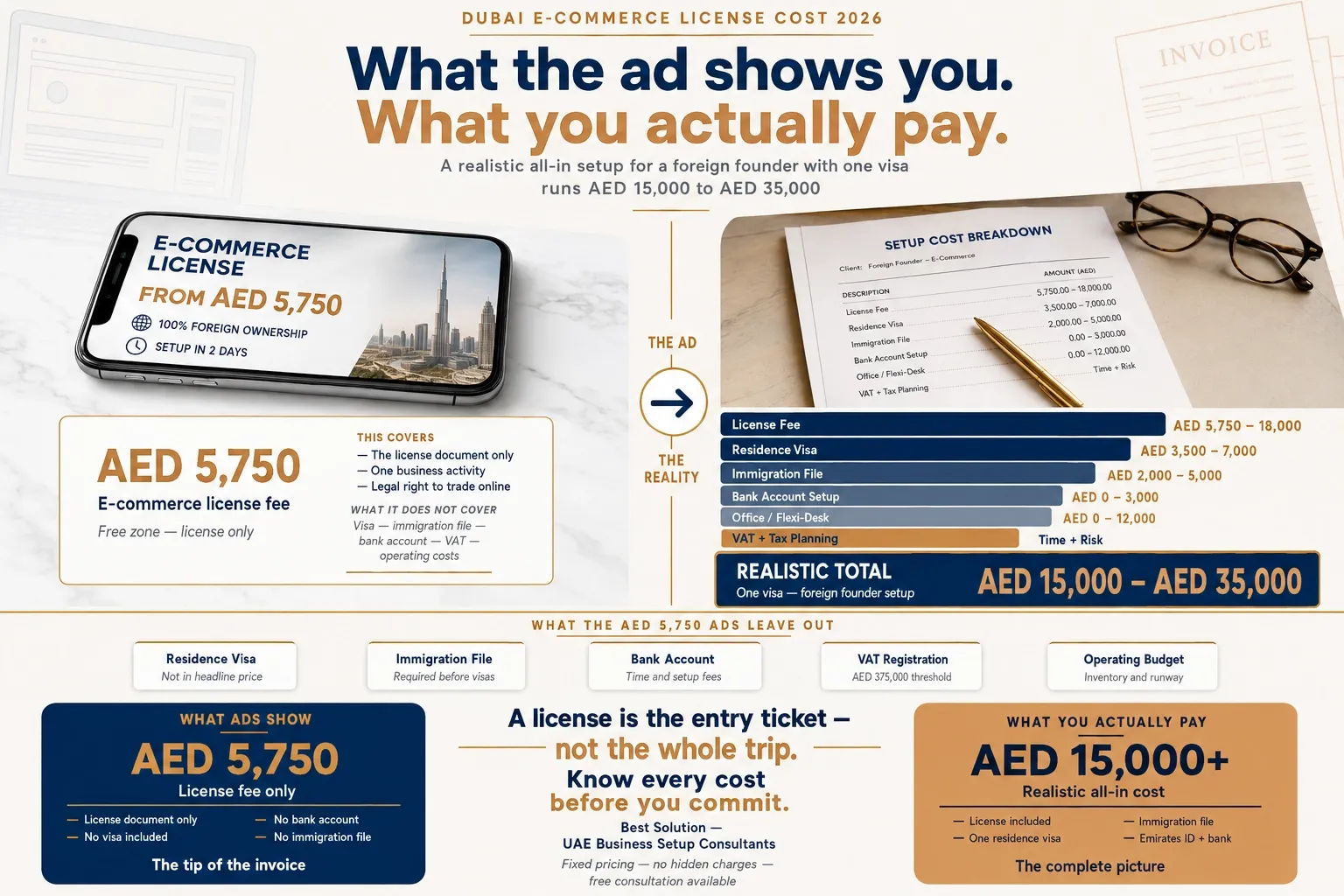
Two browser tabs are open. One shows a free zone ad: "E-commerce license, from AED 5,750." The other shows a mainland quote closer to AED 25,000. Same online business, two very different numbers, and no clear explanation of why.
If that is roughly where you are right now, start with this: the price tag is the wrong thing to compare first. At Best Solution, the most expensive mistakes we fix are not overpriced licenses. They are cheap licenses bought before anyone asked how the business would actually run. A founder picks the lowest headline number for an e-commerce license in Dubai, then finds the structure does not fit how they import stock, reach UAE customers, or get a bank account approved.
So this guide does the comparison properly. It covers what the license is, which type fits you, and how to make the free zone versus mainland call. It also covers the real 2026 cost, the seven-step process, and the work after the license that most guides skip.
| Question | Short Answer |
| What license do I need? | An e-commerce license, issued by a UAE free zone or by Dubai's Department of Economy and Tourism (DET) on the mainland. |
| Free zone or mainland? | A business-model decision. Free zone suits international-first, lean digital sellers; mainland suits businesses whose main market is UAE consumers. |
| What does it cost in 2026? | Free zone licenses start near AED 5,750; a realistic all-in setup with one visa runs AED 15,000 to AED 35,000. |
| How long does it take? | A license can be issued in 1 to 3 working days, but a fully operational business (bank, visa, payment gateway) usually takes several weeks. |
| What is the biggest risk? | Choosing a jurisdiction on headline price instead of how the business actually operates, banks, and ships. |
What an E-Commerce License in Dubai Actually Covers
An e-commerce license in Dubai is a legal permit that lets a business sell products or services online, through a website, social media, or a marketplace. It is issued by a UAE free zone authority or by the Dubai Department of Economy and Tourism for mainland businesses. Without it, selling online is not legal.
You need the license when your business trades through digital channels. That holds even if you carry physical inventory, as long as you are not selling in person at a shop. If you also sell from a physical store, you add a trading license on top. The license is what lets you operate as a registered company, open a corporate bank account, sign with payment gateways, and invoice customers inside the UAE and abroad.
The reason this matters is simple: the market is large and still growing. The UAE's e-commerce sector is worth roughly USD 12.3 billion in 2026 and is forecast to reach about USD 21 billion by 2031. The UAE government's official platform also confirms that any business selling online must hold a valid commercial license (u.ae).
What You Can Sell, and Who You Can Sell To
An e-commerce license covers a wide product range: electronics and gadgets, fashion and accessories, jewelry, home and lifestyle goods, machine and spare parts, plus digital services. Some categories are restricted or prohibited, including alcohol, tobacco, certain pharmaceuticals, and counterfeit goods, so check your product list against UAE rules before you file.
One nuance changes the jurisdiction decision and rarely makes it into a guide: a free zone e-commerce company can sell online to customers across the whole UAE, but to physically distribute goods into the mainland market it usually needs a mainland distributor or agent. Hold on to that point. It comes back in the next two sections.
Which E-Commerce License Do You Actually Need?
For most people there are two real choices: an e-trader license or a full e-commerce license. An e-trader license is for individuals selling on a small scale, mostly through social media. A full e-commerce license is for a registered company running a website, working with marketplaces, and dealing with suppliers and international clients. The dividing line is scale and structure, not the product itself.
| Criteria | E-Trader License | Full E-Commerce License |
| Who it suits | Individual sellers, social-media side businesses | Registered companies, full online stores |
| Eligibility | UAE and GCC nationals (Dubai e-trader) | Open to foreign nationals, including 100% foreign ownership |
| Visa entitlement | Usually no visa | Visa quota based on package and facility |
| Payment gateways | Limited options | Full access to major payment gateways |
| Best for | Solo, low-volume selling | Startups and brands planning to scale |
The E-Trader Route, and Why It Is Only for Some People
The e-trader license sits with each emirate's economic department and is mostly reserved for UAE and GCC nationals:
- Dubai: the DET e-Trader license (formerly issued under the DED) for UAE and GCC nationals, social-media commerce, single owner, no visa.
- Sharjah: the Eitimad license from the Sharjah Economic Development Department (SEDD), for UAE nationals living in Sharjah, aged 18 and over.
- Abu Dhabi: Tajer Abu Dhabi, issued by the Abu Dhabi DED.
- Ras Al Khaimah: the Virtual Merchant License.
If you are a foreign founder, the e-trader route is usually closed to you. A full e-commerce license through a free zone or the mainland is the practical path, and the rest of this guide assumes that is where you are headed.
Free Zone or Mainland: A Business-Model Decision, Not a Price Tag
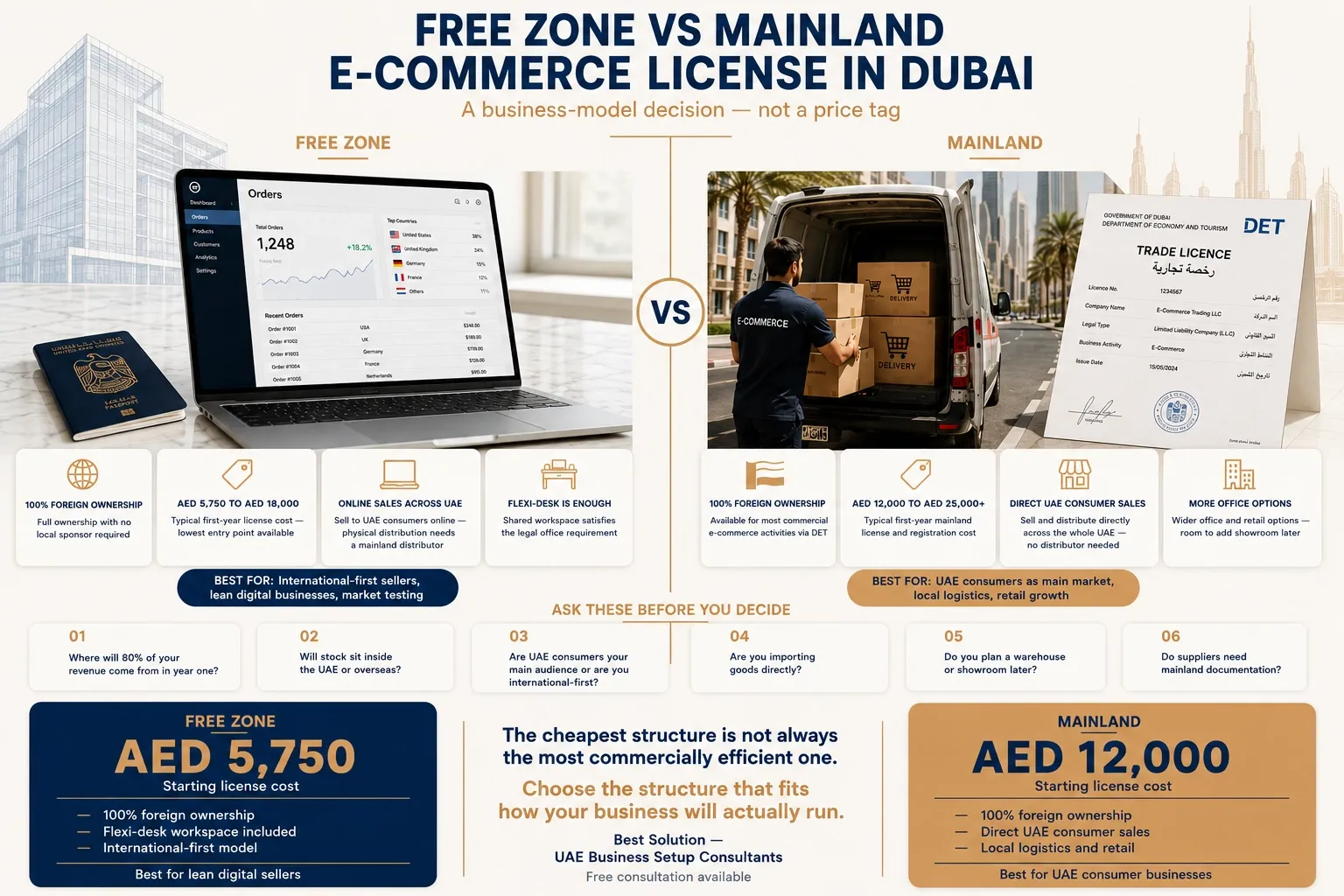
Here is the advice you will read on most blogs: free zone is cheaper, so pick free zone. It is also the advice behind a large share of the setups we end up restructuring. The free zone versus mainland call is a business-model decision, not a pricing decision. The cheapest structure is not always the most commercially efficient one.
Free zones give you 100% foreign ownership, 100% repatriation of capital and profit, a low entry cost, and fast digital processing. Mainland gives you direct trade with UAE consumers, more local operational flexibility, and room to add retail later. Both are valid. The question is which one matches how your business actually works.
And here is the trap. Many sellers assume "online business" automatically means "free zone business." But if your inventory sits in the UAE, your customers are UAE consumers, your delivery runs on cash on delivery, or your suppliers want mainland documentation, you are functionally running a mainland retail operation. A free zone license stretched over that model creates friction you did not budget for. Weigh the free zone or mainland operating permit decision against your model before you file.
| Criteria | Free Zone | Mainland (Dubai DET) |
| Ownership | 100% foreign ownership | 100% foreign ownership available for most commercial activities |
| Typical first-year cost | AED 5,750 to AED 18,000 | AED 12,000 to AED 25,000+ |
| Selling to UAE consumers | Allowed online; physical mainland distribution usually needs a local distributor | Direct, across the whole UAE |
| Office requirement | Flexi-desk or shared facility usually enough | Wider office and retail options, sometimes required |
| Best for | International-first, lean digital sellers, market testing | UAE consumers as the main market, local logistics, retail growth |
The Questions We Ask Before Recommending a Jurisdiction
We never start from the cheapest license. We start from the business model and work backward. Before a Best Solution consultant recommends free zone or mainland, we work through questions like these:
- Where will roughly 80% of your revenue come from in year one?
- Will your stock physically sit inside the UAE, or overseas?
- Are you importing goods directly?
- Are UAE consumers your main audience, or are you international-first?
- Do you plan a warehouse or showroom later, and will you hire staff locally?
- Which marketplaces and payment providers will you use, and do suppliers need mainland documentation?
The step most founders underestimate is banking compatibility. Two free zones can look almost identical online, yet banks treat them very differently depending on your activity, expected transaction size, founder nationality, and whether you sell digital or physical goods. A cheap license that delays your bank account by two months is, in practice, more expensive than a slightly higher-cost structure that opens accounts smoothly. The second underestimated factor is future flexibility: optimising only for year-one savings can box you in when warehousing, VAT, or extra visas arrive.

Not Sure Whether Free Zone or Mainland Is Right for You?
Most founders get this wrong because they start with the price, not the business model. Tell us how your business actually works and we will tell you exactly which structure fits, what it will cost, and how to get moving.
How Much Does an E-Commerce License in Dubai Cost in 2026?
A free zone e-commerce license starts at around AED 5,750. But the license fee is only one line on the invoice. A realistic all-in setup for a foreign founder, including one residence visa, lands between AED 15,000 and AED 35,000 in the first year. The table below shows where the money actually goes.
| Cost Component | Typical Range (AED) | Notes |
| Free zone license (license only) | 5,750 to 18,000 | Varies by free zone and package |
| Mainland license (DET, first year) | 12,000 to 25,000+ | Includes government and registration fees |
| Residence visa (per visa) | 3,500 to 7,000 | Entry permit, status change, medical, Emirates ID |
| Immigration / establishment file | 2,000 to 5,000 | One-time, required before visas |
| Corporate bank account setup | 0 to 3,000 | Many banks free; some packages charge support fees |
| Office (flexi-desk) | 0 to 12,000 | Often bundled into free zone packages |
From Best Solution's own client work, a straightforward e-commerce setup with one visa generally runs AED 15,000 to AED 35,000. That covers the license, the immigration file, one visa allocation, the Emirates ID process, and setup support. Compare that against the real cost of starting a business in Dubai across other activities so your budget is grounded in numbers, not headline ads.
What Pushes the Cost to the High End
Clients move toward the higher end when they need premium free zones, multiple business activities, warehouse solutions, extra activity approvals, more visas, a physical office, nominee structures, or faster processing. Banking complexity matters too. High-risk categories such as cosmetics, supplements, crypto-adjacent activity, or high-volume cross-border payments face heavier compliance checks, which can add both cost and time.
Watch what the "from AED 5,750" ads leave out: visas, the immigration file, your bank account, VAT registration, and your actual operating budget for inventory, marketing, fulfilment, and runway. A license is the entry ticket, not the whole trip.
These Numbers Are a Starting Point, Not a Bill
Figures here are 2026 market ranges for planning, not a quote. Government fees change, and your exact cost depends on activity, free zone, and visa count. This is general information, not financial or legal advice.
How to Get Your E-Commerce License: A 7-Step Walkthrough
Step 1: Define your business activity and model. Decide exactly what you will sell and how, whether through your own website, marketplaces like Amazon.ae and Noon, direct B2B, or a mix. This sets the license activities you need and rules out the wrong jurisdictions early.
Step 2: Choose your jurisdiction. Using the questions above, decide free zone or mainland. Everything else depends on this call, so do not rush it to save a few days.
Step 3: Reserve your trade name. Pick a company name that meets UAE naming rules: no offensive or religious terms, no country names, and it is transliterated into Arabic rather than translated. Submit it to the licensing authority for approval.
Step 4: Get initial approval. The authority confirms it has no objection to your proposed activity and ownership. Some activities need extra approvals from other government bodies at this stage.
Step 5: Submit documents and pay fees. Standard documents include passport copies of shareholders, the application form, and, for many free zones, a business plan and a Memorandum of Association (MOA). If you hold a UAE employment visa, you may need a No Objection Certificate (NOC) from your current sponsor. The license is then issued, often digitally.
Step 6: Process visas and Emirates ID. With the license issued, open your establishment and immigration file, then apply for investor or employee visas. Each visa runs through an entry permit, a status change, a medical test, and Emirates ID.
Step 7: Open a bank account and connect payments. Open a corporate bank account and integrate a payment gateway so you can accept online payments securely. Build in time here, because this is the slowest step for most e-commerce founders.
One practical note for Step 6: your establishment card is the document that unlocks visa processing, so treat the establishment card in Dubai as a milestone, not paperwork
The Part Most Guides Skip: What Happens After the License
Most guides end at "license issued." In practice, that is where the real work starts. Founders obsess over the license, but the bottleneck is almost always the operational layer after incorporation: banking, payment gateways, VAT, and logistics.
Banking and payments now demand more than they did a few years ago. UAE banks and payment processors ask deeper questions: source of funds, supplier relationships, projected transaction volumes, the countries you serve, and your refund and chargeback exposure. A clean license does not guarantee a fast account. Prepare those answers before you apply, not during the review.
Decide early where your inventory will sit: inside the UAE or overseas, whether you need customs registration, and how orders will be fulfilled. These choices interact with your jurisdiction decision, which is exactly why we settle them before registering rather than after.
On tax, an e-commerce business must register for VAT once taxable supplies and imports pass AED 375,000 over 12 months, with voluntary registration available from AED 187,500 (Federal Tax Authority). Corporate tax, charged at 9% on annual profits above AED 375,000, is a separate registration to plan for. Many founders cross the mandatory VAT threshold faster than expected and register late. A short read on tax registration in Dubai will save you a penalty.
Why the "2-Day License" Claim Needs an Asterisk
A two-day license is real. But it happens only when every one of these is true:
• The shareholder structure is simple and passport copies are ready.
• Your KYC documents are clean.
• You sell no regulated products and need no outside approvals.
• Your activity is a standard e-commerce activity.
• You pick a free zone with fast digital processing.
And "license issued" is not the same as "business ready." You still need the establishment card, visas, Emirates ID, a bank account, and payment gateway onboarding. For most founders, the real timeline is several weeks, not two days. We would rather tell you that now than watch you plan a launch around one admin milestone.
A Real Client Who Chose the Cheapest License First
One founder came to Best Solution after setting up a low-cost free zone e-commerce license, because several blogs had said free zones are always cheaper and easier. Their actual model was importing inventory into the UAE, warehousing it locally, and selling directly to UAE consumers with cash on delivery. Operationally, they were running a mainland retail business with a free zone license. The problems stacked up: certain marketplace approvals were harder to secure, suppliers asked for mainland documentation, logistics grew complex, and some activities needed approvals they had not budgeted for. Banking moved slowly, because high projected volumes sat against very little business substance.
The free zone was not "wrong." It had been chosen on headline price, not on how the business would operate. Contrast that with a Danish founder who launched an online cosmetics store. The free zone was matched to a clear B2C model before filing. The application moved fast, and a flexi-desk kept office costs low while still allowing a visa and a bank account. Same country, same license type, very different outcomes. The difference was sequencing.
The Dubai E-Commerce License Checklist: 7 Steps to Get It Right
Where Best Solution Fits In
If there is one line to take from all of this: choose the structure that fits how your business will actually run, then optimise the cost. Not the other way around.
Best Solution Business Setup Consultancy works backward from your model, the products, customers, inventory, banking, and growth plans, before recommending a single license. As an official channel partner of UAE free zones, we can fast-track eligible applications, and we quote fixed pricing with no hidden charges, so the number you see is the number you pay. As Essa Al Harthi, CEO of Best Solution, puts it: "The UAE offers immense potential for e-commerce entrepreneurs; our role is to unlock that potential through a clear, compliant pathway to market entry."


