
If you have set up a company in Dubai, registering for tax is not the box-ticking formality it looks like. It is the point where most owners either protect themselves or quietly create a liability they will not notice until a penalty notice arrives. The portal takes an hour. The decisions behind it (which taxes apply, by when, and whether your Free Zone status actually holds) are what decide whether you pay 0% or 9%, and whether you pay a AED 10,000 fine or nothing.
The "UAE is tax-free" line is out of date. There is still no personal income tax on salaries. But businesses register for Value Added Tax (VAT) above a clear threshold, and corporate tax has applied to business profits since June 2023. This guide gives you the thresholds, the real deadlines, the exact EmaraTax steps, and the mistakes we fix most often, written by a team that has registered these for hundreds of Dubai companies
The short version
| If you... | Then... |
|---|---|
| Have taxable turnover over AED 375,000/yr | VAT registration is mandatory. Register within 30 days of crossing the threshold. |
| Have turnover/expenses over AED 187,500/yr | You may register for VAT voluntarily (useful for reclaiming input VAT). |
| Run any UAE business or earn business income | Corporate tax registration is mandatory, even at 0% and even for most Free Zone entities. |
| Are a new company | Register for corporate tax within 3 months of incorporation. |
| Missed your deadline | AED 10,000 fixed penalty applies, but it can often be waived if you file your first return within 7 months of your tax-year end. |
Not tax advice
Thresholds and deadlines depend on your entity, license and tax period. Confirm your position with the Federal Tax Authority or a certified consultant before you file.
What is tax registration in Dubai, and who actually needs it?
Tax registration in Dubai is the process of registering your business with the Federal Tax Authority (FTA), the federal body that administers tax in the UAE. You register through the FTA's online portal, EmaraTax, and once approved you receive a 15-digit Tax Registration Number (TRN). There are two registrations most Dubai businesses care about: VAT and corporate tax. They are separate regimes with separate TRNs, separate thresholds, and separate deadlines.
VAT registration thresholds (AED 375,000 and AED 187,500)
- Mandatory VAT registration: if your taxable supplies and imports exceed AED 375,000 over the past 12 months, or you expect to exceed it in the next 30 days. You must apply within 30 days of becoming liable.
- Voluntary VAT registration: available if taxable supplies, imports or taxable expenses exceed AED 187,500. Useful for startups that want to reclaim input VAT before they hit the mandatory line.
Most Dubai startups cross the mandatory line within their first year of trading, so it is worth tracking your rolling 12-month turnover from day one rather than waiting for an accountant to flag it.
Corporate tax registration (9%, AED 375,000 profit, AED 1m for individuals)
Corporate tax applies to business profits at a standard 9%. The first AED 375,000 of taxable profit is taxed at 0%; profit above that is taxed at 9%. Registration is mandatory for almost every business even if you expect to pay 0%. A natural person (a freelancer or sole proprietor trading under a license) must register once business turnover exceeds AED 1 million in a calendar year. Large multinational groups within the OECD BEPS Pillar Two scope (combined global revenue above EUR 750 million) face a 15% minimum effective rate.
What is a Tax Registration Number (TRN)?
A TRN is the unique 15-digit number the FTA issues when your registration is approved. One company gets one TRN per tax type, valid across all its UAE branches. You need it to charge and reclaim VAT, file returns, and issue compliant tax invoices, and you can verify any TRN on the FTA portal before you trust an invoice from a new supplier.
Who must register for corporate tax in Dubai?
Corporate tax registration is far broader than most owners expect. Unlike VAT, there is no revenue threshold that exempts you from registering. You must register if you are any of the following:
- A UAE mainland company: LLC, private or public joint-stock company.
- A Free Zone entity, including one that qualifies for the 0% Qualifying Free Zone Person (QFZP) rate. Registration is still mandatory.
- A natural person (freelancer, sole proprietor) with business turnover above AED 1 million per year.
- A branch or subsidiary of a foreign company operating in the UAE.
- A non-resident with a permanent establishment or UAE-sourced taxable income.
Small Business Relief: if your revenue stays at or below AED 3 million, you can elect to be treated as having no taxable income (available through the current relief window). You still have to register and file, you just may owe nothing.
Corporate tax registration deadlines (and the penalty most owners miss)
This is where it gets expensive. Corporate tax deadlines are not one fixed date; they depend on your situation:
- New companies: register within 3 months of your incorporation date. A company formed in April 2026 must register by the end of July 2026.
- Existing companies: deadlines were staggered through 2024 and 2025 based on the issuance month of your trade license. If you incorporated before March 2024 and still have not registered, you are already past your deadline.
- Free Zone companies: register, then file your first corporate tax return within 9 months of your financial-year end.
Miss your deadline and the FTA applies a fixed AED 10,000 administrative penalty under Cabinet Decision No. 10 of 2024. It is flat: it applies even if you owe no tax, and it is separate from late-filing and late-payment penalties. The good news comes next.
How to register for tax in Dubai via EmaraTax: step by step
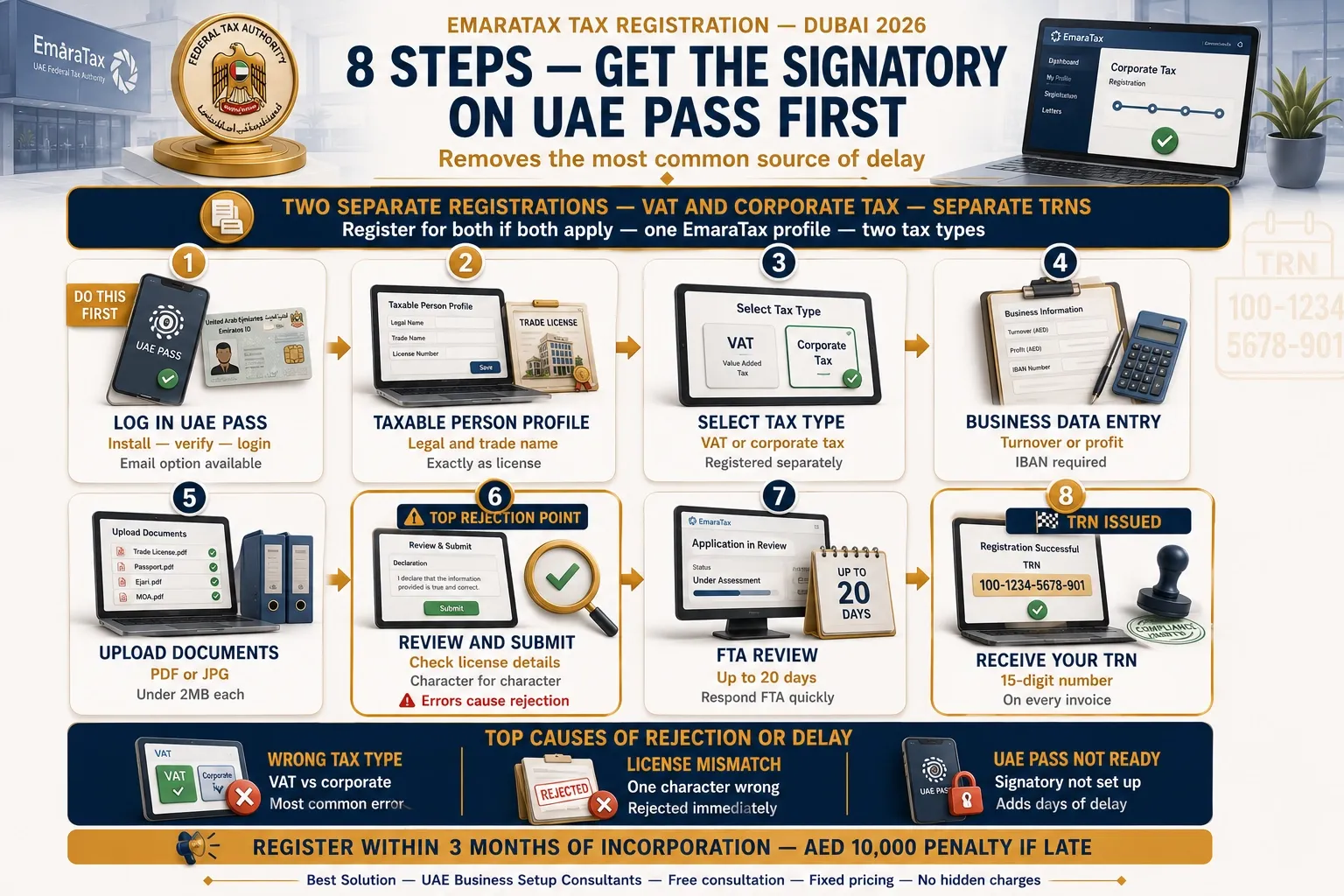
The whole process runs through EmaraTax, the FTA's portal (also available as a mobile app). Here is the route most businesses take:
- Log in with UAE PASS. Install UAE PASS, verify with your Emirates ID, then log in to EmaraTax. First login creates your account automatically. Email login is available if you do not have UAE PASS.
- Create your Taxable Person profile. Add the legal entity name, trade name, trade license number and expiry, and the business activity you chose at setup, exactly as written on the license.
- Select the tax type. VAT, corporate tax, or excise. They are registered separately, even though one profile holds them all.
- Enter business and financial data. Mainland or Free Zone status, turnover or projected profit, authorised signatory and shareholder details, IBAN.
- Upload documents. Trade license, passport/Emirates ID of owners and signatories, proof of address (Ejari or tenancy contract), Memorandum of Association, and financial statements or projections. Use PDF/JPG under 2 MB.
- Review and accept the FTA declaration, then submit. Errors in license details or tax-type selection are the top cause of rejection.
- Await FTA review. Typically up to 20 business days. Respond quickly to any FTA request for clarification.
- Receive your 15-digit TRN, then start your post-TRN compliance: file returns on time, put your TRN on every invoice, keep records, and notify the FTA of any change.
Expert tip. The single most common rejection we fix is the wrong tax type or a trade-license detail that does not match the license character-for-character. Get the signatory registered on UAE PASS first; it removes the most frequent source of delay.
How to register for VAT in Dubai
If you only need VAT, the route is the same EmaraTax profile, then "Register for Tax" and select VAT. Have ready: trade license, owner and signatory IDs, proof of business address, bank details, and your last 12 months of turnover (or projections for a startup). Once approved you get your VAT TRN, which must appear on every tax invoice, credit note and return you issue. Most VAT applications clear within about 20 business days when the file is complete, and our VAT registration and return filing service handles the submission, amendments and quarterly returns end to end if you would rather not manage the FTA back-and-forth yourself.
The AED 10,000 penalty, and how the FTA waiver can cancel it
Here is the part almost no competitor page mentions. Since 14 April 2025, the FTA waives the AED 10,000 late corporate-tax-registration penalty if you file your first corporate tax return (or annual declaration) within 7 months of the end of your first tax period, rather than the usual 9. The FTA also runs a penalty reconsideration route for first-time non-compliance, reasonable excuse, or voluntary disclosure before an audit.
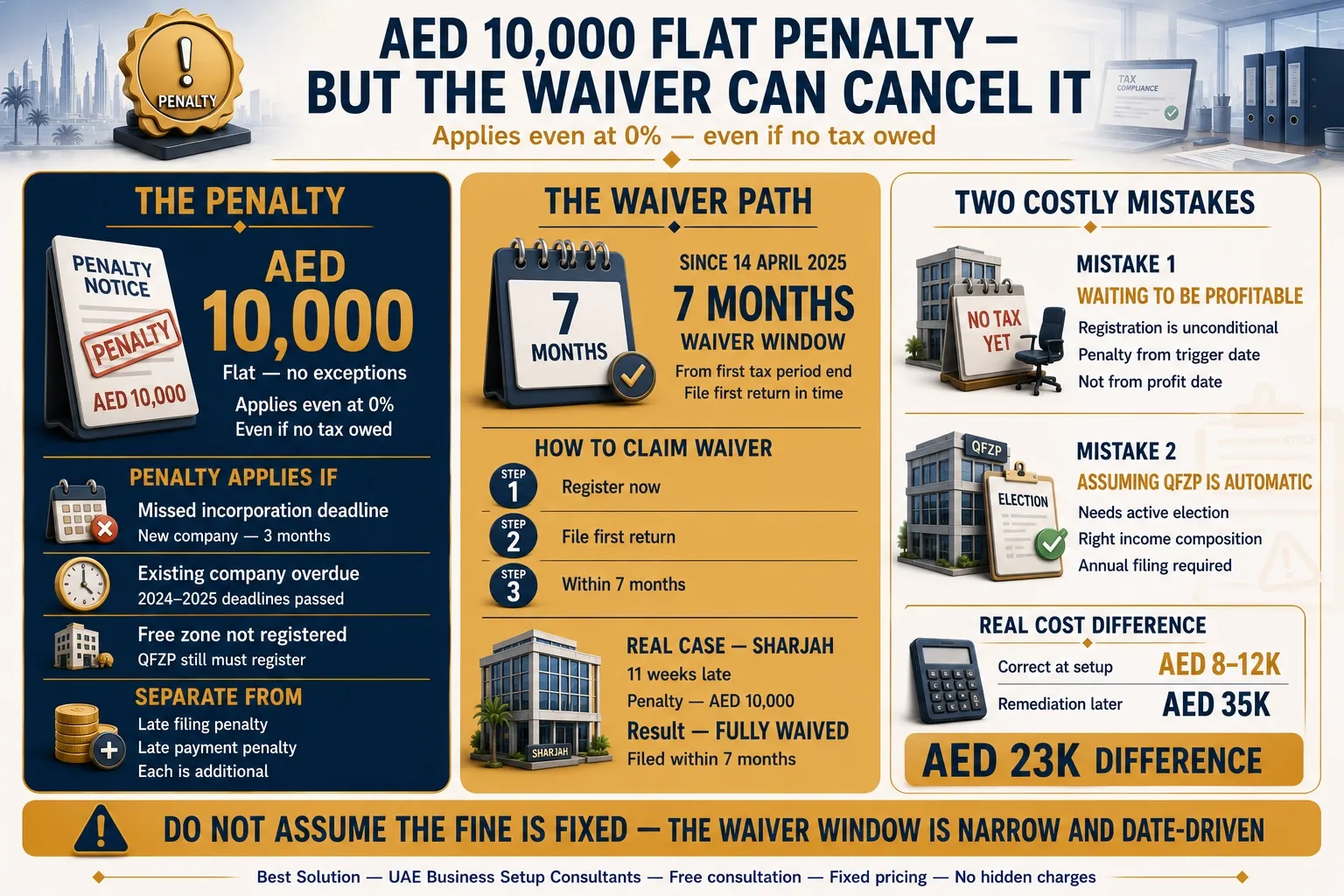
Real case. A Sharjah mainland business came to us after a AED 10,000 late-registration penalty: they had missed their deadline by 11 weeks and the notice had already landed. We completed the registration and filed their first return within 7 months of their financial-year end. The penalty was fully waived under the FTA rules. The window to do this is narrow and date-driven, so if a penalty notice has arrived, the clock is already running.
If you have missed a deadline, do not assume the fine is fixed. The waiver window is narrow and date-driven, so the sooner the registration and first return are filed, the better your chances of cancelling the penalty entirely.
The most expensive tax registration mistakes we see
After registering corporate tax for hundreds of Dubai companies, the same two errors cost owners the most money.
1. Treating registration as optional until you are profitable
The corporate tax registration obligation is unconditional. It applies from the date you meet the trigger, not from the day you turn a profit. A pre-revenue startup that incorporated in September 2023 and has not registered is already non-compliant, and the AED 10,000 penalty is a flat fine, not a percentage of tax owed. Waiting to register does not save money; it accumulates a fixed penalty while you believe you are being careful.
2. Assuming Free Zone QFZP 0% is automatic
Qualifying Free Zone Person status is not a label that switches on the day you set up in a Free Zone. It requires an active election, the right income composition, adequate substance, and annual filing. We are seeing a wave of 2023-2024 Free Zone companies that assumed 0% was self-executing and are now facing their first tax period with no qualifying-income analysis done and non-qualifying revenue that has been accruing since day one. Getting ahead of it means making the critical tax-structuring decisions before your first tax period closes, not after a query lands.
What this costs in practice. A Free Zone SaaS company reached us 8 months after incorporation, never registered for corporate tax, on the old "Free Zone equals 0%, nothing to do" assumption. By then 55% of their revenue was UAE mainland (non-qualifying under QFZP rules) and they were approaching the de minimis threshold. We registered them, filed the overdue registration, ran a qualifying-income analysis, and started a dual-entity restructure to ring-fence the mainland revenue. The AED 10,000 late penalty was unavoidable by that point. Total remediation came to roughly AED 35,000. Doing it correctly at incorporation would have cost AED 8,000-12,000. That AED 23,000 gap is the price of deferring tax advice.
Doing it yourself vs hiring a tax consultant
EmaraTax is free and the portal is usable, so should you just do it yourself? For a simple mainland company with one income stream, often yes. The honest answer is: it depends on what is behind your registration. Here is how the two paths compare on the things that actually carry risk.
Decision | DIY on EmaraTax | With a consultant |
Portal submission | Fine. It is the easy part. | Handled, plus FTA follow-up. |
QFZP eligibility | The portal will not tell you if you qualify. | Reviewed and documented. |
De minimis / income split | Easy to miss; decides 0% vs 9%. | Calculated before you file. |
Wrong-filing risk | One error can trigger AED 10,000+. | Filing built to withstand FTA review. |
Put plainly: the AED 149 packages advertised elsewhere buy a portal submission, not a qualifying-income review or representation if the FTA queries your file. The late-registration penalty alone is 67 times that price. One mistake in the filing costs more than a proper engagement. We do not compete on being the cheapest form-filler; we compete on the registration being correct.
Why businesses choose Best Solution for tax registration in Dubai
Best Solution has operated from Business Bay since 2014, founded by Essa Al Harthi. We have completed 5,000+ company formations and 4,500+ corporate bank account applications, with a 50+ strong in-house team, a 99% approval rate, and 4.8/5 on Google from 200+ reviews. We are FTA Certified. Because every formation since June 2023 includes corporate tax registration as a mandatory step, tax registration is core daily work for us, not a side service.
Compliance is led by people, not a form. Our Compliance and Audit Lead, Teena Thomas, brings seven-plus years in financial oversight with an AML specialism, and our General Manager, Vipin Kumar, has 12+ years and 2,000+ licenses processed. The deliverable we hand you is not a submitted EmaraTax form; it is a correctly structured tax position, QFZP confirmed where relevant, qualifying income documented, ready to stand up to an FTA review.
Ready to register correctly the first time? Our corporate tax registration service confirms what applies to you, hits the deadline, and structures the filing to hold up to an FTA review. Talk to Best Solution about your VAT and corporate tax registration in Dubai today.