在迪拜注册公司昂贵的部分几乎从不是初始设置。而是初始设置错误后进行的重组。
这一点应该重新定义您处理此决定的方式。大多数创始人会比较许可证价格,选择他们在网上找到的最便宜的套餐,并将公司注册视为文书工作。然后,六到十二个月后,银行拒绝开户,某个活动被发现未包含在许可证中,或者自由区公司无法合法地为大陆客户提供服务。届时,公司正在被重建,而不是调整,费用将远远超出最初的设置成本。
本指南是根据迪拜商业设立咨询公司实际观察到的常见错误而编写的。Best Solution 已处理过大陆、自由区和离岸司法管辖区的公司注册,并发现相同的错误以惊人的一致性重复出现。以下是其中21个错误,按其在流程中发生的位置进行分组。每个错误都以通俗易懂的方式解释了风险以及如何避免。目标很简单:帮助您一次性正确设置。
关键要点:在迪拜注册公司
| Key Point | Summary |
| Biggest mistake | Choosing a setup on headline price instead of how the business will actually operate. |
| Mainland vs free zone | Neither is “better”. The right choice depends on who your customers are and where you operate. |
| Real cost | The licence fee is one line item. Budget for visas, Emirates ID, medicals, office and banking on top. |
| Tax | UAE corporate tax is 9% on taxable income above AED 375,000; VAT registration is mandatory above AED 375,000 turnover. |
| Most overlooked step | The corporate bank account. Your jurisdiction and activity choice decide whether a bank will onboard you. |
在迪拜注册公司最常见的错误是什么?
在迪拜注册公司最常见的错误是根据最低许可证价格选择设置,而不是根据业务的实际运营需求。一个便宜的自由区套餐可能会阻止大陆客户,导致银行开户失败,或者限制签证数量。日后纠正这些错误中的任何一个,其成本都远远高于第一次就正确设置。
战略性设置错误
前五个错误发生在提交任何文件之前。它们是关于司法管辖区、结构和活动的决策,也是逆转成本最高的错误。
1. 根据标价而非实际运营选择您的设置
这是 Best Solution 最常看到的错误,也是普通指南从未提及的错误。创始人比较许可证套餐并选择最便宜的,却不检查该结构是否支持业务在6到12个月后的运营方式。
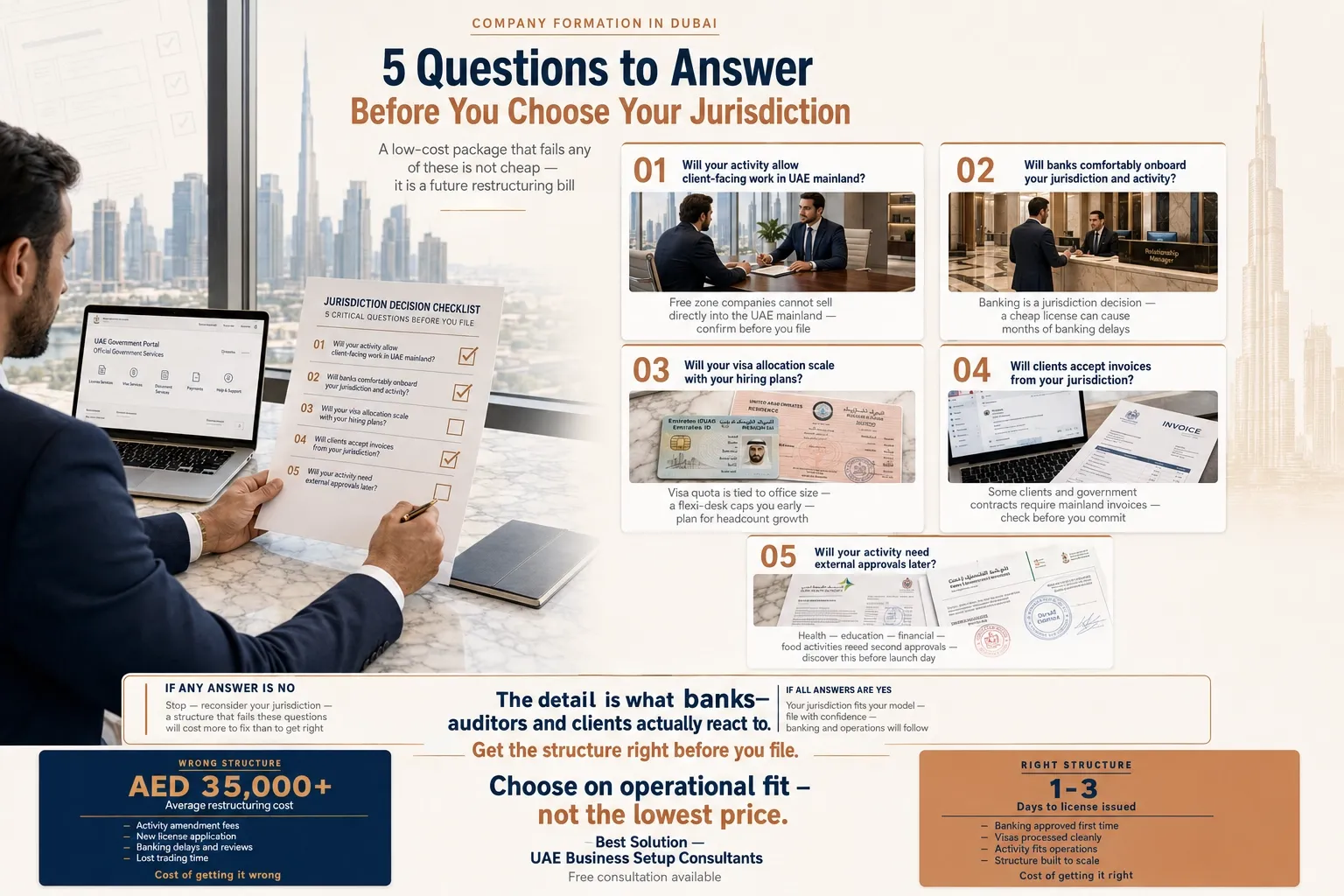
在您承诺之前,有五个问题决定一项设置是否真正可行:该活动是否允许在阿联酋大陆开展面向客户的工作;银行是否会接受该司法管辖区和活动组合的开户;签证配额是否能根据您的招聘计划进行扩展;该活动未来是否需要外部批准;以及您未来的客户是否会接受来自该司法管辖区的发票。一个无法满足其中任何一项的低成本套餐并非真的便宜。它是一笔未来的重组费用。比较 大陆许可证服务 与自由区方案在运营契合度而非价格上进行比较。
2. 将“大陆公司还是自由区公司”视为全部决策
“大陆公司还是自由区公司”是一个有用的起始问题。但它并非全部决策。两家拥有相同许可证的自由区公司可能会因其所在的区域、具体的活动措辞以及银行如何解读这种组合而产生截然不同的结果。
真正的决策是运营层面的:您的客户在哪里,您将在哪里实际工作,您将如何获得报酬,以及您预计增长的速度。将公司设置简化为二选一的创始人往往会选对大方向,但错在细节上。而细节才是银行、审计师和客户真正关注的。
3. 根据知名度而非适用性选择自由区
阿联酋有数十个自由区,包括DMCC、IFZA、Meydan Free Zone、RAKEZ、SHAMS、JAFZA和DIFC。没有哪个自由区对所有人来说都是“最好”的。有些适合国际贸易,有些旨在提高成本效益,有些更适合数字业务,还有些在银行眼中对特定活动更为有利。
常见的错误是选择一个在社交媒体上曝光率高或正在进行促销的区域,然后只比较设置价格和签证数量。真正重要的问题是:银行将如何看待这种结构,该活动是否自然地适合该司法管辖区,办公室的可扩展性是否现实,以及在修改和续签期间当局的响应速度如何。选择自由区公司设置 与业务模式相符的,而不是广告中价格最低的套餐。
4. 选择错误的法律结构
独资企业、民事公司、有限责任公司、分公司,或自由区FZE或FZCO:您选择的结构决定了所有权、责任以及投资者日后如何看待该公司。独资顾问和拥有员工及供应商的贸易公司很少应该使用相同的结构。对于大多数商业和专业活动,外国投资者现在可以拥有大陆公司100%的股权,这是2021年《商业公司法》改革引入的变革(u.ae)。少数战略性行业仍需阿联酋国民参与,因此应始终根据具体活动确认公司结构。
如果您正在权衡选择,独资企业与有限责任公司对比是您提交申请前一个有用的起点。
5. 注册的商业活动与实际销售不符
在阿联酋,您的商业活动决定了您的执照类型和所需的批准。如果注册的活动与您实际销售的产品不符,您将面临真正的风险:超出执照范围运营被视为无执照运营,并会招致罚款。
改正的成本很低,而失败的代价很高。列出企业目前将执行的所有活动以及未来一年内可能执行的密切相关活动,并一起办理执照。之后再添加活动意味着需要修改、批准和费用,有时还会触发您不希望的银行审查。
大陆公司还是自由区公司:如何做出实际决定
大多数创始人首先会问这个问题,所以它值得一个清晰的答案。下表根据会改变实际结果的标准,对这三种途径进行了比较。阅读时请注意一个经常让人困惑的规则:自由区公司不能直接在阿联酋大陆市场销售。它可以在其区域内和国际上进行贸易,但要接触大陆客户,必须指定一个大陆分销商或开设一个大陆分支机构。
对比:迪拜大陆公司、自由区公司与离岸公司设立
| Criterion | Mainland | Free Zone | Offshore |
|---|---|---|---|
| Foreign ownership | 100% for most activities | 100% | 100% |
| Where you can trade | Anywhere in the UAE and abroad | Within the zone and abroad; mainland UAE only via a distributor or branch | Outside the UAE only; no UAE trading |
| Office requirement | Physical office or approved space usually required | Flexi-desk or office within the zone | No UAE office |
| Residence visas | Linked to office space; generally scalable | Capped by package and office size | No UAE residence visas |
| Corporate tax | 9% on taxable income above AED 375,000 | 0% on qualifying income for a QFZP, otherwise 9% | Depends on activity and substance |
| Best suited to | UAE customers, retail, government and corporate contracts | International or B2B service businesses, e-commerce | Holding companies, international structuring |
仅供参考对比。请与DET、相关自由区管理局或持牌顾问确认当前规定。
成本和预算错误
接下来的四个错误与资金有关,特别是创始人预算价格与企业第一年实际支付价格之间的差距。
6. 认为执照费就是总成本
“15,000迪拉姆自由区套餐”是广告宣传的执照费。它并非公司运营的总成本。一旦您加上办公空间、签证办理、阿联酋ID、体检和文件认证,这个表面上的数字通常会接近35,000到45,000迪拉姆,而此时公司甚至还没有赚到一分钱。
预算应考虑第一年的全部总成本,而非广告上的价格。在迪拜创业的真实成本对此进行了更详细的分解,本文后面的表格也列出了具体组成部分。
7. 忘记签证、阿联酋ID、体检和成立卡
公司注册和移民是两个相互关联的过程,创始人通常会预算前者而忘记后者。要为您自己和任何员工办理居留签证,公司需要向移民当局申请成立卡,并且每份签证都需通过体检、阿联酋ID申请和生物识别。
每份签证都是一项经常性费用,而非一次性支出。如果您计划担保家庭成员,请将他们的申请也计算在内。一份看起来对一个签证负担得起的方案,在有五个签证时可能会大相径庭。
8. 将公司银行账户视为形式
在迪拜开设公司银行账户是创始人最容易低估的步骤。银行并非简单地接受营业执照。他们会评估商业模式、管辖区、活动、股东、客户国家和资金来源,并拒绝那些不合理的申请。
这就是为什么管辖区和活动选择在实践中是银行决策。一个看似便宜的结构可能会悄然成为账户办理数月甚至停滞不前的原因。准备一份清晰的商业计划,了解您的客户档案,并将 迪拜公司银行账户 视为公司设立的核心部分,而非事后补办。
9. 设立时没有预留修正和续期的应急费用
计划总是会变。可能会增加一项活动,加入一位股东,办公室升级,执照到期需要续期。每项操作都会产生费用,而一个仅基于启动成本构建的预算将没有空间应对这些情况。
在第一年计划中加入应急费用。在您的预计设立和运营成本之上预留合理的缓冲,可以吸收费用变化、监管更新以及几乎所有成长型公司在第一年所需的修正。

Still Weighing Your Options? Get the Structure Right Before You File.
Most restructuring bills start with a setup decision made on price. Before you commit to a jurisdiction, activity, or free zone, talk to a specialist who works backward from your business model, not the cheapest package. Best Solution gives you a clear, fixed-price answer with no hidden charges.
在迪拜注册公司实际需要多少费用?
没有单一的价格。一个精简的、只有一个签证的自由区公司,没有实体办公室,其成本可能较低,而一个拥有多个签证的大陆公司,有办公空间和受监管的活动,其成本则会高得多。诚实的答案是一个范围,而重要的数字是第一年的全部总成本,而不是执照费。
迪拜公司注册第一年指示性成本构成 (迪拉姆)
| Criterion | Mainland | Free Zone | Offshore |
| Foreign ownership | 100% for most activities | 100% | 100% |
| Where you can trade | Anywhere in the UAE and abroad | Within the zone and abroad; mainland UAE only via a distributor or branch | Outside the UAE only; no UAE trading |
| Office requirement | Physical office or approved space usually required | Flexi-desk or office within the zone | No UAE office |
| Residence visas | Linked to office space; generally scalable | Capped by package and office size | No UAE residence visas |
| Corporate tax | 9% on taxable income above AED 375,000 | 0% on qualifying income for a QFZP, otherwise 9% | Depends on activity and substance |
| Best suited to | UAE customers, retail, government and corporate contracts | International or B2B service businesses, e-commerce | Holding companies, international structuring |
仅为规划提供指示性范围。实际费用取决于主管部门、活动、办公室选择和年份。在预算之前,请与DET、相关自由区或持牌顾问确认当前数字。

执照、文件和结构错误
错误10至14发生在文书工作中。它们很少会阻止执照的签发。它们往往会在之后显现出来,表现为延误、拒绝或银行提出的尴尬问题。
10. 选择触发额外批准的商号
商号是合规资产,而不仅仅是品牌。迪拜经济和旅游部 (Dubai DET) 实行严格规定:名称必须反映所持执照的活动,不得使用宗教、政府或外部组织的名称,必须显示法律形式(例如,以“LLC”结尾),并且必须附有准确的阿拉伯语翻译。受限制的词汇会触发额外批准或直接被拒(迪拜经济和旅游部)。
有些名称在银行办理业务时还会引起不必要的疑问。在印刷任何东西之前,请检查名称是否符合活动、是否存在受限制的词汇以及阿拉伯语翻译是否准确。启动后需要更改的名称会损失发展势头和信誉。
11. 急于或跳过组织章程大纲
组织章程大纲规定了股权、管理权限以及利润分配方式。如果有多名股东,它是决定当出现分歧时如何处理的文件。
模糊不清或复制粘贴的组织章程大纲在第一天感觉像是走过场。但在合伙关系出现问题时,它会成为争议的焦点。应将其视为创始人之间真正的协议,并在签署前进行审查。
12. 低估文件认证和翻译的重要性
在阿联酋设立公司时使用的外国文件通常需要认证和经过认证的法律翻译,这个过程需要时间。不完整或认证不正确的文件是导致注册延迟最常见的原因之一。
创始人还经常忽略一个细节:股东的国籍会改变银行和移民过程中所需的文件。请务必尽早确认您的特定股东所需的文件清单,而不是在提交当天才确认。
13. 忽略您的业务活动所需的外部批准
某些活动需要获得许可机构之外的其他机构的批准。健康、教育、安全、食品、金融以及其他受监管的活动都涉及第二个监管机构,并且该批准有其自己的时间表和条件。
在确定启动日期后才发现这一点的创始人会损失数周时间。在围绕上线日期制定计划之前,而不是之后,请检查您的活动是否需要特殊批准。
14. 为您的业务活动选择错误的办公解决方案
灵活办公桌对于许多服务企业来说是经济高效的选择。但它不适合所有活动,而且办公空间的大小通常与公司可以持有的居留签证数量挂钩。
选择办公解决方案时需同时考虑两点:您的活动在法律上的要求,以及随着您招聘员工所需的签证数量。阿联酋大陆公司还需要通过 Ejari 注册租赁合同。一个今天合适但限制您签证数量达到您计划雇佣人数上限的办公室是错误的选择。
合规和税务错误
迪拜对商业友好,但也日益注重合规。第15至18项错误是创始人视为可选项,直到监管机构提出异议的义务。
15. 忽视阿联酋企业所得税注册
阿联酋企业所得税对375,000迪拉姆以下的应税收入适用0%的税率,超过部分适用9%的税率,由联邦税务局管理。注册是一项法律义务,即使是预计几乎不欠税或不欠税的企业(包括许多自由区公司)也适用。
有两点被广泛误解。符合条件的自由区人士可以享受符合条件收入的0%税率,但仍必须注册并申报。而小型企业救济(允许收入在300万迪拉姆或以下的企业选择被视为无应税收入)是一项过渡性措施,仅适用于在2026年12月31日或之前结束的纳税期。请按时注册、申报,然后申请您符合条件的任何救济。企业所得税注册服务 可全程处理此事务。
16. 未达到增值税注册门槛
在阿联酋,一旦应税营业额在12个月内超过375,000迪拉姆,增值税注册即为强制性;超过187,500迪拉姆则可自愿注册。许多成长中的企业比预期更快地跨过强制门槛,但往往在已经逾期时才发现。
从第一天起就应根据门槛跟踪营业额。延迟注册,或因未能及早建立会计系统而错误征收增值税,这些都是可以避免的,而且后续清理工作并不愉快。
17. 忽视ESR、UBO和AML义务
除税务外,阿联酋公司还处于更广泛的合规框架内:针对某些活动的经济实质法规(ESR)、最终受益所有人(UBO)披露以及相关行业的反洗钱(AML)规定。并非所有公司都受所有规则约束,但每家公司都应了解哪些规则适用于自身。
这些义务在设立时很容易被忽视,但在审计时则会付出高昂代价。请在公司成立时确认您的合规风险,而不是在申报已经逾期时。
18. 任由营业执照过期
营业执照必须续签,通常每年一次。错过续签会导致罚款累积,而且过期的执照可能会在不知不觉中阻碍签证办理、银行服务和合同签订,直到问题解决。
在执照签发当天就将续签日期记录在日历中。每年都将续签视为意外,这是一个虽小但反复出现且完全可以避免的错误。
运营和增长方面的错误
最后三项错误关乎您所成立的公司能否真正承载您打算建立的业务。
19. 低估银行如何评估您的管辖区和业务活动
这一点值得再次强调,因为它是最被低估的单一环节。银行在与您会面前,会根据管辖区、业务活动描述和股东背景对您的公司形成看法。执照上看起来没问题的组合,可能正是导致开户受阻的原因。
良好的公司设立决策应从一开始就考虑到银行要求。如果等到公司注册成立后才处理银行业务,创始人将以最糟糕的顺序发现各种限制。
20. 选择无法扩展的架构
适用于一张签证的设置,在达到十名员工时可能会在运营上失败。创始人只优化了他们正在起步的公司,却忘记了他们打算建立的公司,然后结构本身就成为了天花板。
在提交文件之前,进行一个简单的测试:如果业务增长速度超出计划,这种结构是否仍然适用?如果诚实的答案是否定的,那么这个设置本身就已经是一个未来的重组项目了。
21. 雇佣最便宜或未经许可的注册代理
阿联酋有许多公司设立服务机构,但它们并非都同等优秀。有些承诺不可能的时间表,有些则在客户签约后才披露隐藏费用,还有一些根本不持有提供设立服务的适当许可。
设立合作伙伴不仅应处理文书工作,还应在公司成立前识别银行、签证、税务和增长方面的下游风险。检查代理的资质,询问其在您业务领域的经验,并获取完整的服务范围和成本书面确认。最便宜的代理和最合适的代理往往不是同一家公司。
让创始人付出最大代价的建议:“先廉价设立,以后再升级”
在迪拜商业设立方面,最常被重复的建议,在 Best Solution 看来,也是最具误导性的:“只需从最便宜的自由区开始,以后再升级。”
这听起来很合理。但它忽略了“以后升级”实际涉及的内容。司法管辖区的变更不是升级;而是一种迁移。这可能意味着您未曾预料的银行现实、未曾见过的运营限制、对客户认知的影响、新的合规风险,以及数倍于原始节省的迁移成本。
这里有一个真实的案例。一位客户在通过海外经销商选择了一个非常低成本的自由区套餐后,被“24小时内完成商业设立”的承诺所吸引,来到了 Best Solution。所选的商业活动与所销售的服务不完全匹配,该司法管辖区限制了某些 UAE 公司合同,并且该结构在银行合规审查期间后来造成了复杂问题。那时,客户已经投资了品牌、网站、签证办理和办公室承诺。
解决这个问题意味着需要设立一个具有正确活动结构的第二个实体,重新申请银行服务,更新合同和发票,修改 VAT 记录,并部分重做移民文件。直接的财务影响远超最初的节省。更大的成本是时间:运营被延迟了数周,客户入职流程也被中断。最便宜的设立方案最终变成了最昂贵的。
这就是模式。“100%所有权”也并非自动使某种结构更优越;所有权只是一个变量,运营可用性通常更重要。您在开始时选择的结构会默默地影响税务、银行、签证和未来多年的扩张。它值得您进行更深入的考虑,而不仅仅是价格比较。
Your Pre-Incorporation Checklist: 9 Questions to Answer First
Best Solution 的内部核对清单则比“执照已颁发”更进一步。它包括在公司注册前的银行风险评估、精确活动措辞的验证、签证可扩展性检查、命名审查,以及一个简单的增长-生存测试:如果公司增长速度超出预期,这个结构是否仍然适用。真正的设立过程不是获取执照,而是构建一个能在银行、招聘、合规和增长中存续的结构。
一次性正确设立
本指南中几乎所有的错误都可追溯到同一个根源:一项基于价格或速度而非业务运作需求做出的设立决策。在开始时就确保司法管辖区、活动、结构和银行选择正确,其余过程就只是行政管理。如果选择错误,公司将在第一年花费大量时间进行重建。
Best Solution 帮助创始人做出这些决策,避免日后付出高昂的改变成本。如果您正在权衡各种选择,一次 与设立专家的免费咨询将根据您的实际业务模式、客户、银行需求和增长计划,为您规划合适的结构。在您做出承诺之前,而不是之后,请务必咨询专家。
Choose Professional Business Registration Services
One critical mistake I made during my company formation was choosing the wrong business registration service. I initially selected LegalZoom to handle my business entity registration, but this decision led to six years of recurring problems, including incorrect charges that continued even after I attempted to close the entity. These ongoing issues created unnecessary financial headaches and administrative burdens, distracting from core business operations.
The long-term impact was significant enough that I eventually switched to a professional accountancy practice to properly manage company formations, filings, and compliance requirements. My advice to entrepreneurs is to invest in quality professional services from the start for your business formation needs, as cutting corners on these foundational elements can create costly problems that persist for years.

CEO , Webheads
Set Up the Right Business Structure
Initially, we formed our company as an LLC. Then, during our first investor pitch, the first question I received before I could even start the presentation was, "Are you a Delaware C Corp?"
Being a Delaware C Corp allows you to establish shares, which can be exchanged for investment. Most institutional investors and venture capitalists will only invest in companies with a Delaware C Corp structure.
Once we learned that legal type is crucial, we had to pay an attorney to help us transition from an Arizona LLC to a Delaware C Corp. We could have saved some hassle if we had just set it up correctly the first time.

CEO , Featured
Build a Strong Support Network
Starting ALP Heating was one of the most rewarding decisions of my life, but like any journey, it came with its bumps. One critical mistake I made during the early stages of formation was underestimating the importance of building a robust support network. I was so eager to dive into the technical aspects and get our services rolling that I didn't take the time to connect with other business owners or industry mentors.
In hindsight, this lack of early collaboration and support had significant repercussions. Initially, I faced challenges that I would have handled much more effectively had I sought advice or partnership opportunities. For instance, navigating the regulatory and compliance landscape in the HVAC industry can be daunting. By trying to tackle everything solo, I missed out on valuable insights from those who had been in similar positions, which led to delays and added stress in the early days of the business.
Over time, I realized that a strong network not only provides technical insights but also offers emotional and psychological support. Business growth often requires us to lean on others. It wasn't until I connected with fellow entrepreneurs and industry experts during trade events that I truly grasped this vital component. Now, I emphasize the importance of collaboration and learning from others to our team.
Today, we make it a point to engage with industry associations and partake in community events that foster relationships with other local businesses and professionals. This approach has paid off immensely, fostering a culture of mutual support that has propelled ALP Heating to greater heights.
My advice to aspiring entrepreneurs is simple: Don't shy away from seeking advice and building your network early on. The lessons I learned could have saved me time, energy, and resources, helping me create an even stronger foundation for ALP Heating from the very beginning. Remember, it's not just about knowing the mechanics of your trade; it's also about building rapport and strengthening your community.

Founder, ALP Heating LTD
Combine Fresh Talent with Experienced Professionals
One critical mistake I made early on was relying solely on interns to build our website, without involving any experienced professionals. While interns bring enthusiasm, the lack of expertise cost us valuable time and money. In the long run, it slowed our growth. The key lesson: always maintain a balance between fresh talent and seasoned professionals to ensure both innovation and execution quality.

Founder & CEO, Makes360
Align on Vision Before Finalizing Partnerships
The critical mistake I made during formation was finalizing a business partnership before fully aligning on long-term vision and values. On paper, everything looked synergistic: reputation, skills, and capital, but our views on quality control and growth pace clashed six months in. It drained momentum, strained operations, and cost us our earliest strategic hire.
Most founders rush into partnerships to gain leverage. The smarter move? Test the relationship through smaller collaborations first. In our case, that misstep taught us to treat cultural alignment not as a soft factor but as a non-negotiable.

President and Owne, Neolithic Materials
Implement Proper Financial Controls from Start
One major mistake I made when starting the company was not setting up proper financial controls and budgets from the beginning. We were so busy focusing on developing our product and gaining customers that we didn't pay enough attention to monitoring our expenses or predicting our cash flow. Because of this, we faced unexpected money shortages and had to quickly find emergency funding, which caused unnecessary stress and took time away from growing the business.
Not having good financial discipline also made it difficult to see which marketing and operational efforts were actually profitable, leading us to spend money inefficiently. In the long run, this experience taught us the importance of prioritizing financial planning from the start. We now focus on creating detailed budgets, regularly reviewing cash flow, and using accounting software that shows real-time financial information. Having strong financial controls early on would have helped us make wiser decisions and avoided costly problems as the business grew.

Founde, Rephrasely
Establish Clear Data Ownership Protocols
One critical mistake I made during our company formation was not establishing clear data ownership protocols with our early 3PL partners. When we first launched Fulfill.com, we were so focused on building our matching algorithm and onboarding fulfillment centers that we overlooked the importance of structured data agreements.
This oversight came back to haunt us when we needed to analyze performance metrics across our network. Some 3PLs were reluctant to share historical data they considered proprietary, while others had inconsistent reporting formats that made comparative analysis nearly impossible.
I remember one particularly painful quarter where we couldn't effectively demonstrate ROI to our customers because we lacked standardized performance data across our network. We were flying blind in some respects, unable to showcase the full value of our platform.
The long-term impact was significant - we had to rebuild several key partnerships from scratch with proper data-sharing agreements, which delayed our growth by nearly six months. We also invested heavily in developing our own proprietary data collection systems rather than relying on partner-provided metrics.
The silver lining? This challenge forced us to become experts in supply chain analytics. Today, our data standardization is a competitive advantage. We provide eCommerce brands with unprecedented visibility across potential 3PL partners, helping them make truly informed decisions.
For founders in any industry - but especially those building marketplace platforms - my advice is simple: treat data architecture and ownership as foundational elements of your business model, not afterthoughts. Document everything clearly in your initial agreements, and ensure all stakeholders understand how information will be shared, stored, and utilized. What seems like a minor technical detail during formation can become your biggest operational headache or competitive advantage as you scale.

CEO , Fulfill.com
Delegate Tasks and Build Systems Early
When I first set up Lightspeed Electrical, I made the mistake of trying to do everything myself—quoting, invoicing, scheduling, ordering materials, and still being on the tools day in and day out. I thought wearing every hat made me look tough and hardworking. The truth is, it made me blind to the bigger picture. I was drowning in admin, making errors with job timing, and missing out on bigger opportunities because I had zero bandwidth.
One time, I double-booked a high-voltage upgrade and a meter installation across two different suburbs. Both were critical jobs. I had no team to delegate to, no admin support, and no system in place. I had to cancel one, lost the client, and the other job ran overtime because I wasn't prepared. That one week cost me three months of trust with that builder. Word travels fast in this game.
That mistake taught me the value of building systems early—before things blow up. So I brought in someone to handle the backend: bookings, logistics, and materials. I hired another experienced electrician I could trust to take the lead on jobs when I couldn't be there. I built the crew I wish I had on day one.
If you're starting out, don't fall into the trap of thinking you're saving money by doing it all solo. You're actually limiting your growth. Build lean, yes—but build with people and processes that let you scale without burning yourself out or burning bridges. That one mistake almost cost me my reputation. I never let it happen again.

Electrician / CEO, Lightspeed Electrical
Focus on Core Services for Better Results
In the early days of creating Vortex Ranker, I made the mistake of offering too many services at once. At one point, I believed that offering more would help me attract clients. For that reason, I offered Facebook Ads, Social Media Management, Email Marketing, Website SEO, etc., all simultaneously.
The problem was that none of it felt connected. Projects took too long, results were inconsistent, and work felt somewhat disjointed. I kept switching gears and trying to sell things I didn't believe in.
Once I focused specifically on Google Maps SEO and GMB Profile Optimization, business suddenly started to take off. Thanks to that focus, I built better systems, produced uniform results, and closed deals with confidence.
Trying to be everything to everyone slowed things down. We now communicate one offer, one message, and one outcome that is easy for us to deliver and for clients to say yes to.

Founder & CEO, Vortex Ranker
Prioritize Customer Feedback in Product Development
One of the most critical mistakes I made during the formation of VoiceAIWrapper was underestimating the importance of customer feedback in shaping our platform's initial offerings. Early on, we were so focused on our vision and the technological potential of the voice AI space that we sometimes overlooked the vital insights that come directly from users. We invested considerable resources into building features we believed were essential, but when we launched, we discovered that some of those features weren't as impactful or necessary to our clients as we thought.
For instance, while we were excited about the advanced analytics dashboards, we realized that many of our early users were more interested in the usability of the interface and the ease of campaign management rather than in-depth metrics. As a result, we faced delays in refining the product to match our clients' needs, which not only slowed our go-to-market strategy but also affected our credibility in the market. It took time to iterate and pivot based on real user feedback, and we lost valuable momentum because we prioritized our assumptions over our customers' voices.
This experience taught me the value of an agile approach and the necessity of fostering open lines of communication with users from day one. Now, we place a strong emphasis on continuous user feedback at VoiceAIWrapper, involving our clients in the development process and iterating based on their real-time experiences and needs. It has transformed not only our product offerings but also our relationships with clients, ultimately leading to higher satisfaction and retention rates.
In hindsight, I would advise anyone starting their own business to prioritize user testing and feedback loops throughout the entire development cycle. Embracing a customer-centric approach can save time, resources, and enhance your market fit in ways that you might not foresee during the planning stages. This shift has allowed us to build an enterprise-grade platform that truly meets the needs of agencies and call centers in today's fast-paced environment, and it has been a game-changer for our success.

Co Founder, VoiceAIWrapper
Define Founder Roles Before Major Milestones
In the early stages, I underestimated the importance of formalizing founder roles and equity splits before securing our first major client. At the time, we were moving rapidly—creating pitch decks and conducting strategy calls—and it all seemed organic, as if we were collectively figuring things out. However, once money became involved and our visibility increased, unspoken expectations began to surface. One team member assumed they would have a permanent co-founder title, while I had already envisioned a different structure for long-term growth. This created an awkward tension that persisted longer than it should have.
The lack of clarity not only affected relationships but also delayed decision-making and made early investor conversations unnecessarily delicate. When investors would ask, "Who's really steering this?", I would hesitate, which isn't a good impression when you're trying to project confidence. Eventually, I had to initiate difficult but necessary conversations to resolve the issues, but by then, trust had already been compromised. At Spectup, we now advise all founders to document expectations, even if it feels premature. That experience taught me that avoiding discomfort early on only stores up chaos for later.

Managing Consultant and CEO, Spectup
Avoid the One-Size-Fits-All Approach
Early in DataNumen's formation, I tried building a "one-size-fits-all" data recovery software for every file format. As development progressed, the software became increasingly complex while delivering weaker results for specific formats. The more we tried to accommodate everything, the less effective we became at anything.
The Long-Term Impact: This pivot became our most valuable lesson. We refocused on specialized data recovery tools for specific file formats, dramatically improving our recovery rates. Today, DataNumen's success stems from deep expertise in particular formats rather than shallow coverage of everything.
My advice: Resist the temptation to be everything to everyone. Find your niche, master it completely, then expand strategically. In data recovery—and most industries—specialization beats generalization every time.

President and CEO, DataNumen
Document Internal Processes from Day One
One critical mistake I made during the early days of forming my recruiting firm was underestimating the importance of defining and documenting our internal processes from day one. Like many founders, I was focused on getting clients, making placements, and generating momentum. I figured we'd formalize things later once we had a few wins under our belt.
But what happened was that we grew faster than expected, and without clear, standardized workflows, we ended up with different team members handling tasks -- like candidate outreach or client reporting -- in totally different ways. It led to inconsistent results, miscommunications, and even a few embarrassing moments where a client received duplicate submissions or missed follow-ups.
It also made onboarding new hires much more difficult. We were essentially reinventing the wheel each time, and it drained time and energy we could have spent scaling smarter.
Eventually, we had to pause, audit everything, and build out a proper operations manual. Still, I know things would have gone more smoothly if we'd baked those systems in early.
So, here is a tip for founders: document your processes while they're still fresh and simple. Even if it's just you, start writing them down. It will save you headaches down the road and give your business a much stronger foundation to grow on.

CEO and President, Redfish Technology
Invest in Early Branding and Messaging
When we started Hero Time as a custom board game manufacturer, we were so focused on getting production right that we overlooked the importance of early branding. We didn't invest enough in clearly communicating who we are, what we do differently, or why someone should trust us over a bigger factory.
It didn't hurt us immediately, but over time, we noticed potential clients hesitating or asking the same basic questions about our process. Over time, we realised that if we'd taken the time early on to define and share our story properly, we could've built trust much faster. Since then, we've put more thought into our messaging, and it's made a huge difference in the kinds of partnerships and customers we attract.

CEO , Hero Time
Formalize Partnership Agreements Early
One critical mistake I made during my company formation process was underestimating the importance of clear partnership agreements from day one. Early on, I went into business with the assumption that shared vision and trust were enough. We didn't clearly define roles, decision-making authority, or exit strategies. When challenges arose, the lack of structure created confusion, slowed decision-making, and strained relationships.
To fix it, I brought in legal counsel, formalized agreements, and implemented systems that clarified responsibilities and protected all parties. The impact was immediate: fewer misunderstandings, faster execution, and stronger partnerships. My advice: no matter how good the relationship, put everything in writing. Clarity today prevents conflict tomorrow.

CEO , Stelcor Solutions Ltd
Target the Right Customer Segment
The central mistake I made initially with this venture was targeting the wrong customer base. I envisioned providing services to established, tech-savvy, online-first businesses. What we actually found when we entered the market was that the real need was among startups, especially small, local ones that didn't have the technical skills to fully take advantage of QR codes. This forced us to shift our focus. We put a lot more effort into education, information, templates, and support tools to help those new businesses make full use of our services. It has led to a loyal customer base and a good niche for us.

CEO , QR Codes Unlimited
Thoroughly Vet Outsourced Services
One critical mistake I made during our company formation was outsourcing our marketing efforts to an external firm without conducting proper due diligence on their capabilities and track record. We spent several months paying for services that were largely ineffective, as the marketing company was essentially learning at our expense while delivering minimal results. This decision nearly drove our business to bankruptcy in its early stages, as we were burning through our limited capital without generating the customer acquisition we had projected.
The experience taught me that founders need to have at least a basic understanding of all core business functions, even those they plan to outsource. Looking back, this painful lesson ultimately strengthened our business as we developed more rigorous vetting processes for all external partnerships and invested time in understanding the fundamentals of each department's work.

President and CEO, SportingSmiles
Hire Based on Specific Skill Requirements
One critical mistake I made during our company formation was hiring team members primarily based on their availability and enthusiasm, rather than carefully matching their skills to our specific needs. This approach ultimately slowed our progress and created additional work as we had to compensate for skill gaps and misalignments. We corrected course by implementing a more rigorous hiring process that identified our precise needs first, then found candidates who met those requirements. This change significantly improved our team's effectiveness and reduced the resources spent on training and oversight.

Founder & SEO Specialist, Agence SEO Zenith
Test Company Name Digitally Before Launching
A mistake I didn't anticipate was choosing a company name before testing it digitally. It sounded great in conversation and looked good on paper, but when we tried to secure the domain and social media handles and check SEO competition, we encountered obstacles. The .com domain was already taken, the name conflicted with a defunct brand that still ranked on Google, and inactive users occupied some handles.
As an agency working in SEO and branding, it was a frustrating irony. We ended up modifying our name and relaunching our online presence, which cost us both early momentum and search credibility.
Treat naming like a digital asset first. Check its domain availability, keyword competitiveness, and brand confusion risk before printing business cards.

Director, Marketing Agency Singapore
Separate Personal and Business Finances Immediately
One critical mistake I made during my company formation was underestimating the importance of completely separating personal and business finances from the start. Initially, I used my personal accounts for business transactions to save time and simplify things.
However, this blurred the financial lines, complicated accounting, and created unnecessary tax challenges. Over time, it made tracking actual business performance difficult and caused avoidable stress during tax seasons and when seeking investment or loans. It also posed risks to my personal assets.
From this experience, I learned that establishing dedicated business bank accounts, credit cards, and clear financial protocols from day one is essential. This discipline not only simplifies bookkeeping and tax compliance but also protects personal finances and builds credibility with partners and investors. It's a foundational step every entrepreneur should prioritize to avoid long-term operational headaches and financial confusion.

CEO , Adorb Custom Tees
Balance Speed with Thoroughness in Formation
One mistake I made was trying to get through the process too quickly. This wasn't my first experience as an entrepreneur, so I went into it thinking that I knew exactly how to do things even better and more efficiently than last time. In reality, the process ended up being different simply because the business was different, and because we were in a later year (and so many changes in the business world year-to-year). I ended up having to backtrack a few times, and that led to my timeline actually getting off what I had initially planned for, though I was eventually able to catch up with it down the line.

CEO , CEO