Key takeaways
| Question | Short answer |
|---|---|
| The AED 1,000 licence | A four-day forum offer, 4 to 7 May 2026. SEDD has published nothing extending it |
| How SEDD prices it | 13 per cent of the attested annual rent or AED 11,000, whichever is higher, at issue and at every renewal. On an office file the floor wins. On a factory unit the percentage wins |
| The crossover | AED 84,600 of rent. The smallest Al Sajaa units listed in 2026 sit at it |
| Who does what | SEDD issues the licence. Sharjah City Municipality attests the unit and issues the environmental permit. Civil Defence certifies the fire system. SEWA connects the power. MOIAT registers the producer |
| Premises | A walled industrial unit in a zoned area, attested by the municipality. No desk, no office, no mezzanine production |
| Timeline | Four to eight weeks on a rented built unit. Civil Defence holds it most often |
| The line people miss | SEWA’s connection fee: AED 1,000 per kVA, one-off, never refunded. A 60 kVA line is AED 60,000 before the first invoice |
| Mainland or a zone | SEDD when UAE buyers want a mainland invoice from a Sharjah address. Hamriyah for plant scale, bulk import or export. SRTIP while the product is still being formulated |
For four days in May 2026 you could get a Sharjah industrial licence for AED 1,000. The offer ran at the Make it in the Emirates forum, on the SEDD stand, from 4 to 7 May. Then it closed. Nothing has been published since that brings it back.
That headline still ranks, and it still brings founders to our desk asking for the AED 1,000 licence. So this page starts by settling what the offer was. Then it does the job the headline never did. It shows how the Sharjah Economic Development Department (SEDD) actually prices an industrial licence, and why that price moves with the unit you lease. It lists the five approvals that sit on a factory file. And it says when Sharjah mainland is the wrong answer for a manufacturer.
We license companies across all seven emirates and run the Sharjah free zones as channel partners, so we can say where the SEDD route wins and where it does not. Every AED figure here is indicative for 2026. Ask for a written quotation before you budget.
The AED 1,000 industrial licence: what it was, and when it closed
On 29 April 2026 SEDD announced an instant industrial licence for AED 1,000, in partnership with the Sharjah Foundation for Supporting Entrepreneurship (RUWAD). Its own statement tied the offer to “the days of the forum”. It covered all permitted industrial activities in the emirate. It was available at Sharjah’s stand at the Make it in the Emirates forum, at the Abu Dhabi National Exhibition Centre, from 4 to 7 May 2026. Sharjah24 carried the announcement on 29 April and 4 May, and WAM on the same dates. No SEDD notice after 7 May extends it.
Three things about it matter now.
- It was a forum offer, not a fee change. A file opened today is priced on the standard rule below.
- AED 1,000 bought the licence line. It did not buy the unit, the attestation, the fire certificate, the environmental permit, the power connection or the visas. Those are most of an industrial budget, and none of them was discounted.
- A second incentive has also lapsed. From 16 June to 15 September 2026, SEDD cut its industrial licence fee by 50 per cent for food manufacturing and pharmaceutical files. No extension has been published.
So if you are pricing a Sharjah factory in late 2026, price it on the standard rule. If SEDD runs another offer, it will be dated and short, and the saving will sit on one line of a much longer bill.
What is a Sharjah industrial licence?
A Sharjah industrial licence is the mainland trade licence for making, processing, assembling or packing goods. SEDD issues it against an attested industrial unit in a zoned area. It lets the company produce in Sharjah and sell directly into the UAE market. It is also the licence that puts a producer on the national industrial register kept by the Ministry of Industry and Advanced Technology (MOIAT).
It is one of the three main types of trade licence in the UAE, alongside the commercial and professional licences. The plain definition is in our industrial licence glossary entry.
Five bodies touch a factory file, and it helps to know which one does what.
SEDD licenses it, the municipality attests and permits the unit, MOIAT registers the producer
- SEDD classifies the business activity, reserves the trade name, prices the licence and issues it. It also runs the annual renewal, which on the mainland is the same trade licence renewal cycle every emirate runs, priced off the current tenancy.
- Sharjah City Municipality attests the tenancy contract. Without that stamp SEDD will not price the licence. For a factory the municipality also runs the technical evaluation of the site, agrees that the unit’s use matches the activity, and issues the operating environmental permit through its Environmental Control section. Units in Kalba, Khorfakkan and Al Dhaid file with their own municipality; the licence is still SEDD.
- Sharjah Civil Defence certifies the fire system. SEWA connects the power. Both are covered under the five gates below.
- MOIAT keeps the national industrial register. Registration is separate from the licence, comes after the production line is installed, and is the route to customs duty exemption on machinery and inputs.
SEDD’s own figures show how small this pool is. In the first quarter of 2026 it issued 2,991 new licences, of which 123 were industrial, and renewed 867 industrial licences. Trading and professional files outnumber factories by more than twenty to one. That is why the general Sharjah setup guides on the SERP say almost nothing useful about this licence.
The general Sharjah mainland route, including premises, visas and the two-year cost stack, is covered in Sharjah Business Setup: Start With the Office, Not the Fee. This page covers only what an industrial file adds to a standard mainland licence.
How SEDD prices an industrial licence off the tenancy
SEDD’s licence line is not a flat fee. It is 13 per cent of the attested annual rent, or AED 11,000, whichever is higher. Where every partner is Emirati the rate is 8 per cent. The rule applies at first issue and again at every renewal, because both are priced off the tenancy contract you hand in. SEDD’s own wording is “of the lease or site area”, so a plot held on a title deed is priced on its area rather than a rent figure. A rented unit is always priced on the contract.
Two other lines follow the rent as well. The municipality charges 4 per cent of the rent, with a minimum of AED 500, to attest the tenancy. And the Chamber of Commerce assigns its membership class from your legal form and activity. A manufacturing LLC sits at the top of the trading band, about AED 2,000 a year, never in the consultancy band. That line buys something a factory uses and a consultancy never does: certificates of origin on every export shipment, and the Chamber’s industrial register listing, which some UAE buyers ask for on supply tenders.
On an office file the percentage rarely matters. The crossover is AED 84,600 of rent. Below it you pay the AED 11,000 floor, and almost every small office in Sharjah sits well below it. That is the point our Sharjah business setup hub makes, and it is true for a consultancy on a 200 sq ft attested office.
An industrial unit breaks that pattern. Factory space in Sharjah is let by the thousand square feet, and the smallest units listed in 2026 sit at or above the crossover. So on a factory file the 13 per cent usually overtakes the floor, and the licence fee becomes a function of the unit you choose.
Three Al Sajaa units, three different licence fees
Take three warehouse units advertised in Al Sajaa Industrial Area between April and May 2026. These are asking rents, read in September 2026, not achieved rents.
| Unit as listed | Asking rent | SEDD licence line at 13 per cent | Municipality attestation at 4 per cent |
|---|---|---|---|
| 1,700 sq ft, 25 kW power | AED 84,999 | AED 11,050, just above the AED 11,000 floor | AED 3,400 |
| 3,500 sq ft, 12 kW power, office inside | AED 120,000 | AED 15,600 | AED 4,800 |
| 3,600 sq ft, two mezzanines | AED 160,000 | AED 20,800 | AED 6,400 |
| The middle unit after a 5 per cent rent rise | AED 126,000 | AED 16,380, up AED 780 | AED 5,040 |
The first row is the one to remember. At AED 84,999 the smallest of the three units lands within a few hundred dirhams of the crossover. Everything larger pushes the licence line above the floor. Every AED 10,000 of rent adds AED 1,300 to the licence fee and AED 400 to the attestation.
The last row is the renewal consequence. A rent review of 5 per cent on the middle unit lifts the licence line by AED 780 the following year, before anything else on the bill moves. That is what “the fee follows the rent” means in practice.
Two cautions. Asking rents run above what units let for, so treat these as an upper band until you have a negotiated contract. And SEDD applies the rule to the attested rent on the contract, so a lower negotiated figure lowers all three lines together. SEDD’s published guidance also describes a two-instalment option on industrial fees, half at issue and the balance later. We have not yet seen it offered on a rented-unit file rather than a plot, so do not budget on it until SEDD confirms it for your unit.
The arithmetic also tells you something about the AED 1,000 promotion. On the middle unit above, the licence line SEDD waived was worth AED 14,600. The unit itself, its attestation, its fire certificate, its power and its visas were untouched.
Which Sharjah industrial addresses take a SEDD licence
The address decision is also the licence decision. The reader’s check is simple: if the listing says Hamriyah Free Zone, SAIF Zone or SRTIP, the licence is the zone’s. Every other Sharjah industrial listing is SEDD.
- SEDD addresses. Sharjah Industrial Areas 1 to 18, the numbered areas inside the city, with older stock, smaller units, and the port and the Dubai border close by. Al Sajaa Industrial Area, the largest industrial belt in the emirate along the E311 and E611 corridors, which includes the Sharjah Asset Management units and Emirates Industrial City. Emirates Industrial City is a mainland development, not a zone. The Al Hamriyah mainland plots outside the free zone fence. And the East Coast and Central Region areas, Kalba, Khorfakkan and Al Dhaid, where the attesting municipality changes but the licence does not.
- Free zone addresses. Hamriyah Free Zone, SAIF Zone and SRTIP each issue their own licence. A company there never holds a SEDD licence, and Hamriyah is where heavy, port-dependent and export-led manufacturing goes.
So if the unit you want is inside the Hamriyah fence, you are not filing with SEDD at all. If it is in Al Sajaa or a numbered area, you are.
Visa quota on a factory: activity and floor area, no ratio
Sharjah publishes no square-metre ratio for visas, so we do not print one. The quota is fixed after the licence, when the establishment card is opened with the labour ministry and immigration, and it is assessed on the activity and the attested unit size together.
On a 2,000 to 4,000 sq ft Al Sajaa unit, a storage activity typically carries four to six visas and a production activity eight to twelve. Production gets the higher figure because the line’s headcount is the justification. A storage file cannot justify staff beyond what the floor needs.
Two practical notes. Past a certain headcount the labour accommodation question comes up at approval, so have an answer ready. And each visa beyond the first grant is an amendment on the file, not a right that comes with the unit.
Five gates on a Sharjah factory file that an office file never sees
An office licence is a documents job. A factory licence is an inspection job. These five approvals sit on an industrial file, and each one can hold the licence.
| Gate | Who | What it checks | Indicative cost, 2026 | What usually delays it |
|---|---|---|---|---|
| Technical evaluation and attestation | Sharjah City Municipality | The unit is zoned for the activity, the building matches its permit, the tenancy is in the company’s name | 4 per cent of rent, minimum AED 500 | A landlord’s ownership document out of date, a unit split between two licences |
| Environmental permit | Sharjah City Municipality, Environmental Control section | Emissions, effluent, waste, chemical and gas storage. Application, site inspection, about eight working days, renewed with the licence | AED 200 request fee plus AED 500, 1,000 or 2,000 by risk class A, B or C | Chemical storage with no Civil Defence file; any process with fumes, dust or wastewater |
| Fire compliance | Sharjah Civil Defence | Detection, sprinklers, exits, storage layout, hazardous handling. Issues the Fire Prevention Compliance Certificate | AED 500 to 2,000 for the certificate, plus the contract and the AMAN link below | Racking above the height limit, a mezzanine larger than allowed, an alarm panel not connected to AMAN |
| Power connection | SEWA | Load requested against the block’s capacity | AED 1,000 per kVA, one-off, on the load requested. AED 1,500 per kVA expedited | Under-ordering the load, then upgrading after the line is bought |
| Industrial registration | MOIAT | The licence, the attested tenancy and machinery physically installed at inspection | No application fee, AED 100 inspection fee | Applying before the line is installed. MOIAT will not register an empty unit |
The environmental permit is where most pages get the issuer wrong. For any rented unit inside Sharjah city the operating permit comes from the municipality’s Environmental Control section. The Environment and Protected Areas Authority (EPAA) sets the standards and reviews impact studies for higher-risk or larger projects. A small production unit never files with it.
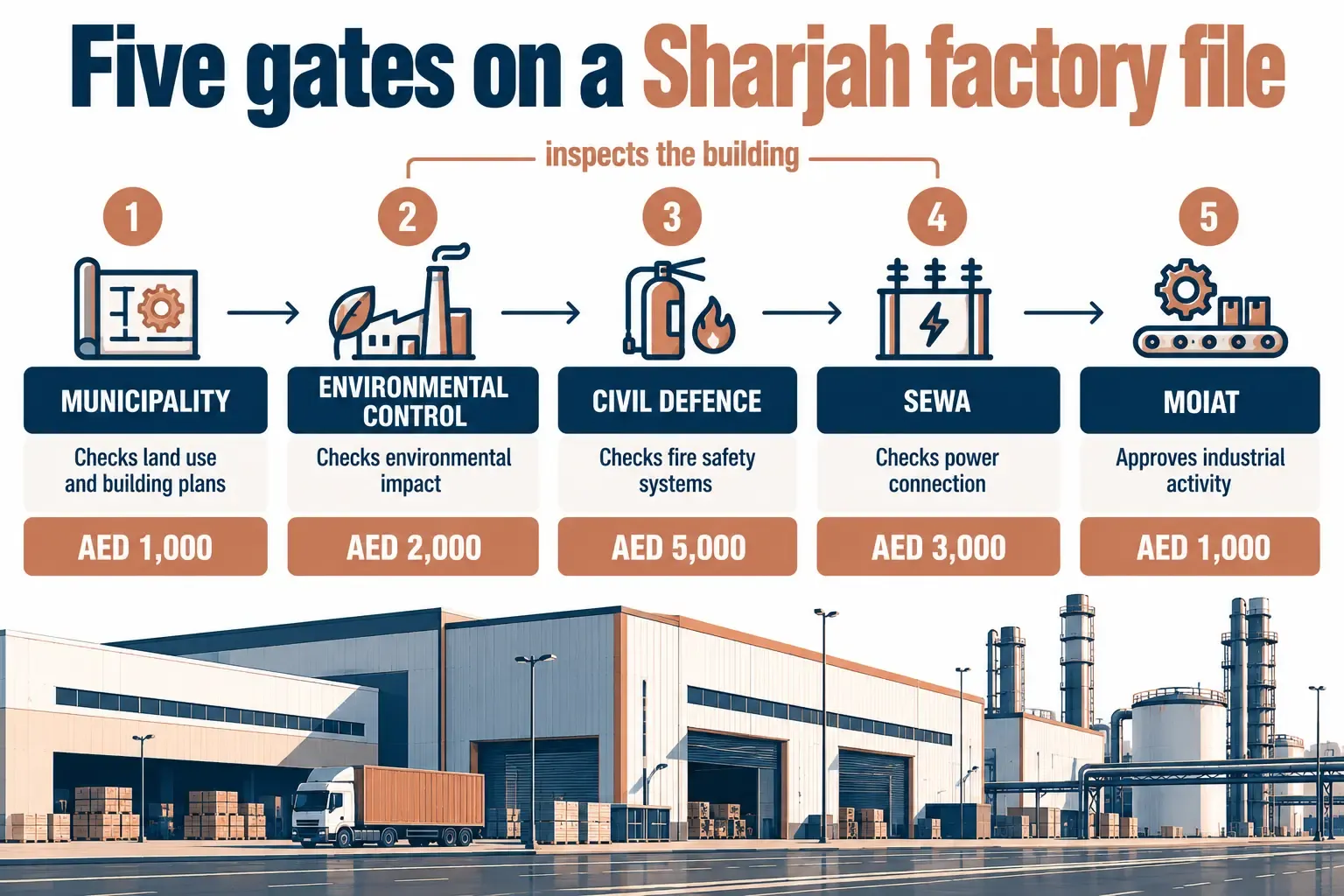
Where the common activities sit on the risk classes. Class A: food repacking, garment work and plain packaging. Class B: joinery with a spray area, printing and cosmetics filling. Class C: aluminium and glass with chemical baths, or any unit holding chemical stock. Budget AED 700 to 2,200 a year by class.
Three of these gates inspect the actual building. That is why an industrial file takes weeks where a trading file takes days, and why the sequence matters: lease, attest, fit out, certify, then MOIAT.
Civil Defence rules that decide whether a unit passes
In April 2025 Sharjah City Municipality, the Sharjah Civil Defence Authority and SEDD ran a joint campaign across the industrial areas, with Al Sajaa named. The rules it set out are the ones inspectors apply.
- Storage stacked no higher than 3 metres.
- 1 metre clear below sprinkler heads, and 1 metre between racks and walls or other racks.
- Mezzanine floors capped at 50 per cent of the ground floor area.
- Escape routes at least 1.2 metres wide, with at least two marked exits and emergency lighting.
- Fire alarm systems serviced every year, and a Fire Prevention Compliance Certificate held for the unit.
The certificate is the smallest of three annual lines. It depends on an annual maintenance contract with a Civil Defence-approved contractor, AED 3,000 to 6,000 on a small unit. It also depends on the AMAN monitoring link, at roughly AED 1,500 to 3,000 a year. AMAN is mandatory in Sharjah under Executive Council Decision 20 of 2019, for mainland and free zone alike. Budget AED 5,000 to 10,000 a year all-in. It recurs because SEDD will not renew the licence without a current certificate. First entry adds a one-off drawing approval on the fit-out.
Read a listing against that list before you sign. A unit advertised with two mezzanines has to show that they sit inside the 50 per cent cap. A unit fitted for storage to the roof has to come down to 3 metres. The cheapest fix is choosing a unit that already passes.
What a rented unit cannot carry
The refusal comes from the municipality’s technical evaluation of the site, not from SEDD. A rented built unit fails for these:
- furnaces, foundries, smelting or heat treatment
- chemical manufacturing or mixing with bulk hazardous storage
- paint, resin or fibreglass with open spraying
- concrete block, asphalt or aggregate
- tyre or waste-oil recycling
- gas cylinder filling
- any line whose emissions need a stack Those go to a plot in the heavy blocks of Al Sajaa, or to a purpose-built facility with its own approved drawings.
Three things are refused whatever the activity: one unit split between two licences, production on a mezzanine, and any address outside industrial zoning. Everything in the routing list further down clears a rented unit.
Power is the line people miss
SEWA’s per-kVA charge is not a deposit. It is a one-off connection fee, AED 1,000 per kVA on a commercial or industrial low-voltage line, AED 1,500 per kVA expedited, charged on the load you request. The refundable security deposit is a separate amount set by unit type. So a 60 kVA line is AED 60,000 that never comes back.
That is exactly why clients sign for the landlord’s 25 kVA meter and return for an upgrade once the machinery is on the floor, paying AED 1,000 for every added kVA plus a meter change. A small production line needs 40 to 80 kVA. Most built Al Sajaa units are wired for 15 to 25 kW. Order the load the line needs, not the load the landlord quotes.
With transformer capacity in the block, SEWA energises the meter two to four weeks after the fee is paid. Without it, SEWA extends the network and the wait is three to six months, longer than every licence step combined. Ask the landlord for the block’s spare capacity before you sign, and treat the answer as part of the rent.
Does a Sharjah factory need MOIAT registration?
Not to hold the SEDD licence. Yes if you want the customs duty exemption on machinery, equipment, spare parts, raw materials and packaging, or the right to sell into GCC and Arab markets on preferential terms. MOIAT registers producers under Federal Decree-Law No. 25 of 2022, and it inspects the installed line before it will register the factory.
There are two things at MOIAT, and the cluster has been blurring them. The Industrial Registry entry has no capital or headcount floor. Federal Decree-Law No. 25 of 2022 sets none, and the 1979 law that did is repealed. The Industrial Production Licence is a separate step, and it is the instrument that brings the customs exemption. The ministry’s own service page still lists two criteria for it: at least 10 employees and capital of at least AED 250,000. So a packaging unit with four staff registers, sells, and applies for the production licence later, when it has grown into those two numbers. Our live guide to the RAK industrial licence is being corrected to the same split. The land, MOIAT and environmental detail that applies in every emirate is in Industrial Licence Requirements: Land and MOIAT.
In fees MOIAT is near zero: no application fee, an AED 100 inspection fee, and the licence about 15 working days after the inspector sees the installed line. Two obligations recur. The production licence renews yearly, and the registry entry is updated every financial year with production inputs, output, energy use and financials.
The order matters. Register too early and the file is refused for an empty unit. Register too late and you have paid duty on the machinery you imported to fit it out. The window is after the line is installed and before the first bulk import of inputs. For most files that means the month after Civil Defence signs off.
How long does a Sharjah industrial licence take?
Four to eight weeks from attested tenancy to licence on a rented built unit. That is our observation across the files we run, not a published service level. A clean Sharjah trading licence takes 5 to 7 working days over the same stretch, because nothing on it inspects a building.
The steps run in this order:
- Municipality technical evaluation. Three to five working days. Attestation, the usual delay on an ordinary Sharjah file, is a day here, because the landlord’s paperwork has already been through the evaluation.
- Environmental permit. Application and site inspection, about eight working days.
- Civil Defence inspection. One to three weeks, longer if the fit-out drawings were never approved. This is the gate that holds most files, because the landlord’s fire system is rarely certified for the new use and the AMAN link is not connected.
- SEDD issue. Two to three days after the last approval lands.
- Card, visas, power, MOIAT. The establishment card follows in 2 to 3 working days and the first Emirates ID in 10 to 15 working days, the same as any Sharjah mainland file. The owner’s permit is the standard two-year investor visa, and staff come in on employment visas against the quota. SEWA and MOIAT both start after the licence, so the full path to production is longer than the licence path.
Budget the fit-out and the approvals as one block, run in parallel where the unit allows, and put the licence date at the end of it rather than the start.
What a Sharjah industrial file costs in year one and year two
The Sharjah mainland cost stack is published on the hub with rent on its own line, because rent is the one figure the client chooses. An industrial file keeps that structure and adds lines that never appear on an office file.
| Line | Year one, indicative 2026 | Year two |
|---|---|---|
| Initial approval and trade name | AED 1,000 to 1,500 | Nil |
| SEDD licence line | AED 11,000, or 13 per cent of the attested rent if higher | Same rule, same rent, so it moves with any rent review |
| Chamber of Commerce membership, industrial class | About AED 2,000 | Recurs |
| Municipality attestation | 4 per cent of rent, minimum AED 500 | Recurs on the renewed contract |
| Environmental permit | AED 700 to 2,200 by risk class | Recurs with the licence |
| Civil Defence certificate, maintenance contract and AMAN link | AED 5,000 to 10,000, plus a one-off drawing approval on the fit-out | AED 5,000 to 10,000 |
| SEWA connection fee | AED 1,000 per kVA on the load requested, one-off. A 40 to 80 kVA line is AED 40,000 to 80,000. Refundable security deposit separate, by unit type | Nil, unless you upgrade the load |
| Establishment card and immigration file | AED 1,500 to 2,500 | AED 1,000 to 1,500 renewal |
| One investor visa, two-year | AED 4,000 to 5,500 with medical and Emirates ID | Nil, returns in year three |
| MOIAT registration | AED 100 inspection fee, no application fee | Production licence renewal and the annual registry update |
| Industrial unit rent | The figure you negotiate. Al Sajaa asking rents in 2026: AED 85,000 to 160,000 for 1,700 to 4,000 sq ft | Same, subject to the lease |
Three things follow from the table. First, the rent-linked lines (SEDD, attestation) recur every year at the same rate, so a larger unit costs more at every renewal, not only at entry. Second, the single largest industrial-only line is SEWA, and it is the one no listing mentions. Third, the fire lines recur because the licence cannot renew without them.
The health insurance on each visa sits outside this table, at about AED 1,200 per person a year for planning. Corporate tax registration is a filing, not a fee, and applies to every mainland company. Your first tax year is set out in our guide to the UAE corporate tax registration process.
Want the unit priced before you sign?
Send us the listing. We will run the SEDD line, the attestation, the risk class, the Chamber class, the SEWA load and the visa count against that unit. We will also tell you whether the address is a SEDD address or a free zone one.
Sharjah mainland, Hamriyah or SRTIP for a manufacturer?
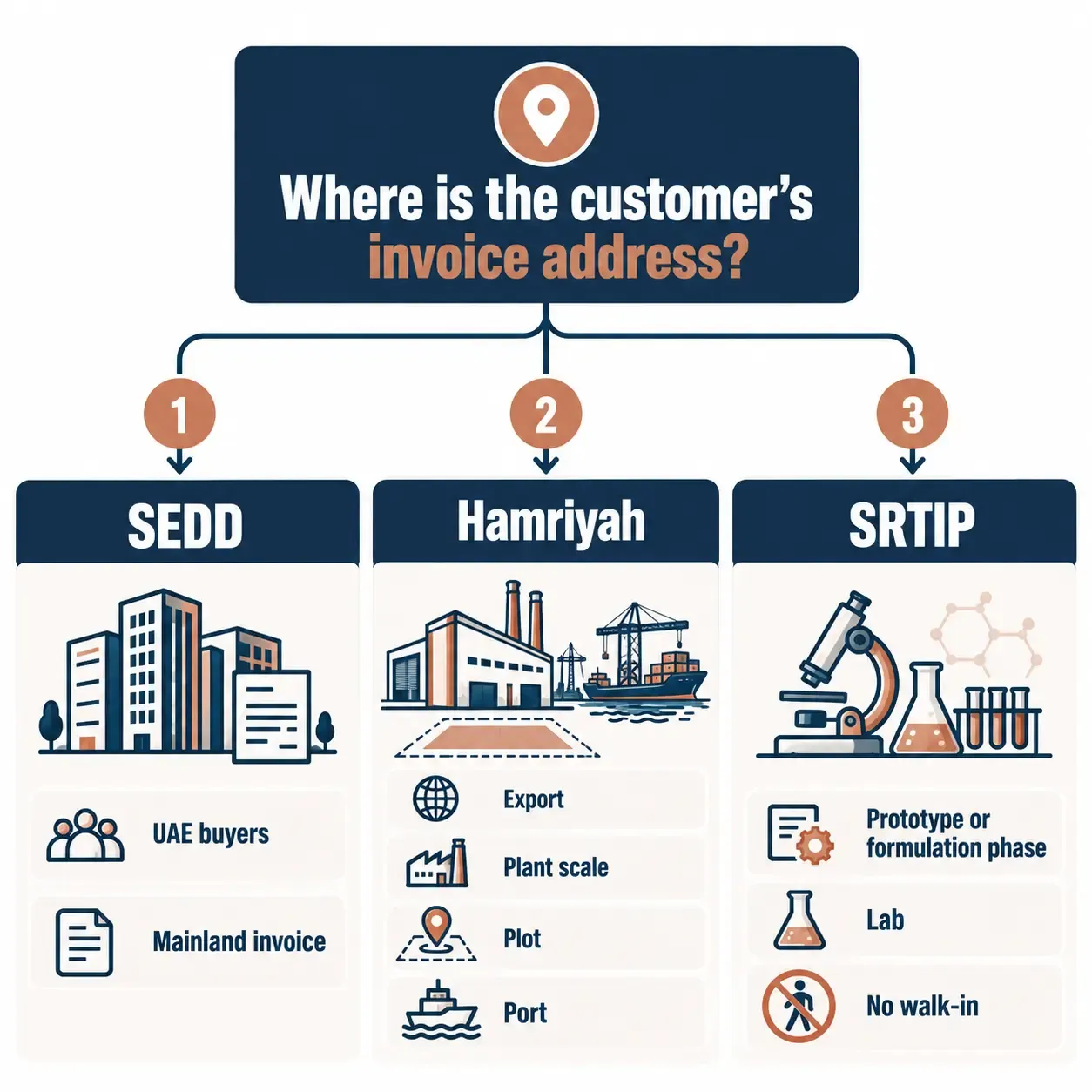
Our house rule for a Sharjah enquiry is simple. Stock, a shopfront or customers who need a mainland invoice from a Sharjah address go to SEDD. Anything that needs a plot, a warehouse at scale or a port goes to Hamriyah. Lab, engineering and light industrial work with no walk-in trade goes to SRTIP. Service, media and e-commerce go to SHAMS or SPC.
In practice nine in ten of our Sharjah files are free zone, and mainland is reserved for the handful that need a physical trading presence in the emirate. For a manufacturer, the test is the customer’s invoice address, not the product.
Who buys the product, and how? If the buyers are UAE businesses and retailers, and you invoice them directly from Sharjah, SEDD is the natural licence. A free zone producer sells into the mainland through a distributor or a mainland entity, and in Sharjah that costs more than the licence saving. A mainland distributor takes 15 to 25 per cent of the invoice. Running your own mainland trading entity replaces that with a second licence and premises, AED 25,000 to 40,000 a year. Add 5 per cent customs duty on goods crossing from the zone into the mainland, unless the product qualifies as UAE-origin through MOIAT registration and local value added. On AED 1.5 million of mainland sales, the distributor line alone is AED 225,000 to 375,000, against a SEDD industrial licence premium of a few thousand dirhams over the free zone fee. The general rule is the same one that governs free zone vs mainland in Dubai; in Sharjah the price gap is small enough that market access decides on its own.
| Situation | Where we route it | Why |
|---|---|---|
| Packaging, food repacking, furniture and joinery assembly, garment work, printing, electrical panel assembly for contractors, sold to UAE buyers | SEDD, in Al Sajaa or a numbered industrial area | The buyer wants a mainland invoice and a Sharjah delivery address. Every one of these clears a rented unit |
| Aluminium and glass at plant scale; anything heavy, chemical, steel, oil and gas, or export-led | Hamriyah Free Zone | The plot, the power, the bulk import, its own port, an environmental regime built for heavy process |
| Cosmetics filling | SEDD when it sells to UAE retail; Hamriyah when it exports | Same product, two invoice addresses |
| Any product still in a prototype or formulation phase; lab, engineering, light industrial with no walk-in trade | SRTIP first, then SEDD when the line is fixed | Innovation park licensing, smaller premises, one-owner files |
| Media, design, e-commerce, consultancy | SHAMS or SPC Free Zone | No industrial unit, no attestation, no factory gates |
We are channel partners for SHAMS, SPC, SRTIP and Hamriyah, so the routing is not a sales preference. The rule is stated the same way when the answer is not a SEDD licence. Every branch of that decision, including the tax treatment of mainland sales from a free zone, is in Sharjah Mainland vs Free Zones: When SEDD Wins. The two Sharjah free zone hubs a manufacturer is most likely to weigh are Hamriyah Free Zone: Sharjah’s Heavy-Industry Hub and SRTIP Free Zone Setup: Sharjah’s Innovation Park. Any free zone licence we quote shows the licence, the unit and each visa as separate lines.
Who should file a Sharjah industrial licence
The SEDD route fits a producer who sells inside the UAE and wants a Sharjah address near Dubai’s border. It fits a plant that can live in a rented unit of a few thousand square feet, with 40 to 80 kVA of power, no stack and no open spraying. Packaging, food repacking, furniture and joinery assembly, garment work, printing and panel assembly for contractors are the activities that land here rather than in a heavy-industry zone. The same split applies next door, where the Ajman route is set out in Ajman Industrial Licence: Al Jurf Rents and Approvals, and further north on the Ras Al Khaimah trade licence. Most files here are a single-shareholder LLC, which carries the activity with full foreign ownership and no agent.
It does not fit a founder who read the AED 1,000 headline and priced the factory off the licence. On a real file the licence line is 13 per cent of the rent. Three separate authorities inspect the building. The power connection can cost more than the licence. And the visas and the fire lines come on top.
One thing we say plainly. We have not filed a SEDD industrial licence. Our Sharjah mainland files are trading and service companies. Our light-industrial and technology clients have landed in SRTIP, a dozen of them, which is why the routing above sends a product still being formulated there first. The fee rule, the gates, the risk classes and the SEWA arithmetic on this page are how we price a Sharjah factory enquiry, and the figures are practitioner figures, not published rates.
Getting your Sharjah industrial licence right
Start with the unit, not the fee. The unit sets the SEDD licence line through the 13 per cent rule. It sets the attestation and the visa count. It decides whether Civil Defence signs off at the first visit, and how much SEWA charges to connect you. Choose it against the fire rules above, ask about the block’s transformer capacity, order the load the line needs, and put MOIAT after the installation, not before. Reserve the trade name early, because a clash is the second most common delay on a Sharjah file. Open the business bank account file the week the licence issues. Compliance teams will ask to see the unit that the licence names.
Five numbers do most of the work. AED 11,000 or 13 per cent of the attested rent. A crossover at AED 84,600 of rent. 4 per cent for attestation. AED 1,000 per kVA to connect the power. And four to eight weeks from attested tenancy to licence. Put them against a real listing and the budget is close.
Best Solution has formed companies in the UAE since 2014 and licenses across all seven emirates, on the mainland and in the free zones. Our mainland licence service runs a Sharjah file from the unit to the establishment card, and the UAE residence visa service picks up where the licence stops. Book a free consultation on +971 52 233 0011 or connect@best-solution.ae. The full line-by-line Sharjah mainland budget, with rent on its own line, is in Sharjah Mainland Licence Cost: AED 15,000-30,000.